


At the end of almost every group meal comes the moment when one person makes an innocent mistake that, at the time, seems like a gesture of efficiency and generosity. The server puts down the bill, everyone starts calculating who ordered a cocktail and who drank water, who ordered dessert and who merely stole a few fries, and then come the fateful words: “Forget it, I’ll pay. Send it to me on Bit.”
The phones stay in pockets, one card comes out and the evening continues. By the next day, it becomes clear that the volunteer did not merely pay for dinner. He has acquired a new job, unpaid and unsolicited: the group’s debt collector.

That is where a ritual begins that is also familiar to PayBox users in Israel and Venmo and Zelle users in the United States. First, you wait because you do not want to seem petty. Then you send a payment request. Two days later comes a smiley emoji and an “Oops, I forgot,” but still no money. Next comes the gentle reminder, followed by the reminder that is increasingly difficult to pretend is gentle and finally the decision: Are those 86 shekels worth another message, or does the price of friendship now include the pasta eaten by the person ignoring you?
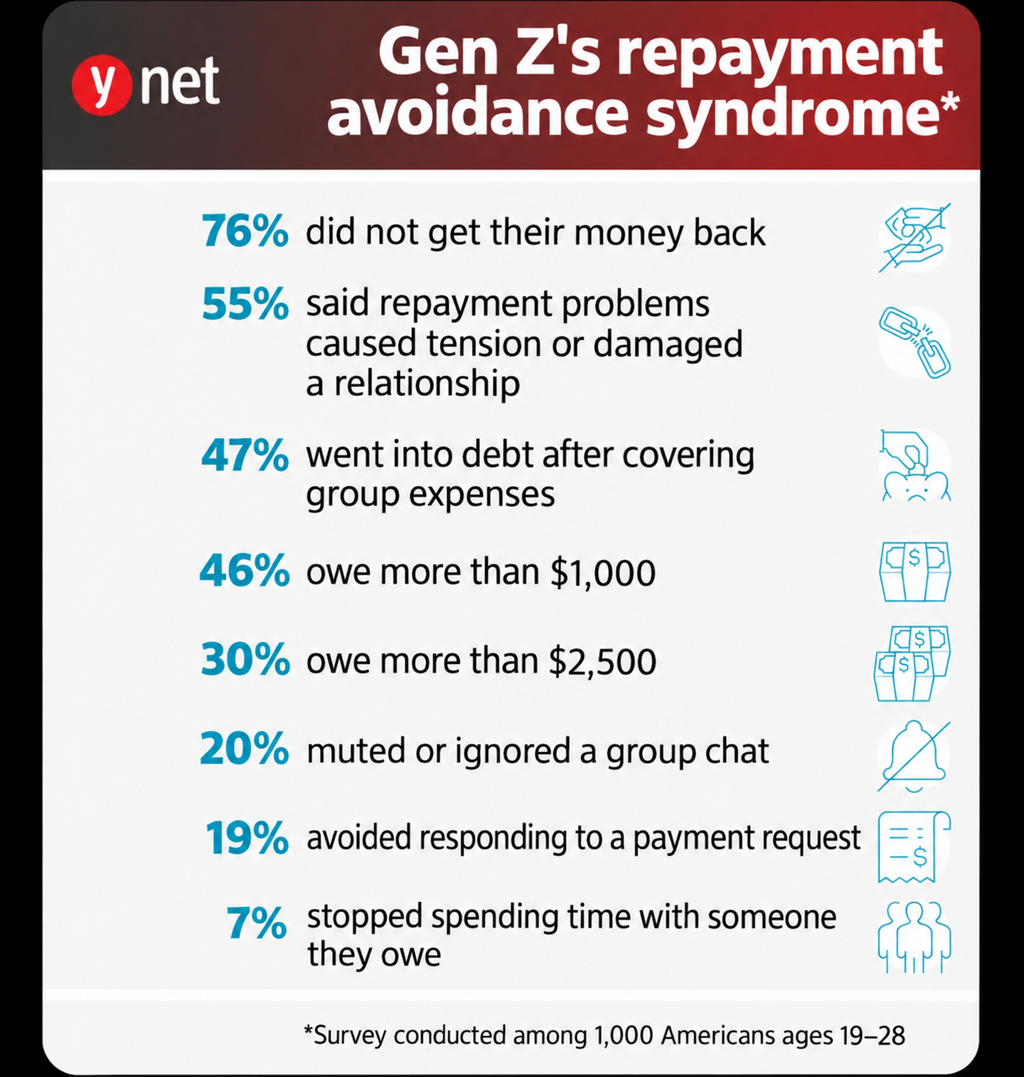
For anyone who suspected until now that this was a personal problem, there is finally some institutional recognition, or at least something close to it in the United States. A report released by Zelle in late June gave the phenomenon a name, “repayment avoidance syndrome,” and found that 76% of Gen Z respondents ages 18 to 29 who had fronted money for a group expense had not been fully reimbursed. Fifty-five percent said repayment problems had created tension or damaged a relationship, while 47% said they had gone into debt themselves after covering group expenses that others were supposed to repay.
The size of the debts also dispels the notion that this is merely about a forgotten beer. Among Gen Z respondents who at least occasionally owe money to friends or relatives, 46% said they currently owe more than $1,000, about 3,000 shekels, while 30% owe more than $2,500, about 7,500 shekels. These are no longer a few shekels for a cab. They are plane tickets, a share of the rent or an entire weekend that someone else has financed in the meantime.
80% of app transactions in Israel are for up to 300 shekels
The survey was conducted in May and June among 1,000 Americans, alongside a separate survey of 1,000 frequent Zelle users, defined as people who use the service at least four times a month. It is also important to know who commissioned it: Zelle is a fintech service owned by seven of the largest U.S. banks. This was a commercial survey, not an academic study, so its findings should be viewed in their marketing context.
Bank of Israel data shows just how common it is in the country to send money to friends through apps. Surveys conducted in 2023 and 2024 found that this was the most common use of payment apps in Israel, accounting for about 29% to 30% of transactions. About 80% of all app transactions were for amounts of up to 300 shekels. It is unclear how much of that money was transferred late or only after a third reminder, but these are precisely the amounts that put the creditor in a bind: too large to happily write off, but small enough to make chasing them seem embarrassing.
The emotional cost appears on both sides of the bill. Eighty-two percent of Gen Z respondents said owing money itself causes them stress or anxiety, while 59% feel stressed when others owe them money. One-third said the very act of settling up causes them stress.
The irony, then, is that it has never been easier to pay someone back. Millennials still remember the transition from cash to PayPal and Venmo, but Gen Z inherited a world in which a bill can be split down to the cent and money transferred with a few taps. The apps solved the question of “how,” but not “when” and certainly not “whether.” Digital debt does not take up space in your wallet or sit on the table in front of you. It can linger for weeks among the notifications until the debtor manages to convince himself that the person who paid has probably forgotten about it.
In one case brought to our attention this week, an Israeli woman who works in communications covered part of the cost of an Airbnb for six friends traveling to a wedding in New York. One person in the group did not repay his share. After she approached him several times, she was told that she was “rich” and therefore did not really need the money. She was then sent a screenshot showing that the person who owed her had $40 left in his account. And so the person who paid because she had a credit card, available credit or simply a little more order in her life discovered that the group had also appointed her its official subsidizer.
This is where money begins to spill into the realm of trust. Generosity among friends is not about keeping a ledger. People buy each other drinks, pick up the bill on birthdays or say, “You get the next cab.” The problem begins when generosity is assigned to someone retroactively, without asking. The friend who paid is forced to choose between two unflattering roles: the person who chases someone down for $50 or the person from whom $50 can be taken without asking. The amount may be small, but the message is anything but.
Set a deadline for repayment
Michal, an Israeli American student in New York, learned that lesson on an international vacation with friends shortly after finishing the semester. One friend announced that his card was not working, and the group suggested that he hold on to the cash he had while the others paid in the meantime. Groceries, alcohol, the rental car, restaurants, cabs, a boat ride and beach chairs quickly added up. Most of the participants spent $800 to $1,000 per person, she said. The friend claimed to have spent about $400, but the numbers did not add up, even after the group created an Excel spreadsheet to reconstruct the expenses.
To avoid directly accusing him of lying, the friends agreed to accept less than they believed he owed. He did not pay even that amount in full. Michal sent Venmo requests, messaged him, raised the issue in the group chat and asked him about it face to face. For about six months, she continued chasing the roughly $200 she was owed before finally giving up. A year later, she does not believe anyone in the group got all their money back. The friendship faded.
“If I can’t trust someone to at least try to pay me back, it’s hard for me to trust them as a friend, too,” she said.
The numbers show that the disappearing act is not merely something imagined by the person waiting for the money. According to the survey, 32% of Gen Z respondents who owe money for shared expenses admitted delaying repayment. Twenty percent canceled plans to avoid paying, 20% muted or ignored a group chat and 19% avoided responding to a payment request. Seven percent stopped spending time with the person they owed. Debt does not always destroy a relationship in an explosion. Sometimes it simply causes one side to disappear from it. When it comes to cutting ties, however, millennials posted a higher rate: 19% said a dispute over repayment had ended a relationship, compared with 14% of Gen Z respondents.
The emotional cost appears on both sides of the bill. Eighty-two percent of Gen Z respondents said owing money itself causes them stress or anxiety, while 59% feel stressed when others owe them money. One-third said the very act of settling up causes them stress.
Dr. Traci Williams, a psychologist and financial therapist whose comments were included in the Zelle report, explains that avoidance offers momentary relief from an uncomfortable conversation but makes the problem worse. For the person waiting to be repaid, the delay is no longer merely a cash-flow problem. It becomes a sign that their expectations, generosity and boundaries are not being respected.
According to financial therapist Aja Evans, financial pressure adds another layer to the mix. Young people face high rents and a rising cost of living while being exposed on social media to a constant stream of vacations, concerts, restaurants and weddings that they are seemingly not supposed to miss. In the survey, 37% of Gen Z respondents reported spending more than $2,500 per person on major events and group experiences, the highest rate of any generation. Evans suggests asking before booking whether the expense is genuinely affordable or whether it is an attempt to project a lifestyle to others that the bank account cannot support.
The recommended, if unexciting, solution is to decide in advance who will pay, how much each person owes, which app will be used and the deadline for repayment. Anyone who cannot afford to absorb a delay is better off not fronting hundreds or thousands of shekels for the group. Anyone who cannot pay immediately can say so before the booking and provide a realistic date instead of disappearing after dessert. Already, 35% of young people who owe money for shared expenses said they have avoided fronting money for others because of a bad experience in the past. A new norm is emerging, one that is less generous but perhaps also more honest.
Itai, an Israeli tech worker who was left holding the restaurant bill for his group of friends in SoHo, has adopted a simpler rule: Next time, no one leaves until they transfer the money to him on the spot. The bill may still be settled on a single card, but no one gets up from the table before the transfer comes through.
It may not be the most elegant way to end an evening with friends. It is just more elegant than chasing them for the money until the next one.