

Intel shares plunged approximately 16% in after-hours trading on Wall Street Thursday after the chipmaking giant issued a weaker-than-expected forecast for the fourth quarter, citing a prolonged slowdown in the personal computer market. The company is also continuing to deal with the fallout from a deadly explosion at its manufacturing plant in Israel, which is expected to cost it hundreds of millions of dollars in lost revenue.
The explosion at Intel's Kiryat Gat facility killed two employees and seriously injured a third. Chief Financial Officer David Zinsner said the incident would cost the company approximately $600 million in lost revenue over two quarters. Intel plans to begin ramping up production at the plant by the end of the week.
Gallery
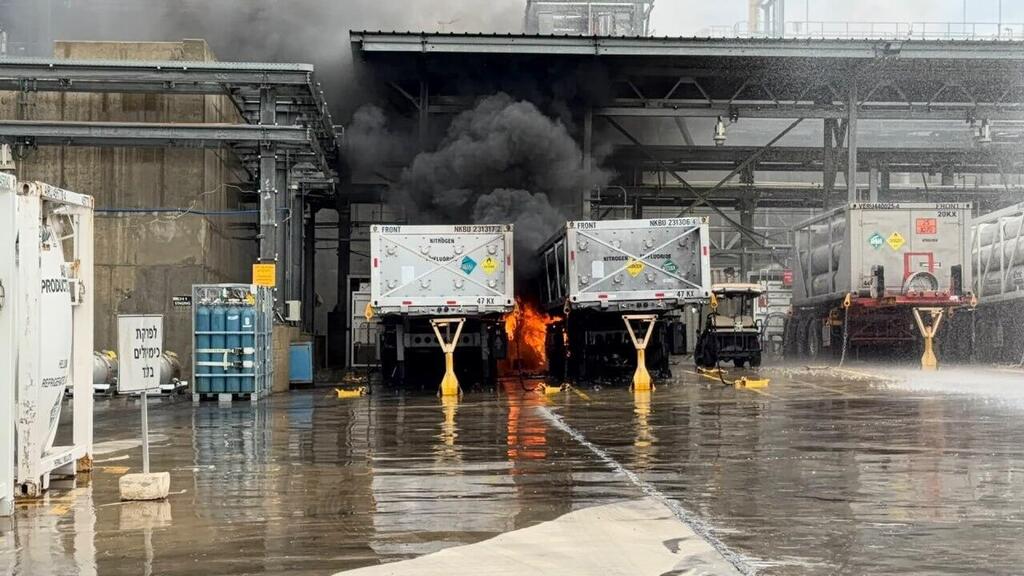
The explosion at Intel's manufacturing plant in Kiryat Gat
(Photo: Israel Fire and Rescue Services)
For the fourth quarter of 2026, Intel forecast adjusted earnings of 25 cents per share on revenue of $15 billion to $16 billion, falling short of analysts' expectations of $17.1 billion in revenue and earnings of 43 cents per share. The company expects the slowdown in the PC market to continue through at least the first half of next year and said it would maintain disciplined investments in production capacity and working capital to increase supply and support future growth.
The disappointing forecast overshadowed stronger-than-expected third-quarter results. Intel reported adjusted earnings of 52 cents per share, compared with the 40 cents analysts had expected, while revenue reached $16.51 billion, slightly above forecasts of $16.5 billion. Revenue rose 21% from $13.7 billion a year earlier. However, revenue from its client computing and physical AI division fell 5% to $8.1 billion, missing estimates, while data center and AI revenue surged 78% to $7.3 billion.
Intel shares had surged approximately 150% since the beginning of the year but declined around 23% in October as investors grew increasingly concerned about the scale of spending on artificial intelligence infrastructure. "We will continue to maintain discipline in our investments and will not spend a single dollar of capital unless we are confident in the health of our products and manufacturing technologies and have clear evidence of customer demand," Zinsner told analysts during the earnings call.
Intel offices in California
(Photo: Shutterstock)
Intel, best known for its central processing units (CPUs), has benefited from the rise of agentic AI. While chatbots and large language models rely heavily on graphics processors from Nvidia and AMD, AI agent applications such as Meta's Muse and OpenAI's Dots use CPUs to coordinate tasks and data on cloud-based computers. "Despite the near-term headwinds in the PC industry, we continue to see strong demand for CPUs and, more broadly, for all of our computing platforms over the long term," Intel CEO Lip-Bu Tan said.
Intel's contract chip manufacturing business, however, continues to face challenges. The company is the only American manufacturer of advanced logic chips and is now mass-producing its advanced 18A chips at its new Arizona facility as an alternative to Taiwan's TSMC. Intel remains the main customer for its own 18A process, although analysts believe a major fabless chip designer could select the company for its next-generation 14A technology. "People want a second source so they can pressure TSMC and keep it honest on pricing," said Dan Hutcheson, an analyst at TechInsights. "All the big players have tried there."
Alphabet shares plunge 12% as Wall Street slides
Intel's after-hours plunge followed a difficult trading session on Wall Street. The Nasdaq fell 1.38%, the S&P 500 declined 0.3%, ending a three-day winning streak, and the Dow Jones Industrial Average slipped 0.25%. The losses were led by Alphabet, Google's parent company, whose shares plunged 12% after third-quarter earnings and revenue missed expectations. Alphabet reported negative free cash flow of $9.07 billion while maintaining its full-year capital spending forecast of $195 billion to $205 billion, reigniting investor concerns about returns on massive AI investments.

Google CEO Sundar Pichai
(Photo: AP)
Amazon also disappointed investors. The e-commerce and cloud computing giant reported third-quarter earnings of $1.89 per share, below analysts' expectations of $1.96, while revenue of $201.94 billion fell slightly short of the $202.31 billion forecast. Advertising revenue of $19.64 billion also missed expectations. For the fourth quarter, which includes the crucial holiday shopping season, Amazon projected revenue of $240 billion to $247 billion, with the midpoint below market estimates. Its shares plunged approximately 7% in after-hours trading.
The bright spot was Amazon Web Services (AWS), whose revenue surged 39% to $45.98 billion, exceeding forecasts. It marked the division's fastest growth since late 2021, while operating income jumped 55% to $17.77 billion. CEO Andy Jassy said the company expects AWS growth of more than 40% next year and in 2028. However, aggressive AI spending continues to weigh on cash flow. Quarterly capital expenditures reached $77.3 billion, well above the $58.7 billion analysts had expected, while free cash flow over the past 12 months was negative $42.4 billion. Amazon maintained its 2026 capital spending forecast of $220 billion.
Microsoft, meanwhile, beat expectations for both earnings and revenue. Its shares initially rose but ended the session slightly lower. The company's announced investment spending was below expectations, sending shares of cloud infrastructure providers lower. CoreWeave fell approximately 5%, while Nebius lost more than 5%. Amazon, which also reported earnings Thursday, had declined more than 2% during regular trading.
Microsoft offices in Seattle
(Photo: AP\Ted S. Warren)
Caterpillar, a Dow Jones component, also tumbled more than 9%, marking its sharpest daily decline since March 2020. The heavy equipment manufacturer beat earnings and revenue forecasts, but sales in its construction equipment division came in slightly below expectations.
Healthcare stocks, by contrast, reached an all-time high, led by Eli Lilly, whose shares surged approximately 8% following strong earnings. The pharmaceutical company reported revenue of $24.4 billion, largely driven by its obesity and diabetes treatments Zepbound and Mounjaro, and raised its 2026 revenue forecast to $91 billion to $92 billion. Merck gained approximately 4.5%, while the small-cap Russell 2000 index rose around 1%, extending its winning streak to three sessions despite weakness among major technology companies.
Among other notable movers, DoorDash climbed approximately 7% after announcing the acquisition of Maplebear, Instacart's parent company. Norwegian Cruise Line surged 13% following better-than-expected earnings, while aircraft and defense systems manufacturer Textron gained nearly 15%.