

In what will no doubt go down as one of the most predictable, drama-free ceremonies in recent years, the 98th Academy Awards at the Dolby Theatre ended with the dominance of One Battle After Another, which won six statuettes, including best picture.
The two Israeli nominees in the live-action short and documentary short categories — directors Meir Levinson-Blount (Butchers’ Stain) and Hilla Medalia (Children No More: Were and Are Gone) — went home empty-handed.

“As far as we’re concerned, we already won the moment we were nominated. We made many connections on this wonderful journey that will stay with us throughout our developing careers, and most importantly, we will keep making films at any cost and with all our strength,” the producers of Butchers’ Stain said in a statement to ynet.
One Battle After Another, Paul Thomas Anderson’s political action epic, also earned its acclaimed creator the awards for directing and adapted screenplay at the ceremony.
These are Anderson’s first Oscars, after 11 previous nominations. Behind it was the period horror drama Sinners, which received a record 16 nominations — the most in Oscar history — but made do with four statuettes overall. Those included best original screenplay for the film’s director, Ryan Coogler, and best actor for Michael B. Jordan, who pulled off an upset over Timothée Chalamet, long seen as the front-runner for his role in Marty Supreme.

Michael B. Jordan
(Photo: Chris Pizzello/Invision/AP)
Chalamet recently landed in controversy after speaking dismissively about opera and ballet in an interview, and in the week before the ceremony his momentum faded, while Jordan — in an impressive dual role in Sinners — emerged instead as the leading contender. By the end of the night, Marty Supreme had not won a single statuette from its nine nominations.
Beyond that, the ceremony — hosted for the second time by Conan O’Brien after a successful turn last year — was marked by a certain blandness, with nearly all the early predictions proving correct.
Veteran character actress Amy Madigan, a well-liked past nominee, won best supporting actress for her juicy turn as the antagonist in the horror film Weapons, which also performed strongly at the box office.
Jessie Buckley won best actress for her role in Hament, and Norway’s Sentimental Value defeated the Tunisian-produced The Voice of Hind Rajab in the race for best international feature. The latter deals with the death of a Palestinian girl who became a symbol after she was trapped in a car with the bodies of her family members, pleaded to be rescued and was then killed in a bombing.
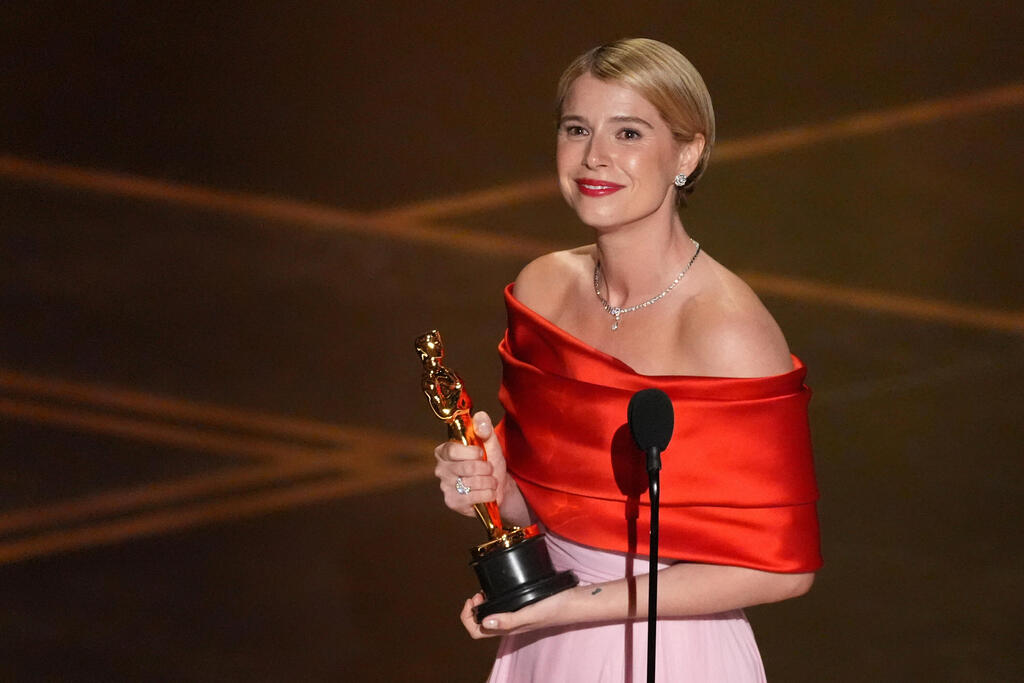
Jessie Buckley
(Photo: Chris Pizzello/Invision/AP)
Sentimental Value had already earned much praise, nominations and awards before reaching the Oscar stage, and those proved stronger, at least for Academy voters, than the continuing relevance of the war in Gaza.
More broadly, politics seemed pushed to the margins this year — despite, and perhaps because of, the storm surrounding the war between the United States and Israel on one side and the Iranian regime on the other.
Here and there, some winners offered more general statements, but the atmosphere was relatively restrained, except for the evening’s bluntest political moment, when Spanish actor Javier Bardem came onstage with actress Priyanka Chopra and, to audience applause, declared: “No to war, and free Palestine.”
Javier Bardem on the Academy Awards stage: 'No to war, and free Palestine'
(Video: courtesy of yes)


Bardem, who often speaks out against Israel, also wore two political pins on his suit, which he had displayed earlier on the red carpet: one calling for an end to wars and the other belonging to a pro-Palestinian organization.
This year’s ceremony saw two precedents: the addition of a new category for best casting, won by Cassandra Kolokondis for her work on One Battle After Another, and a female cinematographer winning best cinematography. The latter was a truly historic moment: Autumn Durald Arkapaw became the first woman ever to win in the category, for her striking work on Sinners. Arkapaw did not mention the milestone in her acceptance speech, but host O’Brien did so for her in his link immediately afterward.
For his part, O’Brien steered the event with pleasant professionalism, though not in a particularly memorable way. “I am honored to be the last human host of the Academy Awards,” he joked at the start of his amiable opening monologue.
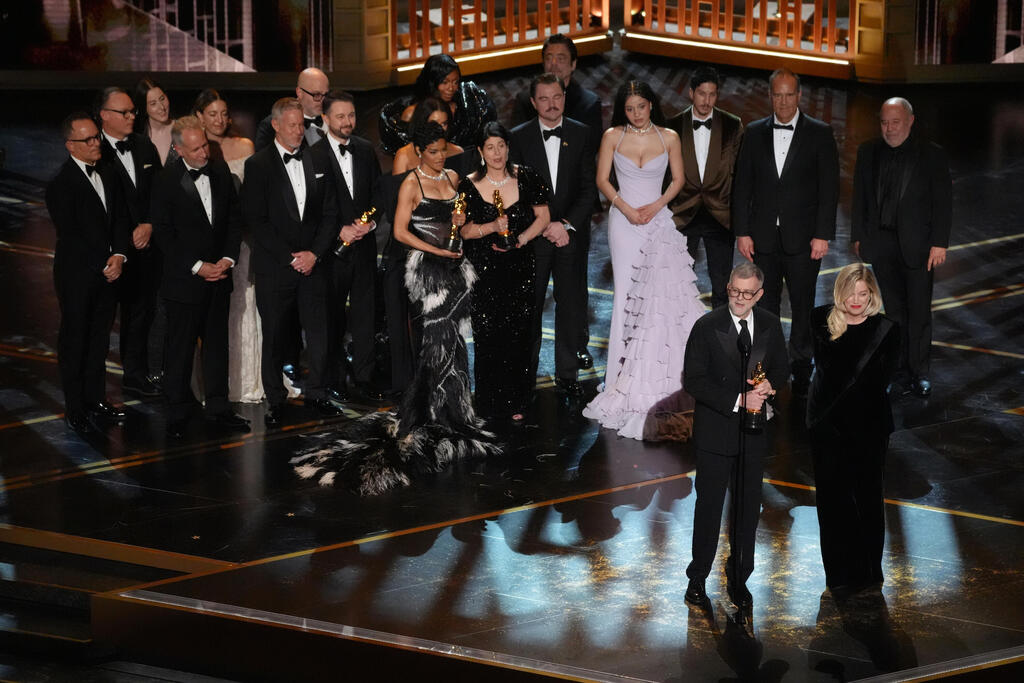
Paul Thomas Anderson (bottom right) and the One Battle After Another crew
(Photo: Chris Pizzello/Invision/AP)
That friendliness largely defined his performance this year, but not much beyond that. The random pretaped sketches inserted throughout the ceremony certainly added a bit of interest, but there was not much inspiration hovering over the show.
One emotional moment came when Billy Crystal took the stage to speak about his beloved friend Rob Reiner — the director and screenwriter who was murdered along with his wife, Michelle Singer, allegedly by their son, Nick Reiner. Crystal listed Reiner’s major works — the classics This Is Spinal Tap, Stand by Me, When Harry Met Sally, The Princess Bride and Misery. “My friend Rob's movies will last for lifetimes,” he said.
At the end of Crystal’s moving remarks, stars from Reiner’s films came onstage, signaling the start of the ceremony’s traditional in memoriam segment. Among the talents who died this year and were mentioned in the tribute were screen legends including Diane Keaton, Catherine O’Hara, Robert Duvall, Val Kilmer, Robert Redford and others.
From the tribute to Rob Reiner at the Academy Awards
(Video: Courtesy of A.M.P.A.S.® ©, yes)
Arab-Israeli-Palestinian actor Mohammad Bakri, who died last December, was also included in the tribute, which continued when actress Rachel McAdams came onstage to speak about the iconic Keaton, followed by Barbra Streisand, who recalled her friend Redford. Streisand even sang a bit of the theme from the 1973 film The Way We Were, in which he starred opposite her. Notable by their absence from this portion of the ceremony were iconic actress Brigitte Bardot and Israeli cinematographer Adam Greenberg, who was nominated for an Oscar for Terminator 2.
In the best animated feature category, the expected winner was KPop Demon Hunters, the Netflix animated film that became a cross-continental cultural phenomenon and one of Netflix’s most-watched films ever. In doing so, it beat two successful Disney films competing against it for the prize: Zootopia 2 and Disney-Pixar’s Elio. It was an impressive achievement for the streaming giant, which left the ceremony pleased with five awards — two for KPop Demon Hunters, which also took best song for the megahit Golden, and three for Guillermo del Toro’s lavish Frankenstein: costume design, production design, and makeup and hairstyling.
Another interesting moment came when the award for best live-action short was shared in a tie by two films (“You just ruined 22 million Oscar pools,” O’Brien joked after the announcement), a rare event that has happened only six times in the ceremony’s history: The Singers and Two People Exchanging Saliva. The latter stars Iranian actress Zar Amir and was directed together with Israeli director Guy Nattiv, with whom she previously collaborated on Tatami.
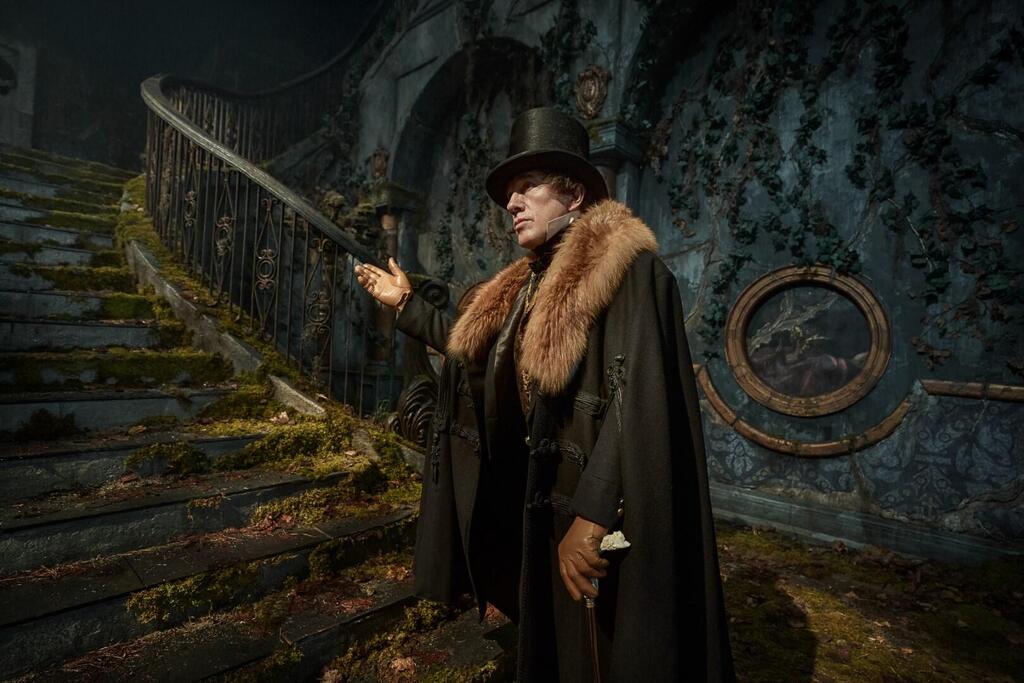
From Frankenstein
(Photo: Courtesy of Lev Cinema)
Kieran Culkin, last year’s winner for A Real Pain, presented the best supporting actor statuette to Sean Penn for his role in One Battle After Another. For Penn, it was a third Oscar win, after victories for Mystic River and Milk. Few before him have won three Oscars, among them Meryl Streep and Jack Nicholson. But Penn did not attend the event. Culkin accepted the statuette on his behalf and quipped, perhaps only half-joking, “He couldn't be here tonight, or he didn't want to.”
After Buckley and Jordan took the acting prizes, Ewan McGregor and Nicole Kidman, who once starred together in Moulin Rouge!, presented the evening’s final category: best picture. The award went — again, and for the last time that night, as expected — to One Battle After Another, completing its victory lap with six statuettes overall.
Full list of winners:
Best picture: One Battle After Another
Best director: Paul Thomas Anderson — One Battle After Another
Best actress: Jessie Buckley — Hament
Best actor: Michael B. Jordan — Sinners
Best supporting actress: Amy Madigan — Weapons
Best supporting actor: Sean Penn — One Battle After Another
Original screenplay: Ryan Coogler — Sinners
Adapted screenplay: Paul Thomas Anderson — One Battle After Another
Animated feature: KPop Demon Hunters
Casting: One Battle After Another
Cinematography: Autumn Durald Arkapaw, Sinners
Costume design: Frankenstein
Editing: One Battle After Another
Production design: Frankenstein
Original score: Sinners
Original song: Golden — KPop Demon Hunters
Sound: F1
Visual effects: Avatar: Fire and Ash
Makeup and hairstyling: Frankenstein
Live-action short: The Singers and Two People Exchanging Saliva
Animated short: The Girl Who Cried Pearls
Documentary feature: Mr. Nobody Against Putin
Documentary short: All the Empty Rooms
International feature: Sentimental Value — Norway