


The year 2026, experts predict, may be the breakout year for the operation of AI agents, known as agentic AI. The day is not far off when all our personal information — emails, social media and phone calls — will be open to these new capabilities. In exchange for relief from tedious tasks, we are likely to pay with a further and significant erosion of what remains of our privacy. It is only right that cinema, and not just television series like “Black Mirror,” should try to say something meaningful about such changes. “Mercy,” the new film by Timur Bekmambetov, could have been such a film, and its creator may even believe that it is. But any serious attempt to grapple with a new and consequential technology requires a level of depth and originality that this film falls several notches short of.
Bekmambetov is the filmmaker who has staked a claim on the concept he calls Screen Life films. In these movies, the fictional world exists almost entirely within the boundaries of a computer screen. Communication through a computer, accessing databases and operating software all become the overwhelming substance of the film. The protagonist confronts a fundamental challenge through actions performed on a computer screen, as in online bullying in “Unfriended” (2014) or a missing daughter in “Searching” (2018).
Last year, Bekmambetov produced a Screen Life version of “War of the Worlds,” in which Ice Cube played a Department of Homeland Security officer who, while sitting in an office chair, thwarted an alien invasion attempting to take over data centers. From the moment it was released, it was clear the film was destined for Razzie nominations for worst film of the year, and indeed, just last Tuesday the nominations were announced, with the film receiving six. “Mercy” is not as wretched as “War of the Worlds.” Its budget is larger, it features at least one actor who knows how to act, though not necessarily in this film, and it is almost possible to mistake it for something that could be called a movie.

The plot of “Mercy” takes place in Los Angeles in 2029, a near future that spares the filmmakers the effort of extensive futuristic planning and design. The city is presented as crime-ridden, divided into “red” danger zones, with a fearful public willing to forgo familiar judicial processes in exchange for efficiency. As in “War of the Worlds,” “Mercy” also relies on a jumble of chaotic documentary and news footage, apparently to save on production costs and, it seems, on the budget for professional screenwriting as well.
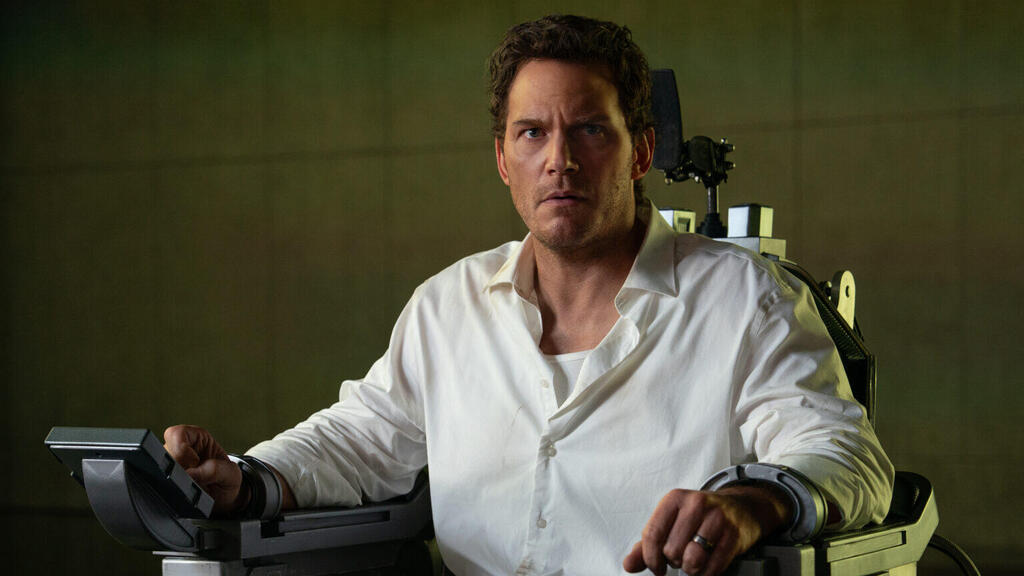
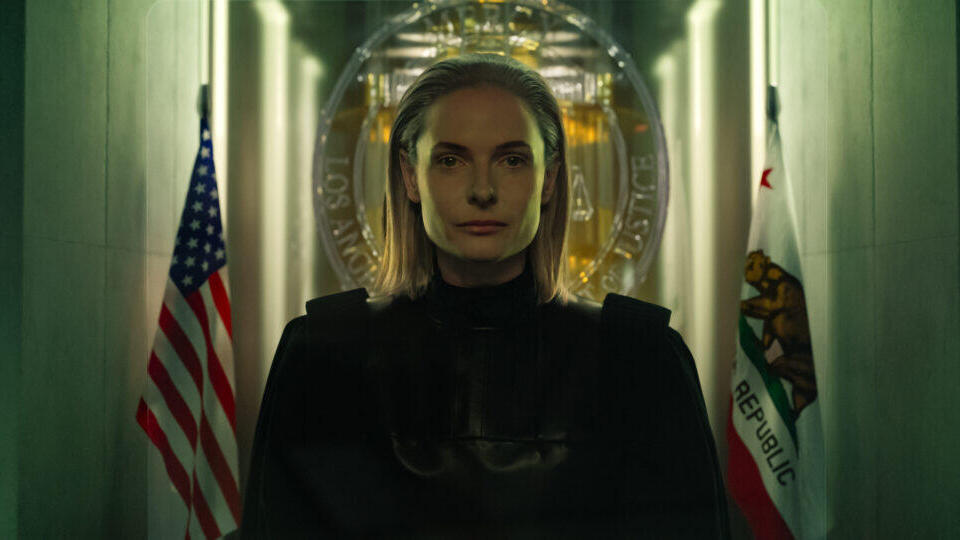
Anxiety over the breakdown of public order leads to the creation of the Mercy system, a virtual court controlled by artificial intelligence. The system examines defendants accused of serious crimes based on all the digital information it can access — in other words, almost anything the plot feels like throwing into the mix. There are no human judges, no jury and no lawyers. Just a defendant strapped to a chair facing a giant screen displaying the avatar of “Judge Maddox” (Rebecca Ferguson), a computerized graphic creation that serves as the “human” face of the AI system. The trial begins once the algorithm identifies a probability of conviction above 80 percent. Exactly 90 minutes are allocated for the legal process, during which the defendant can, at least in theory, challenge the incriminating facts. During that time, the AI judge grants the defendant access to any digital material he wishes in an attempt to lower the conviction rating. If he fails, which is always the case, the lethal sentence is delivered and carried out immediately. The film adheres to this 90-minute real-time framework, with the countdown present throughout.
From ‘Mercy’
(Photo: Courtesy of Forum Film)
The film’s protagonist, Chris Raven (Chris Pratt), is a former police detective and one of the early public supporters of the AI judicial system. At the start of the film, after an exposition video explaining the system’s creation, he awakens from an alcohol-induced blackout in the defendant’s chair. He discovers he is accused of murdering his wife, Nicole (Annabelle Wallis). Early on, the film lays out a series of details that paint a grim picture for the accused: a failing marriage, a history of drinking, loud confrontations, circumstantial evidence and missing memories that prevent him from providing a clear alibi. His portrayal as a flawed, angry man with a record of destructive behavior is meant, ostensibly, to create narrative uncertainty and moral complexity. Emphasis on “ostensibly.”
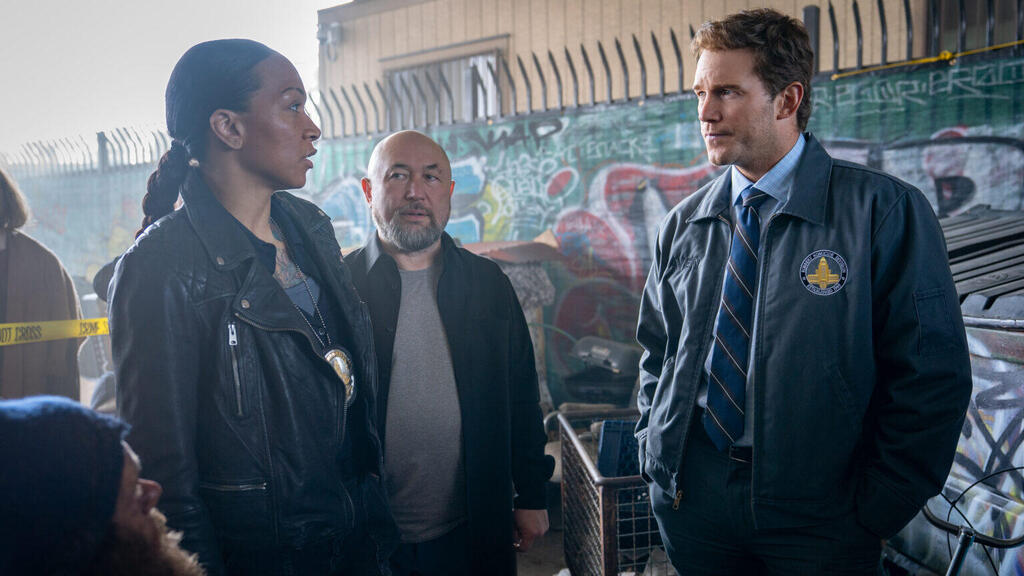
With his law enforcement background, Raven knows how to use the system’s investigative tools. One wonders, incidentally, what happens to those without such technological fluency. Presumably, their lives are deemed worthless. He contacts his teenage daughter, Britt (Kylie Rogers), who is torn between loyalty to her father and a verdict already delivered on social media. Raven also turns to Rob (Chris Sullivan), his close friend and sponsor from Alcoholics Anonymous, and to Jaq (Kali Reis), a former colleague from the police force. Jaq is the only character who operates physically in the urban space, moving between locations on a drone-bike, apprehending suspects and speaking with witnesses, in a manner reminiscent of the agent who plunges her hands into unfamiliar alien technologies in “War of the Worlds.” She wants to help but acknowledges that she is first and foremost bound to the system, operating within its rules, taking instructions from Judge Maddox and not truly questioning the premise of AI-based justice.
From ‘Mercy’
(Photo: Courtesy of Forum Film)
The information flowing in from every investigative source piles up before the viewer at a dizzying pace. Bekmambetov and his editors make a considerable effort to maintain visual clarity, but that clarity is part of the problem. Everything is too accessible, too clear, too smooth. There is no sense of investigation, no interpretive labor, no gray areas. The viewer, like the protagonist, learns to operate within a system that promises that if you only search correctly, the truth will be revealed. Would it not be more logical to have an AI agent serve as defense counsel opposite an AI judge? That way, the human role would be reduced to a piece of flesh likely destined for destruction.
From ‘Mercy’
(Photo: Courtesy of Forum Film)
On an ideological level, the film presents itself as a critique of “algorithmic justice,” but in practice, it justifies it. “Mercy” does not ask whether such a system should exist, but how it might be improved. The failure is framed as a calibration error, not a moral problem. Free and almost unlimited access to all digital information is not portrayed as a radical violation of privacy, but as a functional fantasy: if only we had a smart enough “agent,” everything would work out.
In this context, it is difficult to ignore the continuity between “Mercy” and the “War of the Worlds” that Bekmambetov produced. That earlier film existed largely to glorify Amazon’s logistics and delivery services. “Mercy” represents the next step: open flattery of the worldview of all-knowing AI agents. The artificial intelligence in “Mercy” is not a warning, but a prototype. It is not frightening enough because it is designed to be desirable.

From ‘Mercy’
(Photo: Courtesy of Forum Film)
The comparison to Steven Spielberg’s “Minority Report” (2002) only sharpens the sense of missed opportunity. In that film’s future world, a PreCrime unit identifies and convicts criminals before they have committed their crimes, sometimes before they themselves know they are about to do so. There, too, a senior police officer becomes hunted by the very system he once served. Spielberg’s film raises questions about technology and free will. Bekmambetov’s offers nothing more than an interface overloaded with information. “Mercy” contains no strong cinematic imagery, no thought given to perspective or the body, only more and more layers of data on screens. Nearly a quarter century after its source of inspiration, one might have expected these ideas to receive a deeper update, rather than the flattening they undergo here. It is hard not to feel that we are watching a Temu version of Spielberg’s far superior film.
January is often Hollywood’s dumping ground for subpar releases. In that sense, “Mercy” is exactly where it belongs. The film is not bad enough to provoke anger, or the pleasure that comes from something being spectacularly awful, and not smart enough to offer a new or necessary thought for the moment we are living in.