

British musician Boy George visited the Nova festival memorial site near Re'im on Tuesday, where the October 7 massacre took place, and held a news conference ahead of his two upcoming concerts in Israel. The singer toured the site and met survivors of the massacre and former hostages.
"My starting point was obviously seeing what happened on October 7 on television," Boy George said. "I woke up very early and saw everything. It shocked me. But perhaps what shocked me even more was hearing people who had nothing to do with what happened telling me it was a lie. I believed what I saw because I know enough Jewish people, including Jews in Israel, to know that it happened. I didn't overthink it. I just wrote the song ['We Will Dance Again'] and felt that was a better way to express myself. In a song, you can get straight to the point."
Boy George tours the Nova festival site with Omer Shem Tov
(Video: Gadi Kabello)


The singer explained that when he wrote the song, he never expected it to receive radio airplay. "While I was writing it, I thought to myself that it would never be played on the radio. But at that moment, I wasn't asking myself how to advance my career. I was asking what I needed to do with what I was feeling deep inside."
He said the song's most important line was: "If you ever get confused, I stand with the Jews."
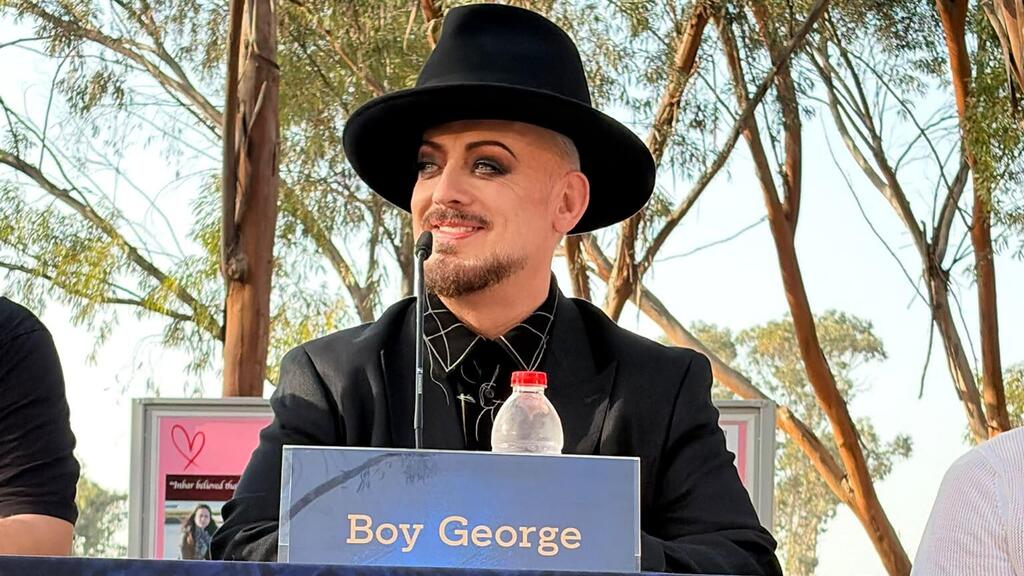
"For me, the song says everything I want to say. That's how I feel. I'm looking forward to performing it for an audience that will embrace it with love in the coming days. I've already performed it in several places around the world, including some synagogues, and it was beautiful. It's supposed to make people feel safe, to celebrate and to feel that they belong. That's the kind of music I want to make."
'Maybe if I had a Jewish partner': Boy George on converting to Judaism
During the news conference, ynet asked Boy George about remarks he made Monday to President Isaac Herzog, when he said his life had been deeply connected to Judaism since he was 14 and that the connection was only growing stronger. Would he ever consider converting to Judaism?
"I'm too lazy. I've heard it's really hard," he joked. "If you're in love with someone, then it's worth going through the process, so who knows? Maybe if I had a Jewish partner."
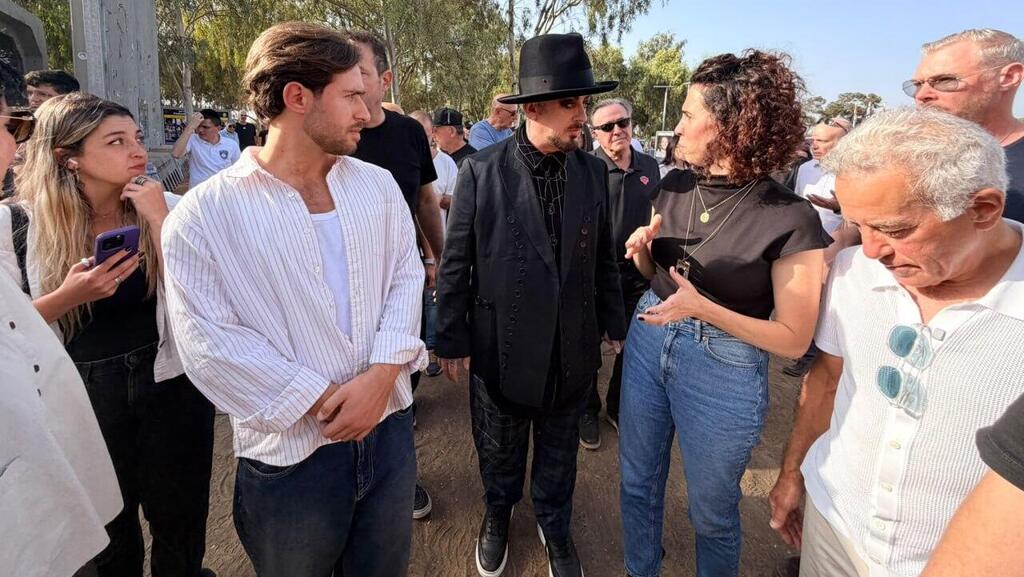
Boy George meets with survivors and families of victims of the massacre at the Nova festival
(Photo: Gadi Kabelo)
"For now, I don't think about converting because I don't think it's necessary. Part of what I do is talk to Jewish people, because I'm a human being and because I have a lot of Jewish friends. They've told me they're very happy about what I'm doing and saying because they feel that some of the things I've said, they couldn't say themselves. It's easier for someone on the outside to point and say, 'What you're doing is wrong.'"
Asked about his childhood and how his upbringing shaped the person he is today, Boy George reflected on growing up in London during the 1970s.
"I think I was so naive back then. I grew up in London in the 1970s, when there was a lot of racism against Black and Asian people. As a gay man and an outsider, I've always felt connected to people who are rejected. I've never liked bullies, and I experienced a lot of that as a child."
'You mean the pop stars I've already blocked?'
Boy George was also asked whether visiting Israel and seeing the Nova memorial site firsthand might prompt him to reach out again to fellow pop stars who have remained silent about October 7.
"You mean the ones I've already blocked?" he joked. "I'm lucky. Everyone I've admired in the industry has been supportive, and the rest are pretty predictable."
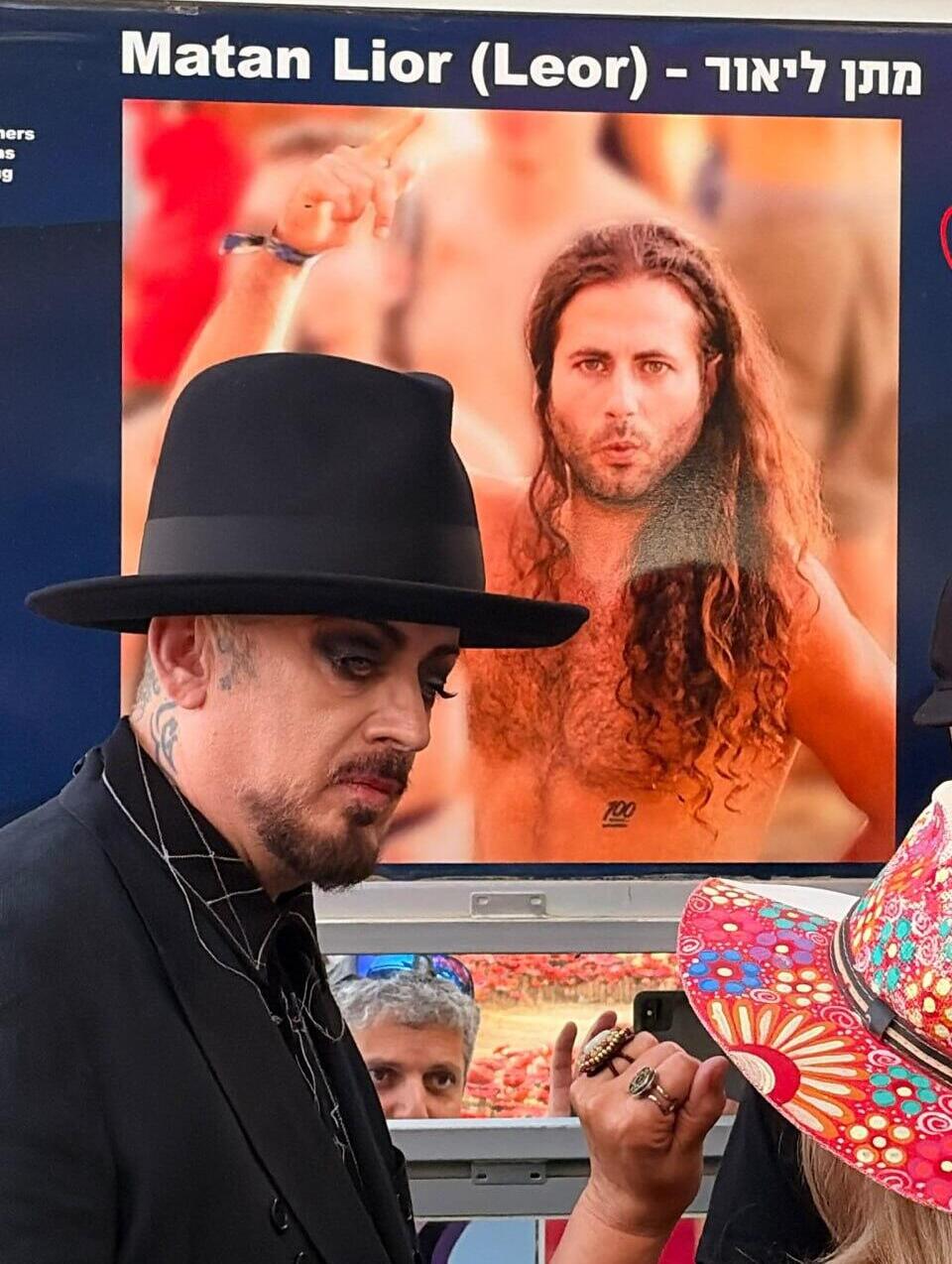
Boy George visits the Nova site
(Photo: Gadi Kabelo)
The musician said he no longer considers himself part of the mainstream music industry. "I don't feel like I'm part of the music industry. I work outside it. I respect what people do musically, but if someone posts things I disagree with, I'll call them out publicly."
He added that those he challenges rarely engage with his criticism. "Usually they don't respond, which is the interesting part. And if they do, they just repeat themselves. When I post something on social media, I see 20 positive comments and just a few negative ones, and I ignore them because they don't contribute anything. As long as people are honest, they'll get my love in return. I've got their backs."
'I came here to dance and be free': Former hostage returns to Nova site
The news conference was hosted by Omer Shem Tov, a survivor of the Nova massacre who was kidnapped by Hamas and held hostage in Gaza. Speaking from the stage, Shem Tov said this was only his third visit to the site. The first was on October 7, when he attended the Nova festival and was abducted. The second came after his release from captivity.
"The feeling and the energy here are sad and dark, but on the other hand, I feel so much light here," Shem Tov said. "I look at the photographs and see so many of my friends. Even if I didn't know them, they're all friends and family. Every face I look at belongs to someone who brought joy and light into the world."
"It's hard for me to be here, but it also fills me with meaning," he continued. "It's very strange for me to be standing here in front of you today. On October 7, I came here to dance and be free, just like the thousands of people who were here with me. I never imagined for a moment that this place would change my life."
"From here, I was kidnapped to Gaza for 505 days. And today, a little more than three years later, I'm standing here again, this time as a free man."
Shem Tov also spoke about what Boy George's visit meant to him and to the Nova community. "His music has touched millions of hearts. That's exactly what this place was supposed to be, a place that brings people together, a place of love, joy and life. I want us to remember everyone who came here and never got to return home."
Turning directly to Boy George, he thanked the singer for choosing to visit Israel despite the controversy surrounding public support for the country.
"I think it takes a lot of courage these days to stand with Israel. And it takes even more courage to get on a plane, come here, perform in front of a huge audience and bring people together. You could have stayed far away, but you chose to come. I think that says a lot about who you are," he said.
"I watched you walking around this site, and I saw how you gave your attention to every person and every story. We can all see how much you care and how much love you have."
Also attending the event were Sylvan Adams, president of the World Jewish Congress's Israel region and Boy George's official host during his visit, and Ofir Amir, a co-founder of the Nova festival, a survivor of the massacre and a co-founder of the Nova Tribe community organization.
'We Will Dance Again': The song that cost Boy George friendships
On Monday, Boy George visited President Isaac Herzog at the President's Residence in Jerusalem and later traveled to the Western Wall. During his meeting with Herzog, the British singer revealed that his support for Israel had cost him numerous friendships, with some people cutting off contact with him.
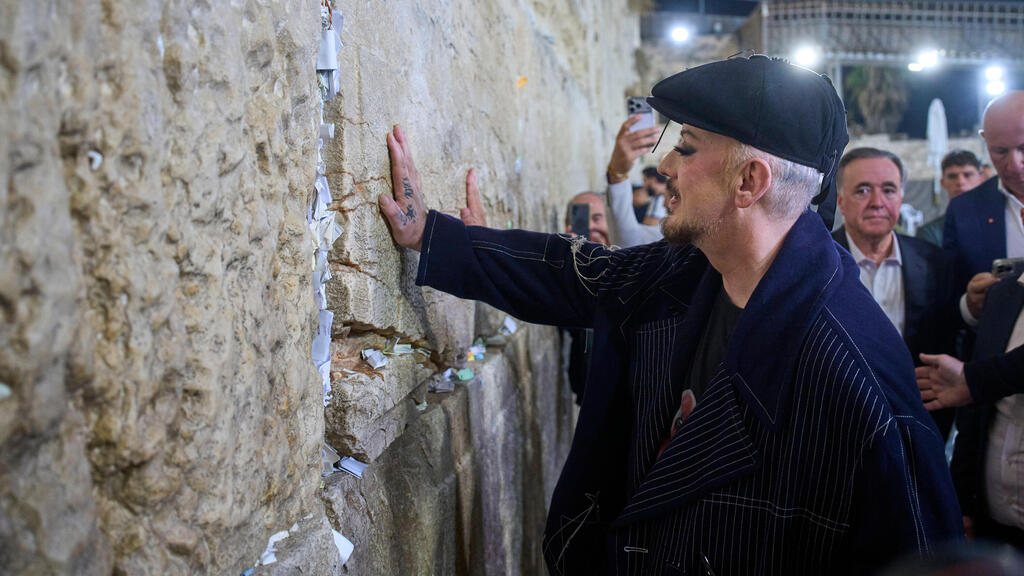
Boy George at the Western Wall
(Photo: Ohad Zwigenberg/AP)
The fallout followed the July release of his song "We Will Dance Again," inspired by the phrase that has become closely associated with survivors of the October 7 Nova festival massacre.
"In the three years since October 7th, Israel and Jews around the world have faced an onslaught of attacks. In the worlds of culture, art, and music, which ought to bring people together, we have seen a particular strain of discrimination against Israelis and Jews run rampant," Herzog said during the meeting.
"However, you stood up and said: ‘If you’re ever confused, I stand with the Jews. I don't feel brave, I just need to behave like a human.’ It was this simple yet profound message of moral clarity and decency in your song ‘We Will Dance Again’ that touched the hearts of Jews and Israelis everywhere,” the president also said.
Two Tel Aviv concerts, including a tribute to Nova survivors
Boy George is scheduled to perform at Menora Mivtachim Arena in Tel Aviv on November 4 alongside Israeli singer Ivri Lider. A second concert will take place November 7, featuring Israeli DJ and producer Offer Nissim as a guest performer. The second show will be dedicated to the Nova community, with 1,500 tickets donated to survivors and bereaved families.
Boy George, whose real name is George Alan O'Dowd, rose to fame as the lead singer of Culture Club. The band broke through in 1982 with "Do You Really Want to Hurt Me?" and later achieved worldwide success with "Karma Chameleon."
After Culture Club won the Grammy Award for best new artist, Boy George pursued a solo career, while also establishing himself as a DJ, fashion icon, songwriter and theater performer. In May, he appeared on "Superstar," a song by Senhit, who represented San Marino at the 2026 Eurovision Song Contest.
Before his upcoming performances, Boy George last appeared in Israel in 2017, at the same arena in Tel Aviv's Yad Eliyahu neighborhood.