

Some works of art can be understood through a screen. Talia Kutz-Shamir’s new exhibition, Threading the Absence, is not one of them.
To grasp the painstaking labor behind the works, visitors must stand before the embroideries, on display at the Petah Tikva Museum of Art through the end of October. Thread traces family photographs line by line, as the needle repeatedly pierces remnants of fabric. Here, the needle is more than a creative tool. It is also a means of confronting a rupture that cannot be repaired.
Gallery
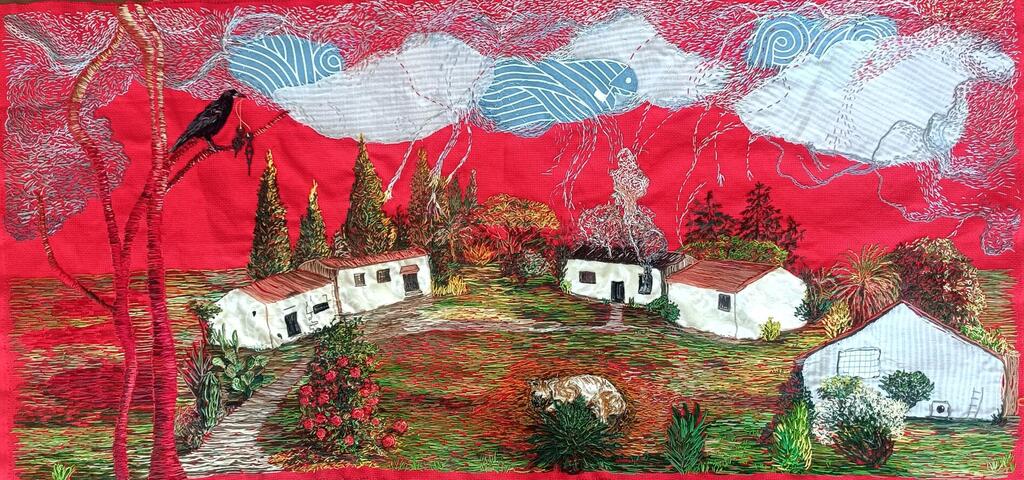
“Death Embroidery,” from the exhibition Threading the Absence
(Illustration: Talia Kutz-Shamir)
In the summer of 2023, Kutz-Shamir felt compelled to learn embroidery, partly in response to what she described as the unraveling of Israeli society.
“That summer, I was dealing with my father’s experiences during the Yom Kippur War,” she said. “I went to my parents’ home in Kfar Aza and found a very large suitcase filled with letters my mother had written almost every day to my father, who had been called up and remained away from home for nearly a year. It is what so many people are experiencing today.
“In those letters she described the difficulty, everything she was going through without him, and also how we, the children, were growing up. I interviewed my father about his experiences and recorded him, thinking I might create a project from it.
“That is actually the only piece I managed to embroider before Yom Kippur 2023," Kutz-Shamir said, pointing toward a small, delicate embroidered image of her father on the day he was drafted.
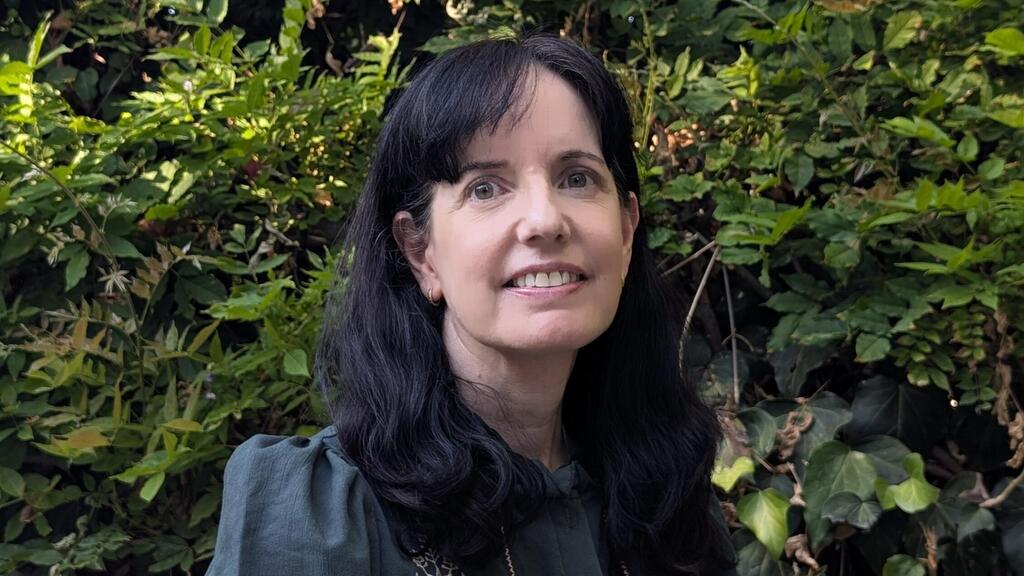
Talia Kutz-Shami r
(Photo: Courtesy)
On October 7, 2023, her life was overturned. Her brother, Aviv Kutz, his wife, Livnat, and their three children, Rotem, Yonatan and Yiftach, were murdered in their home in Kfar Aza, the kibbutz where Kutz-Shamir grew up. The family’s bodies were found and identified about a week later. They appeared frozen in time, with Aviv embracing and covering the rest of the family in bed, trying in vain to shield them with his body.
“I woke up shortly before the sirens began,” Kutz-Shamir recalled. “I felt something like a jolt, though to this day I still don’t know what it was. My sister and I did not live in Kfar Aza, but my parents and Aviv did, and sirens were sounding where all of us lived. We ran to our safe rooms and began messaging in the family group. We expected Aviv and Livnat to respond and tell us what was happening, but gradually we realized they were not answering.”
“At first, I held on to this completely unrealistic illusion that they had run to the safe room without their phones. But the safe room was Rotem’s bedroom, and she had her phone with her.”
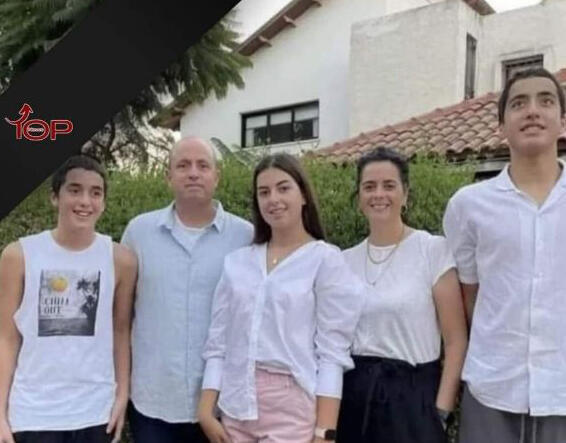
The late Kutz family
The family wondered whether poor cell reception or power outages were preventing them from responding. “It was impossible to get any information,” she said. “My parents tried calling for help, asking someone to go there, but there was no one to turn to. We were in shock. I was in shock.
“I remember sitting through a power outage in Kidron, where I live, terrified that my phone would die and I would lose even that connection. It is impossible to describe those days. It took about another week before anyone could enter the house, identify them and remove their bodies, because the neighborhood was still full of terrorists and fighting continued there in the days that followed.”
“My parents arrived on Sunday and stayed with us throughout that first month. We were all together, and none of us slept at night. You exist in a kind of delirium. Even now, certain things take me straight back to those days.”
“After that, I fell into a kind of silence. For two months, I created nothing. I simply couldn’t,” Kutz-Shamir said softly. “Then I felt an intense physical need to touch something. Maybe it came from that sense of disappearance. There is something about touch that was so painfully absent. I just wanted to touch something.
“The first time I returned to Aviv and Livnat’s home was about a month after the massacre. I took a few things from the house, fabrics and clothes, without knowing I would create with them. I only wanted to take something, to touch it. That was all. Somehow, it evolved into embroidering on the fabrics I had taken and incorporating them into the works.”
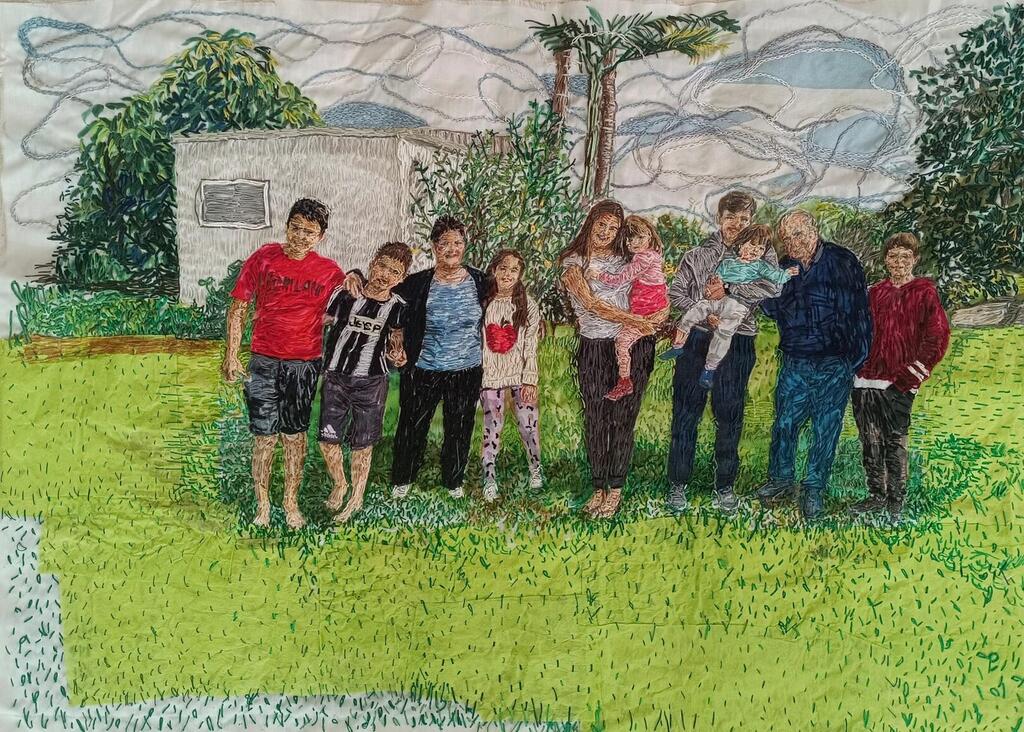
'Portrait with All the Grandchildren'
(Photo: Talia Kutz-Shamir)
Near the entrance to the exhibition, two embroideries hang on opposite walls. One depicts her father. The other shows her brother flying a kite.
“That was the first work I made,” she said of the image of Aviv. “It is embroidered on the back of one of his shirts. He loved wearing plaid shirts to work, much to Livnat’s displeasure, because she did not particularly like them.”
She allowed herself a brief smile. “He had many plaid shirts, and I desperately wanted to touch him. There is a large space in this work, and it contains something that recurs throughout the exhibition. It is as though I am sending a thread high into the sky, trying to hold on to something or pull something down from there, just as he does with the kites.
"Aviv founded Kfar Aza’s annual kite festival, in which residents flew kites bearing messages of peace and hope toward Gaza. The event was scheduled to take place on October 7."
Many of the exhibition’s images are drawn from family photographs taken over the years. “My brother was an amateur photographer who loved taking pictures,” Kutz-Shamir said. “There are hundreds, perhaps thousands, of photographs of the family.
“And there was this feeling that no one was left to hold on to them, no one left to look at them. When parents lose a child, they often return to the photographs again and again. Here, the photographs themselves felt orphaned.”
“From time to time, I would open the folder, for as long as I could. I would look until it became too painful, then close it. I would try to choose one photograph and respond to it.”
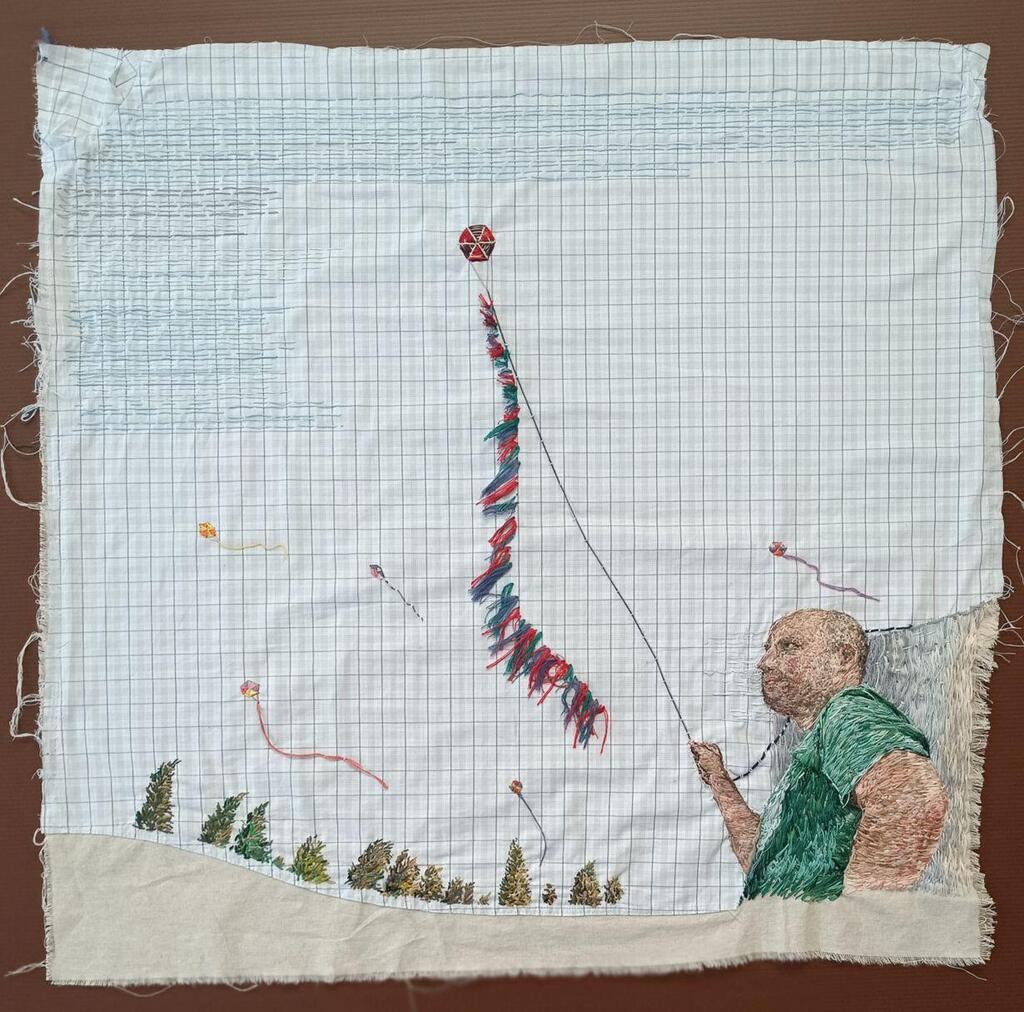
The work 'Aviv'
(Photo: Talia Kutz-Shamir)
Under her hand, the photographs acquired new layers, thread by thread. Yonatan and Yiftach, talented basketball players who trained at Hapoel Tel Aviv’s academy, are shown playing with a ball thrown toward the sun, where it seems to merge with the light.
Rotem, an IDF squad commander who had returned home on leave for the Sukkot holiday, appears as a young child sitting innocently in a field of anemones in the Negev. The image is embroidered on a military shirt hung upside down, carrying an ominous sense of foreboding. Livnat, who was skilled at handicrafts, appears to be using a needle to embroider, repair, or perhaps heal a bird that is the same size as she is.
“The work allowed me to maintain a relationship with them,” Kutz-Shamir said. “I spent hours, days and weeks embroidering each piece. It is an extraordinarily painstaking process.”
Kutz-Shamir is primarily a painter, but she said painting could not answer what she needed or contain the pain she was trying to confront.
“After a disaster like this, you feel as though you are drowning,” she said. “You think you will never get through it, that it will never end. And in truth, it never does. But embroidery is very slow. It is nothing like painting, where a single brushstroke can fill an entire area. It is gradual. It accumulates. Something eventually emerges from the repetition, but nothing changes by magic or all at once.
“This slow action shifts something. I still do not know exactly what, but things do change, even alongside the pain. People speak of healing or repair. Those words feel too large to me. I think more in terms of connection rather than rupture.”
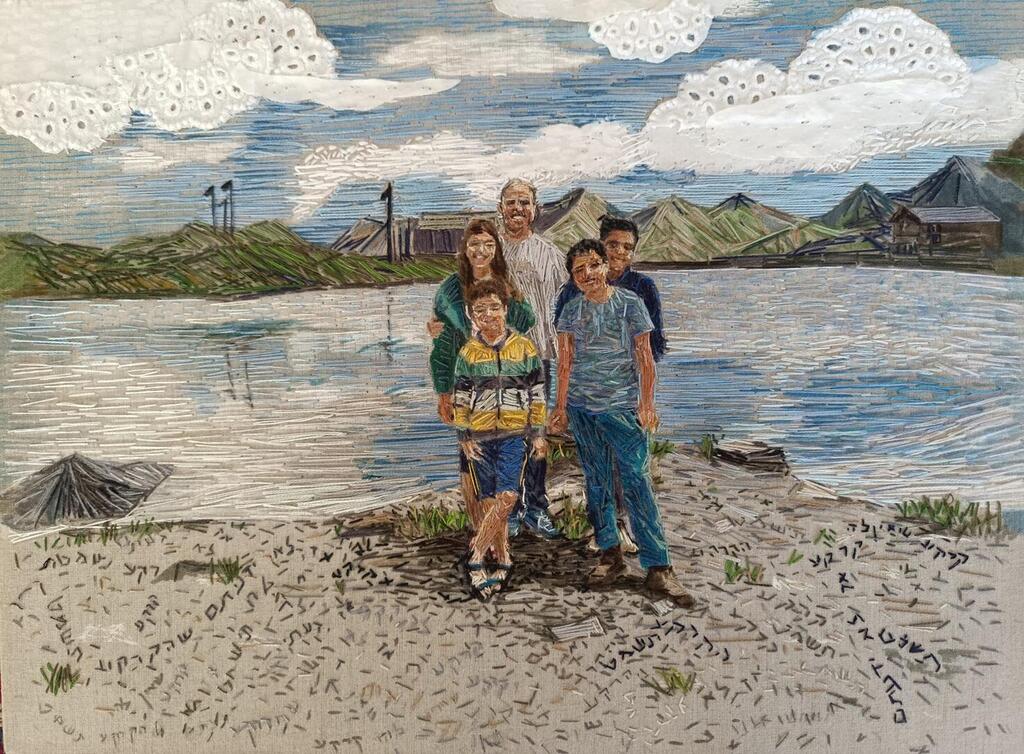
The work 'Once, in Another Country'
(Photo: Talia Kutz-Shamir)
You are also an art therapist. The need to “touch something” is, of course, about reaching for those who and what are no longer here, but turning to touch is also a coping mechanism rooted in the therapeutic world.
“That’s true. In that sense, I may have been slightly more ‘prepared,’ if anyone can ever be prepared for something like this. I studied mindfulness-based psychotherapy, which taught me to stay with physical sensations rather than flee from them. Touch often helps me, and that is what I tried to do then, and what I am still trying to do now.”
She sometimes describes the massacre as a meteor crashing into a person. “It creates an enormous void in an instant, one you can never fully comprehend,” she said. “When I open their photographs, I can look only for a moment before I feel the pain in my stomach and have to stop. Even now.
“Sometimes I experience it from a distance, as though none of it really happened. Then, without warning, the realization that it did comes rushing back and overwhelms me. Trying to make something like this even slightly more bearable, if that is possible at all, is an extremely slow process.”
One series in the exhibition returns to the same image again and again, reconstructing and fragmenting it across different materials. “It is a photograph of Livnat with Yonatan when he was young,” she said. “I also used sheets of paper my brother made kites from, along with rice paper.
“Each time, I approached the image from a different angle, using a different technique, trying to find another way to grasp it. The series reflects the feeling that, no matter how hard I try to hold on to the massacre and to the people who are no longer here, some parts can be captured while others slip away. It can never be grasped in its entirety.”
The exhibition, she stressed, is not about commemoration. “I do not believe in the concept of memorialization,” she said.
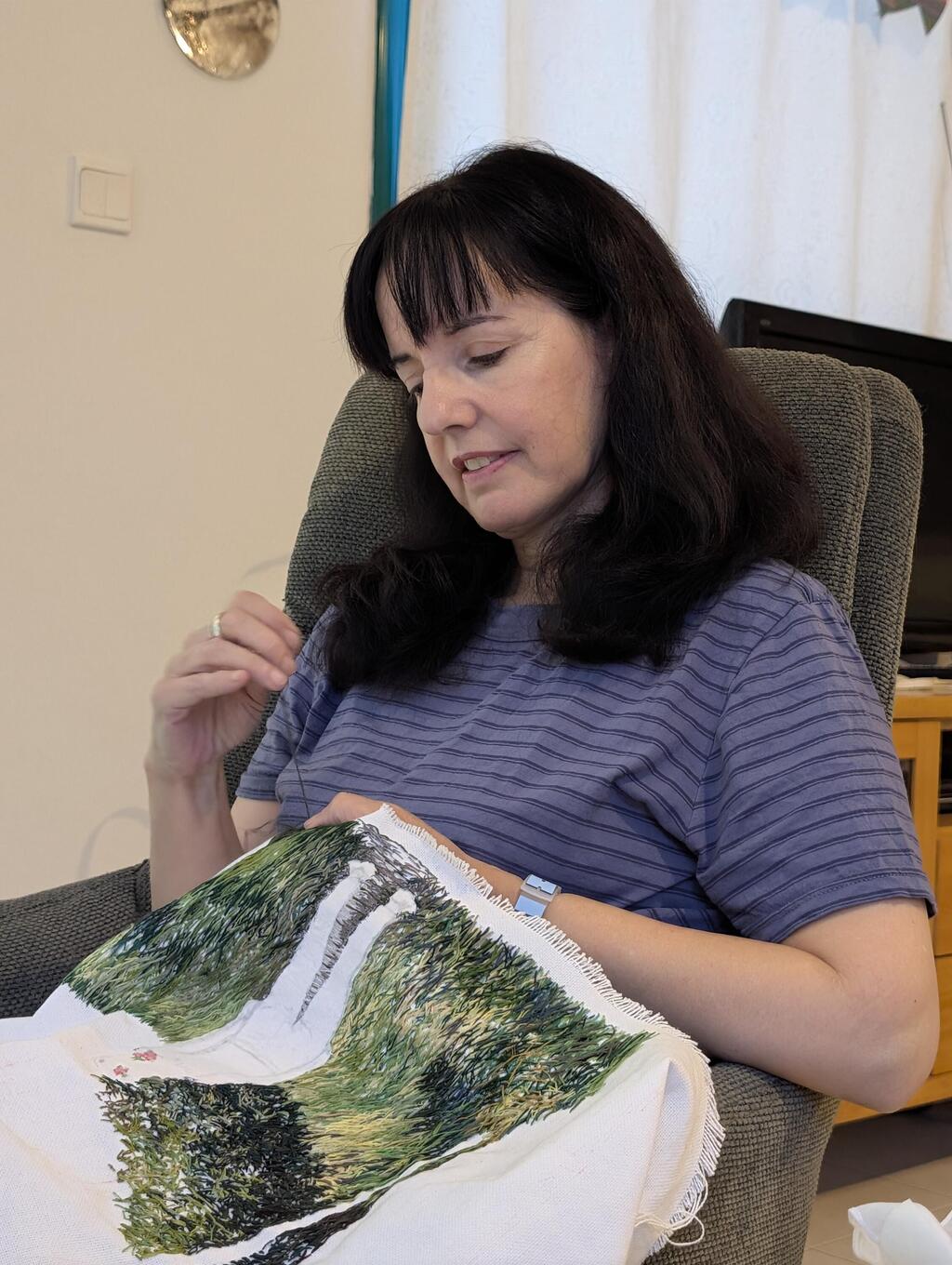
'I feel the pain in my stomach'. Talia Kutz-Shamir
(Photo: Courtesy)
Even though the exhibition is being shown at the Petah Tikva Museum, which is also home to Israel’s first Yad Labanim memorial center?
“That connection exists, but the exhibition is not located there. When we commemorate, we want to freeze a moment in time. We want to preserve something as it was, believing the image will remain and not disappear.
“But I feel that everything changes and everything disappears. I want to communicate that experience, the attempt to grasp something that cannot be grasped. For me, memorial ceremonies and acts of commemoration are so burdensome. What I feel there is only immense pain.
“Embroidery is the only place where I can touch these subjects without everything collapsing entirely into pain. Embroidery is the one place where I can engage with these subjects without everything collapsing into pain. When I embroider, I can feel different things, think different thoughts and carry on a dialogue with them
“The exhibition adds another element: the living. People come in and bring themselves into it, their gaze and their associations. It is alive, and from that something new is created. It is not frozen.”
The repetition in that series also seems connected to grief, something you can approach again and again without ever reaching an end. As you said, it is always changing and can continue forever.
“That is true. The entire event carries a sense of something mythological, as though it exists outside human life. It is an incomprehensible disaster in its scale, something that does not belong to this era at all. It feels like something from another world. And dealing with it somehow, trying to work in relation to it, is the work of a lifetime.”
‘People feel uncomfortable saying it is beautiful’
Other works in the exhibition do not depict the family directly, but circle their story and expose additional layers. One shows birds nesting amid climbing plants growing wild without a pruning hand, reaching upward until there is nowhere left to climb.
Another is a video work created with director and editor Ori Noam. In it, a figure resembling Kutz-Shamir lays pipes across an arid field near Kfar Aza, with Gaza visible in the distance. The figure appears to stitch the pipes into the earth, preparing for life and for water that may one day flow, transforming embroidery into a spatial act and the entire body into a hand.
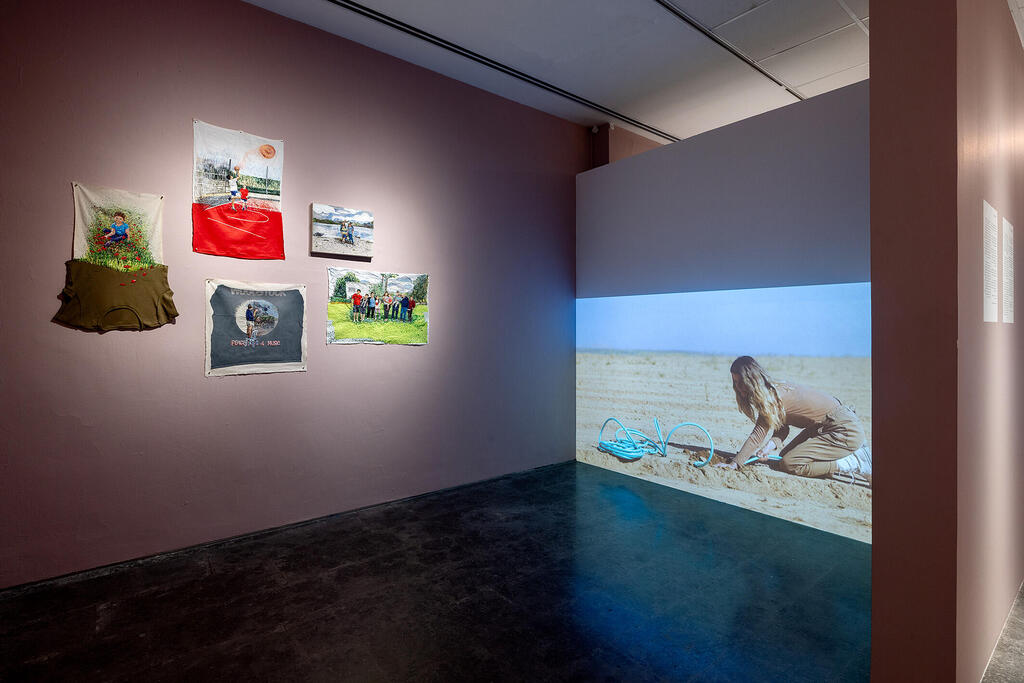
Talia Kutz-Shamir’s exhibition
(Photo: Talia Kutz-Shamir)
“I wanted a voice to be heard in the exhibition, so it would not be filled only with silence,” Kutz-Shamir said. “I wanted there to be life as well.”
Her father’s voice plays in the background. “I asked him several questions about the disaster. One was, ‘If you had to describe it through a single image, what would that image be?’ To my surprise, he chose one from the world of textiles. It sent a chill through me.”
“He said, ‘I see it as a large sheet of fabric with a section cut out of it. I am standing in the middle of that missing section, and every touch of the frayed edges raises pain over something that once existed and is no longer there.’”
Video is not Kutz-Shamir’s usual medium, and she emphasized that the museum helped produce the work, connecting her with Noam and a full production team. They filmed near Kfar Aza while the war was still underway and sirens were sounding. “It was exciting, but also complicated,” she said. “Returning there is complicated in general.
“Since October 7, I have been there several times, mainly with my parents before they moved to assisted living, when they had to pack their belongings. It is terribly difficult. The kibbutz looks like a construction site. Things no longer look the way they did, neither my parents’ home nor Aviv and Livnat’s home. There is a sense of destruction. It is extremely difficult to experience.”
It is hard to imagine what it must have been like to return to the kibbutz a month later and enter Aviv’s home.
“I think that a month later I was still in a state of dissociation. I had not yet managed to feel very much, and I did not experience the pain that I can now feel. Much of the time, it looked like a movie, like some unreal hallucination. Today, the pain is much sharper.
"Everything collapsed, on every level. The family that is no longer here, my parents leaving, my mother dying since then. If my father described it as torn fabric, the image that comes to me is a pile of fabrics that someone cuts lengthwise with a sharp knife.
“On the personal level, within our family, many things were severed. My childhood memories, memories of a place I experienced as safe to grow up in, to marry in and to do so many things in, and then suddenly seeing it as a threatening place, are unbearable. All the memories were buried beneath this disaster.”
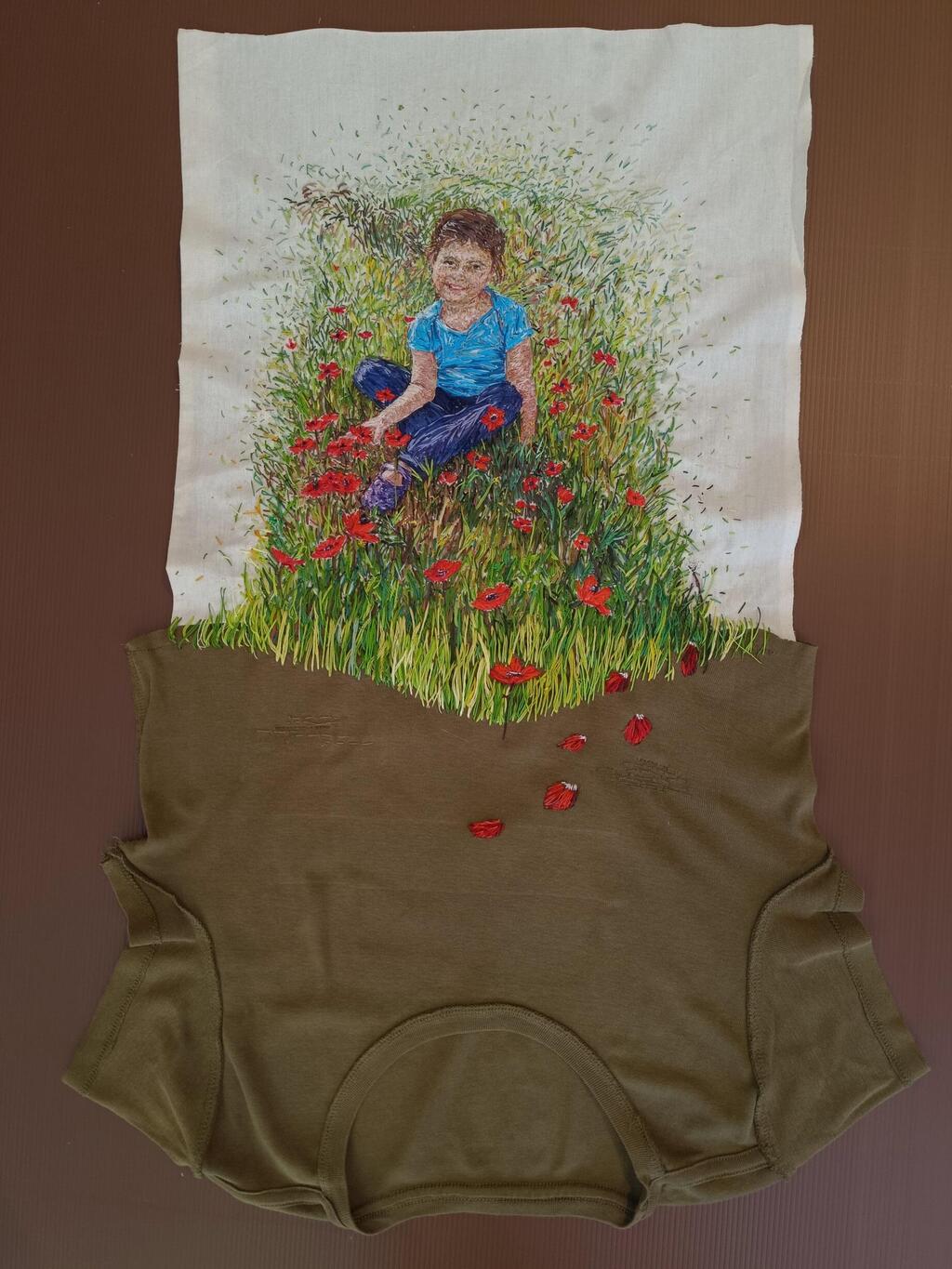
The work 'Rotem in a Field of Anemones'
(Photo: Talia Kutz-Shamir)
Yet for Kutz-Shamir, art makes it possible to continue living beneath the ruins of loss. As she spoke about a new project she is already developing, a continuation of the works in the exhibition, her eyes lit up.
“Many people who come to the exhibition tell me, ‘I feel uncomfortable saying this, but it is so beautiful, and at the same time it is painful,’” she said, smiling. “People feel uncomfortable saying that something dealing with such a terrible subject is beautiful.
“I have been thinking a great deal about beauty and the role it plays in life, especially life after disaster. I have been reading research on the brain and on what aesthetic experiences can offer people living with trauma and grief.
“Beauty helps me contain the pain in some way. It also allows visitors to approach the exhibition’s painful subject matter differently. For me, the search for beauty is what gives me meaning right now. It is not about making reality prettier or softening it. It is simply that, to hold something this painful, you need a vessel made of beauty.”