


There are married couples for whom monogamy is highly overrated. Six decades ago, Bob & Carol & Ted & Alice (1969) by Paul Mazursky portrayed two bourgeois couples in an open marriage, presenting monogamy as conservative and ultra‑bourgeois.
Splitsville, directed by Michael Angelo Covino (who also stars), similarly follows two couples who decide to open their marriages — but it continuously surprises. Not only are the relationships open: the entire space is porous, characters come and go, the image sways between order and chaos, and absurdity sinks into a serious — even sad — tone.
Splitsville - Trailer
(Courtesy of Forum Film)


The film opens with a scene that’s hard to describe: newlyweds Carey (co‑writer Kyle Marvin) and Ashley (Adria Arjona) are driving, singing together, and then try to have sex while he drives. A passing car flips over; the man survives but the woman lies dead at the roadside. Ashley tries and fails to revive her. Then she announces to Carey that she wants a divorce and confesses a long‑standing affair. Carey abruptly stops the car and flees on foot through fields and roads — and even swims — to the beach house of his only friend Paul (Covino) and his wife Julie (Dakota Johnson). At that house, twice during the opening scene, Carey’s penis is shown in full view — an on‑scene police officer even comments on it.
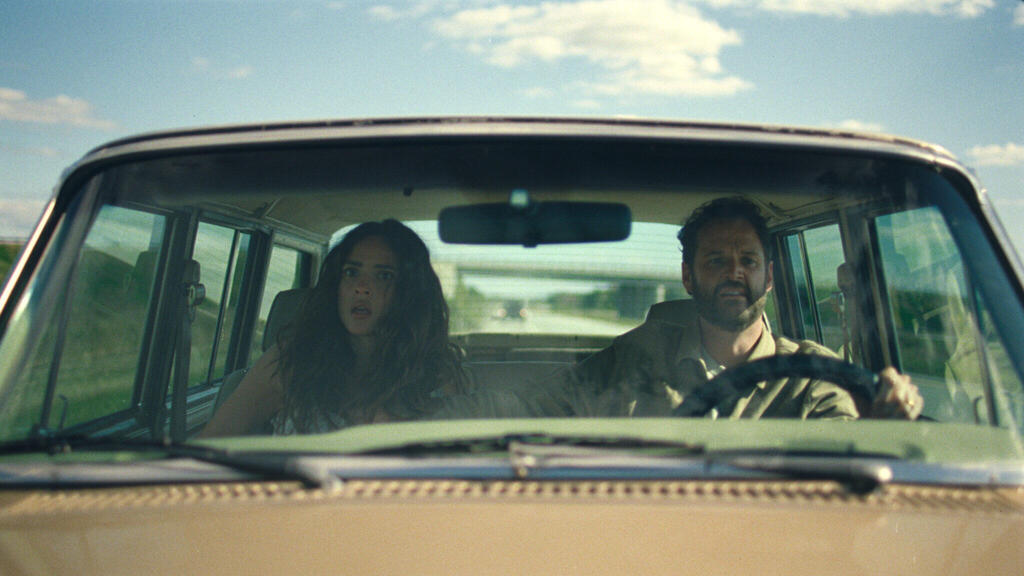
Thus, the tone of the film is set: a comedy‑drama in which the unexpected keeps happening. At the latest Haifa Festival, the filmmakers referenced the anti‑bourgeois French director Bertrand Blier (“Going Places”, “Too Beautiful for You”). Watching Splitsville evokes memories of his satirical ‘80s films — because the film refuses to preach and treats its characters with equal measures of compassion and cruelty. Paul and Julie have an open marriage to preserve their dynamic, and Carey and Ashley follow the same route to avoid the divorce process. But when Carey and Julie sleep together while Paul is on one of his “business trips,” Paul’s status as a desirable house guest crumbles. Carey’s confession to Paul — after a physically realistic fight — leaves the beach house in ruins. The destruction stands as revenge on the fantasy of bourgeois married life that the house symbolises.
From Splitsville
(Photo: Courtesy of Forum Film)
As in John Cassavetes’ films, Splitsville is also a buddy‑movie of sorts: Covino and Marvin are real‑life friends who began in advertising and together wrote The Climb (2019), starring as themselves. That film received strong reviews but faltered at the box office during COVID‑19. Like Cassavetes’ work, Splitsville maps the collapse of the family unit (“Faces”, “Husbands”) with men depicted as vulnerable and weaker, while women are calm, dominant and unquestionably more mature. The Covino‑Marvin dynamic drives the film into unpredictable territory — which is its main merit: it moves rapidly between harmony and chaos so the viewer has almost no chance to predict what happens next. Even the opening titles tremble as though the designer “botched” their imprint. This is a film depicting a world devoid of stability — even when the bourgeois lifestyle at its centre appears idyllic.
For the couple Paul and Julie, their open marriage seems like the fulfilment of a bourgeois fantasy. The homes both couples live in become meaningful spaces — sites of intimacy and intrusion. In one striking scene, the camera follows Carey and Ashley’s array of lovers entering the beach house where Carey stays (in a separate room) while Ashley moves from date to date. All the short‑term lovers occupy the same space while Carey befriends each of them. The long take of entrances and exits blurs time and space. It’s a brilliant visual technique — Altman‑esque in its multi‑character scope — conveying the compressed and ludicrous dimension of the romantic web Ashley enters and Carey occupies within it.

From Splitsville
(Photo: Courtesy of Forum Film)
Splitsville is divided into chapters — each titled after a clause in a divorce agreement — and the film refuses to depict the central dynamic as a perfect fantasy. Its absurdity does not replace seriousness; it questions whether the conservative approach to marriage might, after all, be preferable. The film presents, with accurate comedic precision, the dark side of bourgeois fantasy — and it could easily be thought of as a thriller in the vein of Fatal Attraction, made from the same materials. Moreover, it shows how marriage itself poses a threat to long‑term male friendship. Paul and Carey — each other’s best and perhaps only friend — echo the history of their bond in every heated exchange, starting with comic slaps that resemble a long‑familiar ritual from a years‑old friendship.
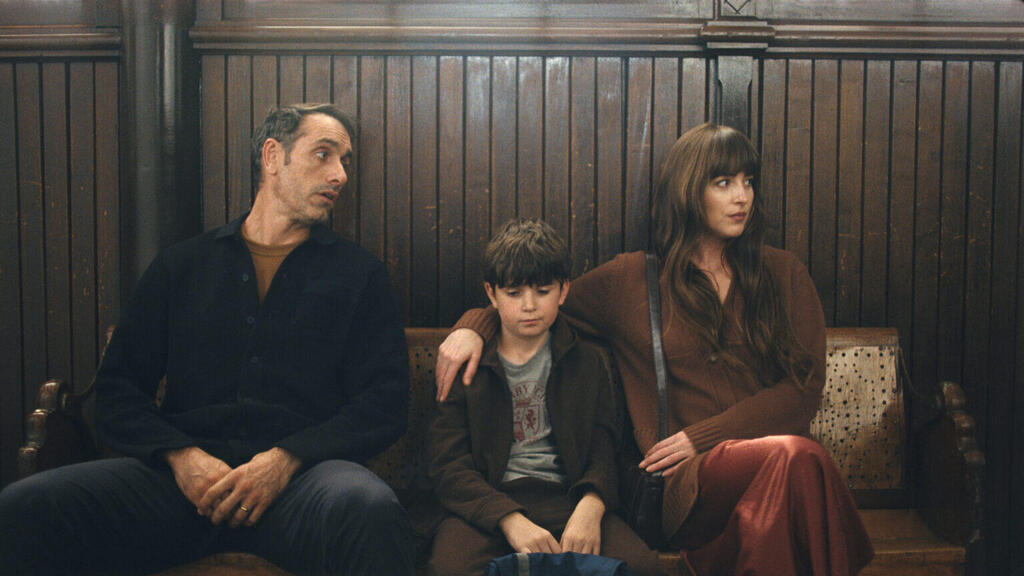
Beyond absurdity, this is a film that conveys genuine insecurity at the heart of marriage: while Carey and Ashley have been married just over a year, Paul and Julie are a long‑married couple whose child’s behaviour at school prompts one of the film’s funniest scenes (in the principal’s office). Marriage is depicted not as personal or financial security but as a source of real uncertainty and fear of disintegration — fear that drives the characters to opt for open‑marriage solutions. Without giving spoilers, Covino and Marvin lead the film to a wonderful climax at a birthday party where the chaotic dynamic evokes scenes from Robert Altman’s ensemble works. Splitsville is a surprise that makes me eager to watch the pair’s previous film — and no less than their next.