


I admit it: I do not have a great deal of appreciation for films in which the narration explains the obvious, as though it were a profound revelation of human emotions and insights. All the more so when that narration comes from the mouth of an aging octopus living in a giant aquarium in a typical American town, holding forth with not-exactly-sharp observations about human beings. On the other hand, the film in question is “Remarkably Bright Creatures,” based on Shelby Van Pelt’s bestseller and starring 79-year-old Sally Field, the queen of awkward gestures. The film deals with old age and with senior citizens — one of them, as noted, an octopus — who suddenly find a late-in-life sense of purpose once they learn to live, well, outside the aquarium, both literally and symbolically. And this film is not bad.
I admit it: My senses have dulled. This film moves toward a twist I should have spotted from a distance, and I failed at that task. Point in its favor. After all, this is a melodrama designed to pull viewers away from the television screen — the film premiered over the weekend on Netflix — with a smile and a tear. In my defense, I will say I did not expect such an absurd revelation; against me, it should be noted that films like “Remarkably Bright Creatures” do not really insist on plausibility. These are fairy tales set in the here and now, and the town where the plot unfolds indeed looks as if it came from a storybook: It sits on the shore of a beautiful lake, everyone is terribly nice to one another, and even the stranger who arrives gets a warm welcome. Trump’s America exists in another territory. Like the octopus watching them, they too live in a colorful and appealing aquarium — they are just not fully aware of it. “Routine,” it is called.
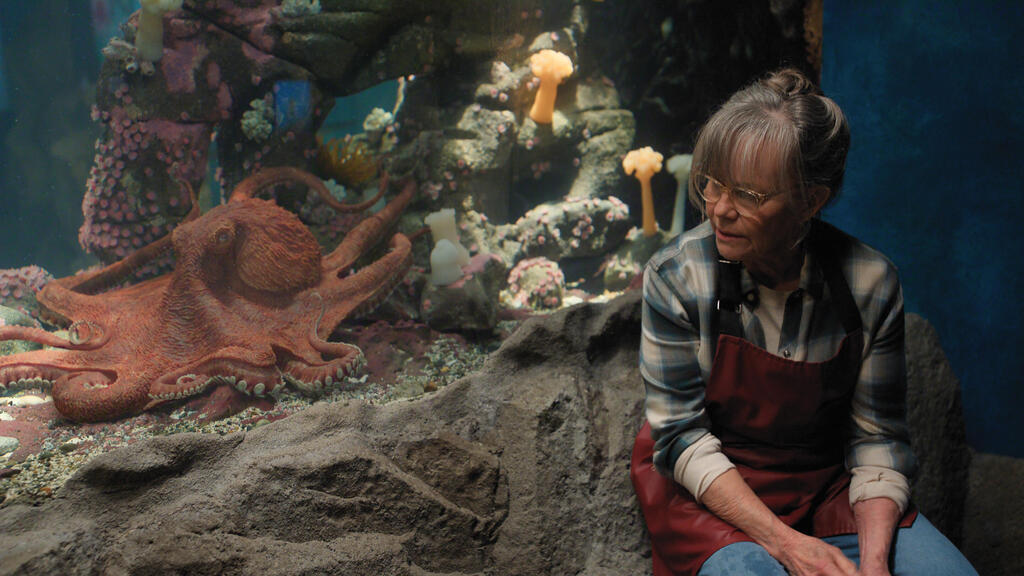
So Sally Field plays a widow who works as a cleaner at the town aquarium, where mostly schoolchildren stream in, smearing their hands on the glass and dirtying the floor with gum. Take note: There is no gum that cannot be removed, if one only tries hard enough. There is a right way and a wrong way to do things, Field keeps repeating, and one must choose the right one. The talkative octopus, voiced softly by Alfred Molina, also has a well-reasoned philosophy of life, though not one that has exactly prevented him from ending up in the glass tank from which he repeatedly escapes, only to be poured back into it. At times, it recalls “My Octopus Teacher,” the Oscar-winning documentary in which the eight-armed mollusk of the title serves as a life teacher for a naturalist going through a midlife crisis.
And yes, it also recalls Guillermo del Toro’s “The Shape of Water,” another Oscar winner, which dealt with the strange bond formed between another cleaner, played by Sally Hawkins, and an amphibious creature imprisoned in the government facility where she works. But in the case of “Remarkably Bright Creatures” — octopuses are considered the most intelligent of the invertebrates — additional bonds are formed between human beings who did not know they were capable of them. One of them is Cameron, played by Lewis Pullman, son of Bill, a member of a failed band called Moth Sausage, who gets stuck in town after his motor home breaks down there. The reason he comes there has to do with his absent father, but until that is resolved, he is conveniently appointed as Field’s replacement after she sprains her ankle and is unable to perform her duties.
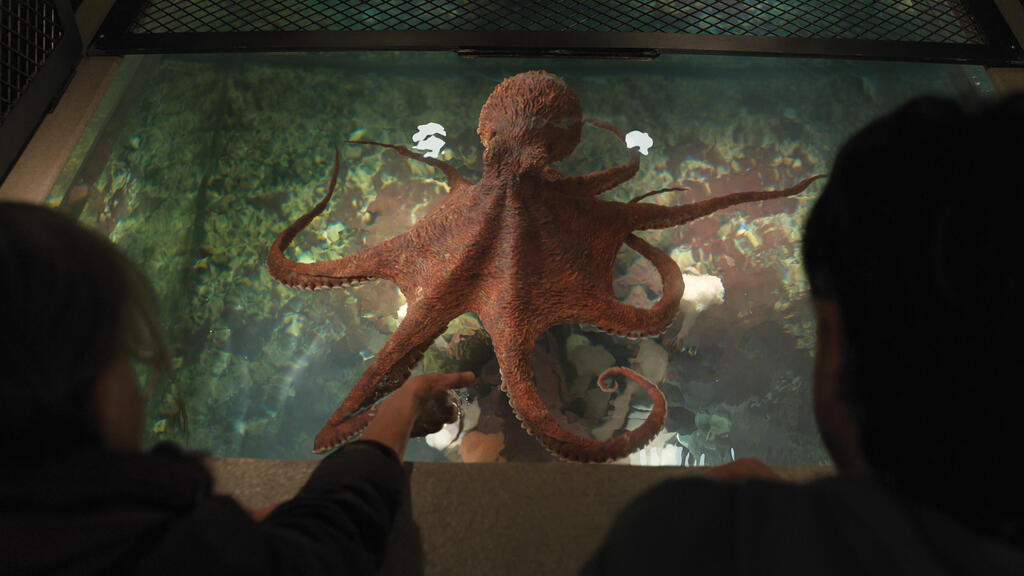
In addition, there is the local grocery store owner, played by the very good Colm Meaney, who also has emotional inhibitions; Field’s talkative friends, played by Joan Chen, Kathy Baker and Beth Grant; and a tragic backstory involving Field’s son in the film. And of course, there is the octopus, named Marcellus, whose insights into the human race are about as deep as the aquarium in which he crawls or camouflages himself. Incidentally, he, too, has problems related to his advanced age and existential fatigue.

From 'Remarkably Bright Creatures'
(Photo: Courtesy of Netflix)
Olivia Newman, who directed “Where the Crawdads Sing” and co-wrote the screenplay here, leads a team of women that also includes the cinematographer, Ashley Connor, and the editor, Tamara Meem. But above all, this is the star, Field, taking on her first leading role in a decade, since 2015’s “Hello, My Name Is Doris,” in which she played a similar character.
It is hard to fault a film whose entire purpose is to move the audience, whatever the cost. We are not supposed to care that the human tragedies revealed along the way suffer from emotional exploitation, nor that all the conflicts are resolved in a satisfying and even perfect way. A subplot about a father who abandoned his pregnant partner and does not know the son born to him exists here only to bring up another story, about homophobia and violent fathers. That story somehow appears, and it too reaches the best possible resolution.
From 'Remarkably Bright Creatures'
(Photo: Courtesy of Netflix)
Ultimately, “Remarkably Bright Creatures” is meant for those who want to watch Sally Field talk to an aging octopus in captivity. All of us, the film says through the voice of that mollusk, need to find the courage to change and reveal ourselves — even in the final stretch of life. Humans and octopuses alike. Fortunately, the film is fairly sympathetic as the unsophisticated melodrama that it is, so those who watch it will be able to get up from the couch with a few basic insights about life.