


Film critics are not supposed to complain about running times. We are the nagging voices who send you to four hours of The Brutalist and say, “Sure, it flies by,” not to mention Filipino festival films that make anything else feel short. Among colleagues, the ultimate flex is asking whether you watched all nine hours of Claude Lanzmann’s Shoah in one sitting, or what you thought of David Perlov’s documentary epic Diary.
To be fair, there are plenty of mainstream Hollywood films that critics and audiences alike agree fully justify their three-plus-hour lengths. Think Avengers: Endgame, packed and epic, The Godfather, The Wolf of Wall Street, Oppenheimer or Schindler’s List, none of which has a dull moment. You can also add a small film called Titanic, whose 195 minutes give us enough time to fall in love with Jack and Rose and believe they truly experienced the love of their lives in the few days they had aboard the doomed ship.
Which brings us to the fact that Titanic was directed by a man named James Cameron — hardly a newcomer to the industry — who now delivers Avatar: Fire and Ash, with a running time of 194 minutes, just one minute shorter than Titanic. The story? Indigenous people versus colonizers. It is exactly the same story as the previous two films. The lush, computer-generated planet Pandora, rich in resources (this time barely explained), is home to blue-skinned Na’vi tribes who can spiritually connect to nature and very much do not want to be conquered by evil humans.
It worked in the first Avatar in 2009, which rode the 3D boom to nearly $3 billion in box office revenue and became the highest-grossing film of all time. It worked again in 2022’s Avatar: The Way of Water, which was longer, more expensive and earned $2.3 billion. Whether it will work a third time, in an even longer installment, remains to be seen. Cameron likely understands audiences better than I do.

Still, this film feels recycled, stretched and punishing to both bladder and backside. The story repeats itself again and again, and checking your watch becomes more compelling than what is happening onscreen. Many viewers come to Avatar not for narrative innovation but for world-building, epic battles and dazzling effects. Even so, framing the series purely as an “experience” — an endless adventure, almost like a video game on a giant screen — this installment may test even the most forgiving fans, prompting the question: Haven’t we seen this exact thing before?
The plot, for those wondering: The blue-skinned Sully family, led by Jake (Sam Worthington), the former Marine who defected to the Na’vi in the first film, is grieving. One of the sons was killed at the end of the previous movie during battles with humans seeking to exploit Pandora’s resources. Some of the children rebel. Jake’s wife Neytiri (Zoe Saldana) is consumed by grief, while Jake prepares for the next round of conflict. Conveniently, the humans are still around and still trying to seize the planet’s resources.
The story also revolves around Spider (Jack Champion), the blond, dreadlocked human boy who lives among the Na’vi with an oxygen mask — a kind of human Mowgli — whose loyalties remain unclear, as in the previous film.
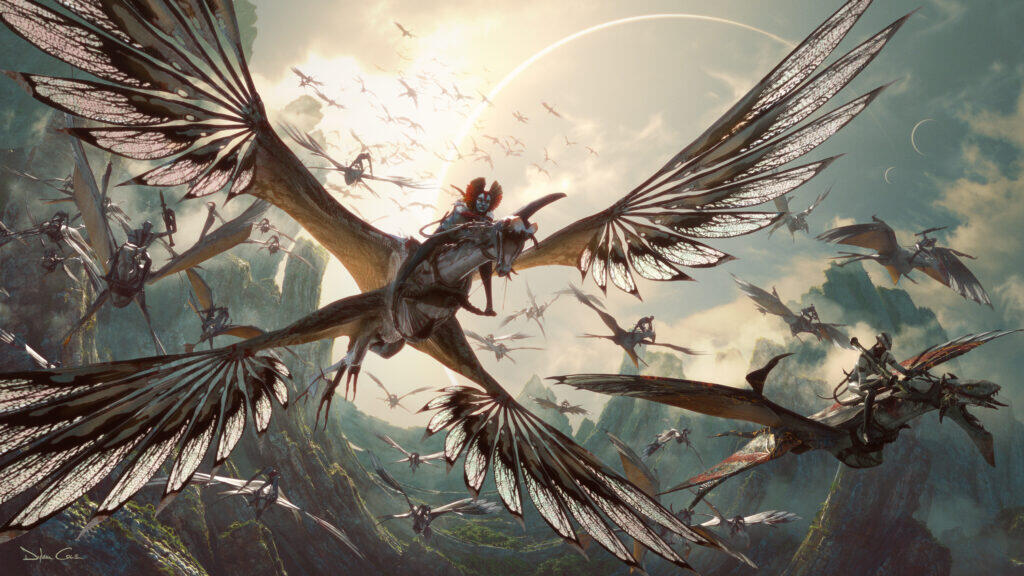
From 'Avatar: Fire and Ash'
(Photo: Courtesy of Forum Film)
The movie starts relatively well, as the family tries to escort Spider back to the human base, drawing clear inspiration from The Jungle Book. Cameron introduces two new elements of Pandora: the “Wind Traders,” a fleet of flying sail ships led by a caravan chief played by David Thewlis, and a new tribe of volcanic Na’vi, far more violent and predatory, led by Varang (Oona Chaplin), a fierce blue-skinned warrior with a perpetual scowl. Cameron seems eager to stress that alongside peaceful “good natives,” there are also “bad natives” who deserve to be fought.
That is largely where the novelty ends. What follows are more than two hours that are nearly indistinguishable from The Way of Water. Scenes could be swapped between the films without anyone noticing. Humans hunt whale-like creatures while the Na’vi try to stop them. Family members leap across cliffs on dragon-like beasts in endless aerial battles. One of the children is captured and must be rescued. Edie Falco barks orders as the human general. A few morally conflicted scientists feel bad about it all. The ending sets up yet another round of “epic” clashes in future installments. Familiar slogans are repeated endlessly, making even “I’m the king of the world!” from Titanic sound like Shakespeare by comparison.
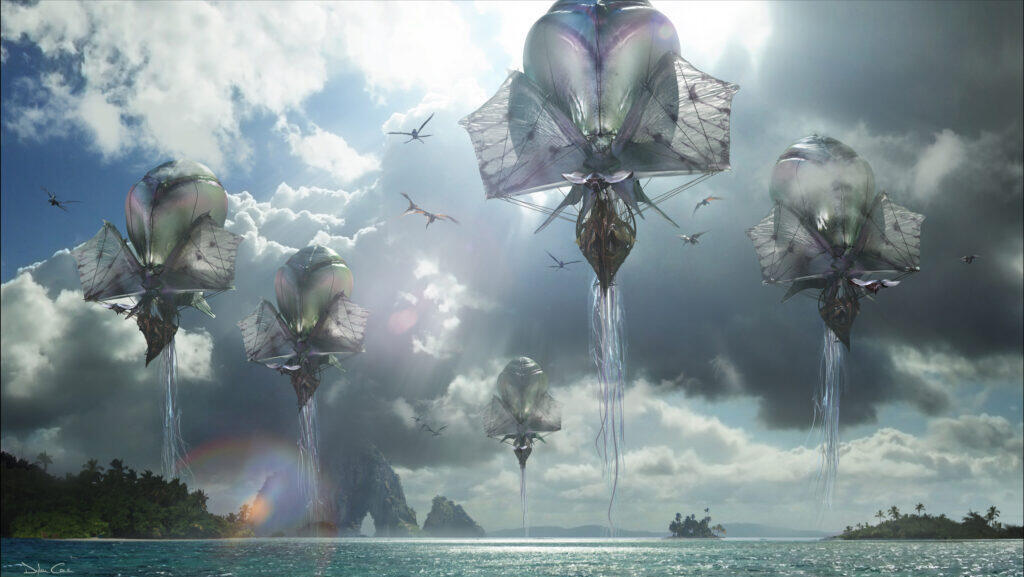
From 'Avatar: Fire and Ash'
(Photo: Courtesy of Forum Film)
Almost everything here feels tired, though one character finally comes into his own: Colonel Miles Quaritch. The former human commander, who in the second film was reborn as a blue Na’vi, is played with charisma by Stephen Lang. He is the only character with a genuine internal conflict, torn between worlds, particularly as the father of Spider. Cameron deepens his arc here, portraying him as a fanatical killer forced to confront his divided identity.
As is often the case with Cameron, the most interesting characters are those who cross lines and live double lives. From Terminator 2 to Titanic, Cameron has long been fascinated by figures who betray their programming. One suspects he might have preferred to make an Avatar film centered on the tragic perspective of the “bad human” discovering traces of good within himself. Instead, he returns once more to the familiar Sully family adventure template.
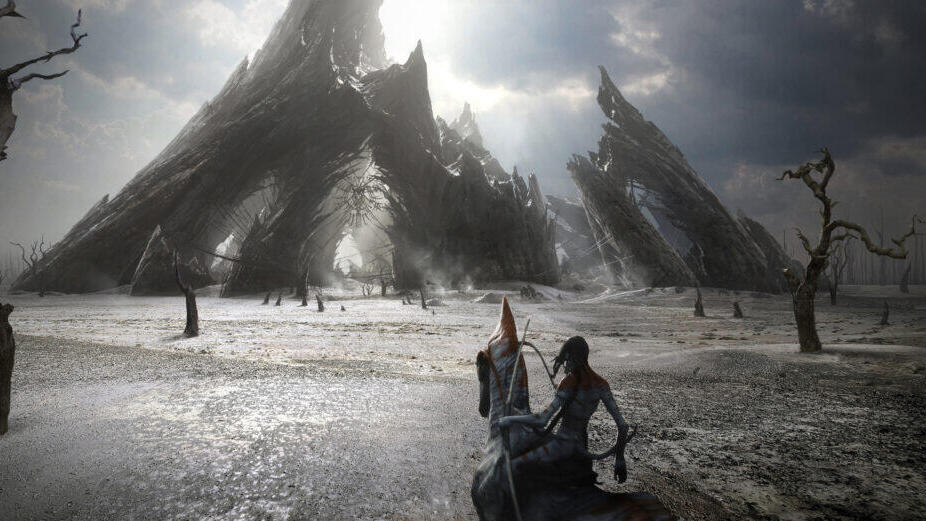
From 'Avatar: Fire and Ash'
(Photo: Courtesy of Forum Film)
From my narrow perspective, Avatar 3 is marginally better than Avatar 2, perhaps thanks to moments of inspired direction and Cameron’s evident love for Pandora, a world he has inhabited creatively for nearly two decades. At the same time, Pandora has become the great tragedy of Cameron’s career — and perhaps of Hollywood itself. A filmmaker once synonymous with innovation is telling the same story for the third time and refusing to let go.
Let go, James. Let us go, and above all, let yourself go. You are 71 and already hard at work on Avatar 4 and Avatar 5, slated for release in 2029 and 2035. We deserve new experiences from you.