


If you’ve ever felt that strength training demands more time, energy and commitment than your schedule allows, new research offers reassuring news: you may not need hours in the gym to see meaningful health benefits.
A large long-term study published in the British Journal of Sports Medicine suggests that 90 to 120 minutes of resistance training per week may represent the optimal range for improving long-term health outcomes.
Gallery

strength training was associated with a lower risk of all-cause mortality
(Photo: Shutterstock)
The study, which followed more than 147,000 participants, found that strength training was associated with a lower risk of all-cause mortality, particularly when combined with aerobic exercise. However, researchers also found that beyond 120 minutes of strength training per week, no additional reduction in risk was observed.
“This is a remarkable study,” says Dr. Nitzan Anav, head of longevity at Maccabi Healthcare Services. “What it provides us with, perhaps for the first time, is what Americans call a ‘sweet spot’: the precise balance point for strength training per week that delivers maximum health benefit and protection in minimal time.
"Ultimately, that is what we all want to know: where the optimal cost-benefit point lies. The key message is that more is not always better. At a certain stage, we understand that doing more strength training does not necessarily help further reduce mortality risk."
Study design and methods
The health benefits of aerobic activity have been well established for years: brisk walking, running, swimming, cycling and similar exercises have been linked in numerous studies to improved cardiovascular health, reduced risk of chronic disease, and increased longevity.
By contrast, the impact of strength training, including weight training, bodyweight exercises such as push-ups, squats and lunges, on overall mortality and specific causes of death has been less clearly defined.
To investigate this relationship, researchers analyzed data from three large U.S. cohort studies in which healthcare professionals were followed for up to 30 years, with repeated assessments of their physical activity habits, lifestyle factors, and health status. In total, the analysis included 147,374 participants (31,540 men and 115,834 women) with a median age of 54 at baseline.
“From a methodological standpoint, this is a prospective cohort study, an observational design,” said Dr. Anav. “Its main strengths are both the scale and the duration. The researchers followed participants for an exceptionally long period of up to 30 years and collected data using questionnaires completed every two to four years. This reduces measurement error and allows for a better understanding of long-term behavioral patterns. We are not talking about a one-off survey, but about repeated assessments of activity patterns over a substantial period.”

The researchers followed participants for an exceptionally long period of up to 30 years
(Photo: Shutterstock)
Based on these data, the researchers examined participants’ physical activity patterns over time, both strength training and aerobic exercise. Nearly half of the participants (46%) reported engaging in some form of resistance training. At the same time, about three-quarters (74%) reported performing more than 150 minutes of moderate aerobic activity per week, the widely recommended guideline for weekly physical activity.
During the follow-up period, 35,798 participants died. After adjusting for additional factors that could influence the results, the researchers found that long-term strength training was associated with a lower risk of mortality.
They also observed that participants who reported higher levels of strength training tended to have lower body weight, healthier lifestyles, and higher levels of aerobic activity compared to those who did not engage in any strength training.
Surprising findings
The most striking result emerged when researchers examined weekly strength training volume: participants who trained for 90 to 119 minutes per week had the lowest risk of mortality. In this group, there was a 13% reduction in all-cause mortality, a 19% lower risk of cardiovascular death, and a 27% lower risk of death from neurological diseases.
“In this study, that appears to be the 'sweet spot',” said Dr. Anav. “Above 120 minutes per week, no additional health benefits were observed in reducing these mortality risks.” He added that this is one of the study’s key contributions: it is not only about whether to do strength training, but how much time to devote to it.
“Until now, much of the research and most recommendations have focused on frequency, for example, how many times per week one should train. This study refines that question by focusing on total weekly volume: how many minutes are needed to reach peak benefit, and where the curve begins to level off.”

Dr. Nitzan Anav
(Photo: Ofer Hajayov)
Alongside the overall findings, Dr. Anav notes that the neurological data were among the most striking in the study. “A 27% reduction in risk of death from neurological diseases is a significant finding,” he said. “This is one of the most comprehensive studies to clearly demonstrate an association between resistance training and lower mortality from conditions such as dementia.”
In addition, the study reinforced a message long emphasized by fitness and health experts: the key question is not only how many minutes are spent on weight training, but also whether it is combined with aerobic activity that engages the heart and lungs, such as brisk walking, running, swimming or cycling.
A particularly large reduction in mortality risk was observed among participants who accumulated high levels of aerobic exercise while also performing 60 to 119 minutes of strength training per week. In this group, there was a 45% lower risk of death, compared with the most sedentary participants (those who did no strength training and failed to meet minimum levels of aerobic activity).
“Importantly, we do want aerobic activity alongside strength training,” said Dr. Anav. “The combination produces a synergistic effect. In other words, strength training is very important, but it does not replace cardio. The practical recommendation is to continue accumulating aerobic activity throughout the week, such as brisk walking, running, swimming or studio classes, while also incorporating resistance training.”

It is important to accumulate aerobic activity throughout the week
(Photo: Shutterstock)
When it comes to cancer-related mortality, the picture was somewhat different. Benefits were observed at lower volumes of strength training: participants who performed up to 29 minutes per week had a 21% lower risk of death from exercise-responsive cancers (such as breast and colon cancer), while those performing 30 to 59 minutes per week had an 18% lower risk.
According to Dr. Anav, this is one of the more complex findings in the study. “One hypothesis raised by the researchers is that prolonged strength training may increase levels of the growth factor IGF-1, which has been linked in some studies to certain types of tumors in older age,” he said. “But it is important to stress that this is only a hypothesis. There is some clinical plausibility, but at this stage nothing can be concluded beyond that.”
However, despite the strong findings, Dr. Anav emphasizes that they should be interpreted with caution. “The study shows an association, but it does not prove causation,” he said. “It is possible that what we are seeing is the so-called ‘healthy user bias.’ People who have the time and capacity to exercise may also have better genetics or a generally healthier lifestyle, and the study cannot fully account for that. In addition, the data are based on self-reported questionnaires. These are not wearable devices or smart trackers, so there is always potential for reporting bias.”
Another limitation, he noted, relates to the fact that the study measured total exercise duration rather than how the training was actually performed. “There is no information on intensity,” Dr. Anav explained. “It does not specify whether participants lifted heavy weights to failure, how many sets they completed, or how much rest they took between sets. These are factors that can be highly significant when trying to understand what exactly within strength training produced the observed benefits.”
He also noted that it is important to consider who participated in the study and when it was conducted. “Most of the participants were healthcare professionals in the United States, so this may not be a population that fully represents the general public,” said Dr. Anav. “In addition, the participants were relatively older — the median age at baseline was 54 — so caution is needed when generalizing the findings to younger or more diverse populations. The study also began 30 years ago, meaning it focused more on exercise patterns common at the time, mainly traditional gym-based training, and did not examine modern trends such as Pilates, CrossFit, yoga or calisthenics.”
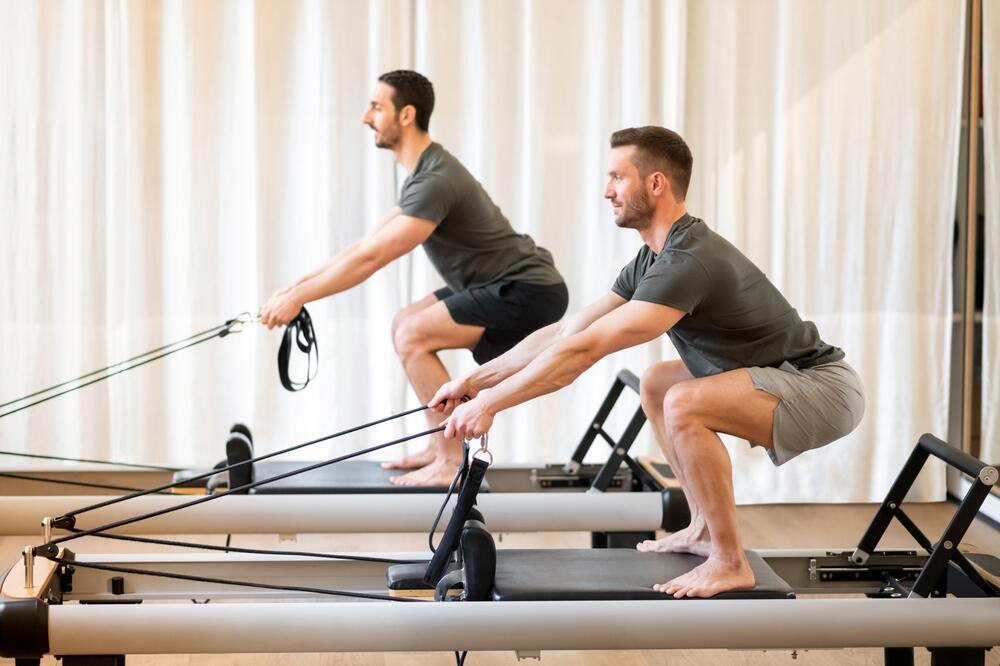
The study did not examine modern forms of training. Pilates reformer
(Photo: Shutterstock)
The practical takeaway, therefore, is relatively straightforward: there is no need to become a bodybuilder or spend hours in the gym. Two to three short strength-training sessions per week, alongside regular aerobic exercise, may be a meaningful combination for long-term health.
“The major takeaway is that a mental barrier can be removed,” Dr. Anav agrees. “Many people avoid strength training because they believe it requires long, exhausting hours in the gym, but this study shows that as little as one and a half to two focused hours of resistance training per week can deliver most of the health benefits.”
If translated into a practical recommendation, he said, it could start with two strength-training sessions per week of 45 to 50 minutes each. “The focus should be on exercises that engage large, compound muscle groups: squats, lunges, push-ups and resistance-band work,” he said. “And alongside that, it’s important not to neglect cardio.”
In conclusion, Dr. Anav says the real value of the study lies in its ability to translate data into a recommendation people can realistically follow. “Longevity, or healthy aging, is not the result of extremes,” he summarized. “It is about consistency and getting the dosage right. In the end, our muscles protect our health. Take care of them, and they will take care of you.”