

In the 1980s, when Israel still had no dedicated environmental studies programs and the concept of “sustainability” was not yet part of public discourse, Prof. Eran Feitelson began his path as a young geography student at the Hebrew University of Jerusalem. What started as an interest in planning, space and environment developed over more than four decades into a career that bridged academic research, public service and real influence on how Israel plans its future.
Over the years, he was among those who helped establish environmental studies in Israel and later took part in founding the School of Environmental Studies at the Hebrew University. Alongside his academic work, he held positions in public institutions and was involved in shaping policy and national-level planning processes. This year, at the 54th Conference of the Israel Society of Ecology and Environmental Sciences, to be held on July 8–9 at Binyanei HaUma in Jerusalem, Feitelson will receive a lifetime achievement award from the Israel Society for Ecology and Environmental Sciences in recognition of his long-standing contribution to environmental and planning discourse in Israel.
Gallery

Prof. Eran Feitelson began his path as a young geography student at the Hebrew University of Jerusalem
(Photo: Courtesy of the photographer)
Behind Feitelson’s public activity stands an extensive academic career at the Hebrew University, during which he worked across a wide range of fields including environmental policy, water management, land-use planning, transportation and earthquake preparedness. His work has combined theoretical research with practical engagement in planning and environmental issues that directly affect the Israeli landscape. In parallel, he has worked on water resource management and regional cooperation, including Israeli–Palestinian research on cross-border water resources.
Over his career, he has published more than 100 articles in scientific journals, supervised many graduate students and played a role in training researchers and professionals in environmental and planning fields. Alongside his academic work, he also participated in shaping several major planning initiatives in Israel, including leading the environmental team within the “Israel 2020” master plan, considered one of the first attempts to integrate sustainability principles into local planning discourse
When integrating environmental considerations into planning was seen as revolutionary

Prof. Feitelson was among the professionals who brought environmental thinking into Israel’s planning system
(Photo: Courtesy of the photographer)
As early as the early 1990s, Prof. Feitelson was among the professionals who brought environmental thinking into Israel’s planning system. As part of work on National Outline Plan 31, designed to address the major wave of immigration from the former Soviet Union, he was responsible for the environmental aspects of the plan at a time when issues such as nature, open spaces and environmental infrastructure were not typically seen as central to planning processes.
“Because of the emergency situation of the massive immigration, a window of opportunity opened that allowed ideas to be introduced that otherwise would not have passed,” he recalls. He says that in those years, the very demand to include environmental considerations in national planning was seen as unusual and even revolutionary. “In the 1980s you had to fight to make environmental issues part of the discussion,” he says, adding: “Today it is an inherent part of the planning process.”
Feitelson emphasizes that in National Outline Plan 31, the environment was not treated as a marginal addition or another clause in planning reports, but as an objective in its own right. “The environmental issue was not included only as one of the criteria, but as an objective and a goal in itself. Thanks to this approach we strengthened nature protection and integrated environmental improvements through the plan.” According to him, the plan marked a turning point in Israel’s planning system, shifting from a perception in which the environment was an external advisory opinion to one in which it became an integral part of decision-making. “National Outline Plan 31 completely changed the norm,” he says. “The environmental issue went from an external opinion to an integral part of decision-making. Today it is obvious that environmental planners are part of planning teams. That did not exist before.” In 2015, he received the “Honored Planner” award from the Association of Planners in Israel for his contribution.
Beyond research and planning, Feitelson was also one of the central figures in shaping environmental studies in Israel. He helped establish academic programs in environmental studies, planning and public policy, and in 2016 was among the founders of the advanced School of Environmental Studies at the Hebrew University of Jerusalem. He says the idea behind these programs was the understanding that environmental problems cannot be solved from within a single discipline, but require cooperation between fields of knowledge.
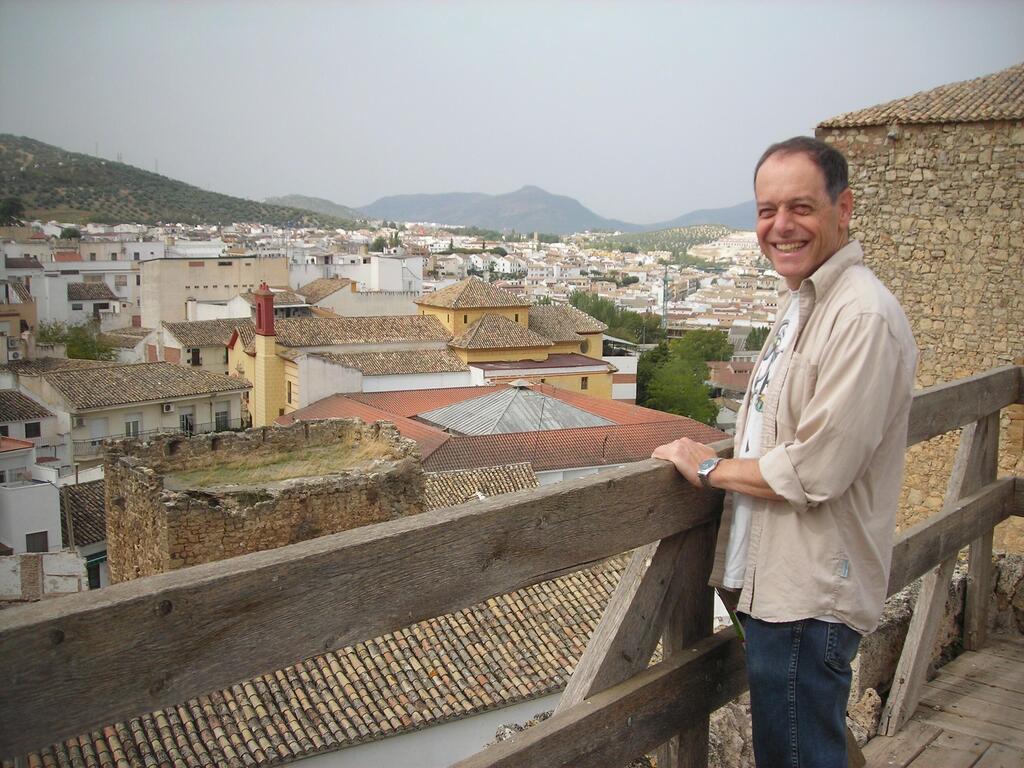
Feitelson continues to work on one of the most pressing issues of the era
(Photo: Courtesy of the photographer)
“In the field of the environment you need to be a broadly trained expert, understand other disciplines and know how to work with them,” he says. This multidisciplinary approach was relatively unusual in Israeli academia at the time, but over the years it has become a significant part of how environmental professionals and planners are trained in Israel. “Forty years ago there was a tiny group of people working on the environment. Today it is a whole professional community,” he says.
The next goal: mapping Israel’s vulnerability to climate change
Even today, after decades of research, teaching and public activity, Feitelson continues to work on one of the most pressing issues of the era. In the past two years, he has served as chair of the steering committee for mapping vulnerability to climate change on behalf of the Israel Academy of Sciences and Humanities, a project aimed at identifying the risks and expected impacts of the climate crisis in Israel.
“There are areas in which Israel is well prepared for the climate crisis, and areas in which we are still very unprepared,” he says. According to him, the goal of the mapping is not only to identify risks but also to understand where immediate action is needed by the state and local authorities. “The purpose of vulnerability mapping is to identify where we are still not prepared in order to guide action.”
Even today, decades after he began working in the field, Feitelson continues to try to influence how Israel prepares for the future in an era of climate crisis.
Discover groundbreaking research at the 54th Annual Conference on Science and Environment, to be held at Binyanei HaUma in Jerusalem on July 8–9.