

The Red Sea city of Eilat and large parts of the Negev and Arava began reopening roads Sunday after a rare and intense winter storm brought heavy rains, flooding and widespread closures that left the resort city effectively cut off for hours.
Eilat Mayor Eli Lankri told Ynet that the city had experienced “a stormy weather weekend, with rainfall amounts the city has never known,” describing an exceptional system that swept across southern Israel on Saturday. Floodwaters nearly filled the Nekarot reservoir near Ein Yahav in the central Arava, which had remained dry for more than a year due to consecutive drought winters.
Flowing floodwaters from Nahal Paran over Highway 40
(Video: Israel Police)


Police said major routes were gradually being reopened after Saturday's shutdowns. Highway 90 was cleared for travel between the Arava junction and Neve Zohar, and Highway 12 was also reopened. However, Highway 40 between Tzihor Junction and Mitzpe Ramon, and Highway 13 between Menuha Junction and Tzihor, remained closed until further notice.
Lankri said past storms had hit the region, “even more extreme ones,” but described this one as highly unusual. “When you get a year’s worth of rain in three hours, it’s extremely rare. More than 10 millimeters fell in Eilat,” he said. “The city was besieged; all entrances and exits were closed. Highway 90 only opened at 2 a.m.”
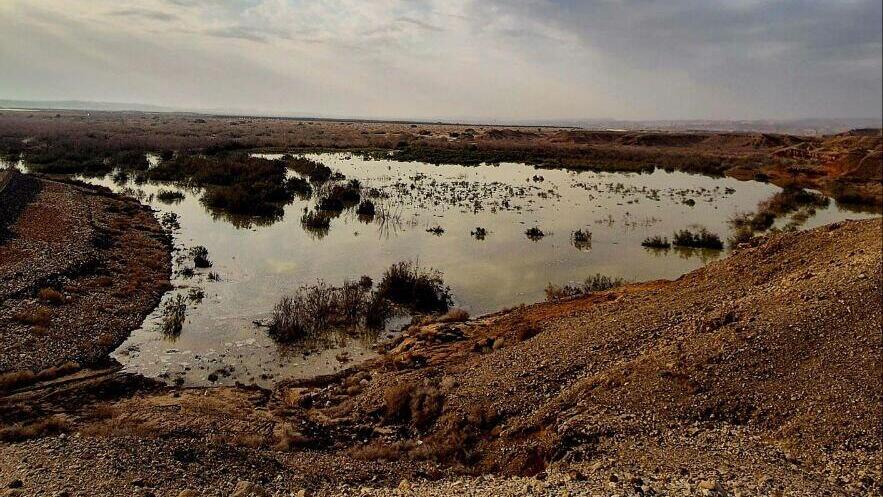
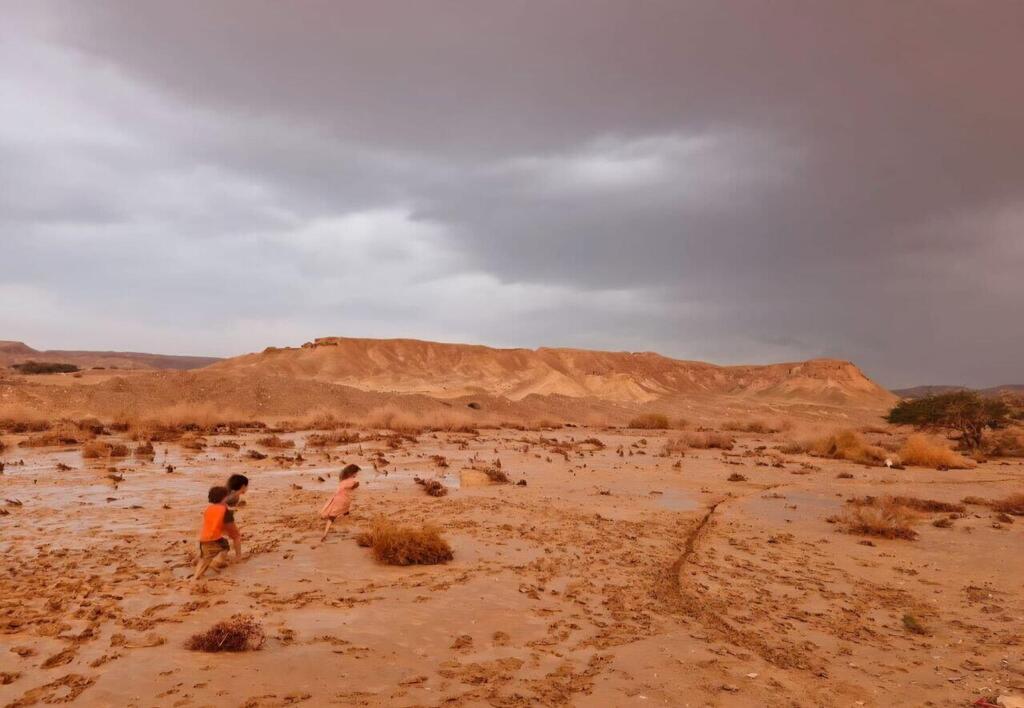
Flash flood in Nekarot Stream
(Photo: Noga Gibori)
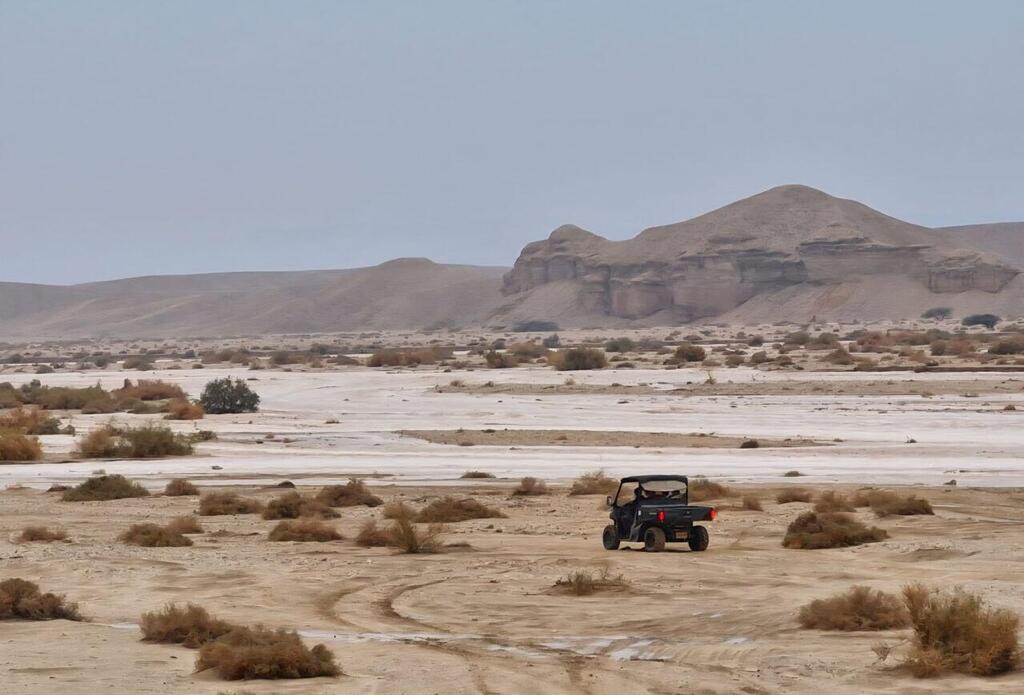
(Photo: Noga Gibori)
Despite concerns about travel safety on flood-prone Highway 90, Lankri said reaching Eilat is secure. “There is really nothing to fear. Since the last disaster— and it was severe—lessons have been learned. Changes were made, including new barriers. Even now, you can come and see that the city is clean and orderly.”
He said the road to Ramon Airport had also been blocked during the storm, complicating air travel. “Yes, there is a major challenge with flights, and we’re working on it. Funds have been allocated in the 2026 budget to resolve aviation access issues,” he said.
Rainfall exceeding much of the annual average within hours
Eilat was effectively cut off for nine hours on Saturday after all access roads were closed from early afternoon. The city recorded 10 millimeters of rain (0.39 inches), causing flooding, and the only exit was toward Ramon Airport. Only after 11 p.m. did police announce that Highway 90 had reopened to traffic, except for a section near the Arava Junction, which was later also cleared.
Flash floods across southern Israel
(Video: Eilot Regional Council, Hai Zumberg, Shahar Zumberg, Eitan Getz, Noga Gibori, Noa Gordon, Hagar Ohayon)
Rain fell across the country on Saturday, but the south saw an exceptionally rare weather event. According to the Meteorological Service, the Arava registered the highest totals: Kibbutz Samar (36 mm / 1.4 in), Hai-Bar Yotvata (35 mm / 1.38 in), Ketura (27 mm / 1.06 in) and Lotan (26 mm / 1.02 in) — each receiving, within a few hours, more rain than their full annual average.
Dozens of southern streams flowed Saturday, from the Eilat mountains to the southern Dead Sea. Unusual floodwaters were recorded in the Hiyyon and Nekarot streams. In the southern Arava, flash floods caused damage, including to infrastructure and communications systems at the Israeli Air Force’s Uvda base. The IDF said operational readiness was not affected, and that commanders were surveying damage to ensure a rapid and safe response to malfunctions.
The flooding in Eilat on Saturday
(Video: Israel Police, Amit Schwartz)
Around 2 p.m., Highway 90 was closed, and only shortly before midnight did police confirm that the route from Eilat to the Arava Junction had reopened — ending the city’s isolation. Highways 12 and 40, which were shut even earlier, remained closed to traffic.
Fire and Rescue Services reported that in addition to rescuing residents from stalled elevators in Eilat, firefighters evacuated a driver caught in flooding on Highway 90; two people whose car was swept off the road and stranded on rocks between Yotvata and Grofit; and three others trapped north of Be’er Ora after an ATV overturned in floodwater.
The rush of people leaving Eilat
According to Ori Lev, security officer for the Central Arava Regional Council and commander of the Arava Rescue Unit, eight adults and nine children — including infants — were rescued last night from flooding in the Nekarot stream. They had arrived in private vehicles when the weather was still sunny, but became trapped with no way out. A police helicopter located the cars deep in the desert, but the group had to wait five hours for water levels to drop before being extracted by police vehicles and rescue teams.
Rain did not fall only in the south. Karnei Shomron saw 21 mm (0.83 in), the Sea of Galilee region recorded double-digit amounts, and in Nof HaGalil heavy hail forced the cancellation of the Premier League match between Bnei Rayna and Sakhnin.
The full forecast
Temperatures will drop significantly throughout the day, returning to seasonal norms. From midday, strong winds are expected along the coastal plain, and overnight local showers may develop with isolated thunderstorms, mainly in the northern coast.
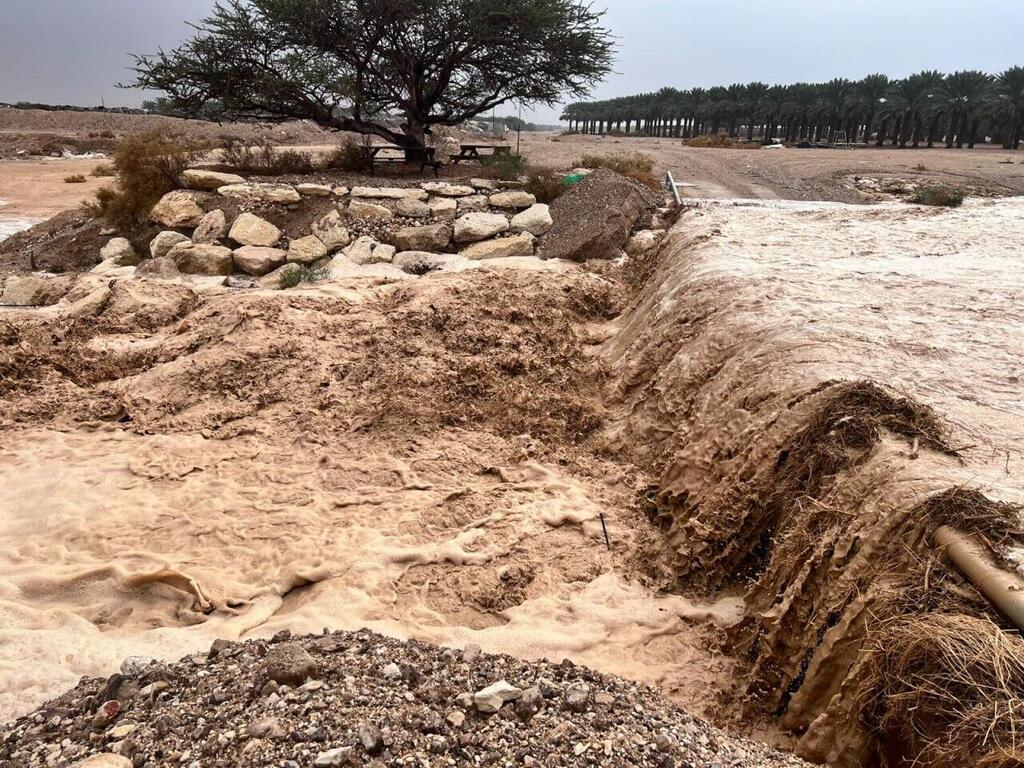
Omer Stream in the central Arava roaring with floodwaters
(Photo: Ofri Lev)
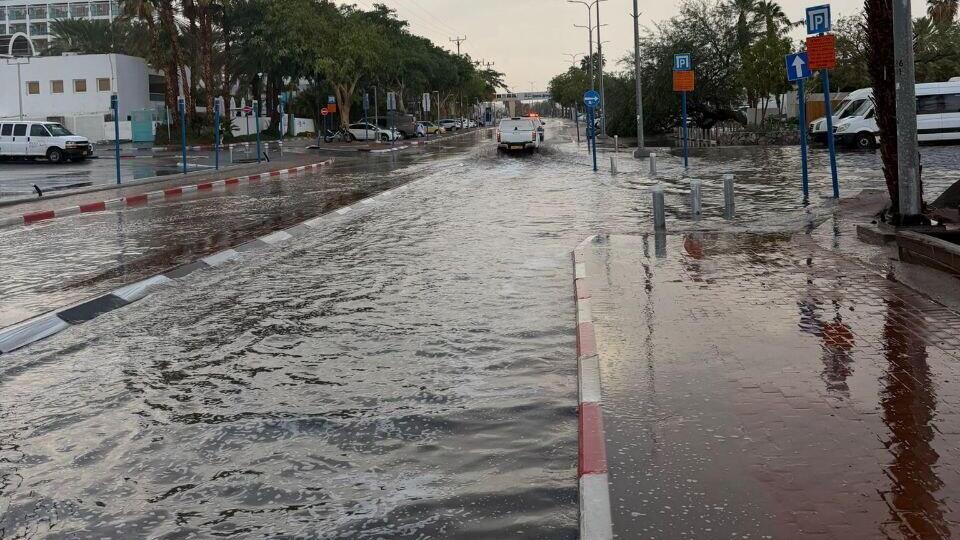
Flooding in Eilat
(Photo: Eilat municipality)
On Monday, local showers and isolated thunderstorms are possible, especially along the northern coast. On Tuesday, local rain and thunderstorms are expected, with partly cloudy to overcast skies. Local showers may develop in the central highlands by midday. Temperatures will remain largely unchanged.
On Wednesday, temperatures will dip slightly, and by early afternoon intermittent rain — accompanied by thunderstorms — is expected mainly in northern and central Israel. Flooding is possible in low-lying areas, especially in central and southern coastal cities and in the Shephelah.
Forecast temperatures (°C / °F):
Jerusalem 8–17°C (46–63°F), Tel Aviv 14–21°C (57–70°F), Haifa 15–19°C (59–66°F), Safed 9–15°C (48–59°F), Katzrin 10–19°C (50–66°F), Tiberias 13–22°C (55–72°F), Nazareth 12–18°C (54–64°F), Afula 12–21°C (54–70°F), Beit She’an 14–23°C (57–73°F), Lod 14–21°C (57–70°F), Ashdod 14–20°C (57–68°F), Ein Gedi 14–21°C (57–70°F), Be’er Sheva 10–19°C (50–66°F), Mitzpe Ramon 9–15°C (48–59°F), Eilat 16–22°C (61–72°F).