


Karma, a two-year-old Labrador, was walking calmly on Beit Yanai Beach with her owner, Nadav Reich from Mikhmoret. When they returned to the car after their routine walk, Reich, a trained marine biologist, suddenly noticed that Karma would not stop vomiting.
“She looked exhausted and in bad condition,” Reich recalled. “I immediately took her to the veterinarian Dr. Dotan Miden in Beit Herut. I thought she had drunk seawater or was dehydrated or swallowed a hook. The real reason did not even cross my mind.”
Gallery
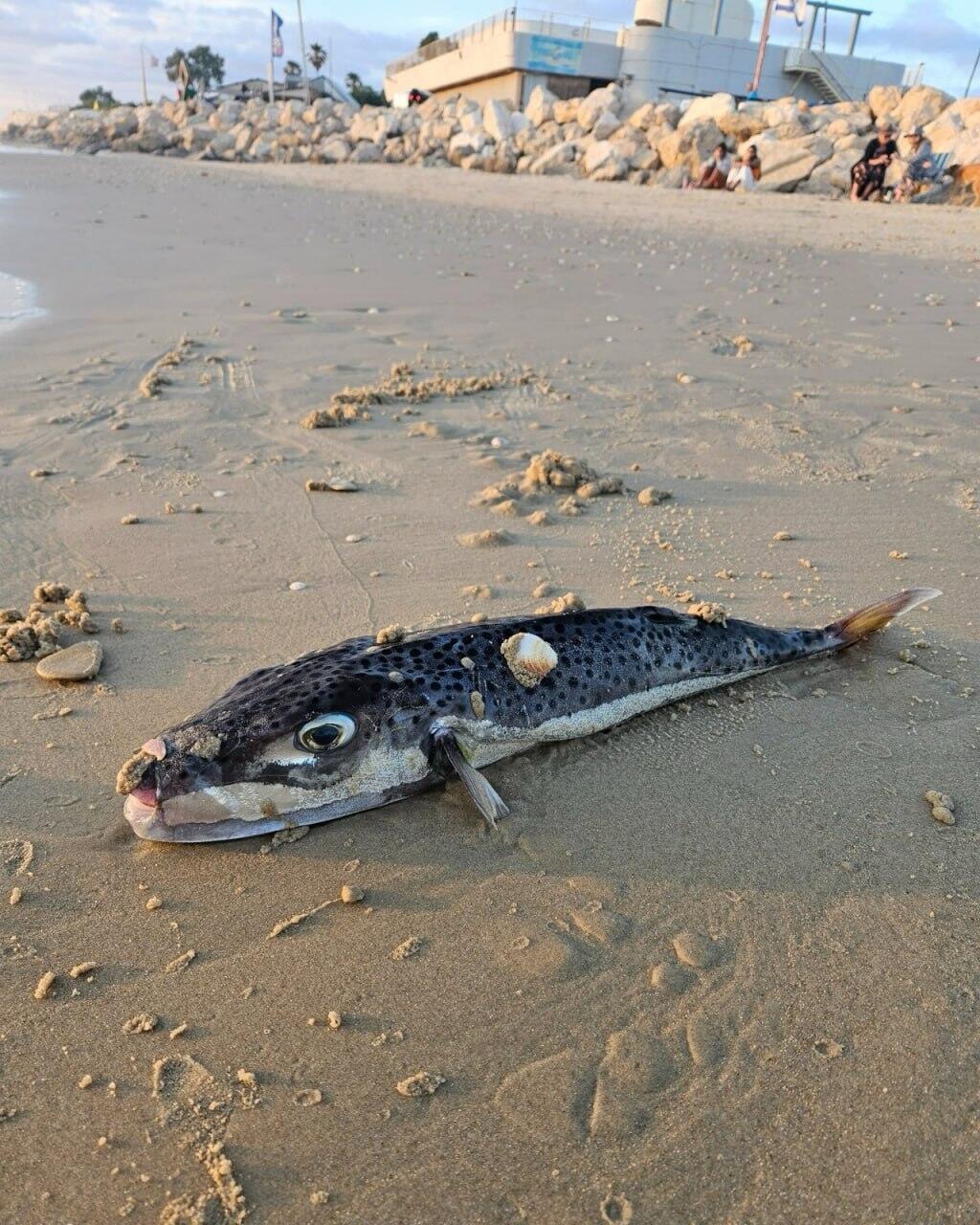
The Abu-Nafha fish (Lagocephalus sceleratus) along the shore
(Photo: From the Facebook page of the Morris Kahn Marine Research Station)
At the clinic, Karma’s condition rapidly worsened and she continued vomiting without stop. “She could barely walk, was disoriented and began showing symptoms of neurological damage,” Reich said. At that point poisoning was suspected. “The vet immediately sent us to the Carmel-Yam veterinary hospital in Meir Shfeya. During the drive Karma was already struggling to breathe and eventually lost consciousness.”
Karma was sedated and placed on a ventilator. According to veterinarians, she arrived in time and survived poisoning caused by the Abu-Nafha fish (Lagocephalus sceleratus). “There were many dead pufferfish along the shore during our walk,” he said. “Karma probably licked or ate one and was poisoned. Thankfully she got through the night and within 48 hours she began to recover and came home. Our story had a happy ending but it should serve as a warning.”
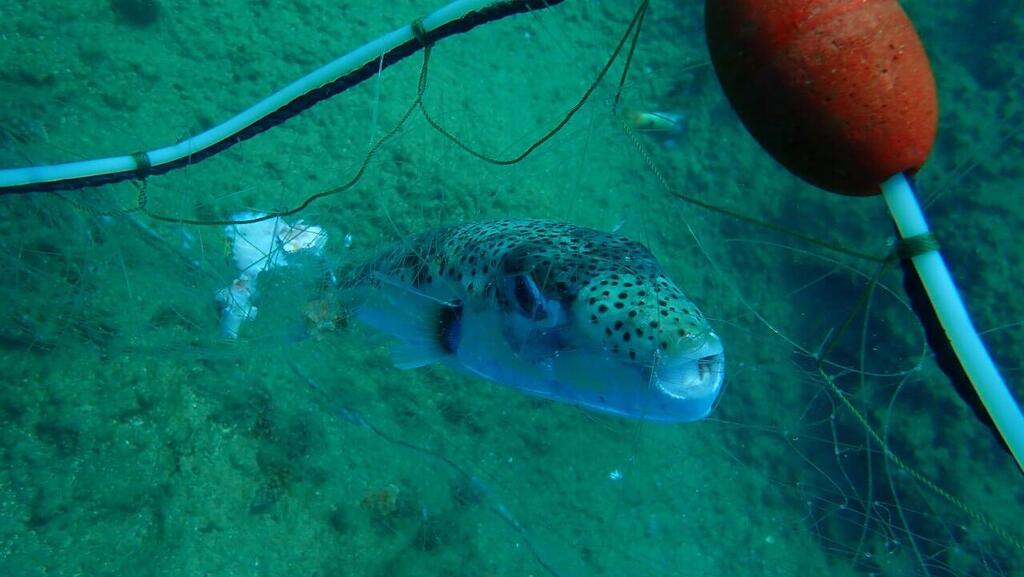
'These fish are not prohibited to catch but they are not attractive for consumption so fishermen simply leave them on the sand'
(Photo: Shai Kabasa, Israel Nature and Parks Authority)
The Abu-Nafha, which reached the Mediterranean through the Suez Canal, is spreading rapidly along Israel’s coastline and is being caught in fishing nets. “There is a phenomenon where fishermen come to the beach, catch rabbitfish or pufferfish,” the Nature and Parks Authority said. “These fish are not prohibited to catch but they are not attractive for consumption so fishermen simply leave them on the sand. It often happens that a child or a dog touches them and gets stung. Not only jellyfish sting, but also venomous fish.”
According to the Nature and Parks Authority, three incidents were reported last week in which children on beaches found a fish from the scorpionfish family known as rabbitfish, picked it up and were stung by its venomous spines. In addition, a surfer was stung in the water by a lionfish and several dogs that came into contact with the Abu-Nafha were harmed.
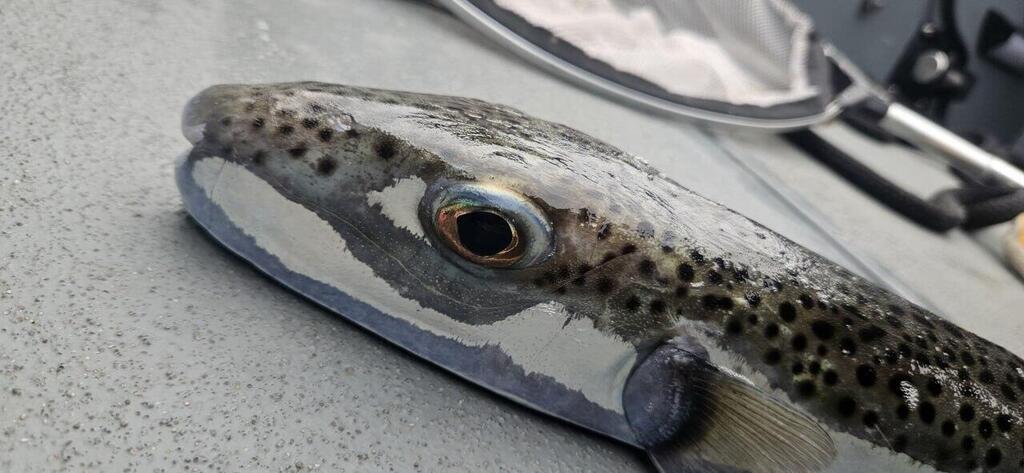
'Do not touch it, do not collect it and certainly do not eat it'
(Photo: Shai Kabasa, Israel Nature and Parks Authority)
At the Carmel-Yam veterinary hospital, doctors warned that the Abu-Nafha contains a powerful neurotoxin called tetrodotoxin, which disrupts the transmission of signals between nerves and muscles. “At the beginning of poisoning you may see vomiting, weakness and muscle tremors but in severe cases the toxin progresses quickly and can cause paralysis of the respiratory muscles and immediate life-threatening danger,” they said. About two weeks ago they treated a dog named Mikey who was hospitalized in intensive care and survived thanks to rapid diagnosis after eating a small amount of the fish on the beach.
The authority is asking fishermen to ensure they do not leave fish on the shoreline where curious hands may come into contact with them. “If you caught a fish that is prohibited for fishing or you do not want it for any reason, it should be thrown back into the water if still alive or into a trash bin if dead,” they warned.

Karma, a two-year-old Labrador
(Photo: Nadav Reich)
The Abu-Nafha is an invasive species in the Mediterranean, similar to the lionfish, and both are considered apex predators. In Greece, efforts are underway to deal with the invasive fish and the Ministry of Agriculture is considering support programs for local fishermen. Scientists are also trying to find ways to neutralize the fish’s deadly toxin, which can also lead to death. Dr. Danny Morik, head of marine pathology at the Morris Kahn Marine Research Station, warns that the toxin is not destroyed by cooking and can be fatal. “Do not touch it, do not collect it and certainly do not eat it,” he urged.
And if you feel that pufferfish have become more common than jellyfish, you may not be wrong. According to the “Meduzot BaAm” - citizen science project and app monitoring swarms of jellyfish through user reports - jellyfish have been reported in the Bat Yam, Ashdod, Netanya, Dor-Habonim and Haifa areas and appear relatively scattered. The Nature and Parks Authority supports this impression. According to Dr. Gur Mizrahi, a researcher at the University of Haifa School of Marine Sciences, jellyfish depend on weather conditions. “When the sea rises it disperses them. It depends on the season and summer conditions that allow blooms. This year we are seeing fewer. It does not mean much because it is cyclical. Like any primitive population it rises and then falls. There is definitely change but it is impossible to know what is really affecting them.”