

Senior officials from Israel’s Prison Service recently visited the Hamat Gader site to learn about raising crocodiles in captivity, a field few in Israel are familiar with, as part of a preliminary examination of the idea of building a prison surrounded by crocodiles.
Yosi Mousanejad, CEO of Hamat Gader, told ynet that the inquiry was formal and focused on learning and understanding the subject, rather than on direct involvement in security or prison operations.
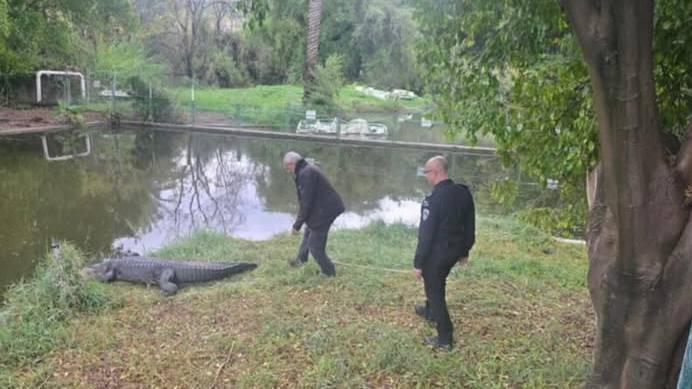
“Hamat Gader, as everyone knows, is a tourism site with thermo-mineral baths and a crocodile farm that has existed for more than 40 years, with unmatched knowledge and experience in Israel,” Mousanejad said. “We received a request from Prison Service representatives to come and learn. They mainly came to see, hear and understand — keeping a crocodile in captivity is no simple matter. It’s not a poodle.”
According to Mousanejad, the issue is complex and requires professional expertise. “There are many implications: what crocodiles eat, how much they eat per day, the fact that crocodiles are less active in winter, the specific water height, width and depth they need, fencing requirements — all of these came up in the discussion,” he said.
He added that Prison Service officials asked about food consumption, feeding methods and differences between crocodile species. “Each crocodile, each species, eats different food at different times. No one has yet invented a bowl where you put food and the crocodile comes with a knife and fork,” he said. “Even the method of feeding is important. They noted additional points to examine and, at this stage, they are conducting internal staff work to assess the feasibility of the idea.”
Asked about the cost of maintaining crocodiles for possible use in a security facility, Mousanejad estimated that keeping 60 crocodiles would cost several thousand shekels a week, in addition to the cost of handlers, a security setup, water treatment, pumps and electricity. “It’s not a simple operation to keep 60 crocodiles in captivity,” he said, stressing that Hamat Gader was not asked to prepare a full cost estimate and is not involved in security decisions.
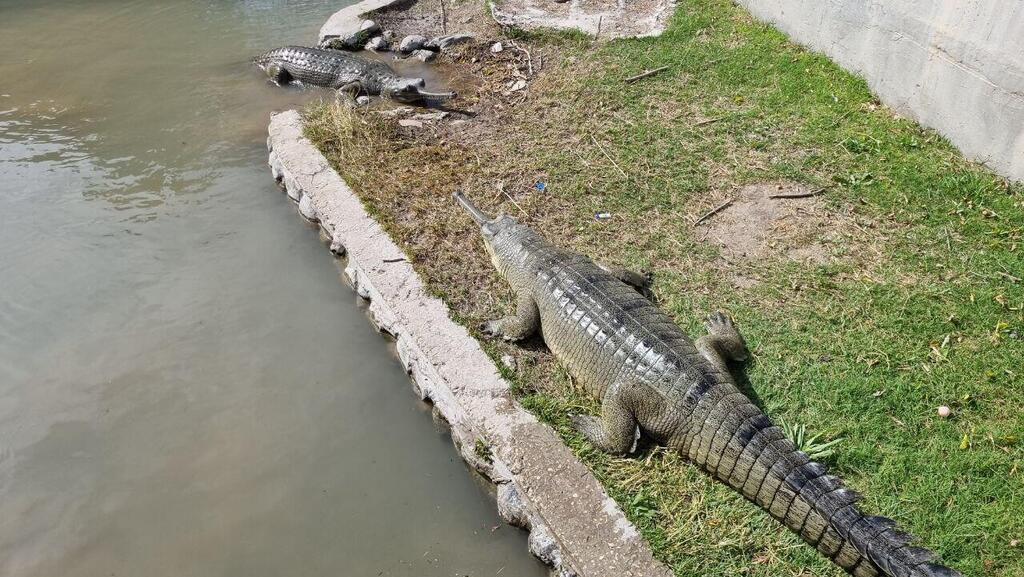
Crocodiles in Hamat Gader
(Photo: Assaf Kamar)
On the risks involved, Mousanejad was unequivocal. “A crocodile is a very dangerous animal. There are many documented cases around the world of encounters between humans and crocodiles that end badly for the person,” he said. “How a crocodile will react if someone enters its territory depends on many factors — the weather, whether it ate the day before and more. I would not enter a crocodile enclosure even after they’ve eaten and at the height of winter.”
Mousanejad also addressed animal welfare considerations. “Crocodiles are adaptable animals and can live in a wide range of regions and climates. Almost anywhere in Israel, crocodiles could be raised in captivity if basic conditions are met — a constant water supply, properly designed pools and food,” he said. “But this is a wild animal and a dangerous predator that must be raised in a specific way. You can’t just buy a plastic pool and put it on the side.”
According to sources familiar with the matter, National Security Minister Itamar Ben-Gvir instructed senior Prison Service officials to examine the feasibility of the idea, inspired by models in the United States where natural obstacles are used as part of prison security systems. At this stage, the examination is purely conceptual.