

Unusual footage of a black desert cobra, the Israeli cobra, in the Judean Desert has drawn significant interest online in recent days, alongside debate over the conduct of the photographer, who filmed the snake from close range.
Shlomo Horovitz of Nokdim, owner of the exotic animal farm “Shlomo’s Animals,” spoke to the ynet studio about the encounter with the venomous snake and stressed that it was important to document it in order to explain that Israel also has black snakes that are venomous.
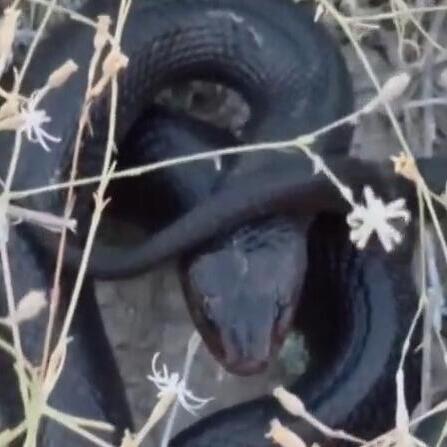
Horovitz described the encounter: “It was in the Judean Desert. I really, really love hiking in the Judean Desert, and I also run there a lot. It’s close to my home. I’m always looking for things, my eyes are always searching. I’m basically a nature person, an outdoorsman, and when I’m out I’m always looking for interesting things. This really is rare documentation, because these snakes are usually active only at night, and even when they are active at night, the chances of encountering them are not high.”
He described the Israeli cobra. “It is a snake that belongs to the cobra family. A lot of people don’t know that. Now, when we imagine a cobra, we basically imagine a snake that rises up and spreads its neck wide to frighten the attacker facing it. That is also what it does before it bites. Now, you have to understand that the black desert cobra is completely a cobra — it belongs to the cobra family — but it almost never spreads its neck like the cobra we know. And even if it does, it does so very, very subtly. So most people who see such a snake would not identify it as a cobra at all, but scientifically it is absolutely a cobra, and it is the only cobra in Israel,” he explained.
Horowitz said he has previously captured black desert cobras in people's homes. “I encountered them in the shower area. Why in the shower area? Because this is a snake that likes to eat toads," he said. "Now, that raises the question of what a snake that eats toads is doing in the desert. So you have to understand that a toad lives in water and on land, and there are also toads in the desert — they simply reproduce in water. The black desert cobra really likes eating toads, though again, that is not its only food.”
He stressed that anyone who encounters a snake should call a snake catcher.
“You have to understand that the black desert cobra, again, is venomous, it is dangerous, but it does not reach the level of the Palestine viper, the black viper or the saw-scaled viper. But it is definitely a venomous and dangerous snake," he said. "People should not think from this video that they can go and pick it up or catch it. I, by the way, when I filmed it and it jumped toward the camera and tried to bite me — you have to understand that this was a foolish act. In other words, I don’t want people to learn from that.”
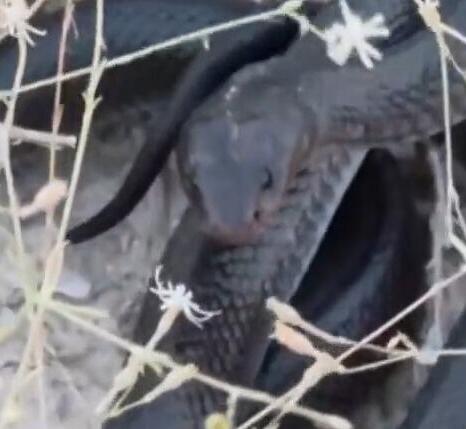
The black cobra filmed by Shlomo Horovitz
(Photo: Shlomo Horovitz)
Horovitz also addressed the criticism directed at him. “I’ll tell you, this is not something I would recommend anyone do, absolutely not. With my familiarity with reptiles, I know exactly the distances I can approach without endangering myself. Sometimes, as far as the snake is concerned, that is already enough — I am close enough for it to lunge and try to bite, but I know the distances and I know the distance does not endanger me. And as for those who say I provoked it — what can we do, that is the world today. Today everyone likes to make comments. In the end, I did not approach it, I did not even touch it with a stick,” he said.
“All I did was get closer and film,” he said. “And by the way, I think the benefit is much greater than the harm. That is, the fact that I document a black or rare snake and explain that even when it is black it is venomous, and even when it is black it can be dangerous, and that it is even a kind of cobra — I think the benefit of that information is much broader than the fact that maybe I put it under a little stress and took it out of its comfort zone when I approached it with the camera. I also, God forbid, did not kill it, God forbid, did not bother it with sticks and the like. I only filmed it, and it is fine that the snake reacted that way — it showed me it has boundaries, it showed me it does not want anyone getting close to it, which is excellent. And on this occasion, I want to remind everyone that all reptiles in Israel are protected wildlife, including venomous snakes, and under the law it is forbidden to kill them.”
In most situations the black desert cobra will simply prefer to flee and avoid confrontation from the outset, before one even encounters it. Add to that the fact that it is found only in the Negev, the Arava, the Dead Sea Valley and the eastern Jerusalem hills, and you get a snake that is very difficult to get bitten by. Its venom is considered less dangerous than that of the Palestine viper, but it can certainly cause significant harm without proper medical treatment.