

Just moments after Orel Kimchi, chef and co-owner of Tel Aviv's Popina restaurant, tells me, "We're not a restaurant for gossip-column celebrities. We're a restaurant for Calcalist celebrities," Israeli pop star Omer Adam and his new wife, Sasha Israelovitz, unexpectedly walk into the impressive space in the city's Neve Tzedek neighborhood.
The happy, much-publicized couple settle into a quiet corner. Kimchi approaches and introduces himself. They opt for a customized tasting menu, "fitness-style." A ripple of excitement runs through the restaurant, but no one intrudes on their privacy.
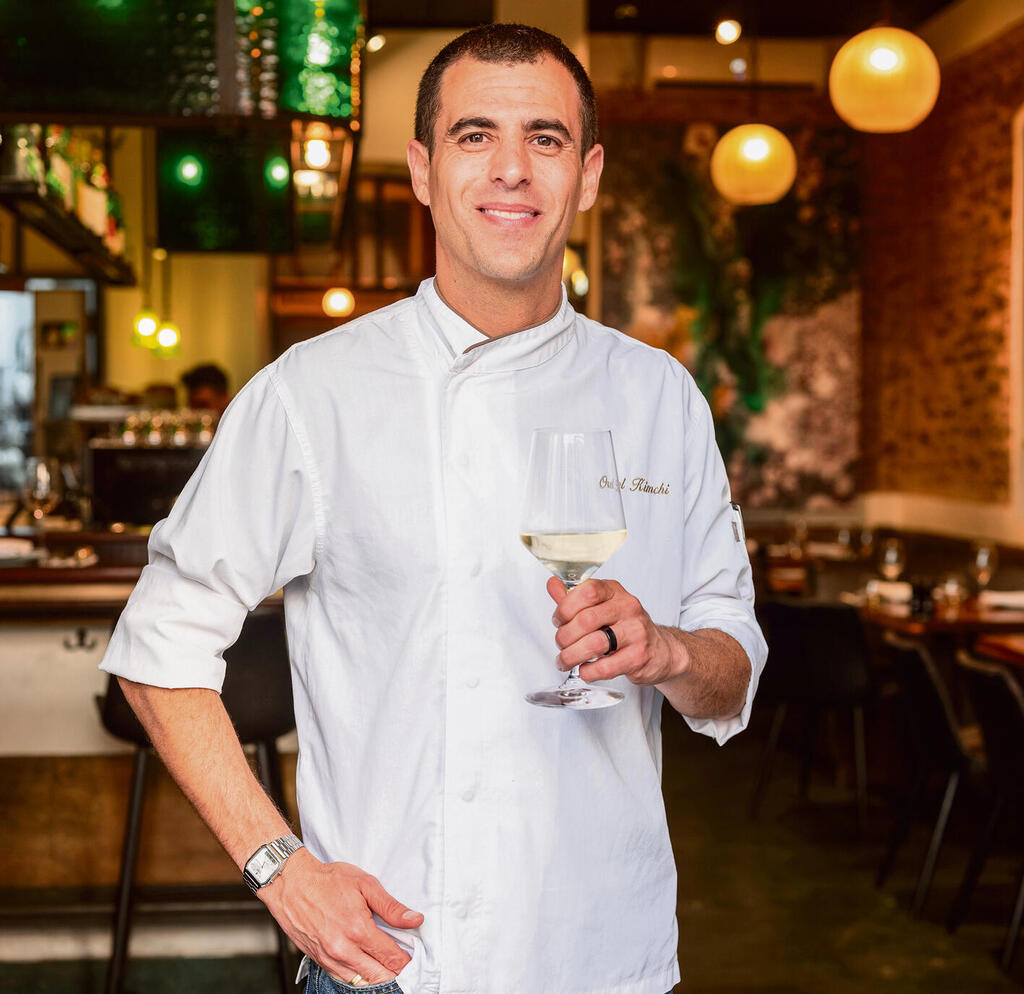
Chef Orel Kimchi
(Photo: Yuval Chen)
"Celebrities and businesspeople like coming here because we maintain discretion," Kimchi explains after the couple finishes their meal. "We won't call the paparazzi or tip off gossip columns. The staff were very excited when Omer walked in, and rightly so. But nobody approached him for a selfie. The staff know they're not allowed to post pictures. I respect my guests."
Learning to control an episode
Kimchi and his partners, chef Omer Sabari and Tzahi Ovadia, who oversees logistics and shift management, will soon celebrate the 14th anniversary of their acclaimed upscale restaurant, which remains more accessible than many other fine-dining establishments.
Sitting in the restaurant, savoring its beautifully presented dishes and observing its diverse clientele — businesswomen and tycoons alongside food enthusiasts and young revelers at the bar — it's hard to believe that Kimchi considered closing it after October 7.
While his Popina partners, both reserve officers, were called up for extended military service following the outbreak of the war, Kimchi experienced a severe flare-up of post-traumatic stress disorder.
"For 20 years, I lived with what I'd call 'polite PTSD,'" Kimchi, 43, confesses. "I learned to hide it from other people. At night, my wife Hadar would wake up to me screaming because of dreams and nightmares.
"For years, Hadar would tell me, 'You have PTSD. Go get treatment.' And I'd answer, 'Everything's fine.' I thought they were just dreams, that these things had happened to someone else. The trauma was so deeply repressed that I didn't remember the events appearing in my dreams and nightmares. Today I know they were flashbacks."
What caused the PTSD?
"It happened during my military service. I was an officer in the Duchifat Battalion during the Second Intifada. When Yasser Arafat died in 2004, I was in Ramallah, and people threw a Molotov cocktail and rocks at me.
"But that was an ordinary incident compared with what happened to me later, much more serious things, like clashes that ended with people being killed, though not on our side. I found myself in life-threatening situations several times. And when I came home on leave, I never told anyone what I'd been through."
What triggered the severe PTSD episode?
"A few months after October 7, Hadar and I went to a Hadag Nahash concert in Tel Aviv. Then Sha'anan Street performed 'Waltz With Sha'anan,' a song based on his experiences in Gaza as a Nahal soldier during the first intifada. Among other things, it describes a refrigerator being dropped on him from a rooftop.
"Hadar warned me the song might be triggering. But the first intifada was mild compared with what I experienced on the ground during the second intifada. Falling refrigerators were just a prelude to the really difficult things.
"When Sha'anan performed the song, my PTSD erupted. I found myself on the floor of the hangar. Someone brought me water. I went outside for a while and then came back. At the end of the concert, I told Hadar, 'I need treatment.'
"I started therapy involving gradual exposure to the trauma. My psychologist, who's an angel and a light, gave me my life back. She even used hypnosis. Thanks to therapy, I now know how to revisit those difficult places."
Why did you decide to talk about this now?
"The reason I'm giving this interview and talking to you about these things is that for 20 years, I genuinely felt there was something wrong with me. I never told anyone what I'd experienced, not even Hadar. Recently, I told my therapist, 'Today, thanks to you, I no longer feel there's something wrong with me.'
"No one should have to go through what our soldiers go through. Almost every day, a reservist dies by suicide, and nobody talks about it. We need to talk because so many people are walking around feeling that something is wrong with them.
"That feeling hasn't completely disappeared for me. There are still days when I think there's something wrong with me, and sometimes I have episodes. But today, thanks to treatment, I know how to control an episode to some extent."
At one point during your crisis, you considered closing Popina. What changed your mind?
"That's true. I had this thought that I needed to close the restaurant because I realized I had to focus on myself. I decided to go on a journey of self-discovery. Two years ago, I traveled alone to a town in Montenegro to explore the roots of my paternal great-grandmother. Her name was Yona. She was a wonderful matriarch, a shining light. She cooked incredible, authentic Balkan food. She died when I was 13.
"During that trip, I disconnected from everyone and stayed in touch only with my wife and father. Everyone at the restaurant knew I needed some peace and quiet. On that trip, I realized I didn't need to close the restaurant."
As he wandered through the landscapes of his great-grandmother's childhood, Kimchi had a revelation.
"I realized the world had changed, and I needed to change with it, to create and innovate. If I didn't, I'd become outdated and irrelevant. I understood that I had to shake up the menu. I decided to drop dishes that had become synonymous with the restaurant and divide the menu into two sections.
"The first would feature nine signature dishes, such as the shrimp burger, foie gras ravioli and seafood pizza. The second would offer rotating seasonal dishes, such as spicy tuna tartare bruschetta, steak and potatoes, thin pasta with shrimp, grape-leaf salsa and nuts.
"I took some of our classics off the menu. And the customers have responded wonderfully to the changes."
Almost a soccer player
Kimchi was born and raised in Moshav Beit Nehemia, a community established by immigrants in the Modi'in region in the 1950s. His father was a manager at Discount Bank, and his mother worked as a school secretary.
"I had an amazing childhood in the moshav. Wonderful parents. I still live on the same family property where I grew up. My brother and sister live there too. We all live together like one big clan."
That rural childhood also came with excellent food. "On my father's side, there was Turkish, Balkan, Jerusalem-style and Yemenite food. On my mother's side, Tunisian food: couscous, marmouma, the Tunisian version of matbucha, and pkaïla.
"My grandmother and mother are amazing cooks. My father may have been a banker, but he's the family cook. On Fridays, he'd stand in the kitchen with music playing in the background. That's why I've always associated food with something positive."
Kimchi originally dreamed of becoming a professional soccer player. "I played from a young age. When I was 17, at the end of a practice session, I asked my coach at Maccabi Petah Tikva, 'Tell me, will I play for the senior team?'
"The coach said yes.
"Then I asked, 'Will I be in the starting lineup?'
"And the coach said, 'You'll have to do this, and you'll have to do that.'
"I immediately told him, 'I'm quitting.'
"The coach tried to talk me out of it. He said, 'I didn't mean to make you quit. I told you that you could make the senior team if you just worked harder.' I told him, 'I'm quitting. I don't think I'm good enough, and I don't want to be a soccer player badly enough.'
"My father took it very hard because his dream was for me to become a professional soccer player."
So how did cooking enter your life?
"I wasn't a particularly food-loving kid. I only started really enjoying food when I was 19. It happened at a platoon outpost on the outskirts of Ramallah. I used to excuse one of my soldiers, Avi Lalush, from guard duty. He'd studied cooking in high school, and I'd ask him to make us something delicious.
"Thanks to him, my food chakra opened. I developed an extreme passion for food. Every shekel I earned in the army went toward restaurants. That's when I decided this was what I wanted to do with my life."
Following in the footsteps of his older brother Moshiko, who studied cooking and now manages a meat-processing plant, Kimchi enrolled at the Tadmor culinary school. At the same time, he worked at a cafe and a seafood bar in Tel Aviv.
After taking a post-army trip with Hadar, who would later become his wife, he moved to Jerusalem and spent three years working at an elegant French restaurant.
How did your family react to your decision to become a chef?
"They didn't like it. At first, they made faces. I'd always been a gifted student with good grades, and as far as they were concerned, becoming a chef was a waste.
"Even today, my grandmother tells me, 'What about a real profession? When are you going to study something?' So I tell her, 'Grandma, I'm considered one of the best chefs in Israel. I have one of the best restaurants in the country, and it's been running for 14 years.' And she says, 'That's amazing, but go become a lawyer or a doctor.'"
In 2011, Kimchi left Jerusalem for Paris to work at L'Atelier, the restaurant of legendary French chef Joël Robuchon. "I was just a regular cook, and I got a real slap in the face there. I discovered that Robuchon's legendary mashed potatoes were one big sham.
"They're very tasty, of course. But as a cook who believes in the importance of preparation techniques, I was shocked to discover that the mashed potatoes were made from cooked, mashed potatoes delivered in bags from a factory. At the restaurant, the chefs would take the mixture, pour it into cream, milk and butter, and stir it into the perfect mashed potatoes."
What was it like working for a culinary legend like Robuchon, who died eight years ago?
"I saw him twice. We weren't allowed to speak to him. We had to stand up straight with our hands behind our backs and say, 'Monsieur Robuchon, Monsieur Robuchon,' as he walked through the kitchen. It was bizarre. A terrible cult of personality.
"The hierarchy in the restaurant was far more extreme than anything in the infantry. There was violence in the restaurant too. My bosses hit me with wooden spoons."
That same year, Kimchi was selected to represent Israel at an international culinary competition in Venice. "One of the judges, Elena Arzak, from the three-Michelin-star restaurant Arzak in Spain's Basque Country, invited me to work for her."
At 29, Kimchi returned to Israel and opened his own restaurant. "I went for a modern, upscale European style, with careful use of high-quality ingredients, attention to detail and aesthetics."
Popina gradually built a loyal following. Oligarchs, including Roman Abramovich, and billionaires such as members of the Ofer family and the late Eitan Wertheimer and his wife, Ariela, became regulars from the day the restaurant opened.
International celebrities also enjoyed the culinary talents of Kimchi and Sabari. "Tony Blair, the former British prime minister, ate here regularly whenever he visited Israel," Kimchi recalls. "He loved the shrimp burger and the gin-and-tonic beef tartare. In 2015, the American boy band Backstreet Boys came to Israel to perform, and they visited us. They ordered a huge spread and ate a lot."
That same year, Kimchi also found himself serving pop superstar Mariah Carey and her then-boyfriend, Australian billionaire James Packer. With a smile, he adds, "And don't quote me on this, but I think Mariah and Packer might have been here with Yair Netanyahu."
A family business
Before the war, Popina relied heavily on tourism. After October 7, its revenue was suddenly cut in half. "We learned how to adapt, strengthen our Israeli customer base and make changes and adjustments," Kimchi said.
"My wife Hadar also started working at the restaurant. She'd worked in education her entire life and had begun pursuing a doctorate, but after October 7, she decided she no longer wanted to work in education. "I told her, 'Come work with me at the restaurant. There's wine, music, good food and good people. You'll have fun.' Now we work together.
"Our eldest daughter, Tamara, works in the pastry kitchen, and our youngest son, Tamir, who's 11, works as a food runner and polishes silverware. "I'm not someone who's into the celebrity scene. I'm a family man who believes in values."