


All it took was one new pita.
Shifka, a Manhattan pita shop co-owned by Israeli restaurateur Amir Nathan, added arayes to its menu this week and quickly became the target of a pro-Palestinian boycott campaign. Activists accused the restaurant of taking an Arab-Levantine dish and folding it into an Israeli culinary identity, framing the dispute around the question: “Can cuisine be stolen?”
Critics on social media accused Israel of appropriating Arab and Palestinian food and culture. One commenter even pointed out that the word arayes begins with the Arabic letter ʿayn, arguing that the dish’s very name reflects its Arab origins.
There is one important wrinkle: Shifka never actually described the dish as Israeli.
In its original post, Nathan called arayes “a Middle Eastern classic built around a simple idea,” seasoned beef stuffed into pita and grilled until the bread becomes crisp and golden. Shifka’s version is made with beef, caramelized onions and a tahini-yogurt sauce.
The Israeli association comes instead from the restaurant’s broader identity, the way it has been covered since opening and Nathan’s own background. For its critics, that was enough. The appearance of a well-known Arab dish at a restaurant identified with Israel became another flashpoint in a much older argument over culinary ownership, recognition and appropriation.
There is little dispute that arayes is an Arab-Levantine dish. It is especially common in Lebanon, Syria, Jordan and Palestinian cuisine, and is also widely eaten in Israel. Its name is the Arabic plural of “bride,” with one popular explanation holding that the meat and bread are “married” together on the grill.
But, like many dishes from the region, arayes does not fit neatly within modern national borders. Recipes have moved for generations between families, cities and communities. The controversy in New York is therefore less about the recipe itself than about credit: who gets to tell the story of a regional food, and what happens when that story is told through an Israeli brand.
Shifka opened on the Lower East Side in October 2025 as a faster, less expensive offshoot of Sami & Susu, the Mediterranean wine bar and restaurant Nathan opened with chef Jordan Anderson during the pandemic. Sami & Susu began as a traveling pop-up before becoming a permanent restaurant and received Michelin’s Bib Gourmand distinction for four consecutive years, from 2022 through 2025.
Shifka grew out of years of experimenting with pita sandwiches in the Sami & Susu kitchen. The original plan was to call it The Pita Shop, but the name was too generic to trademark. Nathan instead suggested Shifka, after the small pickled pepper commonly served with falafel in Israel, following much the same logic that turned chipotle, another pepper, into a restaurant brand.
From Iraq and Yemen to East Jerusalem
Nathan, who was born in Beersheba, is not the only owner behind Shifka. His partners include Anderson, who grew up in a Jewish home in New Jersey, Daniel Tartel and Eli Bandeli, who is Muslim.
Ahead of the opening, Nathan, Anderson and Bandeli traveled through Israel on a research trip. They ate hummus in Acre, visited a Druze restaurant in northern Israel, stopped at the Asif culinary center and at Arab restaurants, and met with a Palestinian chef in Jerusalem.
Nathan said at the time that he wanted Anderson to experience a range of flavors stretching “from Iraq to Yemen and East Jerusalem,” and to understand the mix of cultures that shaped the food Nathan grew up with.
The menu reflects that approach rather than any claim to culinary purity. It includes schnitzel with a Yemeni-style sauce, sabich, harissa chicken, lamb kebab with amba, shawarma-spiced cauliflower, shrimp with tzatziki, Tunisian-style malawach with canned tuna, and sides of muhammara and labneh.
The restaurant is not kosher. The partners considered using kosher meat but decided against it because of the cost, and Nathan has even floated the idea of a future breakfast bourekas with bacon, egg and cheese.
“It’s not just Israeli,” Nathan said when Shifka opened.
Still, the restaurant’s Israeli identity has become difficult to separate from the politics surrounding it. Nathan said that after Oct. 7, Shifka drew more Jewish customers while also being targeted with anti-Israel graffiti.
Who gets to claim the food?
The timing of the arayes controversy was particularly striking. That same evening, several miles uptown, the Marlene Meyerson JCC Manhattan opened A Taste of Belonging, an exhibition curated by Dr. Smadar Sheffi about the role of food in Israeli identity and memory, and the way family recipes, holiday meals and street food can become, in the organizers’ words, a “cultural battleground.”
Gallery
Artworks featured in the ‘A Taste of Belonging’ exhibition
(Photo: Marlene Meyerson JCC Manhattan)
Among the works is Shahar Marcus’ video Sabich, in which an enormous serving of the dish is assembled inside a bomb shelter. The work connects a food developed in Israel by Iraqi Jews in the 1960s with the physical setting of war.
In a work by Eliyahu Eric Bokobza, Israeli and Palestinian children circle a barbecue and are distinguished only by the colors of their shirts, against the backdrop of culinary traditions shared across the region since the Ottoman era.
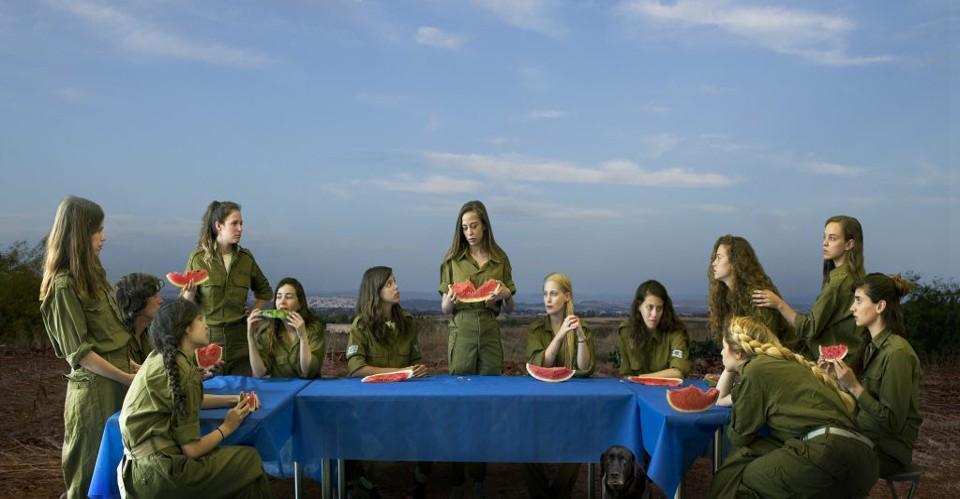
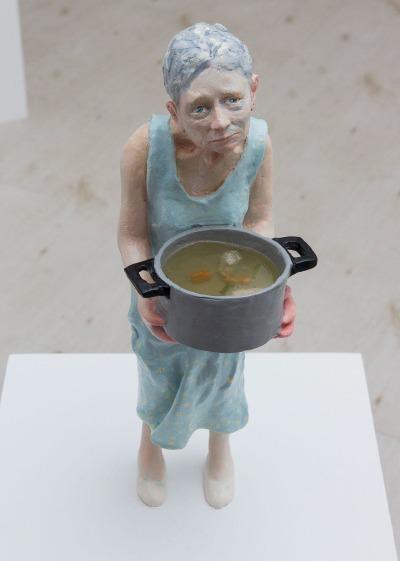
Angelica Sher depicts female IDF soldiers gathered around a watermelon in a composition that recalls The Last Supper. A miniature sculpture by Vered Aharonovitch shows a mother carrying an enormous pot of chicken soup, compressing associations with the Holocaust, family life and the archetypal Jewish mother into a figure just 18 centimeters tall.
(Photo: Marlene Meyerson JCC Manhattan)
The exhibition was conceived partly as a response to New York magazine’s “Habibi City” issue. Its main food feature argued that modern Israeli cuisine had benefited for years from money, prestige and publicity while Arab restaurants remained associated with cheaper, supposedly less sophisticated food, even as some dishes presented as Israeli in the West had Palestinian roots.
The article drew criticism from Sephardi and Mizrahi Jewish organizations, which argued that it erased the histories of Jews who brought cuisines from Iraq, Yemen, Iran, Morocco, Tunisia and other parts of the Middle East and North Africa to Israel.
That dispute mirrors the argument now surrounding Shifka. When a dish belongs to several histories at once, who gets to claim it, name it and tell its story?
The exhibition opening also marked the launch of the Israel Culture Project, a $1 million initiative intended to connect Israeli artists with cultural institutions across North America. Its first program, Work in Progress, will award four artists living in Israel $5,000 each, with no requirement that the money be used for a particular project.
But the controversy unfolding at the same time showed how difficult it has become to separate support for Israeli culture from the fight over how that culture is defined.
That tension is perhaps most explicit in works by Vardi Bobrow, who placed invented kosher certification symbols on images of oranges, sabra cactus fruit and watermelons, three foods and symbols that became closely associated with modern Israeli identity but are described in the exhibition text as also having been appropriated from Palestinian culture.
At first glance, the kosher stamps look entirely authentic.
They are not.