

Like many things in my life, this story began by chance, without warning. Thanks are due to Danny Racotch, who devotes his time to researching the histories of families, communities and holocaust survivors. As a descendant of Chelm Jews, he searches closely for survivors from the town and its surroundings. His discoveries are rare and deeply moving.
My own family also comes from Chelm, a city in eastern Poland near Lublin. Two months ago, Danny brought me a photograph which shows a large, crowded and joyful wedding. The faces are small and blurred. Then we enlarged the image.
Suddenly, my entire immediate family burst into view. Uncles and aunts, one dignified elderly grandmother, cousins, spouses, children and toddlers. All of them are my family. I recognize each one in silence, stunned. My heart, however, refuses to stay quiet. It races.
The date printed on the back of the photograph is 1957. The event is the wedding of Hanoch and Hannah Apelstein. What unfolds in the image can be summed up in one word: a miracle. The photograph captures a large family, which is corroborated by gravestones and burial records, as well as books, testimony pages and memorial documents. They stand before me now, their faces enlarged, adorned with gold jewelry, gemstones and intricate embroidery. The men wear simple black and white, festive attire.
The miracle lies in what did not happen. The simple truth is that all those grandparents, uncles and their children, brothers and sisters who come alive in the enlarged photograph were destined to be murdered. When German forces entered Chelm, the commander ordered the head of the Jewish community to gather 2,000 Jewish men ages 16 to 60 in the market square.
The Holocaust had already begun, though it had no name yet. The Nazi killing machine was still in its early stages. The Germans told them to wait. So they waited, without food or water; they spent the night on the ground, believing it was only for this one night.
Then the organized line broke apart. The Germans opened fire indiscriminately. Those who survived were lined up and shot together. Special firing squads quickly learned to strip valuables from the victims, while those without anything to offer were shot immediately.
Later, the Natzi killers refined their methods. They ordered everyone, including children, to undress. The reason was simple: Jews wore their best clothes to their deaths, and the Germans wanted the garments intact, free of blood and bullet holes.
Columns of unsuspecting Jews marched in Lublin and in the town of Puławy. Many were shot or drowned along the Bug River. Their bodies were thrown into pits without clothing, dentures, glasses, hearing aids, jewelry or money.
Then came the “actions” in Chelm, carried out by SS men and Ukrainian or Polish police. Nearly all of the town’s 15,000 Jews, about half its population, were murdered, some in Chelm, many in the Sobibor extermination camp. They were robbed and stripped of their homes and property.
Another profound loss was the destruction of Chelm’s cultural treasures. The city had been known across Jewish Europe as a center of learning, culture and prayer. Its legacy burned along with its people. I see them all through this photo of Hannah and Hanoch’s vibrant 1957 wedding.
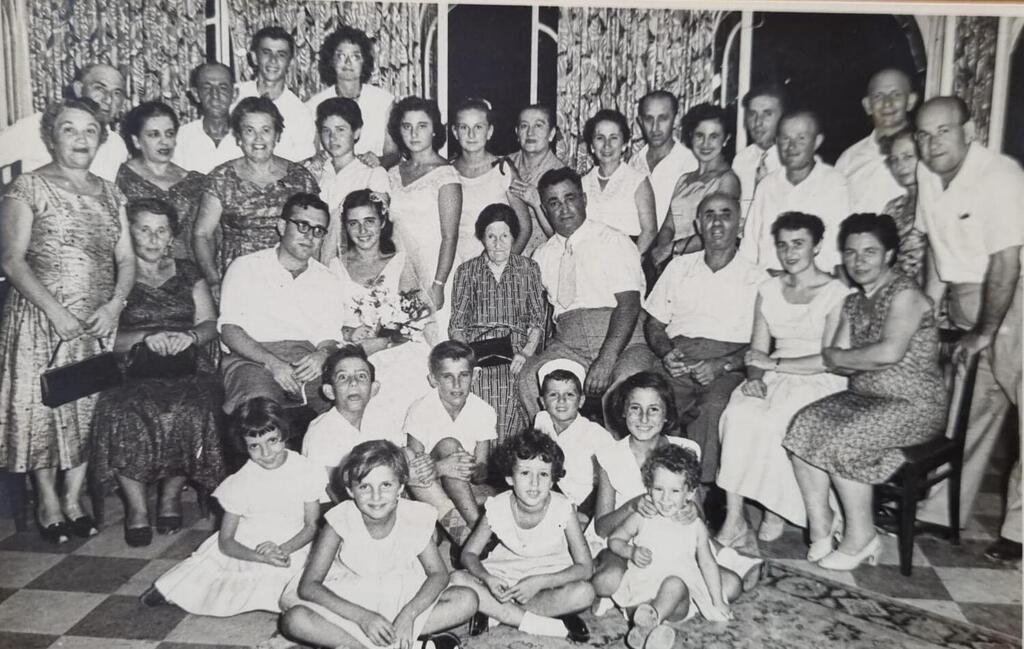
Hannah and Hanoch’s wedding, 1957. Most of those smiling in the photograph owe their lives to two men: Yitzhak Rosenblum and Moshe Apelstein
Children cluster at the adults’ feet, cousins hold hands, and happiness radiates from the image. Yet beneath it all lies the memory of sudden devastation.
A few newly found survivors also appear in the photograph. Some were located through radio broadcasts of “Kol Zion LaGola,” which my grandmother Silka Rosenblum listened to daily. Through it, she found three more cousins. They were immediately housed in a laundry room on the roof of the family home on Gilboa Street in Tel Aviv. When they moved out, new relatives took their place, discovered by Silka’s relentless search.
Two large branches of the family escaped, some before the war and some during it. That was our family’s miracle.
The Rosenblum family fled years before the war. My grandfather Yitzhak could not support his wife and six children, so he traveled to British Mandate Palestine to drain swamps. He took his eldest son, Eliezer, who later became a building contractor.
Yitzhak lost his sight to malaria during that work. Over the years, he and Eliezer managed to bring the rest of the family over, housing them first in Jaffa and Neve Tzedek, then in a new building on Gilboa Street. Each floor held two or three families.
I was five, and that house felt like a colorful amusement park. My cousins, aunts and grandparents filled my childhood with warmth and joy. To this day, I’m still close with many of the dozen cousins who grew up in that same building.
The Apelstein family, closely tied to the Rosenblums, escaped through Russia during the war. As the pace of killings increased, relatives in the land of Israel urged Moshe Apelstein to flee with his entire family to Russia, and so he did.
I was born under the Tel Aviv sun, near the sea, surrounded by the Rosenblum clan. Our life was modest but full with family. As the scale of the Holocaust became clear, we understood how fortunate we were.
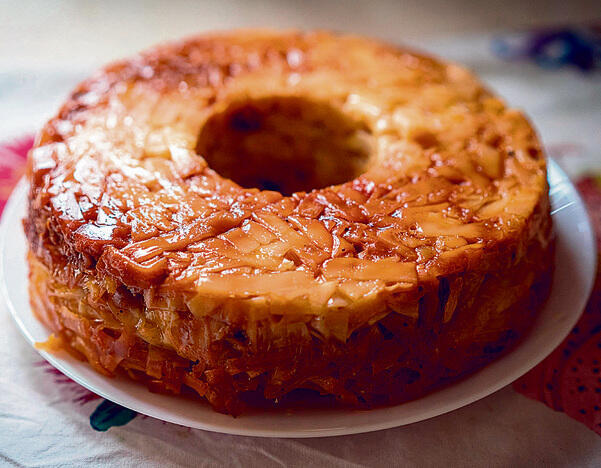
Our kitchen preserved the flavors of that lost world: slow-cooked stews, kugel and kishke baked in the oven. Every bite was cherished. My mother, Pnina, cooked sparingly but exquisitely. The dishes that follow appeared on our table for years. The cholent sparked debates and competitions. My cousin Bilha, considered one of Tel Aviv’s beauties, used to wrap the cholent pot in what looked like an elegant gown of white lace.
Years ago, I published holiday columns in “Yedioth Ahronoth” helping readers search for lost relatives and forgotten recipes. The response was overwhelming, crossing communities and traditions.
Please remember: food, even quiet and modest, speaks. Every dish bows its head to a vanished culinary tradition. Join our table and help expand the treasure kept there.
Barley soup (krupnik) by Varda Meidar
Varda Meidar, a pharmacist and artist from Chelm, was also known for her Friday meals shared with neighbors.
Her barley soup is rich and suited to cold climates. Long cooking is essential, and no ingredient should be skipped. Each adds flavor, nourishment and the aroma of a lost home.
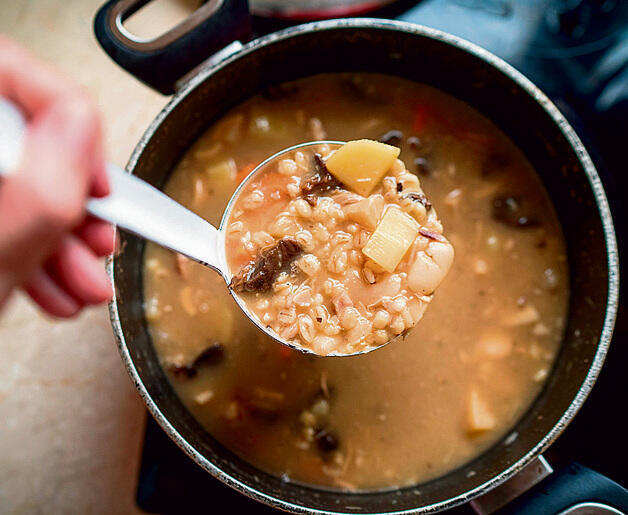
Krupnik. No ingredient should be skipped
Ingredients:
1½–2 liters chicken broth
2 tbsp sunflower or canola oil
2–3 beef marrow bones
1 medium onion, finely chopped
2–3 potatoes, peeled and diced
2 medium carrots, peeled and diced
1 cup pearl barley, rinsed
½ cup dried wild mushrooms, soaked in hot water for 30 minutes
Optional: celery leaves, chopped dill
3 bay leaves
3–5 allspice berries
Salt, pepper
Preparation:
1. Heat oil and fry marrow bones.
2. Remove bones, fry the onion.
3. Add potatoes and carrots once onion softens.
4. Chop mushrooms.
5. Add broth, mushrooms and barley.
6. Bring to a boil, then simmer about 90 minutes.
7. Adjust seasoning.
8. Add dill and celery leaves before serving.
Poppy seed rolls (pletzels) by Aunt Sarah
Sarah Grossman (Rosenblum), my father's sister, was born in Chelm and later, a Haifa resident. She was known for her crisp, golden rolls baked in a heavy oven. The aroma reached the city center.
I was a thin child, and she would prepare all week for my visits from Tel Aviv. At breakfast, I received the darkest, crispiest rolls with butter and cheese. A taste of heaven that didn’t add a single gram to my weight. This recipe, too, comes from Varda Meidar.
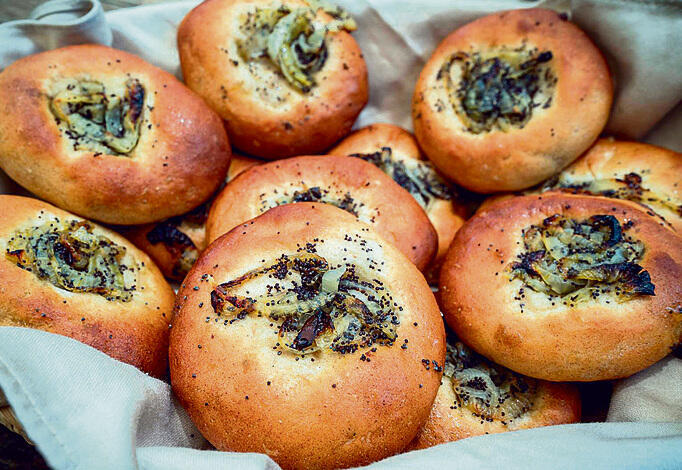
Pletzels. The aroma reached the city center
Ingredients:
840 g flour
100 g sugar
1 tsp dry yeast
500 g water
1 tbsp salt
Filling:
1 onion, finely sliced
1 tbsp whole poppy seeds
Salt
Topping:
Coarse salt
Olive oil
Preparation:
Filling:
1. Fry onion in olive oil until soft.
2. Add poppy seeds and salt.
Dough:
1. Mix dough for about 5 minutes.
2. Let rise until doubled.
3. Form 30 balls.
4. Let rise 30 minutes until doubled.
5. Make a small well in the center and add a teaspoon of filling.
6. Rest 10 minutes. Bake at 425°F (220°C) for 10 minutes.
7. Brush with olive oil, sprinkle salt.
8. Bake another 5 minutes.
The lost radish salad
Here is a sketch of our mother’s radish salad, once a Passover favorite.
My brother Yossi and I have tried to recreate it. Our mother, Pnina, has long since died. We fry eggplant slices, grate fresh radish, add parsley and dill, lemon juice and a bit of mayonnaise. It is good, but not the same.
Readers, help us. The salad originated in Lodz. Does anyone know it? Does anyone remember the taste? If so, please send the recipe and it will be published.