

A few years ago, we packed a small bag and headed north to Mitzpe Matat in the Galilee for a baking workshop we forced on the brilliant and wildly creative baker Erez Komarovsky.
It was late afternoon. We just finished chatting with Erez’s chickens, playing with his dogs and eating squash that mysteriously sprouted from his melon patch.
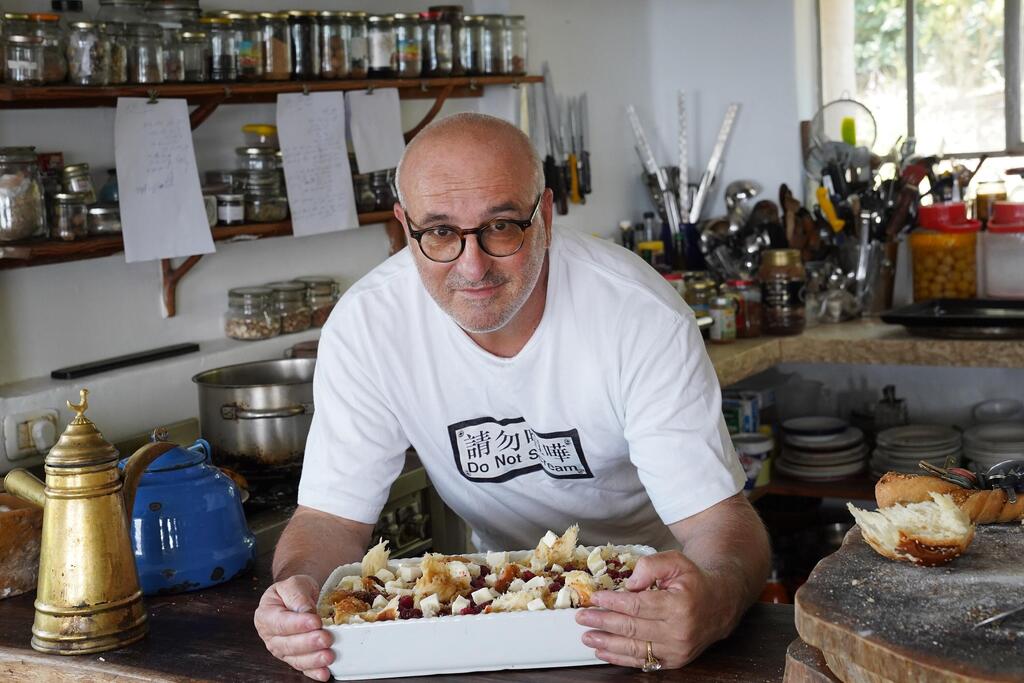
Then Erez got to work. He weighed flour and water and measured, and we diligently recorded everything down to the gram. Suddenly, he shifted gears - he began pouring flour straight from the bag into the mixer. There was no way to tell how much. As he did, he said with mock seriousness and a mischievous smile, "Baking is an exact science. Everything needs to be measured by the gram. Watch."
That evening, Erez taught us the most important lesson about dough: the first thing to know is what texture you're aiming for. Touch it once. That’s it. After that, it's up to you to find your way there; sometimes you need a bit more flour, sometimes a bit more water.
The differences can be more dramatic than you’d expect, depending on the type of flour, the time of day, the season, or the humidity in the air. That’s why, if you stick strictly to a dough recipe down to the gram, it often just won’t work.
Get the Ynetnews app on your smartphone: Google Play: https://bit.ly/4eJ37pE | Apple App Store: https://bit.ly/3ZL7iNv
We love dough. We enjoy working with it, and we believe there’s something divine in the simple union of flour and water. Over the years, we’ve also learned to recognize the kind of dough recipes you simply can’t mess up. No kneading, no fussy textures. The dough practically works itself. These are always recipes that rely on a long rise, which naturally builds the gluten network that traps air and creates the large, signature bubbles.
One such recipe we’ve made dozens of times is Tuscan focaccia, baked in a large rectangular pan, boiling with giant bubbles and swimming in olive oil.
A few weeks ago, we had a wild idea: to combine that simple dough, which mostly needs time in the fridge, with the magical trio of cinnamon, brown sugar and butter. Focaccia meets cinnamon roll. Two family obsessions that make you very happy.
Here is the road to happiness.
A yeasted pastry with butter and cinnamon (but not your usual kind).
We broke the rules here, combining Tuscan focaccia, made from a high-hydration dough rich in olive oil, with a cinnamon roll, a yeasted dough packed with butter and filled with brown sugar and cinnamon.
The result is wild, aromatic, caramelized, crisp, soft, sweet, bitter, spicy. All in one bite.
Why do we love this recipe? No kneading required. No need to understand dough textures. No prior experience with yeast needed.
The downside:
You must make the dough the day before. And yes, the process is a bit chaotic.
But you know that saying, which is usually not true, "trust the process". Well, we trusted it. And we asked ourselves: What could go wrong when bubbling dough, melted butter, brown sugar and cinnamon hit a blazing-hot oven?
What could go wrong? Your diet. Or any attempt at mindful eating.
Prepare yourself to become addicted to pressing your fingers into dough.
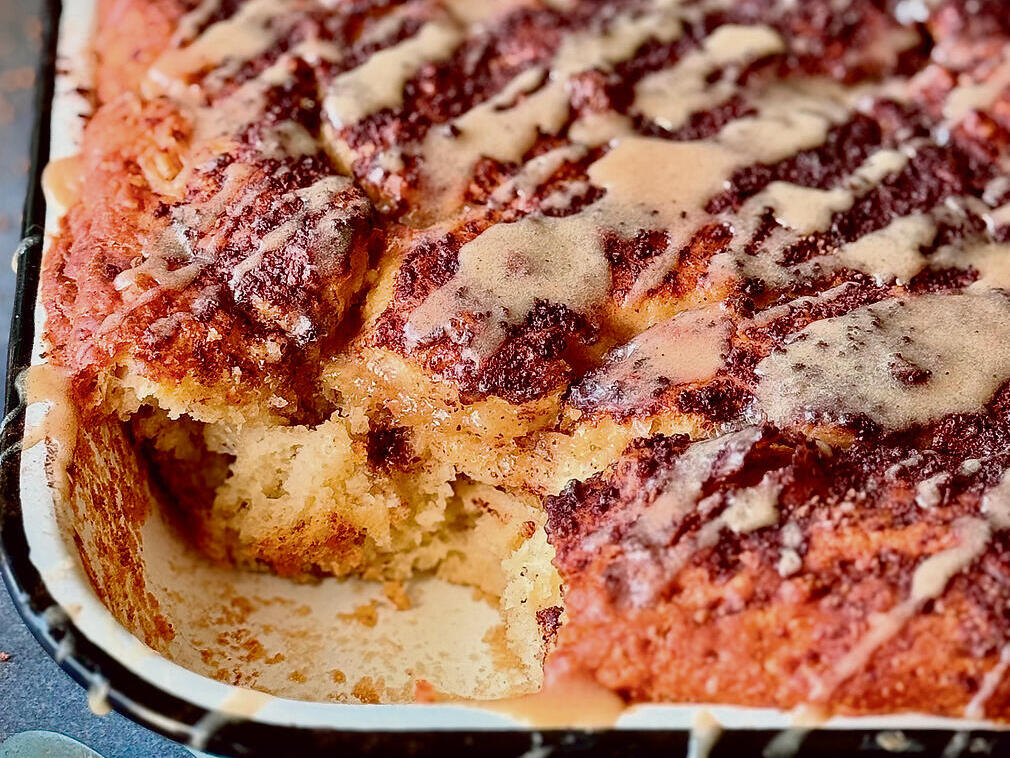
(Photo: Ruthie Rousso)
Ingredients
Dough:
- 1 kilogram challah flour
- 80 ml. water (27 oz)
- 2 tsp yeast
- 2 tbsp maple syrup or honey
- 3 tsp salt
- 6 tbsp olive oil, plus a little extra
Filling:
- 200 grams butter
- 1 tsp quality vanilla extract
- 200 grams brown sugar
- 2 heaping tbsp cinnamon
- 1/2 tsp salt
Optional frosting:
- 100 grams powdered sugar
- 1 tbsp milk
- 1/4 tsp salt
What else do you need?
Patience and fridge space.
Instructions:
1. Mix all the dough ingredients in a large bowl, except the olive oil, with a spoon. Add the oil and mix again until relatively homogeneous. The dough will be very wet, so don’t expect it to come together like traditional dough. Cover and let rest for 20 minutes.
2. Stir again with a spoon for 2-3 minutes, cover, and place in the fridge for 24 to 48 hours.
3. Take the dough out of the fridge. Melt the butter with the vanilla extract. In a separate bowl, mix the brown sugar, cinnamon, and salt.
4. Grease a large rectangular baking pan with a bit of the melted butter. Transfer the dough to the pan. Pour half the melted butter over it and sprinkle half the sugar mixture on top. Fold the dough into thirds, or however it folds (it's very wet, so don’t stress. It’s okay if it tears or opens). Cover and let rest at room temperature for two hours.
5. Fifteen minutes before the dough is done rising, preheat the oven to 210°C (410°F). Press your fingers into the dough in several places to release some air. Pour the remaining butter on top and sprinkle the rest of the sugar and cinnamon mix. Bake for 20 minutes.
6. Meanwhile, if desired, mix the powdered sugar with milk and salt to a frosting-like consistency. Once the pastry is puffed and fragrant, drizzle with frosting. Serve hot.
7. Vanilla ice cream would be a perfect pairing.
The world is flat
Osem recently launched “flat pretzels” in Bissli BBQ flavor. We’re usually opposed to combinations from different snack worlds and prefer to stick to the classics. However, their bizarre experiment worked. The odd combo of pretzel and Bissli seasoning is dangerously addictive. After falling for it once or twice, we now try to keep our hands out of that bag.
Our recommendation? Protect yourselves. Don’t try it.
Or in other words, you really should try.
Fruit of our childhood
Anyone who grew up on a moshav, passed the age of 40, or has ever gone swimming at a kibbutz pool knows: you don’t buy loquats, not at the supermarket, not at the corner store, not at the produce market. Loquats grow wild on big trees, and they are free, and for a few magical weeks, you eat them with dripping chins and squinting eyes from the tart sweetness.
Technically, the loquat season isn’t that short. But for us, it is, because once the fruit ripens, a noisy war breaks out between humans, fruit bats, flies and birds, who are seeking the treasure. Without a proper net, every loquat is an open buffet, and first-come, first-served.
In our yard stood a humble loquat tree: average-sized fruit, nothing special. But for two weeks, it exploded with bounty. We’d sit in the shade with a bowl of ice water, dunking small, perfect loquats in, and eating them with delight.
Everyone had their way of eating it: some peeled, some didn’t bother. But we all knew - if you peel it, you win. A peeled loquat is a whole different experience: smooth, juicy, indulgent.
When friends or relatives came from abroad during these precise two weeks, they looked at us in awe: how could we treat such a marvelous fruit like it was just another weed? For them, loquats were a revelation. A color and taste they did not know. For us, they tasted like slow walks to the moshav pool.
Today, of course, you can buy loquats. Sometimes they’re big and impressive, glossy and flawless. But then you take a bite, and realize the shiny exterior hides a watery, bland fruit. In the war against bats, bulbuls, and flies, someone forgot to preserve the sweetness.
And yet, for all our love, we have a confession: we’ve never found a good loquat recipe. Except maybe serving them with a light scent of sunscreen, because that’s how we always ate them.