

Matbucha is one of those dishes that brutally demonstrates the relationship between the amount of ingredients you start with and what you actually end up with. You begin with a crate of tomatoes that takes over the kitchen counter, blocks the sink and threatens domestic harmony. You peel them, halve them, squeeze them. There are tomatoes on the counter, on the floor, on your clothes and in your hair. You cook them for hours, and in the end, you have enough to give your neighbor two jars the size of cottage cheese containers. Is all that chaos really worth it? Absolutely. Because nothing tastes better than good homemade matbucha.
The Arabic word matbucha means "cooked." It comes from the same root as the Hebrew word mitbach, meaning kitchen, the place where cooking happens. In North Africa, the dish is also known as salade cuite, or cooked salad. In one family, cooked salad and matbucha are exactly the same thing. In another, cooked salad contains roasted peppers, while matbucha is spicier. Or the other way around. One is smooth, the other chunky. One contains cumin, while in the other, you wouldn't dare mention cumin in front of Grandma. There is no international matbucha police to settle the matter.
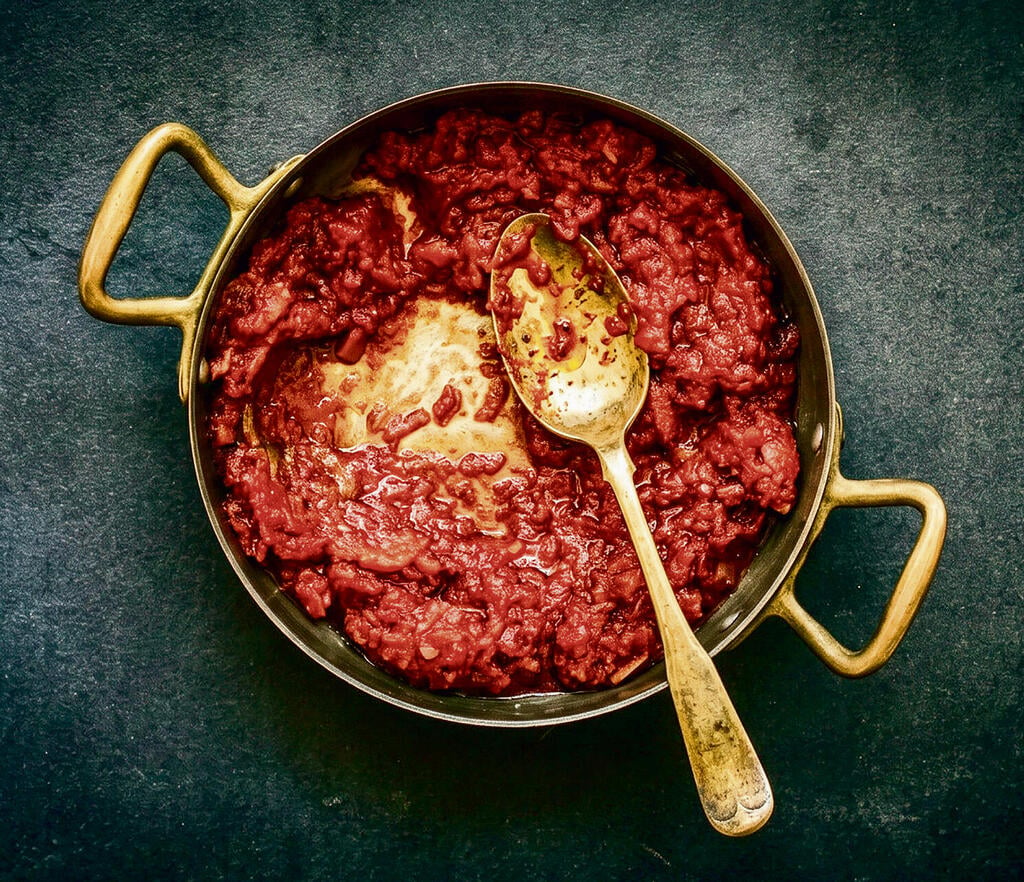
What matters is the common denominator: ripe tomatoes, garlic, oil and plenty of time. Long, slow cooking transforms the tomatoes into a thick, concentrated, meaty spread. Beyond that, every family is entitled to defend its version by whatever means necessary.
Seven kilos of tomatoes, barely a jar
Some recipes can be scaled down. If a cake recipe makes two cakes, you can halve it. If a soup serves 10, you can divide everything by two. Even an egg. Matbucha does not belong to that family of recipes. Our single most important tip for making matbucha is this: Don't start with less than 7 kilos of tomatoes.
We know. It sounds like the kind of quantity that requires a truck and a business license. But 7 kilos of tomatoes do not produce 7 kilos of matbucha. They're more like a vague promise of a jar of matbucha, provided nobody wanders through the kitchen with a fresh challah while it's cooling.
Which tomatoes work best?
We prefer Magi tomatoes. Nothing quite matches the flavor of matbucha made from them. Deep, tangy, sweet and aromatic. A masterpiece of a tomato, and therefore a masterpiece of matbucha. The downside? They're small, and their skins are stubborn.
Very ripe Tamar tomatoes also do a respectable job. They're fleshy, contain less water and fewer seeds, and seem to understand exactly what we're trying to achieve. They're larger than Magi tomatoes and much easier to peel. For us, the ideal combination is Magi and Tamar. Tamar brings the body, Magi brings the flavor.
Yes, you really have to peel them
We can tell ourselves that tomato skins contain dietary fiber and nobody will notice them. They will.
So blanch the tomatoes, peel them, halve them and gently squeeze out some of the liquid and seeds. There's no need to hunt down every last seed. We simply don't want to begin cooking with a pot of tomato juice. The less water we put into the pot, the fewer hours we'll spend trying to get it out.
Now, leave it alone
To 7 kilos of peeled, squeezed tomatoes, we add 3/4 cup of oil, a heaping tablespoon of salt, 2-3 tablespoons of sugar (two are enough for Magi tomatoes, while Tamar may need three) and 6-7 garlic cloves. Bring everything to a boil, then lower the heat.
Now comes the part that has no shortcut. The matbucha simmers over low heat for hours, uncovered, until the liquid evaporates and the tomatoes become concentrated. Stir occasionally, increasing the frequency as the mixture thickens.
At first, you can leave the kitchen. Toward the end, it's best to stay nearby. Matbucha has a remarkable ability to demand five hours of patience and then burn during the seven minutes you stepped outside to walk the dog.
And no, you cannot simply turn up the heat and finish sooner. We're not just removing water. During those hours, the sugars become concentrated, the pectin does its work, the oil and tomatoes come together, and the flavor changes.
To achieve that thick, intensely flavorful, meaty emulsion, you need time. You can buy a shortcut at the supermarket and get one-tenth of the pleasure. On a good day.
The moment matbucha becomes matbucha
There is a moment during cooking when matbucha actually becomes matbucha. Until then, you have cooked tomatoes in the pot. Perhaps even very tasty cooked tomatoes, but still tomatoes.
And then something changes. The color, once pale orange, deepens into red. Almost Cabernet red. The texture thickens, and the tomato flesh begins to break down. You can help it along with a potato masher.
The oil and tomatoes come together into something resembling an emulsion, and the flavor develops the concentrated depth of sun-dried tomatoes. When you drag a spoon across the bottom of the pot, the matbucha doesn't rush to fill the trail. It's no longer a sauce. It's almost jam. That's your cue. As long as the mixture is pale, orange and watery, you're not there yet.
You can't determine the exact moment by watching the clock. It depends on the variety of tomato, how much water it contains, the width of your pot, the intensity of the flame and the mood of the universe. Usually, the whole process takes at least five hours. Sometimes longer. Matbucha has absolutely no interest in your schedule.
One hot pepper is not a unit of measurement
Toward the end of cooking comes the hot pepper, and with it, the great problem of every recipe that includes the words "one hot pepper." A hot pepper is not a standardized unit of measurement. Sometimes one is enough to wake up an entire pot. Other times, you can eat three as though they were cucumbers.
Heat varies according to the variety, the season, growing conditions and even the pepper's position on the plant. Humans aren't particularly reliable measuring instruments either. What one person considers a pleasant tingle might send another calling for a helicopter evacuation.
So taste and adjust. We remove the seeds and white membranes, where much of the heat is concentrated, and roughly chop the pepper. You can start with less and add more. What you can't do is remove heat once it's entered the pot.
Heat about 3 tablespoons of oil in a small frying pan and fry the pepper. After half a minute, add a very heaping tablespoon of sweet paprika and 1/2 to 1 teaspoon of cumin. Fry briefly, just until the spices release their aroma and the kitchen smells wonderful.
Don't let the paprika burn. The distance between "we've bloomed the spices in oil" and "why does everything taste bitter?" is remarkably short. Add the seasoned oil and everything in it to the matbucha and cook together for another half-hour. We like adding the spices at this stage because they can lose their aroma after hours of cooking. This way, they enter the matbucha bright, fragrant and full of good intentions.
Don't be afraid of the oil
In total, nearly a cup of oil goes into this pot, and there's no need to alert the authorities. It's spread across 7 kilos of tomatoes, and those tomatoes, remember, are going to shrink considerably.
The oil carries the flavors of the garlic, pepper and spices, softens the acidity and creates the rounded flavor and glossy, almost creamy texture of good matbucha.
Without enough oil, you might end up with a reduced tomato spread, but it will lack the richness that separates a sauce from matbucha.
Of course, you can use less. You can also make hummus without tahini, mayonnaise without egg yolks and a birthday party without cake. Life is full of possibilities. Not all of them are recommended.
Matbucha, North African cooked tomato salad
Yield: Approximately 1.5 liters
Ingredients
- 7 kg very ripe tomatoes, preferably Magi or a combination of Magi and Tamar varieties
- 3/4 cup corn or sunflower oil (please, no canola or soybean oil)
- 1 heaping tablespoon salt
- 3 tablespoons sugar
- 6 garlic cloves, peeled
- 1 hot pepper or more, depending on its heat and your preference
- 3 additional tablespoons oil
- 1 very heaping tablespoon sweet paprika in oil
- 1/2-1 teaspoon cumin
Method
1. Fill a large pot with water and bring it to a boil.
2. Score a small cross in the top of each tomato and remove the stem attachment with a small, sharp knife. Blanch the tomatoes in boiling water for two minutes, then transfer them to a bowl of cold water. Peel, halve and gently squeeze them to remove some of the liquid and seeds.
3. Transfer the tomatoes to a large, wide pot. Add 3/4 cup oil, the salt, sugar and garlic, and bring to a boil.
4. Lower the heat and cook uncovered, stirring occasionally. As the matbucha thickens, stir more frequently to prevent it from burning on the bottom.
5. Continue cooking until the liquid evaporates and the color changes from orange-red to deep red. The tomatoes should break down completely. The mixture should become thick, meaty and glossy, almost like jam. This process can take five hours, sometimes longer.
6. Remove the seeds and white membranes from the hot pepper and roughly chop it. Taste a tiny piece to assess its heat and decide how much to add.
7. Heat the remaining 3 tablespoons oil in a small frying pan and fry the pepper until fragrant. Add the paprika and cumin and fry for a few more seconds, just until the spices release their aroma. Be careful not to burn the paprika.
8. Add the pepper and seasoned oil to the matbucha, mix and cook over low heat for another half-hour.
9. Taste and adjust the salt, sugar and heat. Allow to cool and transfer to clean jars. The matbucha is delicious immediately, but it's even better after a night in the refrigerator.
What else can you do with matbucha, besides eating it straight from the jar?
Matbucha is excellent just as it is, with challah, bread or pita, and that's usually how it disappears. But if you manage to save some, it can become a wonderful base for other dishes.
Heat it in a frying pan, loosen it with a little water and crack in a few eggs for shakshuka with an unfair advantage. Spread it inside a sandwich with schnitzel, tuna or fried eggplant. Mix a little into pasta, spoon it onto dough with salty cheese, or cook fish in it.
Fish cooked in matbucha is a wonderful dish, although it does feel like a bit of a shame to sacrifice the matbucha. On the other hand, if you've already spent five hours making a jar, it's entitled to become dinner rather than disappear by the spoonful in front of the refrigerator.
Add a little water so the matbucha isn't too thick, adjust the salt and heat, place pieces of fish inside and cook gently until they're done. The result tastes as though someone spent an entire day preparing it. Which, for once, is actually true.
Still, before you put the matbucha into another pot, set one jar aside. At the back of the refrigerator, behind the pickles, somewhere the rest of the household never thinks to look.
After 7 kilos of tomatoes and five hours of cooking, even the cooks deserve to know there's something left for them.