

Good news for people living with obesity: beginning next week, for the first time in Israel, a weight-loss drug from the GLP-1 receptor agonist family will be marketed as an oral pill rather than an injection. Eli Lilly announced that POUNDAIO, or orforglipron, will arrive in pharmacies after the holiday, on September 15. The price is not cheap and will range from 691.59 shekels for the lowest 0.8 mg dose for a month of treatment to 1,146.46 shekels for the highest 17.2 mg dose.
Israel will thus become the fourth country in the world where the pill is commercially available, after the United States, Britain and the United Arab Emirates. And there is more good news: Novo Nordisk’s competing weight-loss pill, an oral version of Wegovy, is expected to arrive in Israel toward the end of the year.

POUNDAIO is a once-daily pill based on a small molecule that is absorbed through the digestive system regardless of when it is taken, or whether it is taken with food or drink. That gives it an advantage over the Wegovy pill, which must be taken on an empty stomach, with a small amount of water and at least half an hour before eating. POUNDAIO also does not require refrigeration, a significant logistical advantage for patients compared with weight-loss injections, as well as for the drug supply chain.
The less encouraging news is that, for now, the drug is not included in Israel’s national health basket. It has been submitted to the Health Ministry for review and possible inclusion. During the initial period, it will be available by prescription through Form 29C, used for medications that have not yet been registered in Israel, and will be purchased at private pharmacies at full price.
According to Dr. Lior Neuman, a family medicine specialist and physician specializing in diabetes and obesity, cost is one of the main barriers facing patients.
“The leading injections currently available in Israel, Wegovy and Mounjaro, are sold through the health funds’ supplemental insurance plans at a 50% discount, but even then they still involve a fixed monthly expense of several hundred to 1,000 shekels,” he explains.
The prices now published, reaching about 1,146 shekels (about $375) a month for the highest dose, illustrate just how far treatment with the weight-loss pill remains from being affordable for everyone.
For comparison, the price of Mounjaro, an injectable weight-loss drug from the same manufacturer, ranges from about 400 shekels (about $130) for the lowest 2.5 mg dose under supplemental insurance to 993 shekels (about $325) for the highest 15 mg dose. It should be stressed that the price for patients who purchase the drug privately is twice the supplemental-insurance price.
“It is extremely important that as soon as possible the pill be made available through the health funds’ supplemental insurance plans, ideally at a more attractive price than the injections,” Neuman says. “Since more than half of Israelis are already overweight or living with obesity, I very much hope that in the coming years treatment for obesity will finally be included in the national health basket, so that drug treatment will not remain the exclusive preserve of those who can afford it.”
What did the studies show?
In the ATTAIN-1 registration trial, conducted among adults with overweight and obesity, the highest dose produced an average reduction of 12.4% in body weight. About six in 10 participants at that dose lost 10% or more of their body weight.
The study also found metabolic benefits: a reduction of up to 11.1 centimeters in waist circumference, a drop of up to 6.7% in LDL, or “bad,” cholesterol, as well as a decline of about six mmHg in systolic blood pressure and 2.5 mmHg in diastolic blood pressure.
(Photo: Shutterstock)
In a separate study in patients with diabetes, ACHIEVE-4, a statistically significant reduction was observed in the combined risk of cardiovascular death and myocardial infarction compared with placebo. In those patients, glycated hemoglobin levels also fell by up to about 2%.
The safety profile is similar to that of other drugs in the GLP-1 family and mainly includes gastrointestinal side effects — nausea, vomiting and diarrhea — which generally appear at the beginning of treatment. About 10.6% of patients who took the higher doses in the studies discontinued treatment because of side effects.
Attention should also be paid to drug interactions: The pill may reduce the effectiveness of oral contraceptives taken at the same time, particularly at the beginning of treatment and when the dose is increased, and it also interacts with medications such as the cholesterol-lowering drug simvastatin.
Pill or injection?
Against the convenience of the pill stands one major limitation: The rate of weight loss is lower than that achieved with the more powerful weight-loss injections.
While POUNDAIO led to an average weight loss of 12.4%, the high dose of injectable tirzepatide, sold as Mounjaro, demonstrated in its registration trial weight loss of up to 22.5% of body weight within 72 weeks. Injectable semaglutide, sold as Wegovy, also produces greater weight loss than the pills.
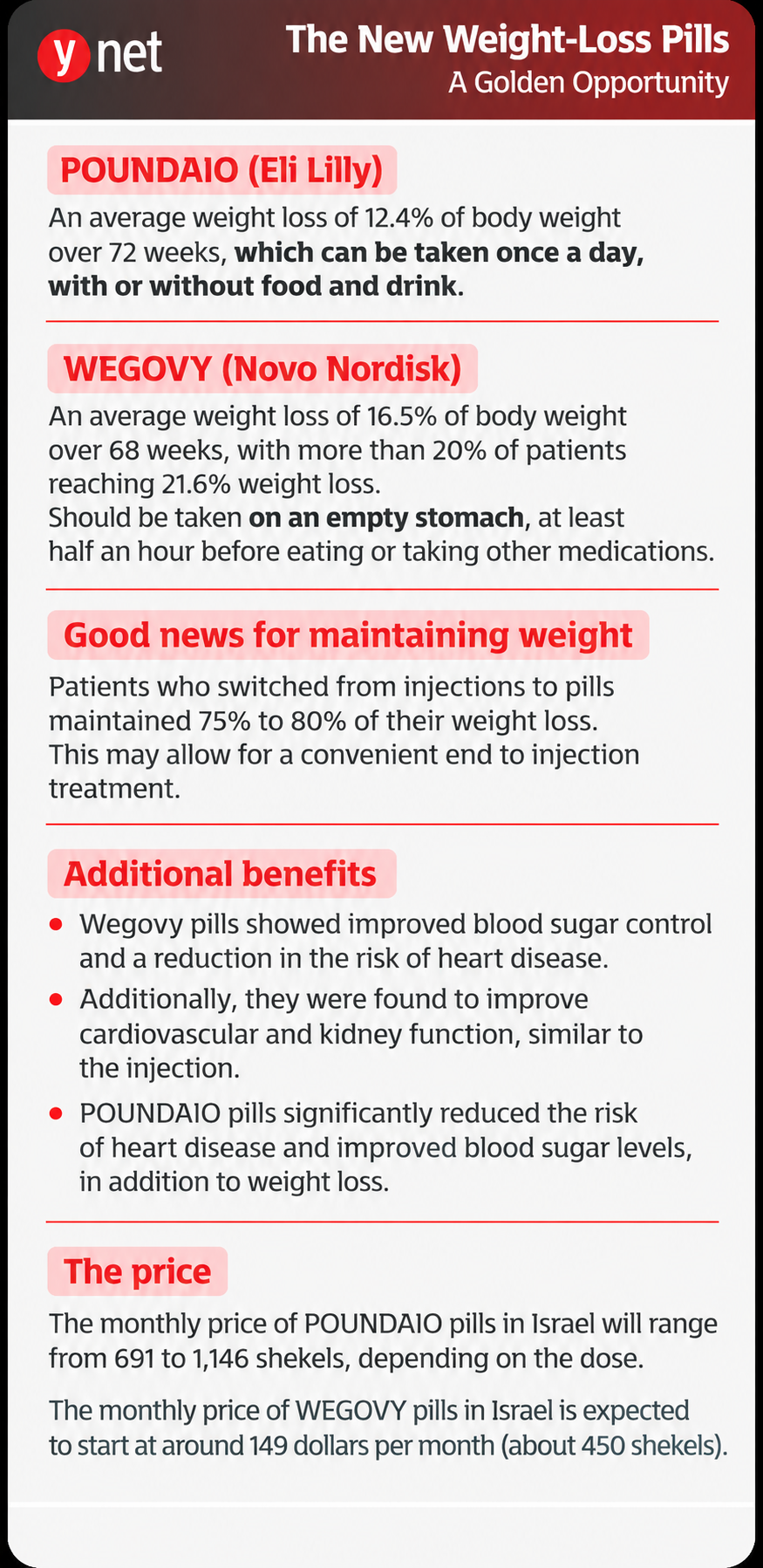
These were separate studies rather than a direct comparison, but the overall picture is clear: The pills work, but they have not yet reached the top league of the injections.
Still, Neuman sees the arrival of the pill as a genuine turning point.
“There is still a large segment of people dealing with obesity who would like to receive treatment but avoid it for the simple reason that it comes in injections,” he says.
“In my experience in the clinic, the reluctance does not stem only from a fear of needles or from technical difficulty operating the injection pen, but also from the deeper psychological meaning of treatment by injection, which some patients tend to interpret as though they are suffering from a ‘serious’ illness that cannot be treated by conventional means such as pills. The reluctance also characterizes patients who tend to travel frequently and do not want the logistical challenge involved in carrying the medications.”
Now, he says, those patients will finally be able to benefit from a new-generation drug treatment that is “as convenient and simple to take as any pill for another chronic condition, such as high blood pressure or cholesterol disorders.”
Lose weight with an injection, maintain it with a pill
Another advantage of the pill concerns maintaining results over time. The convenient oral treatment can serve as maintenance therapy for patients who have already lost weight with injections, and may even allow them to switch from injections to pills without losing the progress they have made.
This approach is based on the ATTAIN-MAINTAIN study, published in Nature Medicine, which examined precisely the question of switching from an injection to a pill. In the study, patients who had already lost weight using Wegovy or Mounjaro injections switched to treatment with orforglipron or placebo. Those who continued with the pill maintained 75% and 79% of the weight loss achieved in the two study groups, compared with only 49% and 38% in the placebo groups.
“Patients who have already begun treatment with injections and wanted to switch to pills for one reason or another will now be able to do so without fear, while maintaining the weight loss they achieved,” Neuman explains.

(Photo: Shutterstock)
But he notes that neither form of treatment is magic, and that treatment must always be accompanied by lifestyle changes — a balanced diet and physical activity, with an emphasis on strength exercises to preserve muscle mass.
The launch of the pill in Israel comes amid unprecedented demand for these drugs in the United States. Since POUNDAIO was launched there in April, more than 20,000 Americans have begun using it, and more than 8,000 doctors have already prescribed it to their patients.
POUNDAIO is also not the final word. Later, Israel is expected to receive the higher 7.2 mg dose of Wegovy, Novo Nordisk’s CagriSema and Eli Lilly’s retatrutide — an injectable drug that in studies produced average weight loss of more than 30% within about two years, a figure that until recently would have been considered almost unbelievable.
“In short,” Neuman concludes, “there is plenty to look forward to.”