

Control over light underpins many of the technologies used today, from cameras and sensors to communications systems and advanced computing. Yet while light travels at extraordinary speed, the components used to direct and shape it typically operate much more slowly.
A new international study, involving a researcher from Tel Aviv University's Faculty of Engineering, presents a way to overcome that limitation. The researchers succeeded in steering and shaping light beams in just 74 femtoseconds — less than one-tenth of a trillionth of a second. According to the researchers, in that brief interval, light travels a distance smaller than the thickness of a human hair.
Gallery
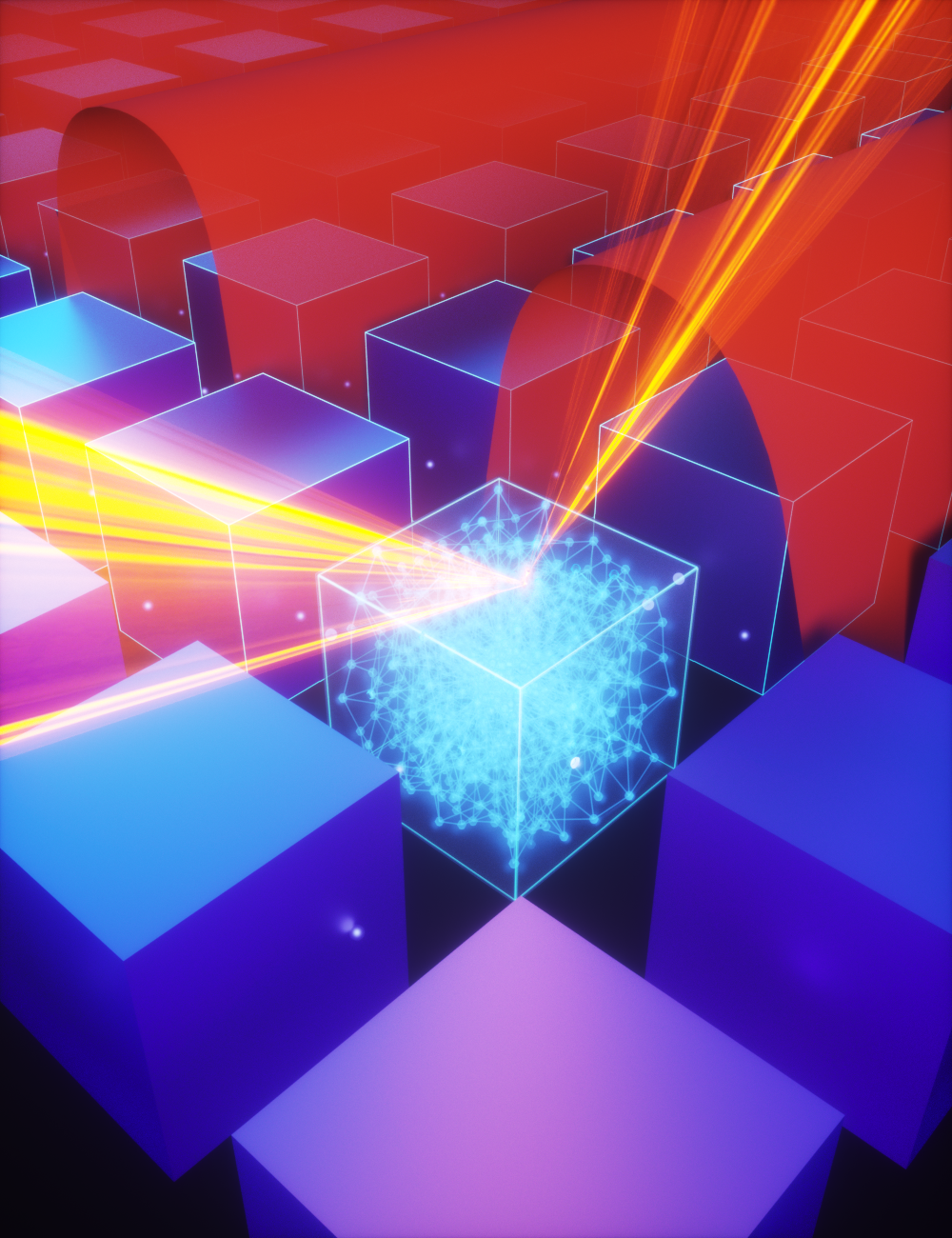
A metasurface developed in the study can steer and shape light beams in less than a trillionth of a second
(Illustration: Claudio Hail)
The study was led by Dr. Claudio Hail, now a faculty member at the University of California, Berkeley, with the participation of Dr. Lior Michaeli, who was a postdoctoral researcher at the California Institute of Technology (Caltech) at the time of the research and is now head of the Meta-Optomechanics Lab in the School of Electrical and Computer Engineering at Tel Aviv University. Both researchers were members of the research group led by Prof. Harry Atwater of Caltech, who supervised the study. The findings were published in the journal Nature Nanotechnology.
At the heart of the development is a metasurface — an ultrathin layer covered with tiny silicon structures, each smaller than the wavelength of light. Despite its microscopic dimensions, the surface's unique structure enables it to exert a powerful influence on light passing through it.
When the surface is illuminated with a short laser pulse, the light briefly changes the properties of the silicon. This makes it possible to control the beam passing through the surface without moving a mirror, lens or any other mechanical component. In experiments, the researchers steered the beam by up to 13 degrees in either direction. They also went beyond changing its direction: by altering the illumination pattern across the surface, they were able to shape the beam and generate complex light patterns.
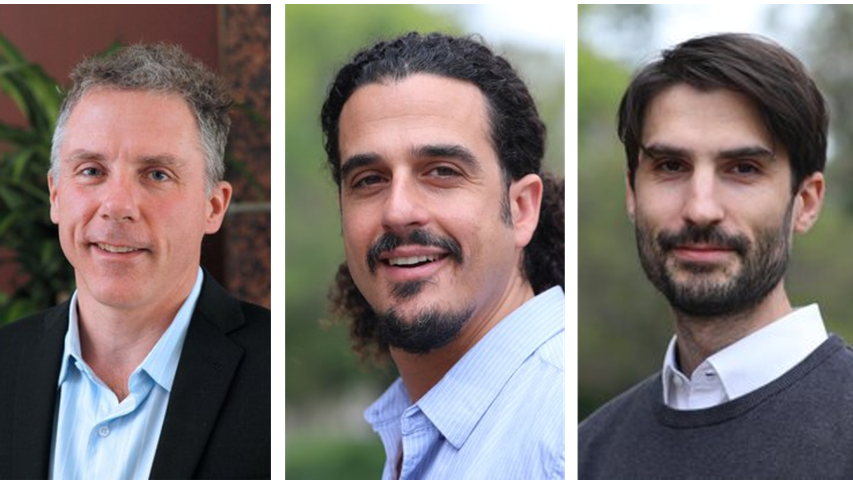
Prof. Harry Atwater, Dr. Lior Michaeli and Dr. Claudio Hail
The researchers explained that the component's function is not fixed in advance. The same surface can perform different tasks depending on how it is illuminated. The result is an ultrathin component with no moving parts that can change both the direction and shape of light almost instantaneously.
"For me, it is especially exciting to see an idea that has been with me for years become an experimental reality," Michaeli said. "The biggest challenge was that the ultrafast effect we wanted to harness is usually very weak. We had to design the metasurface so that it would amplify the effect enough for us not only to measure it, but actually to use it to steer and shape light."
According to the researchers, the measured switching speed was close to the duration of the laser pulse itself. That means even faster operation may be possible in the future using shorter laser pulses.
Today, in many communications and computing systems, information carried by light is converted into an electrical signal for processing and then converted back into light. The ability to control light directly at such speeds could eventually make it possible to perform some of that processing using light itself.
"The development could contribute to optical computers, high-speed communications systems, sensors and cameras capable of tracking extremely fast processes," Michaeli said. "Over the longer term, it could also be relevant for quantum photonics, where fast and precise control of light is essential. This research reflects the direction we continue to pursue at Tel Aviv University. Our goal is to use engineered structures to strengthen the interaction between light and matter and turn it into a tool for control, sensing and information processing."
The researchers stressed that the work remains basic research and is not yet a product ready for practical use. Even so, they said it opens new possibilities for components in which light not only carries information but also helps process it.