

The role played by K. — whose identity must not be revealed under any circumstances — sounds like something out of a science fiction movie. She herself admits that, from a young age, inspired by a mix of Star Wars films and the adventure books of her childhood, she dreamed of being part of the systems that defend the State of Israel.
Dreams do come true. For the past three years, during one of the most challenging periods for Israel’s security, K. has served as a vice president and head of the unit at Elbit Systems that develops some of the world’s most advanced high-power laser systems. Some of these systems are now entering operational use and are expected to transform Israel’s entire air defense array.
“Elbit’s Intelligence Division, where hundreds of engineers from various disciplines work, is considered the ‘delivery room’ of laser development in the State of Israel,” she says proudly, and with justification. “We’ve been developing laser technologies for all types of military applications for decades, and electro-optical systems since 1937. That’s quite a tradition.”
What do you do?
“We develop lasers for a range of IDF uses — for example, infantry applications, airborne applications and integration into aircraft and helicopter defense systems against shoulder-fired missiles. All of this led us to the capability to supply a high-power laser of more than 100 kilowatts for the Iron Beam system. In addition, we are developing high-power laser systems for airborne platforms.”
The Iron Beam system, a global technological and engineering breakthrough, is a high-energy laser system that seems drawn from science fiction. It is designed to defend against aerial threats such as rockets, mortar shells and unmanned aerial vehicles. The system is equipped with an advanced laser source and a unique electro-optical targeting mechanism, enabling it to intercept a wide range of targets at extended range with maximum precision and very high efficiency — all at negligible marginal cost.
The system, which began entering IDF service just last month, is already being integrated into Israel’s multilayered air defense array as a complementary capability to the Iron Dome, David’s Sling and Arrow systems. In recent days, there have been assessments that the system intercepted Hezbollah missiles fired toward Israel this week.
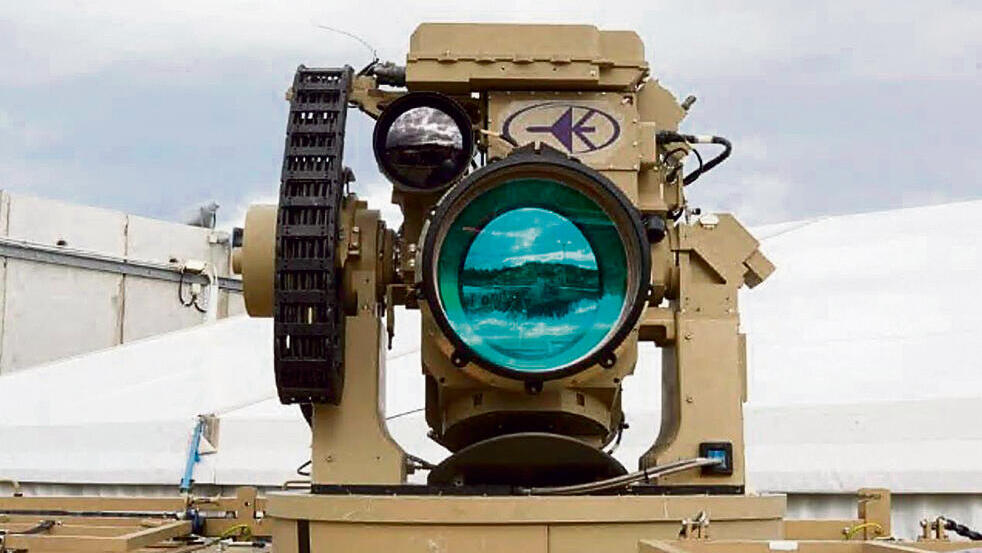
The Iron Beam laser defense system
(Photo: Spokesperson and Public Relations Division at the Ministry of Defense)
K., who played a significant role in developing the system, feels a heavy responsibility but also immense satisfaction. “I don’t sleep well at night,” she says, and this is understandable. She oversees hundreds of developers and engineers in mechanics, electronics, software and physics.
“I work at a Sisyphean and wonderful job, with many challenges and a lot of satisfaction. It’s completely a kind of Star Wars. The thing is, when I say ‘Star Wars’ to the young engineers working with me today, they don’t know what I’m talking about,” she laughs.
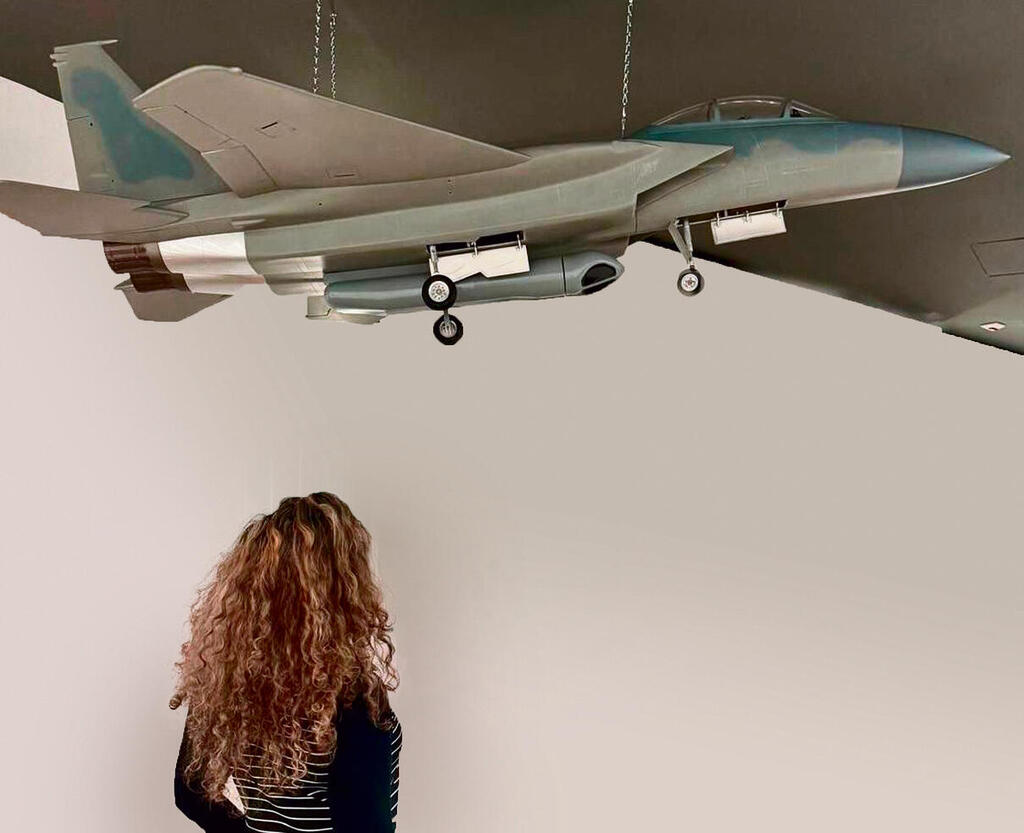
After the ground-based Iron Beam system, K.’s next challenge is to take laser interception systems into the air. The advantage of the high-power airborne laser system that she and her team are developing is enormous in terms of national defense. It would be able to move toward the threat and intercept it in the air outside Israel’s borders — unlike a ground-based laser system. The airborne system would also be dynamic, capable of intercepting above and below cloud cover. Science fiction in action.
When will the system you developed enter use, and what advantages will it provide that do not exist today?
“The ground system is currently in the process of becoming operational,” she said shortly before the outbreak of the war with Iran — meaning there is a strong chance it could be used in the current campaign to help intercept incoming threats and missiles. “This system is going to revolutionize Israel’s entire security doctrine. Later, in a few years, an additional airborne defense layer will be added, enabling combat helicopters to intercept threats with lasers that today can only be intercepted from the ground.”
How did the idea originate?
“We go back to Star Wars,” she explains. “In the past there were chemical lasers that were very dangerous and could not be used on the battlefield. In recent decades, fiber lasers have developed, and Elbit’s Intelligence Division is among the world leaders in producing them. When you combine many fiber lasers, you reach the high-power laser we developed, which is also safe to integrate into an operational battlefield system.”
To understand her enthusiasm, it helps to recall that a laser is a light source. When it strikes material, it raises the temperature at the point of impact to thousands of degrees, causing failure and destruction. The breakthrough achieved by K.’s unit is twofold: combining numerous laser fibers into a single high-power source and developing the capability to mount these powerful systems on aircraft, enabling them to strike enemy missiles and drones while they are still in the air — before they reach Israeli territory.
“This is truly a revolution in the IDF’s ability to defend the country, based on the extraordinary technological capabilities of Israeli teams who are world-class pioneers. Everyone is afraid that AI will replace us, but we’re already several steps ahead. The idea is to develop, based on the high-power laser we invented, an entire squadron of aircraft equipped with laser systems that can respond the moment a large number of threats are fired at us. The planes will take off and use lasers to eliminate large numbers of threats.”
When might such a squadron be established?
“We would like to operationalize the system in the coming years,” she says, as if discussing replacing printer ink. “We believe this will be the first system of its kind in the world. It’s a huge challenge for many reasons. First, there’s the issue of size — taking a ground system and producing something light enough to be carried on a combat aircraft without losing precision in a dynamic environment affected by aircraft movement, threat movement and weather conditions — that’s a big deal. Beyond that, the system has to hit accurately while in flight. For comparison, the required precision is like hitting a one-shekel coin from a distance of 10 kilometers.”
K., 53, married and a mother of three — “who were born into their mother’s job” — has worked at Elbit for more than 25 years. In her youth she dreamed of becoming an astronaut. After earning bachelor’s and master’s degrees in aeronautics and space engineering at the Technion, she worked as a control and navigation engineer on aerial photography projects, moved into systems engineering in autonomous vehicles and other complex systems, and now stands at the forefront of laser-based defense technologies.
What does it feel like when such a significant project, one you worked on for years, goes operational?
“Beyond the technological and engineering challenge, it’s an enormous feeling of pride and Zionism, especially over the past two years. We all give our soul to this, and there’s a profound sense of mission and immense satisfaction — a reward for years of work," she said. "This year I experienced another peak that took 26 years to reach, when a classified system I led with dozens of engineers became operational during the Swords of Iron war and won the Israel Defense Prize. It’s hard to describe the satisfaction and also the pride of my family and parents.”
First published: 17:37, 03.04.26