

One of the world's two most prestigious medical journals, The Lancet, published on Saturday a call to suspend the Israeli Medical Association (IMA) from the World Medical Association (WMA) "over its failure to speak out against the genocide of Palestinians."
The unusual publication, appearing under the journal's "World Report" section, marks a further escalation in growing boycott pressure against Israeli medical and academic institutions amid the war.
Gallery
The Lancet published on Saturday a call to suspend the Israeli Medical Association from the World Medical Association
(Photo: Shutterstock)
According to the report, 1,150 healthcare professionals signed a petition calling for the IMA's suspension from the WMA.
The petition was initiated by the People's Health Movement together with Artsen voor Gaza (Doctors for Gaza) and the Health Advisory Council of the Jewish Voice for Peace. The signatories urged that the suspension of the IMA be placed on the agenda of the WMA General Assembly, scheduled to convene in four months.
Prof. Ido Wolf, director of the Oncology Division at Tel Aviv Sourasky Medical Center and head of the medical school at Tel Aviv University, wrote on X: "Really scary. An article in The Lancet, one of the two most important medical journals in the world, is covering calls to boycott the Israeli Medical Association. The article also includes the IMA's response, but the very fact that the issue is being raised here lends legitimacy to the calls for a boycott."
Responding later to users, Wolf added: "The boycott is not against the Medical Association. It is a boycott of the entire Israeli healthcare system. New medicines, research, collaborations and professional training will all be harmed. It will cost patients' lives. They are the ones who will suffer."
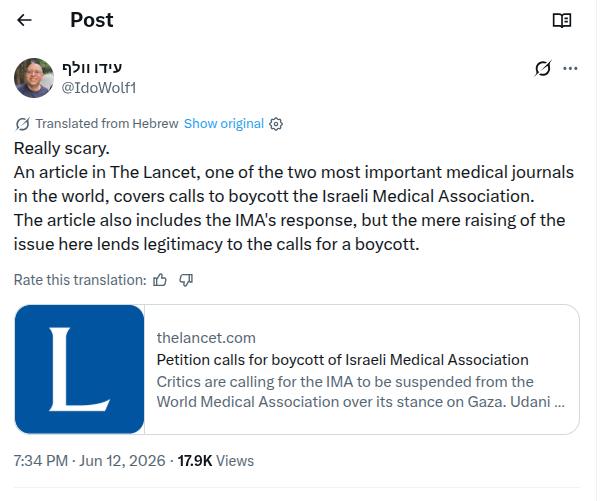
Prof. Ido Wolf wrote on X
(Photo: Screenshot from X)
Leslie London, Emeritus Professor of Public Health at the University of Cape Town and a member of PHM South Africa, told The Lancet that the IMA has "colluded in the unspeakable treatment of Palestinians during this war." He argued that the association had never acknowledged evidence of deliberate attacks on healthcare facilities and healthcare workers in Gaza, nor the conditions in which Palestinian detainees are allegedly being held.
Juliette Mattijsen, co-coordinator of the PHM Europe and a doctor in the Netherlands, says the IMA is “not upholding its medical oath; namely, to stand up for health roles and for colleagues being murdered and detained."
Derek Summerfield, honorary senior clinical lecturer at King's College London, who signed the PHM petition, said the IMA “have broken every WMA rule in the book”. In October, 2025, the South African Medical Association suspended links with the IMA and called for the IMA's suspension from the WMA over “the conduct of the IMA in the context of international medical ethics and humanitarian obligations” in the Gaza crisis.
IMA rejects allegations
The Israeli Medical Association strongly rejected the claims. In its response to The Lancet, it stated that "the accusations against us are, at best, lies and, at worst, disputed allegations presented as facts."
According to the IMA, the petition "ignores Hamas' role in the destruction of Gaza's healthcare system, including its deliberate strategy of hiding beneath and within hospitals and using them as command centers and ammunition depots, in violation of Article 19 of the Fourth Geneva Convention."
The association said it had issued statements calling for respect for medical neutrality, humanitarian aid for Gaza's civilian population and humane treatment of detainees in hospitals.
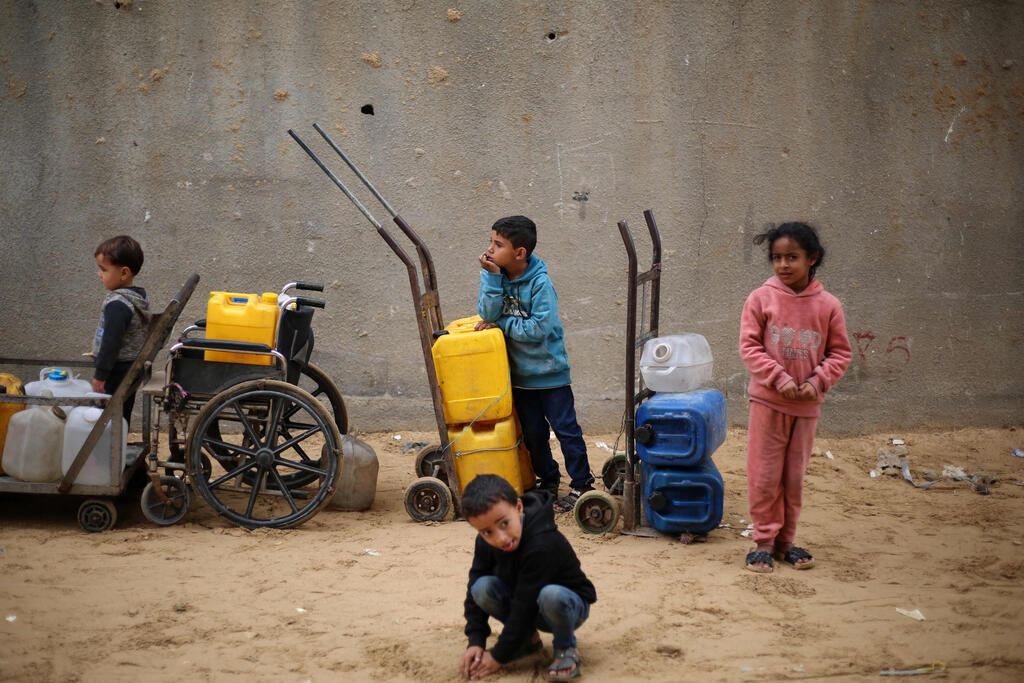
The association said it had issued statements calling for respect for medical neutrality
(Photo: Eyad Baba / AFP)
However, The Lancet noted that it had not found statements in which the IMA publicly condemned attacks on Gaza's healthcare system, criticized Israeli conduct during the war, called for a ceasefire or responded to UN reports alleging genocide.
The article's critics reject that assessment, noting that IMA chairman Zion Hagay twice appealed to the Israeli military chief of staff in July 2025, urging the entry of medical and humanitarian supplies into Gaza and stressing "the necessity of ensuring medical supplies and basic humanitarian conditions for the civilian population in Gaza."
Escalating boycott campaign
The call in The Lancet follows a series of actions involving the IMA over the past year.
In June 2025, the British Medical Association voted by a margin of more than 80% to suspend ties with the IMA and criticized the World Medical Association for condemning an attack on Israel’s Soroka Medical Center while failing to denounce the destruction of Gaza’s health care system. The move followed claims by BMA members that the IMA had remained silent regarding the killing, detention and targeting of Palestinian healthcare workers and facilities.
At the time, Hagay told ynet that British doctors had adopted a much more aggressive stance toward Israel since the start of the war and had shown bias from October 7 onward.
In October 2025, the South African Medical Association suspended its ties with the IMA and called for its removal from the WMA, citing concerns related to international medical ethics and humanitarian obligations during the Gaza crisis.

IMA chairman Zion Hagay
(Photo: Gil Nechushtan)
'A bright warning sign'
Nadav Davidovitch, director of the Center for Health Innovation Research and Social Impact at Bar-Ilan University and head of health policy at the Taub Center for Social Policy Studies in Israel, said the article represents "a troubling escalation in attempts to isolate the Israeli medical and scientific community internationally."
Beyond the symbolic dimension, Davidovitch warned that medical and academic boycotts could have far-reaching practical and ethical consequences. Medical isolation, he said, could cause multinational pharmaceutical companies to hesitate before including Israeli centers in clinical trials, delaying access to innovative, life-saving treatments for Israeli patients.
He also warned that damage to Israel's institutional standing could make it harder for Israeli researchers to lead or participate in international research collaborations, publish in leading journals, attend conferences and take part in professional exchanges and training abroad.
"Gradually, we are seeing more and more such cases," he said, cautioning that turning medical associations into political tools ultimately harms patients and undermines the universal values of the profession.
At the same time, Davidovitch argued that the Israeli medical community should play a more active role in addressing the ethical dimensions of the war, including the treatment of prisoners, protection of medical neutrality and humanitarian assistance.
"The article is a bright warning sign," he said. "If the current situation continues, it will directly harm the healthcare system. The response must be deep, transparent and proactive ethical engagement by the entire medical and healthcare community."
The WMA itself will decide whether to suspend the IMA at its October assembly. For now, the organization has expressed reservations about such a move. In comments to The Lancet, the WMA said it "deeply values engagement" and believes dialogue among its 117 national medical association members is essential to advancing health and medical ethics worldwide.
The organization stressed that it "opposes the exclusion of any member because of the actions of its government, as this weakens our ability to call for accountability and risks reducing dialogue among physicians at precisely the time when consensus in support of medical ethics is most needed."