

When someone is seriously injured, survival may depend on how quickly they receive first aid and whether the person treating them has the necessary medical equipment. But what happens when there are no bandages, splints or other basic medical supplies, and the nearest hospital is days away?
In South Sudan, this is not a hypothetical scenario. Medical workers and first responders often face severe equipment shortages, difficult field conditions and lengthy delays in evacuating patients to hospitals.
Gallery
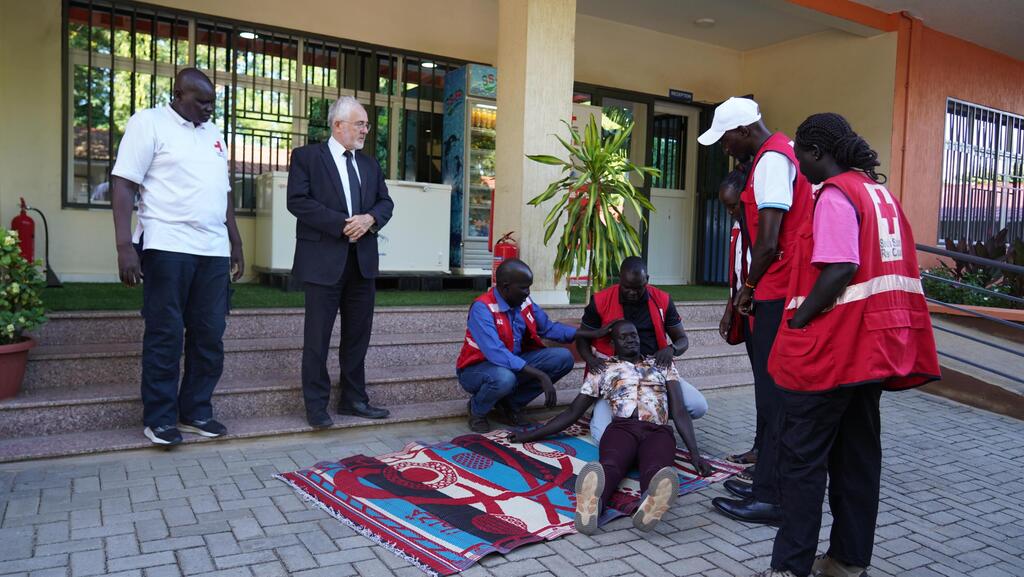
Participants learned how to control bleeding, dress wounds and stabilize injuries using household items such as old bedsheets, towels, blankets and sticks
(Photo: Red Cross)
To help address these challenges, Israel's national emergency medical service, Magen David Adom (MDA), has trained local Red Cross first aid instructors to treat injuries using whatever materials they can find. The training, led by Chaim Rafalowski, MDA's director of disaster preparedness, focused on practical solutions for emergencies in which conventional medical equipment is unavailable.
Participants learned how to control bleeding, dress wounds and stabilize injuries using household items such as old bedsheets, towels, blankets and sticks. A bedsheet, for example, can serve as an improvised bandage, while sticks and other rigid materials can help immobilize an injured limb.
Beyond learning these techniques, the instructors developed realistic emergency scenarios based on conditions they are likely to encounter in their own communities. The exercises allowed them to practice making critical decisions with limited resources, preparing them to pass those skills on to other first responders.
The situation can be particularly difficult in remote areas, where a first responder may be the only person available to provide medical care for days.
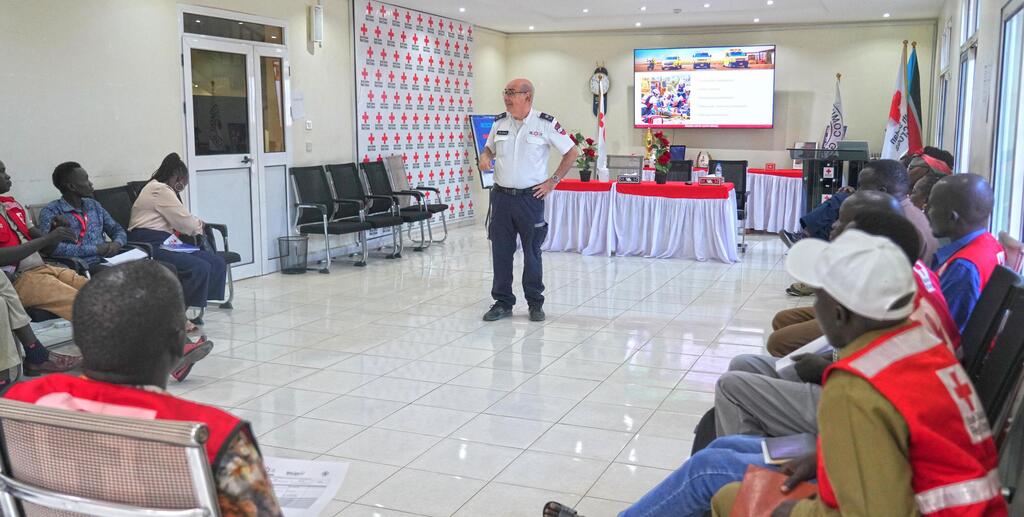
Israel's national emergency medical service, Magen David Adom (MDA), has trained local Red Cross first aid instructors to treat injuries using whatever materials they can find
(Photo: Red Cross)
"A first aid provider may be the only person available to deliver medical care at the scene for a day or two, until evacuation to the nearest hospital becomes possible," said Uri Shacham, MDA's director of movement relations and coordination.
Shacham noted that conditions rarely encountered by Israeli emergency medical teams are an everyday reality for their counterparts in South Sudan.
The workshop was organized through a collaboration involving MDA, the Israeli Embassy in South Sudan, the Israeli Foreign Ministry's Agency for International Development Cooperation (MASHAV) and the International Committee of the Red Cross.
The initiative builds on previous Israeli medical assistance efforts in South Sudan, including the establishment of a trauma center at a teaching hospital in Juba, the country's capital.
Israeli Ambassador to South Sudan Gershon Kedar said the training was intended to help Red Cross personnel across the country respond more effectively to life-threatening emergencies.
He also emphasized the broader relationship between Israel and South Sudan, saying that initiatives aimed at developing local professional capabilities contribute to stronger ties between the two countries.
MDA Director General Eli Bin described the program as part of the organization's longstanding cooperation with the South Sudan Red Cross and its efforts to share Israeli emergency medical expertise internationally.
For the instructors who participated, however, the immediate goal was more practical: learning how to provide potentially lifesaving care when professional equipment and hospital treatment are out of reach.
In those circumstances, knowing how to turn a blanket into a medical aid or a simple stick into a makeshift splint could make all the difference.