

Tel Aviv’s Space Center
Tel Aviv University has launched a new Space Engineering Center in its Faculty of Engineering. The center currently brings together five researchers from a range of fields connected to space activity, including materials engineering, information theory, inertial navigation, communications and quantum encryption.
The new center will expand the university’s satellite-building activity, which has been growing in recent years. “Until now, we have built nanosatellites weighing up to three kilograms. We now have equipment for integrating and testing satellites weighing up to 30 kilograms, which allows us to build satellites with far greater capabilities and carry out a wider range of space missions,” Professor Meir Ariel, head of the center, said.
Gallery
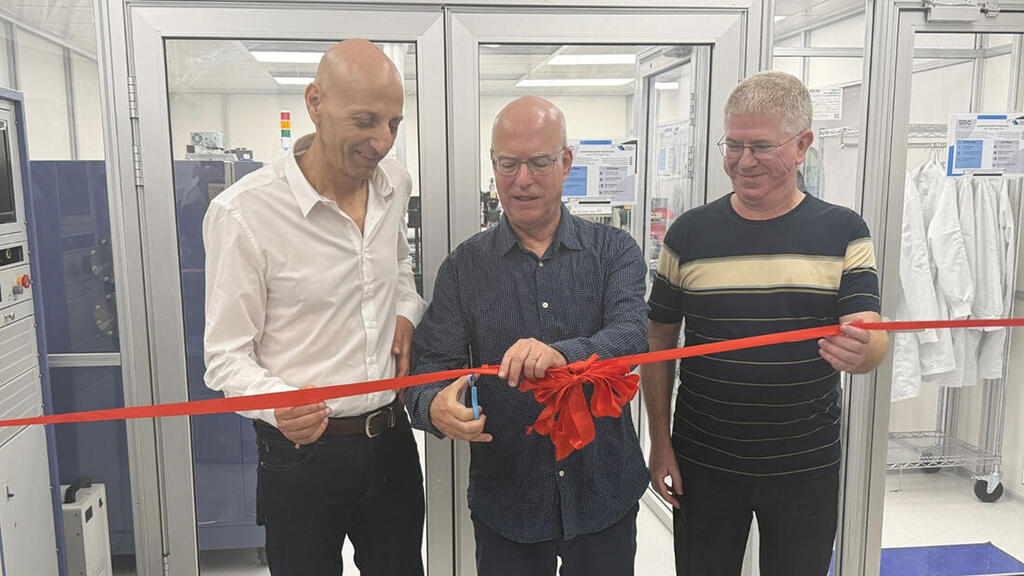
Working on satellite number 24. Meir Ariel (left), with Tel Aviv University President Ariel Porat (center) and Dean of the Faculty of Engineering Noam Eliaz, at the inauguration of the Space Engineering Center
(Photo: Tel Aviv University)
“Several million shekels were invested in establishing the center. At the same time, we opened new tracks within the engineering schools, so that students in fields such as electrical engineering or materials engineering can earn a master’s degree in their discipline with a specialization in space engineering.”
A significant share of the space center’s funding comes from tenders to build satellites, in which it competes against commercial companies. To date, the university has built 23 satellites, most of them as part of the two cycles of the Tevel program — led by the Israel Space Agency. In the program, high school students, mainly from Israel’s periphery, develop and launch tiny research satellites.
“We are now building satellite number 24, a 16-liter satellite under a Ministry of Defense tender that we won, for testing certain technologies in space,” Ariel added. “This is already the fourth satellite we are building for them. We also collaborate with other organizations, such as the Nuclear Research Center, and these partnerships sometimes make it possible to use a single satellite for several different applications.”
One of the defining features of the new center is its multidisciplinary approach, both among its researchers and among their roughly 20 graduate students. In addition to Ariel, the center’s researchers are Professor Slava Krylov, Professor Ofer Amrani, Professor Ronen Werker, and Dr. Lior Medina.
“These collaborations allow us to harness the expertise of all the researchers so that we can compete successfully in tenders and develop products for our clients. The center also gives students hands-on experience in space engineering. Our aim is for the outcome of their research always to become part of a real satellite that flies into space,” Ariel said. “Aside from tenders, an important source of funding for academic research is research grants, including international grants, but these have become very difficult to win. We are being boycotted without anyone saying so openly, and we have felt it very strongly over the past two years.”
Recovering from the explosion
Blue Origin says it will resume New Glenn launches later this year, despite the heavy damage caused to its launch pad at Cape Canaveral when a rocket exploded there on May 28. The explosion occurred during a static fire test, in which the engines are fired while the rocket remains secured on the ground. No one was injured, but the launch pad and the surrounding area sustained extensive damage.
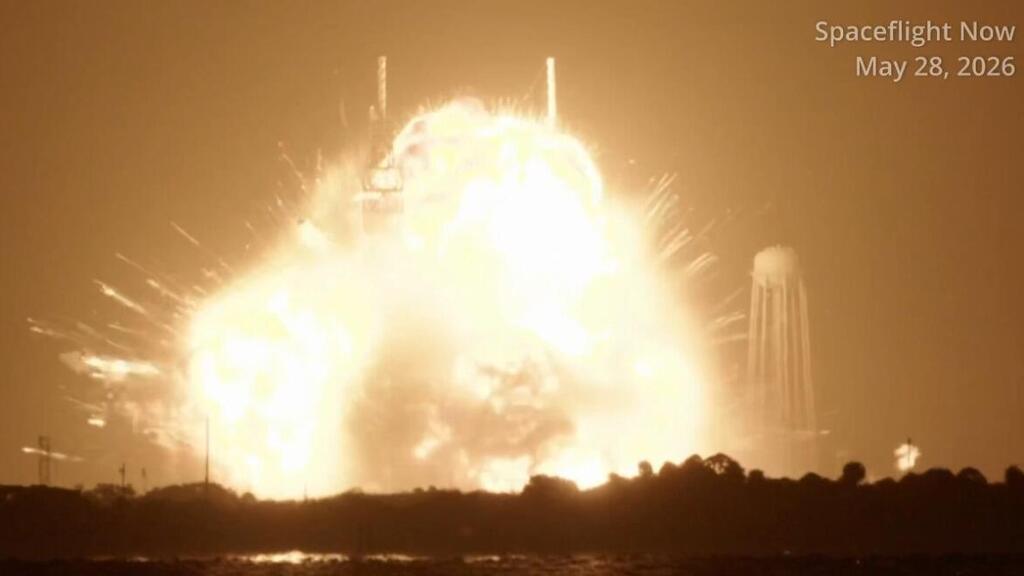
Blue Origin's New Glem rocket explodes on the launch pad
(Photo: NASASpaceflight, from social media)
Still, Blue Origin CEO Dave Limp wrote in a post on X last Tuesday that the fuel tanks near the launch pad were not damaged, nor was the water tower that supplies cooling water during launches. He added that other company rockets in the nearby assembly building also appear to be in good condition. Limp also said the company would not rebuild the transporter vehicle used to move the rocket from the assembly building to the launch pad, because it had already begun developing a different transport system and will continue developing that system.
Limp also addressed rumors that Blue Origin would abandon the next launches of the current New Glenn model, which has seven engines in its first stage and two in its second, and instead accelerate development of larger rockets — with nine and four engines, respectively — along with the launch pad intended for them, rather than repair the damaged pad. He stressed that production of the current model is progressing well and will continue, and that the rockets now being built will be stored until they can be launched. “We will fly again before the end of this year,” he promised.
NASA Administrator Jared Isaacman sounded less optimistic after touring the explosion site with Limp and other Blue Origin executives. “Even if you’re moving at… a pretty quick pace, that’s going to take some serious time,” Isaacman said in an interview with CNBC. Just last week, NASA announced that Blue Origin had won the contract for the Moon Base 1 mission, which is intended to send the company’s uncrewed Blue Moon Mark 1 lunar lander to the Moon later this year. The company also won contracts to deliver two rovers, developed by other companies, to the lunar surface. All three missions are supposed to launch on New Glenn rockets — which currently have no operational launch pad.
Blue Origin is building another New Glenn launch pad at Vandenberg Space Force Base in California, but work there is still at a relatively early stage. The rover delivery missions are planned for 2028, which Isaacman said was still “within the realm” of a possible launch-pad recovery timeline. The near-term mission, however, puts Blue Origin in “Falcon Heavy land,” he said, referring to SpaceX’s super-heavy-lift rocket. “In terms of heavy lift, you know, real heavy lift, you’ve got SpaceX and Blue Origin, and obviously one of them is down a pad right now.”
Blue Origin has not yet announced what caused the explosion, but experts estimate that a malfunction in one of the engines ultimately caused the rocket to ignite. The engines in question are Blue Origin’s BE-4 engines, which are considered relatively reliable: they have already successfully launched three New Glenn rockets and are also used on ULA’s Vulcan rockets. The company will likely identify the fault and receive approval to resume New Glenn launches — but for now, it has no place to launch them from.
SpaceX and Blue Origin are currently competing to develop the first crewed spacecraft that will land humans on the Moon as part of NASA’s Artemis program. The launch of Blue Moon Mark 1, a smaller version of Blue Origin’s crewed lunar lander, is an important step toward that goal. It will be interesting to see whether Blue Origin asks to launch its spacecraft on a rocket built by its rival — and how SpaceX would respond if such a request is made.
The launch pad went up in flames. The explosion of the New Glenn rocket on Blue Origin’s launch pad:
A trillion-dollar company heads to market
SpaceX has won a U.S. Space Force contract worth more than 4 billion to develop tracking satellites for detecting missiles and other aerial threats. The satellite network will be part of the “Golden Dome” system, designed to provide air defense for the United States. The Space Force plans to begin operating the detection − satellite system as early as 2028. SpaceX is expected to receive $4.19 billion for developing the satellites, though the announcement did not say how many will be included in the network.

Elon Musk, founder and CEO of SpaceX
(Photo: Frederic Legrand - COMEO/Shutterstock)
Last week, SpaceX won another contract, worth more than $2 billion to build a secure satellite internet network for the Space Force. The system is intended to enable the rapid and covert transfer of information between threat-detection systems and interception systems.
The two contract wins came ahead of SpaceX's initial public offering, the largest IPO in history. The company reported that it plans to offer 555,555,555 shares at $135 per share, raising about $75 billion and implying a post-offering valuation of roughly $1.77 trillion. Ahead of the IPO, Musk merged SpaceX with his artificial intelligence company, xAI, signaling his intention to push into the field of space-based data centers.
Back safely to base
Three Chinese astronauts returned from China’s Tiangong space station last weekend, after a 210-day mission in space. Zhang Lu, Wu Fei, and Zhang Hongzhang were launched to the station in late October 2025. Their mission was extended by a month after a crack was discovered in the window of the spacecraft that had carried the previous crew.
That crew returned to Earth in the spacecraft originally intended for Zhang, Wu, and Zhang, leaving the three astronauts temporarily without an emergency return vehicle. China’s space program then launched the spacecraft designated for the Shenzhou 22 mission without a crew. The three astronauts have now returned safely aboard that spacecraft, while the crew that arrived to replace them has been assigned the number 23. One of the three new crew members is expected to remain in space for a full year, although Chinese officials have not yet announced which one it will be.
Returning a month later than planned. The landing of the Shenzhou 21 spacecraft in northern China:
A surprise launch
China has successfully launched its new Long March 12B rocket on its maiden flight. The rocket closely resembles SpaceX’s Falcon 9, with a first stage designed to be reusable and to return for a controlled vertical landing, much like its American counterpart. On last week’s launch, however, the China Aerospace Science and Technology Corporation (CASC) did not attempt to land the first stage.
The launch from the Jiuquan Satellite Launch Center in the Gobi Desert came as a surprise, with no prior notice of an airspace closure, as is customary. Another surprise was that the rocket carried two satellites into space on its very first flight. The satellites are part of the Qianfan network, a communications constellation designed to provide internet from space — China’s answer to SpaceX’s Starlink network. CASC reported that the satellites were successfully placed in low polar orbit around Earth.
The Long March 12B is nearly identical to the Long March 12A, which made its maiden flight last year and failed in its attempt to land the first stage. The main difference is the fuel: the 12A is powered by methane, like Starship, while the 12B uses kerosene, like Falcon 9. In addition to the state-owned corporation, several Chinese companies are developing similar rockets, including LandSpace, whose Zhuque-3 rocket made its maiden flight late last year, though its first stage exploded during the landing attempt. CAS Space, Galactic Energy, and Deep Blue are also developing similar rockets with reusable first stages.
A successful launch, without an attempt to recover the rocket’s first stage. The launch of Long March 12B on June 1st:
Jupiter and the shock wave
Space is full of particles moving at tremendous speeds, but exactly how they are accelerated to such velocities has long remained an open question. Now, an analysis of data from NASA’s Juno spacecraft, which orbits Jupiter, provides the first observational evidence supporting a theoretical model that may explain the process.
When a planet moves through space, shock waves form in the region where its atmosphere meets the solar wind — the stream of particles and radiation emitted by the Sun. Physicists call these bow shocks, because they resemble the waves that form at the bow of a ship as it pushes through water. In “ordinary” shock waves, such as those created when a meteorite enters Earth’s atmosphere, particles in the medium in which the wave forms are compressed and collide, and the medium — in this case, the atmosphere — behaves like a fluid.
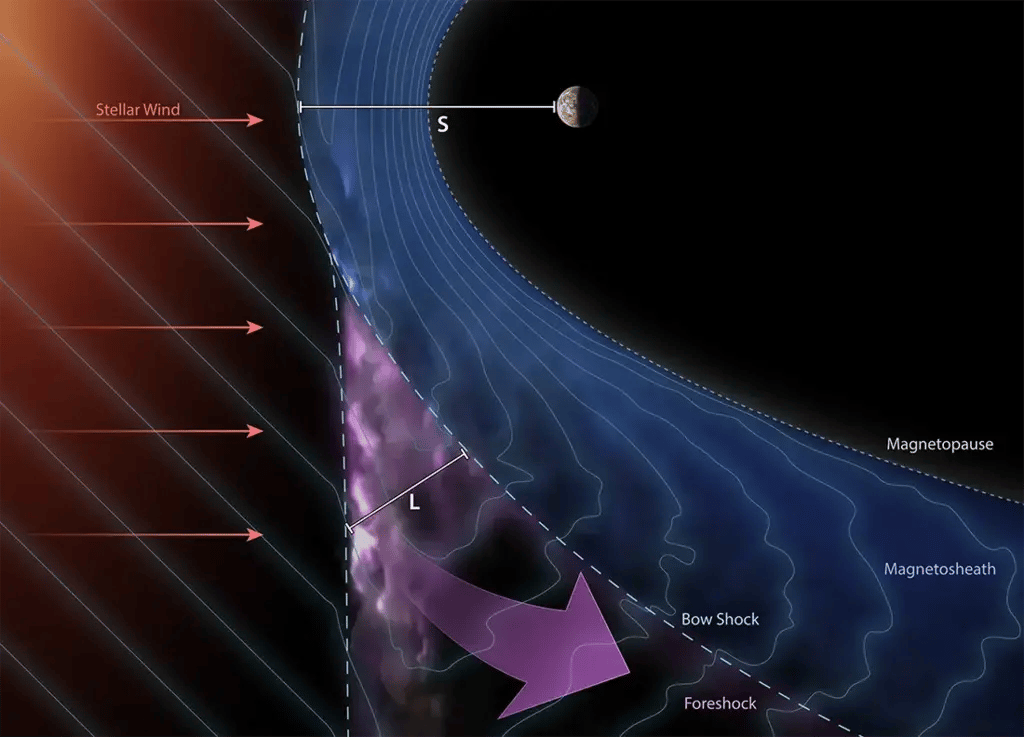
Transient plasma structures in the region ahead of the shock front accelerate particles in the direction of the arrow | Illustration: Ben C. Smith, from the research paper by Raptis et al.
In space, by contrast, shock waves form in extremely low-density plasma, where particles rarely collide with one another. These shock waves are therefore not driven by direct particle collisions, but are mediated by the plasma’s electric and magnetic fields. Researchers believe that such collisionless shock waves can accelerate electrons and other particles to nearly the speed of light, but until now there had been no practical way to examine the idea.
The researchers, led by Savvas Raptis of Johns Hopkins University in the United States, used measurements taken by Juno, which has been orbiting Jupiter since 2016. The spacecraft measured particle flows as it passed through Jupiter’s bow shock. When the researchers analyzed the data, they found that in a region even farther upstream, ahead of the main shock wave, short-lived plasma structures form and quickly disappear — and that these structures are what accelerate particles to nearly the speed of light.
How close is “nearly”? The researchers compared the Jupiter data with radiation measurements from other planets and concluded that particle speed depends on the size of the bow shock, which in turn depends on the size of the object creating it and the properties of the upstream medium. In their paper in Nature, the researchers write that this acceleration model could also help explain particle acceleration in other systems, including protostellar jets — jets from forming stars — and the remnants of supernova explosions. It may also provide key insights into the formation of the cosmic-ray spectrum, meaning how cosmic rays are distributed across different energies.