

This is dedicated to the memory of our cousins Yosef Malachi Gedaliah and Ben Zusman, and all our soldiers, may Hashem avenge their blood, who fell defending the people and the State of Israel.
In the Torah portions of Acharei Mot and Kedoshim, the word "blood" appears 31 times across 21 different verses. This frequency highlights a central theme within these portion, organized into three distinct groups of seven verses each.
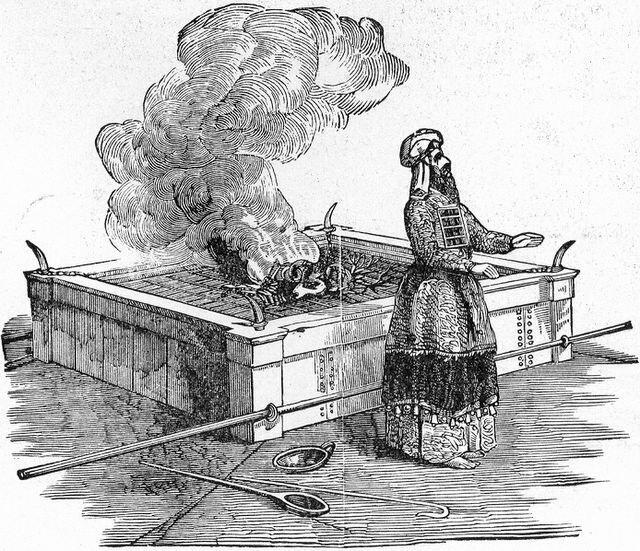
'High Priest Offering a Sacrifice of a Goat' (illustration from Henry Davenport Northrop's 1894 'Treasures of the Bible')
(Photo: Wikimedia Commons)
The three pillars of blood
The first group, found at the beginning of Acharei Mot, details the Temple service and the sprinkling of blood on the covering of the Ark and the altar during the Yom Kippur atonement rituals. The final group, at the conclusion of Kedoshim, warns those who commit severe sins that “they shall be put to death by stoning, their bloodguilt shall be upon them."
Between these two sections lies a middle group of seven verses that discuss blood in various contexts:
● The prohibition of slaughtering animals outside the Tabernacle.
● The obligation to cover the blood of hunted animals or birds.
● The strict prohibition against consuming blood.
The Torah explains this prohibition by noting that blood, which carries oxygen to produce energy (ATP) for all life processes, is the "nefesh," or the pulsing soul of the creature. This concept transitions into the social sphere with the command: "Do not stand idly by the blood of your fellow," an allegory emphasizing the duty to save human life.
Historical and moral context
After the Flood, God commanded Noah that, while meat may be eaten, one must not eat "flesh with its lifeblood." Sages interpret this as a prohibition against eating a limb from a living animal, suggesting that a disregard for animal life can lead to a disregard for human life and even murder.
In Deuteronomy, as the Israelites prepared to enter the land, they were warned: "Only be strong not to eat the blood." This echoes the encouragement given to Joshua to "be strong and courageous" during conquest. The warning serves to ensure that the fervor of wars against other peoples, and the occupation, will not turn them into beasts and make them bloodthirsty, causing them to lose their humanity.
Distinguishing Israeli identity
In this week's Torah portions, the opening describes the blood of atonement, and emphasizes precision and respect rather than gore. Using small amounts of blood from kosher animals, which lack the biological predator drive to sin, serves to atone for the souls of humans who have the choice to err.
Later, the Torah explicitly contrasts the desired behavior of Israel with the "doings of the land of Egypt" and the "doings of the land of Canaan." While Canaan represents a culture of unbridled lust and immorality, Egypt represents a culture of blood and the devaluation of life. Egypt’s first plague was blood because they filled the Nile with the blood of Hebrew infants. In contrast, Israel used the blood of the Passover lamb to mark their homes as a sign of life and salvation.
Then we get to the phrase “Do not eat over the blood” which has several interpretations:
● The Ramban views it as a prohibition against a type of witchcraft where people would gather around a pit of blood to bribe evil spirits from Sheol (the shadowy underworld) and predict the future.
● The Talmudic Sages expanded the meaning to include various ethical behaviors, such as the prohibition against a court eating on the day they issue a death sentence, or the prohibition against gluttony.
Ultimately, these laws cultivate a culture of self-control and a profound appreciation for life. The goal is the shaping of a distinct Israelite identity that sets itself apart from the two dominant cultures of the region - the bloodthirsty Egyptian and the instinct-saturated and licentious Canaanite.
Through a series of prohibitions and commandments, culminating in the injunction to honor the image of God within man: "You shall rise before the aged and show deference to the old," a set of norms is constructed for the establishment of a model society and a human civilization that is not predatory. Therefore, in the injunction to not eat blood because it is the lifeblood and since the behavior of one affects the other, the commandments include the stranger as well. For example: "No person among you shall partake of blood, nor shall the stranger who resides among you partake of blood."
A modern reflection
As we reflect on Israel's Memorial Day and Independence Day that just took place this week and while we remain in a struggle that exacts a heavy "price of blood," it is essential that we remain an army and a nation that treats every individual as being created in the Image of God.
While the gentile prophet Bilam might describe Israel using the predatory language of "eating prey" and "drinking the blood of the slain," that is the language of our enemies, not our own. And it is astounding how little things have changed since then.
Our goal remains to build a model society of solidarity - one where we "do not stand idly by the blood of our fellow." We owe our lives to those who went out to defend the nation, embodying the highest values of humanity and love for others. May their memory be a blessing.
First published: 23:30, 04.23.26