

Behind the massive show of support that included the placement of a million and a half Israeli flags across the United States stood not the Jewish-American community, but rather the Christian one.
Daniel Edelson visited one of the 1,300 churches that participated in the International Fellowship of Christians and Jews’ annual event and met the people who insist on standing with Israel while the world turns against it. “You can be cynical or keep saying that we can rely only on ourselves,” says Yael Eckstein, president of the Fellowship. “But the only way to fight antisemitism is together.”
A pro-Israel event in Nashville
(Video: Daniel Edelson)


The first thing Ilan Isaacson, saw upon landing at Nashville Airport, aside from the local honky-tonk band greeting arriving passengers, was a bodyguard. The security chief of the Eshkol Regional Council, a survivor of the October 7 massacre who was sent by the Fellowship to tell his story at a southern U.S. church, hadn’t imagined he would need close protection there. “Poor guy,” Isaacson says with a half-smile, “he lost track of me for half an hour and panicked.”
After October 7, many U.S. religious institutions tightened their security, but since the murder of Charlie Kirk, that anxiety has been in overdrive. The guard escorts Isaacson to a large SUV. They drive south, far from the Sodom and Gomorrah of Nashville’s Broadway, deep into the heart of America’s “Bible Belt”, or as locals call it, its buckle. As the scenery opens, the cheerful capital of country music gives way to a land of faith. Billboards quoting Bible verses mix with commercial ads and then, suddenly, blue and white. Hundreds of Israeli flags line the roadside. To be exact: 1,200 — nearly the number of victims of the October 7 massacre.
Gallery

Show of support for Israel
(Photo: courtesy of Daniel Edelson and the International Fellowship of Christians and Jews)
The road leads to the World Outreach Church in Murfreesboro, Tennessee, one of 1,300 churches that took part this year in the “Flags of Fellowship” event, a large-scale initiative by the International Fellowship of Christians and Jews (IFCJ) that has become a symbol of Christian support for Israel since the war. In each community, from the East Coast to California, 1,200 Israeli flags were planted as a sign of remembrance and solidarity. In total, over 1.5 million flags were raised, a sight unseen since October 7.
With over 10,000 congregants, World Outreach Church is everything one would expect from a southern “mega-church”: a sprawling 740-acre campus complete with a café, classrooms, a gift shop, and four massive worship halls. The community is led by Pastor Allen Jackson, one of the most prominent voices in the southern evangelical movement and a longtime friend of Israel. As a child, he split his time between Tennessee and Jerusalem. “His voice is one of the strongest in confronting antisemitism among Christians,” says Robin Van Etten, CEO of IFCJ USA. “He speaks openly about the need to face our shared enemy — radical Islam. You see it in Europe, and it’s happening here, too. There’s a saying: ‘They come first for the Saturday people, then for the Sunday people.’”

Ilan Isaacson
(Photo: Daniel Edelson)
In the vast worship hall, now bathed in blue and white light, Pastor Jackson takes the stage. Behind him, images of Jerusalem are projected, and the words “Shalom to Israel” appear on the screens in Hebrew. Thousands of worshippers rise to their feet, singing together, “Pray for the peace of Jerusalem.” Jackson raises his hand to the crowd: “How many of you are willing to pray for Israel, for the hostages?” and the audience erupts with cries of “Amen!” “Charlie Kirk was supposed to stand here this week,” Jackson says in a broken voice. “But he was murdered. We will continue what he began.” He invites Isaacson to the stage to share his story of that terrible morning near Gaza, of homes burned, friends murdered and kidnapped. “Your prayers strengthen us,” Isaacson says, and the crowd rises to its feet.
In his main sermon, Jackson speaks candidly about the roots of Christian antisemitism: “The greatest persecutor of the Jews throughout history has been the Church, and it’s horrifying to see Christians continuing that today. There is a clear line of evil in the world — and whoever doesn’t see it is simply blind.” He indirectly criticizes conservative broadcaster Tucker Carlson: “When I hear Christians separating the Jews of the Bible from the Jews of today — that’s nonsense. Utter nonsense. There is no nation like Israel, and you can’t miss it. It’s written in the Bible seventy times.” Jackson adds a disclaimer that earns a smile from the crowd: “That doesn’t mean Israel is always right. If you land at Ben-Gurion Airport tomorrow , you probably won’t hear the flutter of angel wings. But honestly — your church isn’t perfect either.”

Yael Eckstein, president of the International Fellowship of Christians and Jews, at Nir Oz."
(Photo: courtesy of Daniel Edelson and the International Fellowship of Christians and Jews)
The lights dim, and a short film begins playing, horrifying scenes from October 7. The crowd falls silent. “I see antisemitism now at a level I’ve never seen before,” Jackson says. “And much of it comes from Christians — past and present. This is the time to choose a side.”
Outside, in the field behind the church, dozens of young volunteers bend down to plant flags — children, parents, young couples. Eight-year-old Brooke Hand insists on planting one more: “It’s important because Israel has so many wars and it’s not fair.” Beside him stands Rachel Wood, nine months pregnant, placing flag after flag. “There’s a lot of confusion among Christians,” she says. “Not everyone understands why it’s important to support Israel. But God didn’t replace the Jewish people. We’re here to remind others of that.”
As they speak, a car passes by, a woman in a hijab leans out, shouting “Free Palestine,” recording everything on her iPhone. Rosa smiles sadly: “Just ignore it — we’re used to it.”show the world what it means to stand with Israel.”
Momert says the youth in his church are exposed on social media, especially TikTok, to anti-Israel content. “They ask, ‘Why should we even support Israel?’ It’s a real information war.” Tim and Rosa Harris say that when they wear an Israeli flag pin or a Star of David necklace in public, people glare at them. “We have work to do in our community,” says Tim, referring to the Black community. “People hear ‘racism’ and ‘minority,’ and their hearts go straight to the Palestinians. I can’t even talk about it with my own family. I used to get angry and walk away; now I just tell my truth.” As they speak, a car passes by — a woman in a hijab leans out, shouting “Free Palestine,” recording everything on her iPhone. Rosa smiles sadly: “Just ignore it, we’re used to it.”

Show of support for Israel
(courtesy of Daniel Edelson and the International Fellowship of Christians and Jews)
Conservative podcaster Brandon Tatum recently faced backlash after accepting an invitation from one of his regular listeners, Yair Netanyahu, to interview his father, the Prime Minister. “It was an incredible honor,” Tatum says. “But right after that came a wave of hate, even from pastors. They called me a traitor, said I’d ‘sold out.’ It’s ridiculous. I don’t know anyone who’s been paid to support Israel. I’ve always supported it. Anyone who doesn’t, just doesn’t understand the Bible.” Tatum says criticism came not only from the left but also from within the conservative and evangelical right. “There are Christians who distort Scripture, as if God replaced the Jews. And there’s also a part of the MAGA movement that’s gone too far, believing conspiracies about Israel. It’s frightening.”
One man who experiences this firsthand is Pastor Johnny Moore, a board member of the IFCJ and one of the most influential voices in the evangelical movement. Since assuming his additional role as head of the Gaza Humanitarian Foundation, he has received death threats against himself and his family and must live under heavy security. “The threats come from both directions,” he says, “from the far left and the far right, a strange alliance united by one thing only: shared antisemitism.”
It used to be almost automatic: being an evangelical believer meant taking the Bible literally, “I will bless those who bless you, and curse those who curse you.” Whoever blesses the Jewish people will be blessed; whoever curses them will be cursed. But today, that’s no longer taken for granted. “The generation of pro-Israel preachers like Billy Graham is fading,” says one elderly attendee. “The question is whether our kids will carry that same love for Israel. Honestly, I don’t know. They ask more questions — not out of weakness, but because they didn’t grow up in the same reality.” Moore firmly rejects that assumption.
“It’s simply not true that support for Israel is weakening among younger generations. The polls showing that aren’t reliable and I say that as an academic who studies the issue. But I am deeply worried about the rise of far-right antisemitism — a classic Christian antisemitism we thought was gone, now returning. Outsiders think it’s coming from within the faith community, but it’s not. These aren’t pastors or believers — they’re media figures, podcasters, influencers. They don’t speak for the Church.”

Show of support for Israel
(Photo: courtesy of Daniel Edelson and the International Fellowship of Christians and Jews)
When asked what prevents anti-Israel discourse from penetrating younger evangelicals, he answers immediately: “Work. A lot of work. One of the biggest challenges is that Jews and evangelicals simply don’t know each other. These are difficult times, and everyone must step up. I’m working on an initiative to bring thousands of young American Christians to study for undergraduate degrees at Israeli universities. I also believe that at every Shabbat table there should be at least one Christian guest once a month — and that every church should know its nearest synagogue.
“That’s exactly why the Fellowship is so important. There’s no other organization like it — led by a religious Jewish woman, commanding an army of millions of Christians learning about Judaism and Israel. All the other pro-Israel organizations are Christian led. The Fellowship is the only one led by Jews, with a supporter base that’s 99.9% evangelical — and their teacher is a Jewish leader. That’s extraordinary,” he concludes.
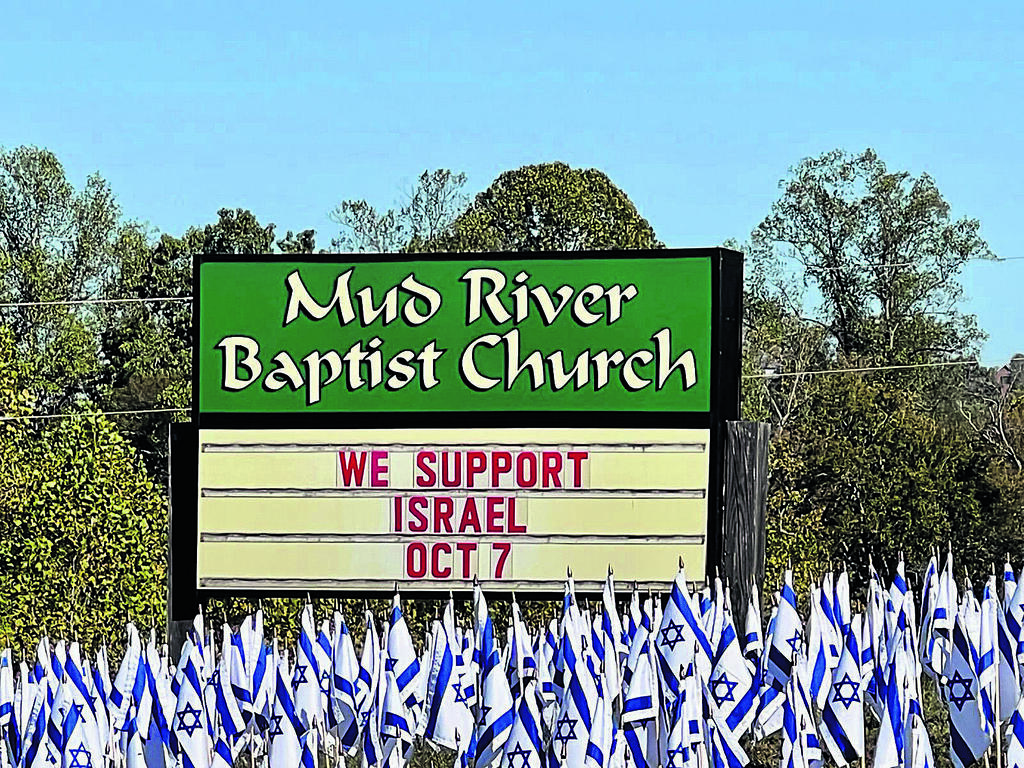
the massive show of support for Israel
(Photo: courtesy of Daniel Edelson and the International Fellowship of Christians and Jews)
Yael Eckstein, president of the International Fellowship of Christians and Jews and daughter of its late founder, Rabbi Yechiel Eckstein, is the first to acknowledge the suspicion many Israelis feel toward evangelicals — a sentiment that has followed her family since the Fellowship’s founding. She recalls that her father faced boycotts and accusations of missionary activity, and that even today, despite changing attitudes, many in the Jewish community struggle to accept the depth of this alliance. Critics often cite the evangelical vision of Armageddon, in which most Jews perish, and the few survivors accept Jesus as the Messiah.
“The facts speak for themselves,” says Eckstein. “The Fellowship has existed for 42 years, and no one has ever tried to ‘convert’ us. We have over 800,000 donors, and the Fellowship has contributed more than a billion shekels in aid to war victims since October 7. Yes, most of them believe in spreading the Christian gospel, but that’s clearly not what we do at the Fellowship. The evangelical community has supported us unconditionally, even in the hardest times. The ‘Flags of Fellowship’ event, which began with 1,200 flags planted at Kibbutz Nir Oz and spread worldwide, is a central part of that effort.
“In Israel, people can be cynical. They say, ‘They’re suckers.’ But they’re not. They are people of deep faith who

Pastor Allen Jackson
(Photo: courtesy of Daniel Edelson and the International Fellowship of Christians and Jews)
know the difference between good and evil and want to stand with justice. They’re neither naïve nor fanatical. They see Israel as standing at the front line of the struggle for democracy and the sanctity of life, not death. The Jewish people must learn to reach out in return. We can keep saying we can rely only on ourselves, but when so many Christians stand with Israel, pray for Israel, donate to Israel, this is not the time for cynicism. The only way to fight antisemitism is together.”
Then, almost as an unspoken answer to all that lingering suspicion, Pastor Jackson returns to the stage. The lights dim, the singing fades, and the hall falls into a tense silence. “Some take it too far,” he says. “They start keeping Shabbat, eating kosher, trying to become Jewish…” He pauses dramatically and scans the crowd. “But if you start imitating them, you’re a fraud. The Jews don’t need us to understand their holidays. They need us as friends.”
On the drive back to Nashville, the highway again fills with Bible verses and billboards promising redemption and bad coffee. Isaacson, the bodyguard silent beside him, looks out the window.
“Sometimes,” he says, “it’s only when you’re furthest from home that you realize who’s really with you.”