

They are still focused on personal recovery and have yet to return home, but residents of the Gaza border communities say it is important to gather around Holocaust remembrance. This year, the communities of Nir Oz and Kfar Aza will mark Holocaust Remembrance Day with “Zikaron BaSalon” (Living Room Remembrance) events.
The Nir Oz community, most of whose members remain displaced in Karmi Gat, will host Holocaust survivor Hannah Gofrit. The Kfar Aza community, largely staying in Ruhama, will meet there with Holocaust survivor Rama Reiss.
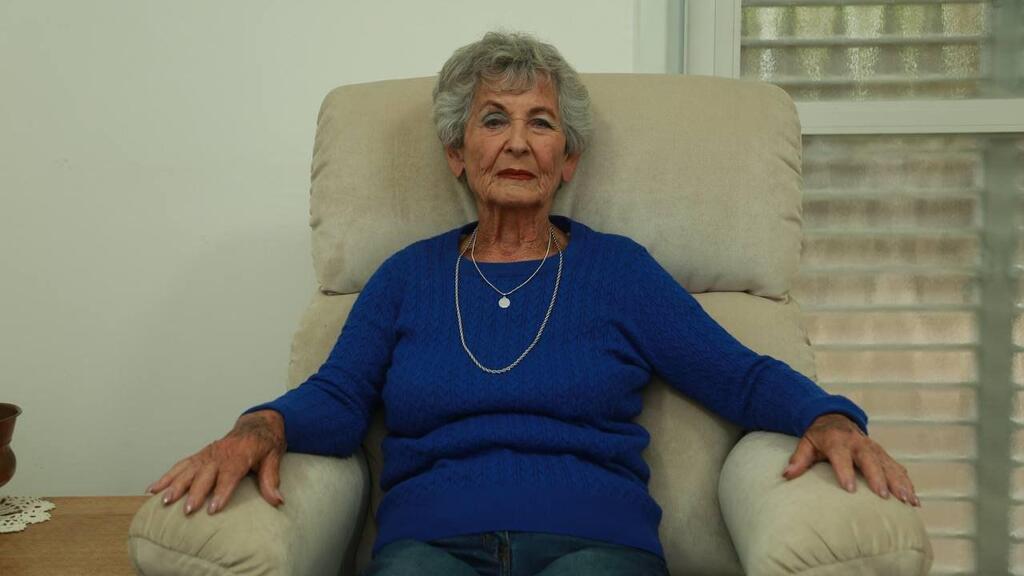
“To be honest, the idea of holding a ‘Zikaron BaSalon’ event with them was difficult for me,” Reiss said. “I thought to myself: they have gone through such terrible things — why do they need to hear more? But it is important for me to tell them that I was at the bottom, I fought, I survived, I came to Israel and built a wonderful family. There is hope to emerge even from something very, very difficult. I hope this will inspire them and give them hope that it is possible to rise from what happened to them.”
Her first memory of the war is being uprooted from her home, when Ukrainian collaborators forced her family into a ghetto. After a few months, her parents spoke to her. “They told me these were bad times and that I needed to be a good girl because they were going to send me to other people,” she said. That night, her mother took her to the ghetto wall. On the other side waited the Knizhevsky couple, a local Polish doctor and his wife. Her parents gave them all their remaining possessions to save their daughter. Their treatment of her was distant. “I understood I had to be good and quiet,” she said. “I waited for my mother to come and take me.”
Mrs. Knizhevsky would occasionally bring food to a factory outside the ghetto where Reiss’ parents worked. The child begged her to take her along, and eventually she agreed. “When we got there, I told them I was not going back to the Knizhevsky family. My father sat me on his lap and said: ‘If you want all of us to live, you must go back to your aunt.’ My mother said nothing, only cried and hugged me.” It was the last time she saw her parents, Berta and Munio Kramnitzer. She was four years old.
Later, a Jewish relative of the Knizhevskys, Lusha Hirt, nine years older than her, joined her and took her under her wing. They remained in the house for two years until their hiding place was discovered. They then found shelter in the home of an elderly Polish man who did not know their true identity. After the liberation of Lviv in July 1944, Reiss and Hirt moved between displaced persons camps in Czechoslovakia, Austria, Germany and Italy before immigrating to Israel in 1948.
“These living room gatherings are important because young people need to hear where we came from, what strength it took to build the state and how important it is that they stay here and protect it, so that what happened does not happen again,” she said.
“I am excited about the meeting,” said Gofrit. “My goal as a Holocaust survivor — in fact, a ‘Holocaust victor’ — is to share from my life experience and, modestly, to offer points of light. There will be recovery, and the sun will continue to shine.
Gofrit was born in 1935 in the town of Biała Rawska in Poland. After the German invasion, she was placed with a Polish foster family, but after a few days she wanted to return to her parents, who were hiding in a potato pit. At the end of 1942, the town’s Jews were deported to the Treblinka extermination camp. A neighbor helped Gofrit and her mother obtain forged documents. Her father was forced to part from them, and his fate remains unknown. The two hid in an apartment in Warsaw until the end of the war, and in 1949 Gofrit immigrated to Israel.
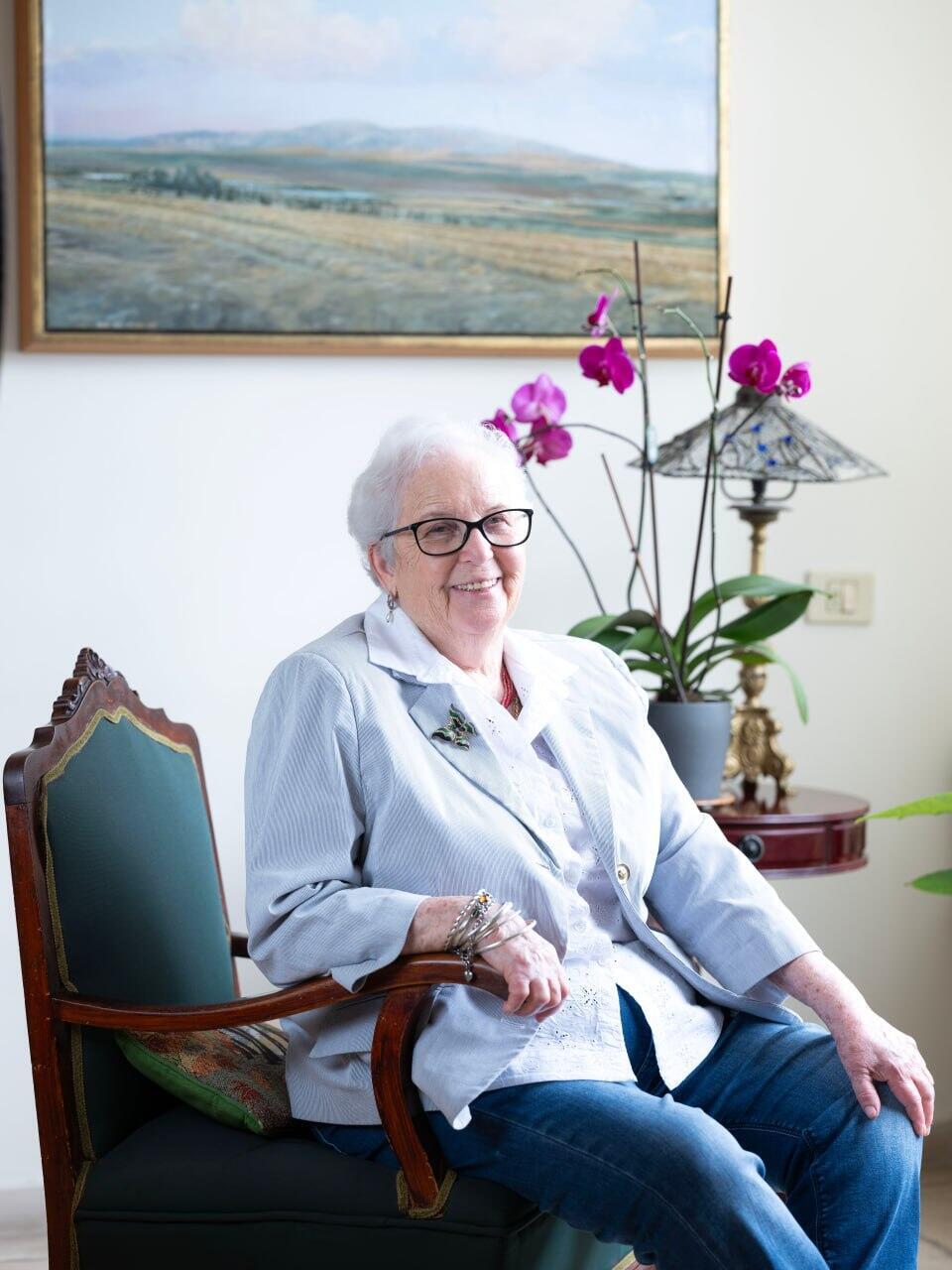
Hannah Gofrit
(Photo: Yuval Chen)
Poly Amikam, a member of Kibbutz Kfar Aza whose family perished in the Holocaust and whose son Nadav was killed defending the kibbutz on October 7, said: “‘Zikaron BaSalon’ has been a tradition for years. Apart from that terrible year after October 7, we have always held these gatherings. Even last year there was a meeting. We must continue to talk about the Holocaust regardless of what happened to us. Of course, personally and as a community it is very difficult, but there is a very strong response from people here.”
Asked whether there are similarities between past and present, she said: “There are some similarities and many differences. The time is different, everything is different. During the gatherings I do go back and think about what I went through — the difficult time in the safe room, the feelings — but these are completely different scales. Two days without food or water is nothing compared to what they went through in the Holocaust. But such a meeting does take you back to October 7 in some way.”
Karin Zinger, CEO of Zikaron BaSalon, said: “This year, Holocaust Remembrance Day is being marked while Israel is still dealing with a complex security reality. Precisely in this period, it is more important than ever to keep the memory of the Holocaust present. It is not only testimony about the past, but an anchor that sustains us as a society in the present. The stories of Holocaust survivors remind us what true human resilience is — the ability to rise from destruction, to choose life and to continue building even when everything seems broken.”