


It was supposed to be another sleepy evening of auctions in a small Ohio town. On the sales list were two small floral paintings, each measuring 12.7 centimeters by 20.3 centimeters, painted in oil on copper panels. But an anonymous tip from a collector well-versed in Nazi art theft revealed that the works were a historic treasure: paintings looted from the Jewish Schloss family in Paris in 1943, last seen hanging in Hitler’s offices in Munich before they disappeared at the end of the war.
The Monuments Men and Women Foundation, which tracks thousands of objects looted in Europe during the 1940s, halted the auction at the last minute after receiving the alert. The artworks were about to be sold for paltry sums — $3,250 for one and only $225 for the other — though their true value is estimated at close to $1 million apiece.
The paintings are attributed to Ambrosius Bosschaert, a 17th-century Dutch artist and a pioneer of floral still lifes. Bosschaert depicted rare flowers, whose cultivation at the time was costly, painted in meticulous detail alongside butterflies, insects and small seashells around the vase. The two paintings located in Newark, Ohio, match precisely the descriptions and black-and-white photographs preserved in the Jewish Digital Cultural Recovery Project, which compiles data on Nazi-looted art — including dimensions, descriptions and titles: "Fleurs" in French, "Blumenstück" in German.
Gallery
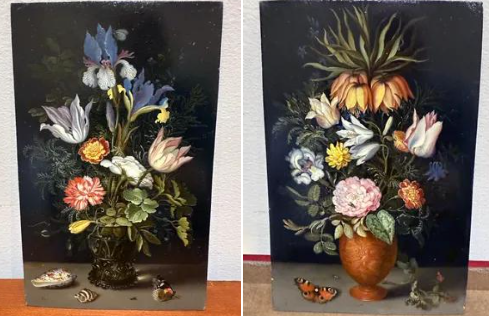
The paintings that were put up for sale in Newark, Ohio
(Photo: The Monuments Men And Women Foundation)
They were part of a vast collection of 333 works assembled by Adolphe Schloss, a German-Jewish collector who lived with his wife, Lucy, in Paris. Focused on Dutch and Flemish masters, the collection was considered one of the most impressive in Europe. It was first kept in a castle in southern France until French collaborators revealed its location. In 1943, the Nazis seized the entire collection: 49 works were taken to the Louvre, 22 were sold, and the remaining 262 were shipped to Munich to wait in the Führerbau — the Führer’s building — for the museum Hitler planned to establish in Linz, Austria.
On the backs of the paintings are the original collection markings, S-16 and S-17, identical to numbers listed in German inventories now housed in the U.S. National Archives. Also found was a torn label reading "Caisse 1" with a curling blue decoration beside it — the same ornamentation visible in the original French shipping documents.
“Even the blue flourish on the label is identical,” said Robert Edsel, founder of the foundation, who boarded a plane to the auction house just hours after receiving the tip in order to identify the works.
Documents from the era reveal further details. Rose Valland, a French resistance member who worked inside the Jeu de Paume museum in Paris, wrote in her memoirs that Hitler complained he received “only pretty crumbs” from the Schloss collection. For the Nazi regime, which used art as a political tool, it was a symbolic collection — hence its selection for inclusion in Hitler’s planned museum.
The trail went cold in late April 1945. Two days before American forces entered Munich, Germans broke into the Führerbau and looted its contents. The paintings likely left the city in the personal baggage of an American soldier returning home. Edsel noted that, despite General Eisenhower’s explicit orders, many soldiers took wartime souvenirs. Over the years, hundreds of families have approached the foundation after finding flags, books and paintings in their attics, passed down through generations without knowledge of their origin.
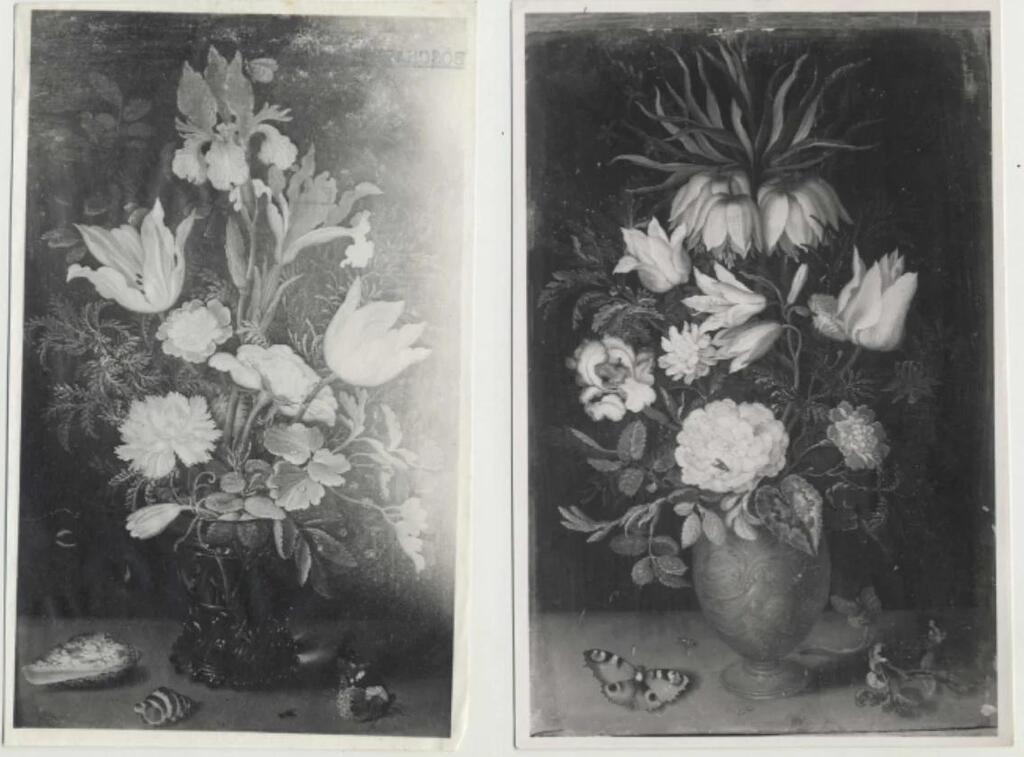
Black and white photographs preserved in the Jewish Digital Cultural Recovery Project archive
(Photo: The Jewish Digital Cultural Recovery Project Foundation)
For the art market, the discovery represents an object of both historical and financial significance. The record price for a Bosschaert was set in 2008, when one of his paintings sold for more than $5.2 million. In recent years his works have also fetched millions: this year, the Metropolitan Museum of Art in New York purchased one for about $4.4 million. By contrast, the two Ohio works nearly slipped away to anonymous collectors for a pittance.
For now, the paintings are being held in a safe at the Newark auction house until the process is completed with the Schloss heirs. Debbie Goddard, a manager at the Ohio auction house, said ethics required them to halt the sale once the provenance was discovered but declined to reveal the consignor’s name.
“Hundreds of thousands of cultural objects looted during the Holocaust are still missing,” said Anna Bottinelli, president of the foundation and Edsel’s wife. The foundation, founded in 2007, has handled about 30 successful restitution cases so far. “Some are in the United States, hidden in attics, hanging on walls or passed down in unopened boxes. Each object can change the history of a single family — and restore to it the heritage that was stolen.”