

This week’s Torah portion of Ki-Tavo opens with the commandment of bringing the Bikkurim - the First Fruits - to the Temple, a ritual accompanied by a unique declaration. This declaration recalls the journeys of Abraham and Jacob, the harsh subjugation in Egypt and the Exodus. Then it proceeds to proclaim our arrival to the Land, and acknowledges the fruits are the product of the Land given by God.
At first glance, the portion of the First Fruits appears to be a straightforward expression of gratitude for agricultural abundance: "And you shall rejoice in all the good which the Lord your God has given to you and to your house, you, and the Levite, and the stranger in your midst."
However, unlike many other places where the Torah commands us to share our joy and bounty with the poor, the orphan, and the widow, they are strikingly absent here. Instead, the Torah emphasizes only two figures: the Levite and the stranger who lacks an ancestral landholding. This shortened list is not an accident. It suggests that the primary focus is not the abundance itself. Rather, the Bikkurim express the profound privilege of possessing and being rooted in the Land.
Quantity, quality, and connection
Therefore, the declaration made by the bringer of the First Fruits tells a story of historical wandering, not of agricultural or religious achievements. The narrative begins with "My father was a wandering Aramean," continues through centuries of enslavement in Egypt, and culminates in the arrival in the Land of Israel.
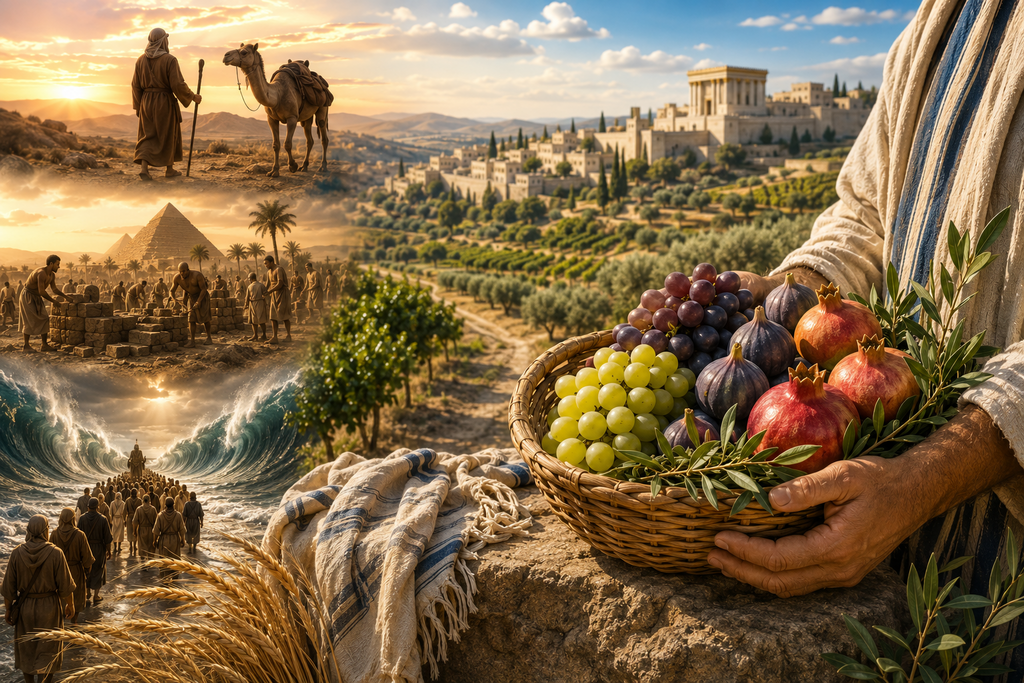
(Image generated by AI)
The individual is not joyous merely because he yielded a successful harvest of figs or pomegranates this year. He is joyous because he can proudly declare: "I have a place in this world. I have soil that I cultivate - soil in a land of my own, given to my people."
Standing with the exemplar fruit grown in his field, the farmer of traces this journey of wandering patriarchs, through the affliction and slavery in a foreign land, the Exodus, and finally to the present reality: "And now, behold, I have brought the first of the fruit of the ground, which You, O Lord, have given me."
The fruit is merely the physical representative of the land itself. It symbolizes that the national story has finally blossomed.
This stands in stark contrast to the "Tithes Confession" which follows. While similar in structure, its essence is opposite. In the Tithes Confession, the farmer declares his compliance with all commandments regarding his produce, detailing his own virtuous actions, and then asks for continued agricultural blessing. In the Bikkurim declaration, there is no such request. Instead of recounting what he has done, the farmer recounts what God has done throughout history because the Bikkurim is a testament to our eternal bond with the Promised Land, our homeland.
This explains why Bikkurim requires no specific quantity, and not even absolute quality. The Mishnah explains that a farmer goes down to his field, sees the very first fig or pomegranate that has ripened, ties a reed around it, and declares: “It is Bikkurim.” At that early stage, he does not know if the year will be bountiful or if this fruit will be the finest. Tying the reed is purely a symbol of unbreakable connection to the land.
The simple basket vs. plates of silver and gold
The Torah specifies bringing the fruit in a basket, called a tene. The Mishnah notes that toward the end of the Second Temple period, the wealthy brought their fruits in plates of silver and gold, while the poor used woven willow baskets. What was meant to symbolize a connection to the land turned into a display of economic status.
But the Torah's original model envisions a simple basket - an agricultural tool - as it uses the same word for blessing later in our Torah reading of this week: “Blessed shall be your basket and your kneading bowl” (Deuteronomy 28:5). Gold symbolizes achievement and distance from manual labor, the kind of labor that connects the worker to the soil of the Land of Israel.
The basket, made from the growth of the earth, carries the dust of the soil upon it, and seeks to bring the work of everyday life into the sacred realm itself. Humbly, I would suggest that it is possible that the striking delta between the simple biblical image of the farmer placing his first fruits in a simple basket and the elaborate and gilded procession described in the Mishnah, reflects, at least in part, the adoption of the ceremonial language of the surrounding Hellenistic-Roman world.
The individual and the nation
God calls Israel "My firstborn son" and the prophet Jeremiah calls Israel "the first fruits of His increase." The person bringing the first fruits sees himself as part of a divine historical process, building a sovereign nation to model an exemplary society.
The Haftarah (portion read from the prophets) of Ki-Tavo (Isaiah 60) echoes this beautifully. It describes a return to the Land and immense wealth flowing into Zion. Yet, it concludes with a different image: "Your people are all righteous; they shall inherit the Land forever...". Earning money may be done in the Diaspora, as it did for our forefathers. The true peak of our history is the inheritance of the Land and the righteousness of the society built upon it.
Reading this Parasha during the month of Elul offers a profound perspective. At the end of the agricultural year, one might naturally calculate yields and profits. The Torah suggests a different accounting: "Where am I rooted? What is my relationship with God, and my nation?"
We pray for economic prosperity, but the Bikkurim insist that our fundamental gratitude must be for our national home. The history of wandering, antisemitism, and economic pressure reminds us of the immense blessing found in the moving declaration: "I have come to the country which the Lord swore to our fathers to give us." Today, with antisemitism rising globally, we are reminded how profoundly grateful we must be for our return to Israel, praying that more Jews will come back home.