

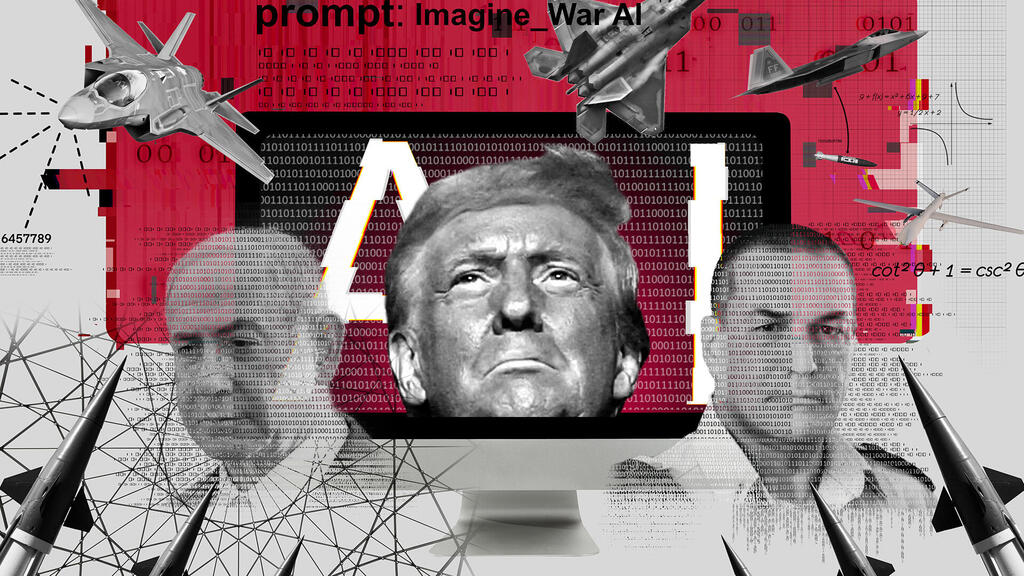

Israeli civilians who were here during the first war with Iran — just eight months ago — may notice that something about the ballistic missile alerts has changed this time. They arrive earlier, and the predicted impact locations are far more precise.
The improvement comes from a new technological capability that Israel did not previously possess. In fact, it did not exist anywhere in the world. It emerged because artificial intelligence has reached a level where it can help defend Israel’s skies.
The Israeli air defense system’s new capability rests on two foundations: enormous volumes of data and the ability to process it with supercomputers and AI algorithms.
The amount of data involved is staggering. The system includes the details of roughly 60,000 flight paths of every missile and drone launched toward Israel since October 7. It records where they were launched from, the exact time, altitude, speed and every known detail about their impact points: the weather conditions, time of day, road traffic density, the level of protective infrastructure in the area, the locations of schools, strategic Israeli facilities and the positions of interception systems.
All of that information is processed by AI within fractions of a second while launches are underway, sometimes even before they occur. The system then presents Israel’s Home Front Command with clear recommendations: which alert to issue, to whom and at precisely what moment.
“This is a very complex system that constantly learns and improves,” said Brig. Gen. (res.) Ran Kochav, a former commander of Israel’s air defense array. “It learns partly through people, but mainly through artificial intelligence.”
Watching the battlefield from the sky
Another example of AI already operating on the battlefield is the SkEye system developed by Elbit Systems.
Installed on the Israeli Air Force’s Hermes 900 drone, the system observes the battlefield from high altitude. What once covered a relatively small area now monitors up to 80 square kilometers of dense, fast-moving activity.
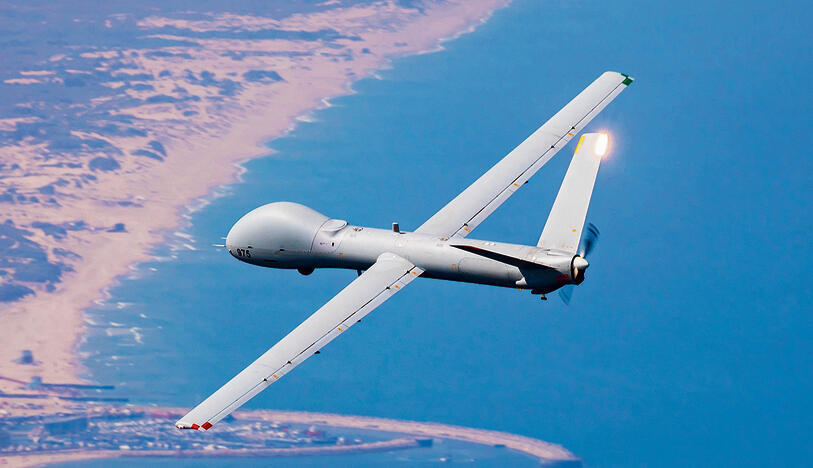
Israeli Air Force’s Hermes 900 drone
(Photo: Israeli Air Force)
The system generates massive amounts of data that are analyzed in real time by artificial intelligence. It automatically detects events — such as preparations for a missile launch — at the moment they begin.
More than that, it can replay events backward, almost like traveling through time, allowing analysts to determine where a threat originated and what happened before it was identified.
“It’s a system that not only saved lives but also produced enormous intelligence value,” said Shuki Yehuda, Executive Vice President – Strategy and Chief Technology Officer at Elbit Systems.
According to Yehuda, the system can present commanders and operators with options and recommendations about how to respond.
“The more automated these systems become, the easier it is to make decisions,” he said.
The first true AI war
In many ways, the campaign against Iran may be the first real AI war.
Modern generative AI emerged only in late 2022. Since then, its development has accelerated faster than any previous technology.
Governments quickly realized that AI could outperform humans in many analytical tasks, and it is now widely considered a strategic tool in global geopolitical competition.
Future wars, many analysts argue, will be decided not only by who has better aircraft, more lethal weapons or more precise intelligence, but by who develops the most effective AI systems to integrate them.
Drones that strike, not just observe
About three years ago, the IDF publicly acknowledged that its drones were not only gathering intelligence but also conducting strikes.
The backbone of Israel’s strike drone fleet includes the Hermes 900, capable of flying for 36 hours; the earlier Hermes 450; and the Heron TP “Eitan,” the largest unmanned aircraft operated by the IDF, which can carry nearly three tons and remain airborne for up to 45 hours.
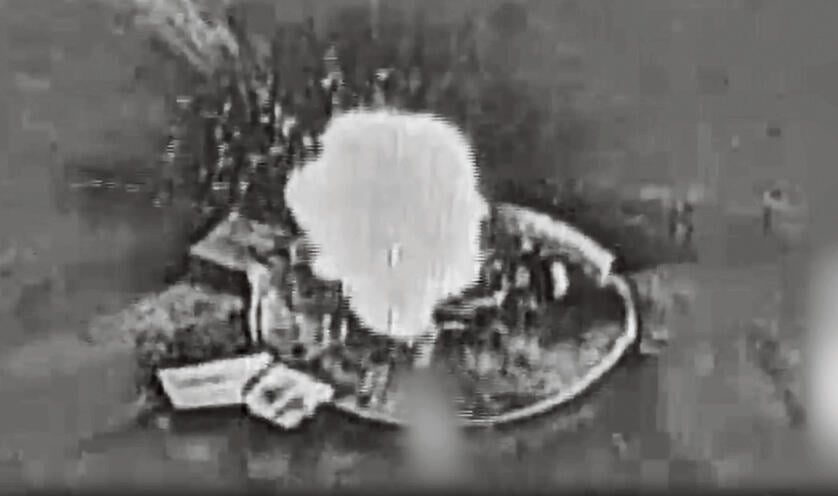
Air Force strike on an Iranian force: 'The system doesn’t replace humans, it helps them stay focused'
(Photo: IDF)
These platforms perform reconnaissance and surveillance missions, but they also carry out targeted strikes against terrorists and rocket launchers.
Such drones are central to Israel’s AI-enabled defense systems.
“In the past, the Air Force would conduct reconnaissance missions, land, develop the film, study it for months and then determine what the enemy’s airport looked like,” Yehuda said.
“Today, thanks to the Tzayad command system and drones like the Kochav, the process happens in minutes. The enemy truck is detected and immediately the operator is told: ‘Here’s the truck. Decide whether to strike it.’ The entire process takes less than a minute.”
The problem of too much information
The digital battlefield has also created a new challenge: data overload.
Every drone, sensor and platform generates enormous quantities of information. When dozens or hundreds operate simultaneously, the result is a massive ocean of data.
Consider a drone flying for ten hours. During that time it might capture one minute of footage showing a concealed missile launcher.
In real time, a human operator might miss that moment entirely.
AI solves that problem.
“There is a huge amount of data from sensors and platforms,” Kochav explained. “Add radar targets, air images, optical data, intelligence feeds and more. The result is overload.”
“When an air defense operator sees a thousand rockets in the air or a swarm of 2,000 drones, without artificial intelligence he cannot extract the maximum value from that data.”
“That’s where AI becomes essential.”
Industrializing intelligence
AI also plays a critical role in identifying targets across a country as large as Iran.
What was once known as a “target notebook” evolved into a “target bank,” and later into what the military calls a “target factory.”
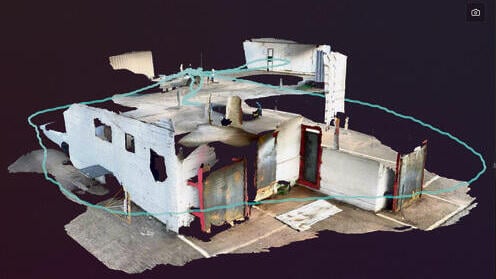
AI-generated structural mapping by the ReSight system
“The ability to understand where targets are in a country the size of Iran — a human being simply cannot do that,” Kochav said.
AI can integrate intelligence from electronic signals, radar, human sources and aerial imagery, combining it with real-time updates to produce actionable intelligence.
“The artificial intelligence does not replace humans,” Kochav said. “It simply helps people stay focused.”
The command system that puts the battlefield in a pocket
The technological revolution is equally visible on the ground.
One of the most important developments enabled by AI is in command-and-control systems. The IDF’s central system for ground forces is called Tzayad — short for “digital ground army.”

Shuki Yehuda, Executive Vice President – Strategy and Chief Technology Officer at Elbit Systems
(Photo: Gil Nechushtan)
First introduced more than two decades ago, the system continues to evolve. Its newest version, Tzayad 750, is now being upgraded with advanced AI capabilities.
Elbit Systems describes it as the foundation of what it calls “digital warfare.”
Every commander can see the battlefield in real time on a computer, tablet or smartphone. The system displays the locations of Israeli forces in the air, on land and at sea, as well as known enemy positions.
A commander who identifies a target can immediately pass it to attacking forces, including the Air Force or Navy, dramatically shortening the IDF’s response cycle.
Digital observers and autonomous forces
The latest AI developments go even further.
Modern systems can operate autonomous “AI agents” capable of executing tasks independently.
“I can have an agent that constantly scans a large area and finds targets,” Yehuda explained. “It’s essentially a digital observer.”
Instead of human soldiers watching surveillance screens along the border, AI systems can now detect vehicles, motorcycles and even partially concealed individuals with high probability.
Once a suspicious activity is detected, the AI can initiate further actions — such as sending drones to investigate or zooming in on the area.
In some cases, swarms of drones can be deployed autonomously to locate and neutralize threats.
The future battlefield
Israel already deploys dozens of drone models for intelligence gathering and attack missions.
Some drones can enter buildings, transmit video from inside and even detonate explosives against terrorists.
New systems are capable of operating semi-autonomously. Operators simply designate a target, and the drone flies to it.
In more advanced systems, large drones carry smaller “pocket drones,” releasing them near a target where they scatter to perform reconnaissance or attack missions.
The trend is clear: maximum autonomy and minimal cognitive burden on soldiers and commanders.
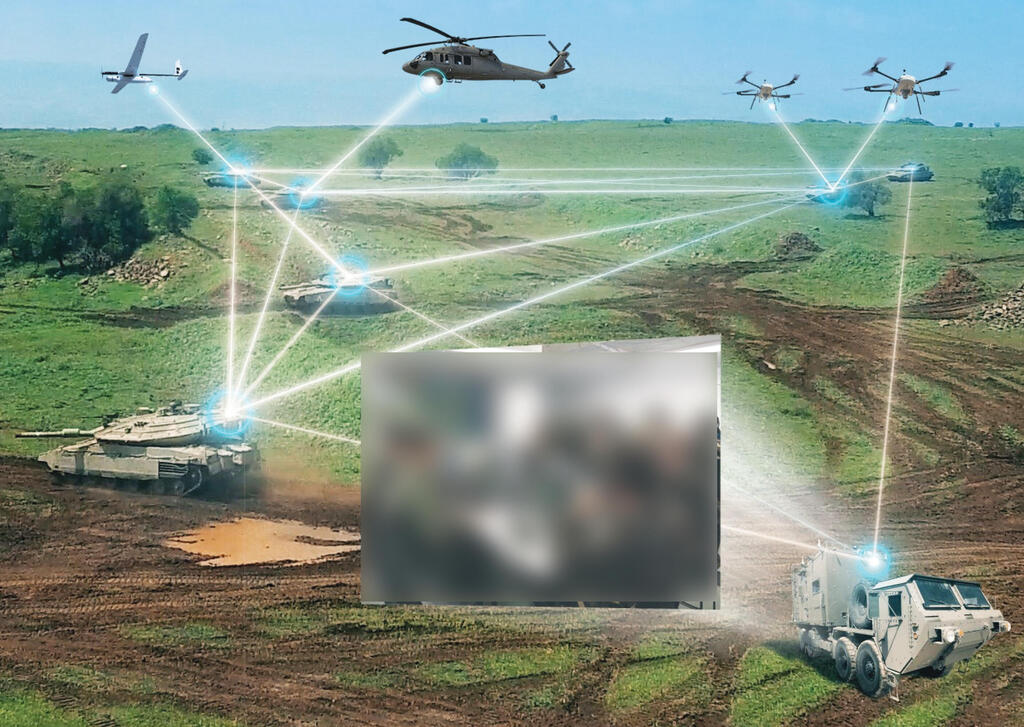
The holy grail: Tzayad — short for 'digital ground army'
(Photo: Elbit)
The AI revolution inside the military
The rapid growth of defense AI has led the IDF to establish an entire new formation: the Information and Artificial Intelligence Brigade within the military’s communications directorate.
The unit oversees numerous AI projects, most of them classified. Among the technologies already developed are systems for real-time transcription of radio communications and rapid digital identification of fallen soldiers.
Beyond the military itself, hundreds of startups are now active in Israel’s booming defense-tech sector.
Companies that once described their technology as “dual-use” — civilian and military — have largely abandoned that distinction since the wars in Ukraine, Gaza and Lebanon.
The field is now heavily funded and rapidly expanding.
Startups turning games into warfare technology
One such company, ReSight, emerged from the gaming and augmented reality sector.
Using technology originally developed for video games, it created a system capable of mapping buildings in three dimensions in seconds using ordinary cameras.
Before entering a building, soldiers can send in a drone. As it moves, the system constructs a real-time 3D model of the interior.
“It’s like the video game Doom,” said CEO Omri Stein. “You see the fog of war disappearing as the environment builds itself around you.”
AI everywhere
AI is also reshaping maritime operations.
Another startup, Sealartec, is developing systems to launch and recover robotic boats from larger ships using computer vision and machine learning.
Meanwhile, companies like Flyworks are building heavy-lift drones capable of carrying equipment weighing up to 10 kilograms for more than an hour.
Until October 7, many of these technologies were being developed primarily for civilian markets.
The war changed that overnight.
“Suddenly it became clear that there is a huge opportunity on the defense side,” said Flyworks CEO Gad Peleg.
And across Israel’s defense sector — from drones to satellites to AI command systems — the message is clear.
Artificial intelligence is no longer just a tool of war.
It is becoming the battlefield itself.