


Col. (res.) Amir Ben-David stands, visibly moved, near the helipad at Beilinson Hospital, waiting for the helicopter carrying the first hostages to be released as part of the deal that marked the end of the war. As head of the Home Front Command’s Jerusalem and Central District, he had overseen the forces deployed at the site in preparation for the return of the hostages.
When he gave the helicopter permission to land, the pilot instructed him to tell the people on the ground to keep their distance because the rotor would generate a particularly strong wind. “We waited two years for that wind,” Ben-David replied. “It’s okay. Let it blow us around as much as it wants.” The rear ramp of the helicopter opened and the first four hostages disembarked. “On the one hand, seeing them walk out, and on the other, feeling the wind of the rotors on my face — it was powerful beyond words,” he recalled.
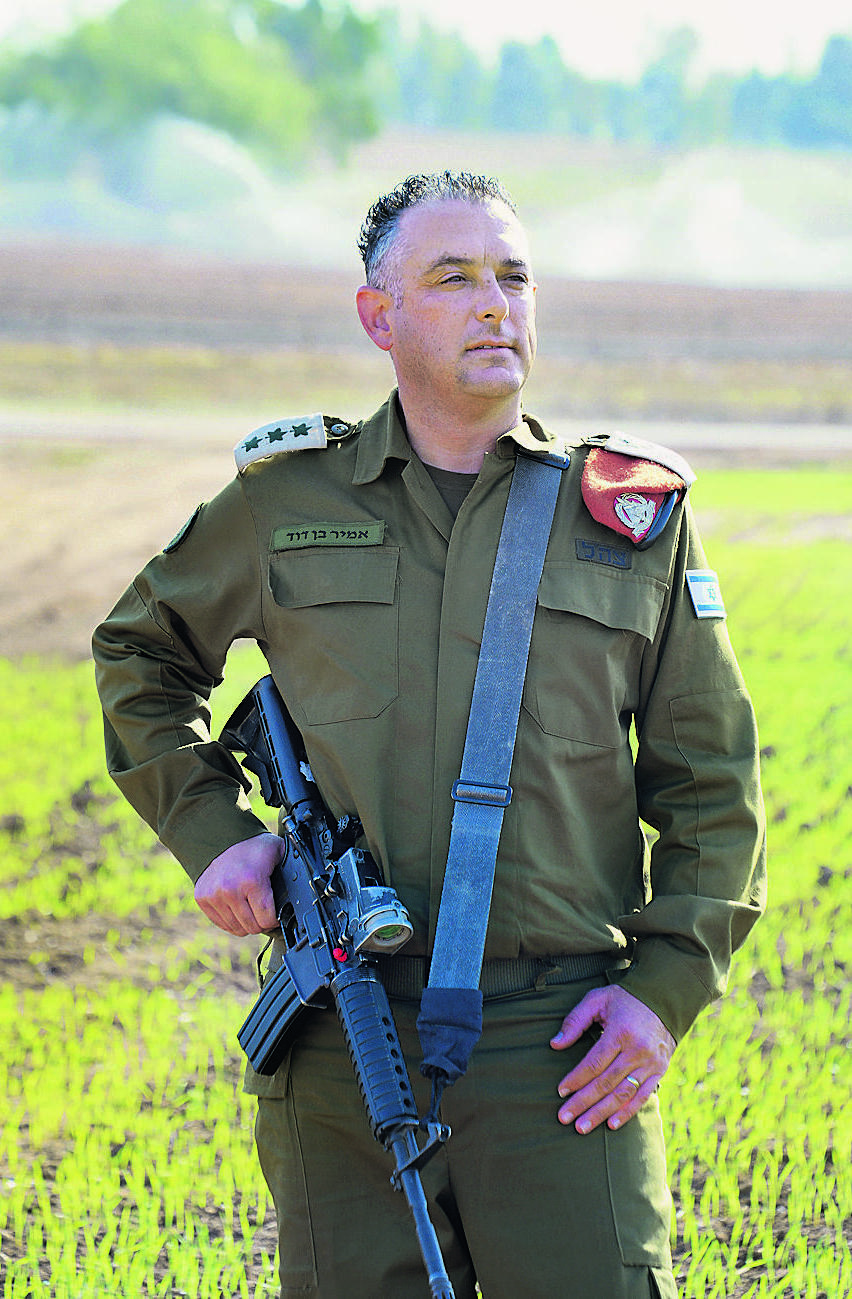
A few weeks ago, Ben-David concluded his military service and transitioned to civilian life. At the same time, he began writing a book titled The Orange Heart, chronicling his 27 years in the army, most of them with the Home Front Command. The book recounts key events he took part in: providing aid to victims of natural disasters abroad (Ben-David led, among other missions, the Home Front Command delegation to the Haiti earthquake), major wildfires, search and rescue operations, the battle against COVID-19, the October 7 terror attack, and Operation Raising Lion.
Although his final position was in the Jerusalem and Central District, the most formative and dramatic chapter of his military career was his time as the Home Front officer for the Gaza Division in the years following Operation Protective Edge, a period during which Hamas was rebuilding its strength and beginning to formulate its “Jericho Wall” plan for a future invasion of Israel, even as the country’s leadership, the army and the intelligence unit convinced themselves that “the organization is deterred and has no interest in escalation.”
Ben-David assumed the role just two weeks after the operation ended in the summer of 2014 and served until 2018. Most of his efforts were focused on strengthening the Israeli communities along the Gaza border and nearby areas: building and training emergency response squads in each community, appointing security coordinators, placing bomb shelters and protective walls, establishing escape routes from the towns, and more.
Later, he commanded the Home Front Command’s training base, led the National Emergency Response Center during the pandemic, and headed the National Resilience College. Just a few months before the war, he was appointed commander of the Jerusalem and Central District.
'I risk my life for civilians, I go in after the wall collapses, and for me there’s no dilemma'
On October 7, Amir Ben-David was vacationing with his family in Eilat. When the surprise attack began, he immediately headed north, on his way, he managed to issue a full call-up of the district’s troops. As he tried to contact his colleagues from the Gaza Division and the surrounding communities, he learned they were already deep in combat.
That day, 33 people he had known through his role in the division, many of them close friends, were killed. Among them were Shachar Aviani, the security coordinator of Kibbutz Kfar Aza; Ilan Fiorentino of Nahal Oz; Saar Margolis of Kibbutz Kissufim; and Col. Asaf Hamami, commander of the Southern Brigade.
“There was a period in the Gaza Division when Asaf and I had rooms next to each other, we became very close friends,” Ben-David recalls. “I didn’t make it to the funerals of my fellow security coordinators; the situation didn’t allow it. But the moment I had even a brief pause, I went to their graves. I sat there for a long time and spoke to each of them. I said goodbye. I thought about what they’d say about what happened, about the drills we ran together, the training sessions. I looked at my phone to see when they were last online on WhatsApp. I thought about what went through their minds in those final moments. I think about them every day. I miss them deeply. They’re heroes I’ll never forget.”
That same Saturday, Ben-David arrived at the Home Front Command headquarters in Ramla to get a situational overview. “When I entered the war room, I told myself: Gaza Division is fighting, and in a minute it’ll be over. This is what we’ve been preparing for all these years — to fight, to risk our lives. It didn’t seem natural to me that the division wouldn’t win. But very quickly I realized we weren’t even close.
“I served in the Gaza border area for 15 years, in the Gaza Division, at the Southern District headquarters in Camp Urim, at the Zikim base, as commander of the Home Front training base. I’m watching the footage and seeing the places that were home to me. And I’m torn between whether to go down south to the front or stay where I am.”
He ultimately chose to remain in the sector under his command. “We were certain the terrorists were on their way to the center of the country. We prepared for that. I told every mayor and local authority head on a conference call: We are at war. In the district’s first situational assessment, I wrote by hand: ‘We failed. Now we have to fix it.’
“It took 12 hours before I even began to process what had happened. I drove to Shura base. I got there and saw parents looking for their children, the young people who had been at the Nova festival. I moved from room to room, among the bodies, and the families stood outside, waiting for any information. More and more trucks with bodies kept arriving. It was horrifying.”
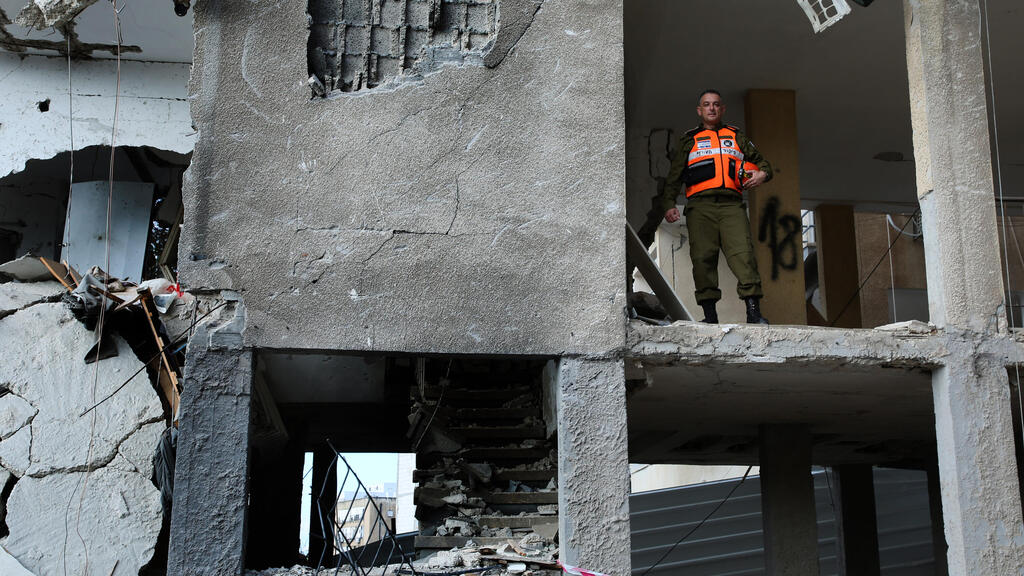
Col. Ben-David at the missile strike site at the Weizmann Institute
(Photo: Ryan Frois)
When did you understand the scale of the failure?
“I still don’t understand the full scale. Not even today. I don’t understand how 3,000 terrorists reached the fence without us knowing. Forget the SIM cards. Just to move a single company, I have to go through a long operational process. I can’t do that quietly. So how is it that 3,000 people wake up one morning, all at the same time, fully coordinated, and launch an assault on the Gaza border communities? That’s what I can’t wrap my head around.”
As someone who served in the Gaza Division, you must have your own sense of how it happened
“I don’t have the answer. It frustrates me every day, and I’ll carry it with me for the rest of my life. But I didn’t allow myself to dwell on it because I knew it would distract me from the main objective — protecting the civilians in my district. At the time, I was responsible for 57 hotels housing evacuees. I became their father and mother in those hotels. I felt like the Gaza border was mine again. Suddenly, the home front became the front line.
“I told my people: We’re going to respond to every rocket or missile impact. There will never again be a situation where an incident happens and the IDF isn’t there. No one will call for help and be met with silence. I’ll do everything, even at the cost of my life. When the sirens go off, we’re out there. When civilians go into the shelter I go out. Like a firefighter running into the flames.”
Still, where do you see the root of the failure?
“I think we were too focused on the fence, and not enough on what was happening inside Gaza. We didn’t build up enough reserves so that if the line was breached, we’d have a way to defend ourselves. When I used to visit places like Nahal Oz, I would tell the residents, ‘You’re protected. There are tanks here, the IDF is nearby.’ But in the end, the shelters I had placed in the area to save lives became death traps. It’s insane.
“I paved the evacuation routes in the Gaza border communities. I wrote the evacuation plans. I built all the emergency scenarios. The worst case I had ever envisioned was an infiltration by 10, 15, maybe 20 terrorists, not thousands. The plans assumed that the emergency response squads would need to hold out for just a few minutes. On October 7, they saved lives and paid a heavy price.”
He went down to the Gaza border region three days after the massacre and entered Kibbutz Be’eri. “That day, I couldn’t get a single word out,” he said. “In previous years, I spent Simchat Torah in Be’eri, and suddenly I was seeing blood everywhere. I had to pinch myself to believe it was real.”
On October 7, there were many cases where soldiers and commanders hesitated before entering communities under attack and did not actively engage the terrorists. What do you think about that?
“I think the commanders had never encountered anything like this, having both at the same time: terrorists and civilians in need of rescue. For me, in the Home Front Command, it’s very clear. I risk my life for civilians. I rescue. I go in after the wall collapses. For me, there is no dilemma. I make decisions that go against the laws of engineering, the laws of gravity, and the laws of logic.
“Have you ever seen a firefighter stand outside and refuse to go in and save people from a burning building? There’s no such thing. I don’t want to judge the decisions of commanders; I wasn’t there, and I won’t put myself in their place. But yes, it’s very hard for me to accept that people stood outside Kibbutz Kfar Aza and didn’t go in to rescue. That’s why the first page of my book opens with the sentence: ‘I swear to devote all my strength, even at the risk of my life, to the defense of the homeland and the freedom of Israel.’”
A missile is not the same as a rocket
As district commander during the war with Iran, Amir Ben-David was responsible for a sector home to more than three million civilians.
“In Operation Rising Lion, we encountered the real threat — building collapses and genuine rescue events. I had imagined much less damage, but the first time I arrived at an impact site, I saw 30 or 40 buildings that were no longer fit to live in. I was shocked by the extent of the destruction. This is a missile, not a rocket. We’re no longer talking about a single house being hit, or even a street, it’s an entire neighborhood. That was the most significant change.”
Which scene is burned into your memory the most?
“I arrived at the first strike in Petah Tikva, at the home of Yaakov and Dasi Blue. I met their son Assi on the stairs. He told me, ‘This is my parents’ apartment. You can’t get in, it’s completely blocked.’ The refrigerator was on the floor. The door had been blown off. We went in immediately. The safe room had taken a direct hit from the outside, and the door was jammed. I saw a hole in the wall, looked inside, and saw them hugged, but lifeless. The blast wave killed them.”
“I walked out to Assi — he was on a call with his brother abroad — held his hand and told him: ‘Dad and Mom didn’t survive.’ Then I hugged him. I visited their home again the very next day.”
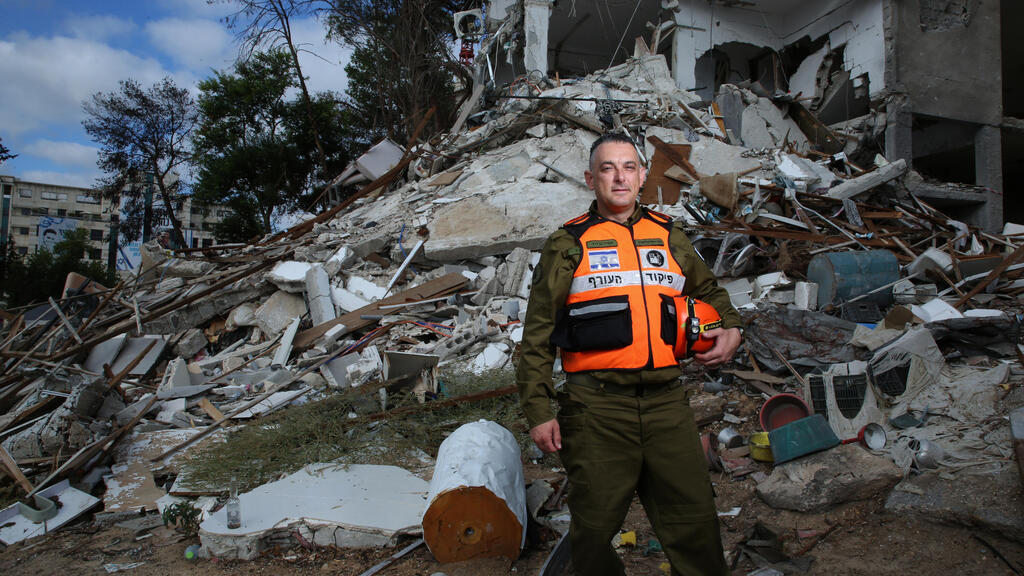
Col. Ben-David at the Weizmann Institute site after an Iranian missile strike
(Photo: Ryan Frois)
In another incident, in the city of Rehovot, Col. Ben-David arrived at a building on Taller Street that had taken a direct hit from an Iranian missile.
“During the rescue operation, a man approached me and said his 80-year-old father was inside the building. I asked him for his father’s name. He said — Moris Marzuk. I told him, ‘Give me something to help identify him.’ The son said, ‘He has a large scar on his leg.’
“While sweeping the area, I suddenly saw an elderly man lying curled up, injured and barely conscious, after two floors had collapsed on him. I reached my hand in through the rubble, felt his leg, and found the scar. I shouted to the team: ‘Moris is here!’ After two hours of work, we pulled him out. Moris made it out alive but sadly passed away a month later from an infection. When I came to pay a condolence call, his family told me: ‘Thanks to you we got to have our father for one more month.’”
Was it the right call to wake up the entire country early in the morning when Operation Rising Lion began?
“Looking back, we probably could have done it more calmly. But we didn’t know what the day would bring, so we erred on the side of caution. Because if 200 missiles had been fired at that moment, you’d be asking me: ‘Why didn’t you wake me up?’ We said: ‘People, a war is starting. Wake up, everyone.’ Worst case, I woke you up. Fine, you’ll be annoyed with me, maybe laugh about it later.”
Is the Israeli home front better prepared today?
“I feel like the public is more ready now — they understand the threat. Today, you can ask a seven-year-old where the nearest shelter is, and they’ll know. We also understand better what we’re dealing with. We’ll show up to the next event more precise, more focused.
“Today, the Home Front Command is a brand. People trust us. As a young officer in an orange beret, I didn’t always feel comfortable. Today, I’m proud to wear it. There’s a reason they call us ‘the angels in orange.’”
At age 45, Amir Ben-David hung up his uniform and began a new chapter as deputy director general and head of operations at the Jerusalem Municipality. There too, he will deal with matters of security and emergency preparedness. In between, he reflects on himself, on the army, and especially on Israeli society.
“When we are united, as a people, we can achieve miracles,” he said. “We just need to stay together.”