

The conversation about the future of their relationship that Sasha Troufanov and Sapir Cohen had planned after a year together never happened. Instead, they found themselves somewhere neither could have imagined, though not particularly far from each other. He was being held in a hideout in the Gaza Strip, while she was underground in a tunnel.
"Our relationship wasn't very good in the months before we were kidnapped, and you could even say we were about to break up just before October 7," recalls Sapir, who was released from Hamas captivity after 55 days and is now sitting on a sofa beside Sasha, who was freed after 498 days.
Sapir and Sasha's wedding


"I think that if October 7 hadn't happened, we would have had a conversation after the Jewish holidays along the lines of, 'Listen, I don't think this relationship is going anywhere. We've tried everything, including moving in together and opening up to each other, but it's just not working. We're too different, and for both our sakes, I think it's better if we break up,'" Sasha says.

Who would have initiated that conversation?
"Probably Sapir. She was almost 29, and I was 27. She wanted a serious relationship and marriage, while I'd just moved to central Israel after finishing my studies in the south. Marriage was the last thing on my mind. That's why, when I was in captivity, I never expected her to wait for me. Logically, she had absolutely no reason to."
But she did wait. For more than 400 days after her own release, she joined the campaign to bring him home and became a source of support for his mother, Lena.
"I didn't even know where I should wait when they told us he was coming back," Sapir recalls. "I thought it wouldn't be appropriate for me to be at the first reception point in Re'im, which is usually reserved for family members. I didn't want to surprise him, and I knew he wasn't expecting me. I didn't want him to feel obligated. But Lena was absolutely insistent, and I felt I deserved to see Sasha reunited with his mother after such a long struggle, regardless of what happened between us."
"From my perspective, she completely invited herself," Sasha jokes.
"We practically threw ourselves at him, and after that, I barely remember anything because I was so overwhelmed," Sapir says. "He told me he'd found faith during captivity, and I immediately saw in him qualities I'd always hoped he would have. Still, I tried to give him space and stayed out of his room. But when they asked whether he wanted to sleep alone, with his mother or with me, he called for me."
"I'd already spent enough time sleeping alone, and sleeping with Mom would have been strange," Sasha says. "At first, the whole interaction was awkward. You're having these intimate conversations with someone you've already broken up with in your head and never expected to see there. Then you discover she was a major part of what had become your most important goal in captivity: making sure your mother stayed alive.
"There was enormous gratitude, but also a need to understand where our relationship stood. And I discovered that we had both changed."
Their journey culminated in a wedding in July, attended by 500 guests who could scarcely believe the moment was real. Among them were Israel's president and Nitzan Alon, who headed the military's hostage headquarters. "They were invited by Lena, because they really helped us throughout the way," Sapir recalls. "We felt they deserved to be part of our happiness. I saw this wedding as a moment of national joy, not just a personal celebration."
"Sasha greeted the guests, while I stayed out of sight until the ceremony. As I left the bridal suite, I caught a glimpse of everyone through a glass door. I thought about how unimaginable this moment had seemed when we were both being held underground."
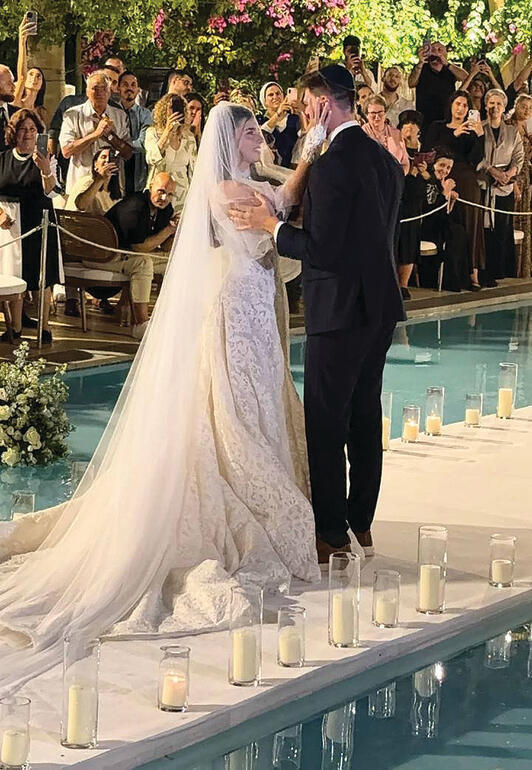
Sapir and Sasha on their wedding day
Sapir walked down the aisle to "MiMa'amakim" ("Out of the Depths") by Israeli musician Idan Raichel, a song Sasha had heard while in captivity.
"A terrorist guarding me once left his radio with me," Sasha recalls. "I listened at a very low volume so I wouldn't drain the battery. I remember being desperately hungry and hearing all those radio commercials for supermarket chicken and grilled-meat restaurants. Then this song came on, and I thought about Sapir."
"There was also 'Shir LaMa'alot,' the song Sasha walked down the aisle to," Sapir adds. "I used to hear it in my head when I thought about him in captivity."
"For me, being able to walk down the aisle at my own wedding after everything my legs had been through in Gaza was extraordinary," Sasha says. "Back on October 7, when they were using broomsticks as makeshift splints for my injured legs, I could never have imagined a moment like that. I was a different person then."
"During our final slow dance, I suddenly noticed that everyone around us was crying, just crying tears of joy," Sapir says. "I told Sasha, 'Look what's happening here.' And he said, 'Sapir, I'm crying too.'"
‘I decided I had to break up with him’
Today, after the adrenaline of two separate experiences of captivity, the struggle to bring the hostages home, speaking tours around the world, a marriage proposal in the Caribbean and a wedding, the couple are a little less emotional.
They are the first to acknowledge that their relationship is a miracle, much like their survival after countless moments in which they believed they were about to die.
But returning to ordinary life is another matter. They are now two people in their 30s who lost a substantial part of their 20s and were left with trauma instead.
We meet in an apartment in central Tel Aviv, about a 10-minute walk from the sea, which friends have temporarily lent them.
"We're between temporary apartments right now," Sapir explains. "We came back from a speaking tour abroad, and we're living out of one suitcase of clothes I took with me, not realizing those would be all the clothes I'd have. Everything else is in storage until we move permanently to Herzliya soon."
Sasha has returned to his engineering job at Amazon on a part-time basis. "We don't really talk about captivity in our day-to-day lives, but we're not at the point where we can joke about it either," Sapir admits. "Sometimes I forget, or find it hard to believe, that I was actually held hostage. There were moments during captivity when I imagined I was being tested for a job with the Shin Bet security agency, and that any minute a recruiter would walk in and say, 'You're hired.'
"I can watch an interview with former hostages on television and think, 'Wow, what they went through was terrible,' and Sasha, sitting beside me, can't believe what he's hearing. It still hasn't fully sunk in that we went through it too."
"I look around and see that everyone has moved forward while I was gone, and you realize you're a step behind," Sasha says. "It's hard for me to have fallen out of the race. I feel as though I've been held back a grade, and I could have been somewhere else in my career. But then I remind myself of all the ways I grew during that time, and the picture changes.
"Before everything happened, all I cared about was making as much money as possible. I wanted to reach 10 million shekels as quickly as I could, have enough financial security to stop worrying about money and then become a teacher.
"After captivity, I can't wait that long to find meaning in my life. I need it now. I want to feel that being taken hostage and surviving isn't the greatest thing I'll ever accomplish."
"I was a software engineer before I was kidnapped, and even before that I'd been wondering whether it was right for me," Sapir says. "I didn't have the courage to leave, but when I came back, sitting in front of a computer working on some feature felt so far removed from who I was. Now I'm searching for what comes next."
They met on a dating app, and the beginning was hardly promising. "We were together for a year before the kidnapping, but it wasn't a year in which the relationship was getting better," Sasha says.
"I used to show my brothers pictures of guys from the app," Sapir recalls. "They'd say things like, 'Nah, boring,' or 'Wow, handsome!' With Sasha, everyone agreed he was good-looking.
"We talked for about two weeks before meeting, and it was genuinely fun. Then we met, and the first date wasn't great. I took the train all the way from Kiryat Ata to Sarona in Tel Aviv, and of course he didn't make the effort to come to me.
"When I saw him, I couldn't believe my eyes. It was like Hercules was walking toward me. But once we started talking, things just didn't click. The conversation felt awkward, and there was no chemistry.
"I headed back to the train station feeling disappointed, convinced we'd never speak again. But then he texted to ask if I'd gotten home all right."
"Neither of us thought there would be a second date," Sasha says. "On the way home, I thought about how little I'd enjoyed the date itself, but I remembered how much fun it had been talking to her for those two weeks beforehand. So I decided to cast a line."
"I replied, 'Good night, sweetie,' the way I'd written to him before our date," Sapir says. "When he asked, 'What, am I still sweet?' I told him yes. And that's how it continued."
The following dates were even stranger.
"On our second date in Yarkon Park, a jackal picked up my bag in its mouth, and I had to chase it," Sasha says. "It also ate the cheese pastries she'd brought me. On our third date, a thief stole my phone without me noticing."
"He used my phone to call a service that helps locate lost phones," Sapir says. "The representative asked him, 'Wait, which phone are you calling from?' And he replied, 'Um, my girlfriend's phone.' I remember thinking, wow, this guy is serious about us."
"On another date, we were cuddling on a beach chair when someone came over, stood next to us and simply took my bag with my laptop inside," Sasha recalls. "At that point, with everything happening on our dates, I started wondering whether it was a sign that something wasn't right."
"And then, on our last date, they took him from me," Sapir says. "And they took me too."
When did things finally start to turn around between you?
"They didn't!" they answer in unison.
"As the months went by and I felt our relationship wasn't going anywhere, I pushed for us to move in together," Sapir says. "I felt like I still didn't really know him. Eventually, I told him, 'Your lease is ending. Let's move in together, or we break up.' Everything was an ultimatum.
"Somehow, he agreed. It was only after six months together that I first went to Nir Oz to meet his family and friends. Even after we moved in together, we struggled to communicate. We argued a lot and just couldn't understand each other."
"In a relationship, you have to be willing to give as well as receive," Sasha says. "Back then, I didn't want to give anything. Without realizing it, I kept pushing her to see how much she could take before she'd finally break up with me, because I couldn't bring myself to end things. Meanwhile, she wanted me to be the one to do it. I knew she was a good woman and that I'd be losing something valuable, so I didn't want to be the one who made that decision."
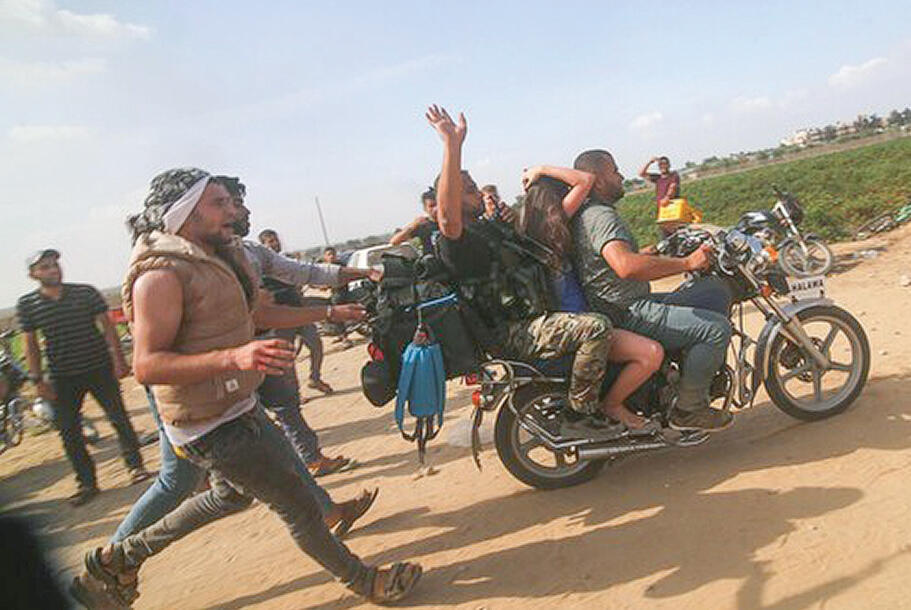
Sapir on the kidnappers' motorcycle
"I grew up in a family where achievement was everything. Then I served in military intelligence in southern Israel, where you feel enormous pressure to do your job well because you're protecting your own home. After that, I studied engineering at Ben-Gurion University.
"Everything in my life had been demanding and highly structured. Then I finally moved to central Israel, and suddenly I was in a relationship, another commitment with its own expectations. I wanted her to understand that I simply wasn't ready for that kind of commitment. Maybe I would be someday, but not yet. And she had to decide whether she wanted to stay."
"I was exhausted," Sapir says. "I was constantly traveling to see him in central Israel and initiating dates. That Saturday, when we were already living together and it was a holiday, I wanted to go somewhere. I knew that otherwise he'd spend the entire day playing PlayStation, and what was I supposed to do?
"So we could either visit my parents or his. I convinced him to go to the kibbutz, even though he kept saying he didn't want to. It was a real negotiation, and the winning argument was that it was the last day the kibbutz swimming pool would be open until Shavuot."
"I thought about that a lot in captivity," Sasha says. "Why was I so reluctant to go to the kibbutz that Saturday? I deliberately started taking my time, and we missed at least two buses."
"We argued on the bus on the way to the kibbutz," Sapir recalls. "I remember he said something that made me cry, and I decided I had to break up with him after that weekend."
‘I was certain they were going to execute me’
After that weekend, they really were separated, but not in the way Sapir had imagined.
When they arrived at Nir Oz, they settled into a guest room opposite Sasha's parents' house, planning to give their relationship one last chance.
"It was the guest room my mother always liked giving us because she could look out of her window and try to figure out where things stood between us," Sasha says. "On October 7, that turned out to be a less-than-ideal arrangement."
"I remember sitting with his friends on the evening of October 6," Sapir says. "I think Shani Goren was there, along with her sister Shira, Arbel Yehoud, and maybe Ariel joined us later. Everyone who grew up with Sasha."
"We had a great time, as always," Sasha recalls. "A little smoking, playing Jenga. We went to sleep around 1:30 or 2 a.m., and at 6:30 we woke up to chaos. Sapir woke me and said there was a rocket alert."
"I was in shock," Sapir says. "I wasn't used to anything like that. We waited, but there was no quiet, and it went on for about an hour. Then terrorists started entering communities, first Be'eri. I remember someone messaging Sasha that terrorists had infiltrated a kibbutz. Ynet was already publishing headlines with quotes like, 'Terrorists are murdering us, nobody is coming.'
"At that point, terrorists began entering our kibbutz. We could hear screams in Arabic and gunfire in the background. There was no safe room in the apartment, so we hid under the bed. Sasha was using his phone a little. I didn't touch mine. I didn't want to say goodbye to anyone, and I didn't send any messages."
Were you able to talk to each other under the bed?
"I was sure we were about to die, and I kept thinking, what am I supposed to say to him? Say goodbye? Tell him I love him? But after everything we'd been through that year, I didn't feel like I loved him at that moment. And yet, were we really going to die without me saying anything? Those were the thoughts racing through my mind as we hid under the bed."
"I was also a little angry that he couldn't protect me. We were both curled up like sardines, pressed against the wall, and he kept telling me to be quiet. All I could feel was anger."
"At one point, they started banging on our door," Sasha recalls. "The kind of banging that tells you someone is about to break it down and tear apart whoever is inside. By then I knew there was nothing I could do. It wasn't one or two terrorists, and I was helpless in a tiny room. The best thing I could think of was staying under the bed and hoping they'd miss us and leave.
"Sapir was having a panic attack. Pure panic. She wrapped herself in blankets, shaking and saying, 'Hug me, hug me.' But that wasn't the moment to start fumbling around under the bed trying to hug. It was the moment to figure out what was happening and how we might save ourselves.
"Then we saw the beam of light as the door opened, and it was as though death itself had entered the room. I saw uniforms and weapons. A terrorist came in and started overturning the beds. I was wearing boxer shorts, and Sapir had on a little pair of pajamas. I raised my hands, and he looked almost surprised. I shouted in English that we were civilians.
"About 10 terrorists came in carrying machetes, clubs and guns. They started approaching us and pulling Sapir out of all the blankets she'd wrapped herself in. I was trying to understand whether they intended to rape her in front of me or something like that. I started shouting in English, 'Give her pants!'
"From my military service, I had some idea of what was happening in Gaza and what they were capable of. I understood they could slaughter us, and worse. I just wanted them to put some clothes on her. One terrorist threw me a pair of jeans, thinking I was the one who needed something to wear. I kept insisting until one of them came over and punched me in the face.
"I started panicking because they were becoming violent. They grew angry and began rushing us. They took me out with my head down, on my knees. From that point, I couldn't see anything. I was certain they were going to execute me."

Sasha and Sapir
(Photo: Shai Franco)
"I saw a burned-out tank as they were leading me toward a motorcycle," Sapir says. "And all I could think was, 'A Holocaust is happening, and the trees are still green, and the sun is still shining in the sky. How can that be?'"
‘The terrorist said, “Of course we're humane”’
Cohen was abducted by Hamas terrorists and held in apartments and tunnels alongside other hostages from Nir Oz. Troufanov, meanwhile, was kidnapped by Islamic Jihad terrorists and spent most of his captivity alone.
His entire family was either kidnapped or murdered in the attack. His mother, Lena, and grandmother, Irena, were abducted and held for 55 days, while his father, Vitaly, was killed and buried without family members present. Their home in Nir Oz, where the family had settled after immigrating from Russia more than 25 years earlier, was completely burned down.
"I arrived in Gaza completely broken," Sasha recalls. "At one point, after they'd already taken Sapir, I tried to escape. It was a matter of life or death because I imagined they'd take me into Gaza, torture me, try to extract military information from me and then kill me. When I tried to run away, my punishment was being shot in the legs from about a meter away. The bullets shattered my bones." He points to his legs, now resting on the sofa, with scars running along them.
"At the border, we fell off the motorcycle. I couldn't stand because of my leg, and I just collapsed with the bike. Then a group of Gazans started kicking and punching me. They took me to an apartment with a bag over my head. At first, they placed broomsticks around my leg to immobilize it, using an improvised elastic bandage. They also put an oven grill rack against my leg to keep it straight. I still have marks from it on my skin."
One of the hardest moments came when he began to comprehend his new reality and realized he might not be rescued anytime soon. "In those first days, I really gave up on everything," Sasha says. "I'd lost so much blood. I was physically and mentally exhausted. They kept moving me from one house to another, and I just lay down on a mattress and fell asleep.
"I woke up in the middle of the night because the medication had worn off. I wanted to believe it was all a dream. Then I woke up a little more, saw a dim light in the room and realized two terrorists were sitting there watching me. I pulled back the blanket and saw that the entire mattress was covered in blood. My whole body hurt, and I could barely move.
"The following day, they took me to a celebratory meal for everyone who had participated in the kidnapping. There was a large tray of chicken and rice in the middle, and everyone was delighted. The terrorists kept saying, 'Ta'al, ta'al,' meaning 'Come, come.' Everyone who saw me wanted to take a picture with me. It was as if someone had brought in a giant tuna, like in Japan, to show off the catch."
Did they talk to you?
"They started interrogating me about who I was and what I did for a living. From what I knew about Gazans during my intelligence service, I understood that many were religious. I was afraid that if I said Sapir was only my girlfriend, not my wife, they'd see her as a woman who had been with a man outside marriage.
"I didn't know what had happened to her, but I thought that if she was also being held hostage, I wanted them to understand that she was someone's wife and that they weren't allowed to touch her."
Did you both realize that you needed to build relationships with the terrorists, perhaps even some degree of trust, to survive?
"Yes, and it wasn't easy," Sasha says. "You have to swallow your pride and absorb endless insults about who you are as a people, where you grew up, things you never did. You have to put your ego aside. The instinct to ask, 'Why are you letting them treat you like this?' only reduces your chances of survival if you become insolent or violent.
"I had to keep reminding myself what my goal was: getting out of there. And I understood that my one purpose was to return home, not so I could play PlayStation or go back to work, but so I could be with my mother and father again and bring them happiness."
Sapir found her own way to build a relationship with one of her captors. "The owner of the house where I was being held was a religious man, and I managed to connect with him partly because the others couldn't stand him," she says.
"I started asking him questions in English about what he was reading. I thought that if I brought up the Quran, he might engage with me. He began explaining the Quran to me. Gradually, I asked more questions, and he became completely absorbed in our conversations.
"At a certain point, he'd open the shutters in the morning and say, 'Sabiro,' which is what he called me, 'Let's talk. Wake up, let's talk.' He always wanted to talk. Eventually he started suggesting that maybe I should become Muslim. He saw potential. I said, 'Why? I don't understand. Is Islam a good thing? Prove to me that you're humane.' He said, 'Of course we're humane. The Quran says that whenever a captor eats, he must give food to his prisoner.' So I said, 'Well then, go ahead.'
"The next day, I saw him eating and said, 'What's going on? Didn't we agree the Quran says it's fifty-fifty?' And he'd bring me another pita. I'd compliment him when he cooked. I'd say, 'Smells very good. You are a good chef.'
"He was a family man with two wives whom he'd sent away from the house. They didn't know what he was doing with the apartment while they were gone. He understood that if he allowed me to move around the house freely, without having to ask permission to use the bathroom, our conversations would continue. So he went along with it."
Did he gradually become more sympathetic toward you?
"One day, he drew a memorial candle on a piece of paper and wrote my name on it. I thought he was hinting that they were going to kill me soon. He had a Hebrew-English dictionary, and I tried opening it to words I thought he might want to say.
"I opened the dictionary to the word 'enemy,' and he said, 'Yes, this is you.' Then he added, 'But when you're here, everything is full of light.' I looked at him strangely. I couldn't understand how a terrorist could say something like that. Then he tore up the drawing and threw the paper away."
Sasha also learned to navigate the complicated relationship between a hostage and his captors. "Look, there were too many of these terrorists for every single one of them to be a psychopath," he says. "Most were doing it for ideological reasons and what they regarded as their values, not because they were insane.
"There were moments when I broke down crying in front of them, when I sensed they might be about to put a bullet in my head. They'd look at each other, confused, and say, 'He's in pain.'
"When they listened to the radio, I'd ask them what was being said so I could understand how the war was unfolding. They could easily have lied to me. When I heard my mother's and Sapir's names mentioned on the radio, for example, they could have told me they'd been killed instead of released. They could have done it just to torment me, to watch me suffer, if they'd hated me and hadn't cared about me at all.
"On October 7, I felt they saw me as an animal. But over time, some kind of connection developed. One of them began translating the news for me accurately. I also managed to make him laugh and learned how to create situations where he needed me."
What did you know about your father during captivity?
"I had some indication that he'd been kidnapped, based on a fragment of information I received from them during the first month. But their accounts contradicted each other. My father was alive in my mind throughout captivity. Whenever things were hard, I'd say to myself, 'I hope he isn't suffering as much as I am, or that he's somewhere better.'
"One thing I realized was how important family is. I wanted to repair my relationship with my parents. I'm an only child, and our relationship wasn't particularly good. I'd speak to them occasionally, but the conversations were superficial, not emotional. I never really shared anything significant about myself.
"My father had great emotional intelligence and a good heart, but I somehow missed that because I saw the version of him at home, the tough Soviet father who pushed you to achieve. In captivity, I promised myself I'd strengthen our relationship. I imagined us traveling around Europe together, the way he wanted. But as time passed, the realization that he might no longer be alive grew stronger."
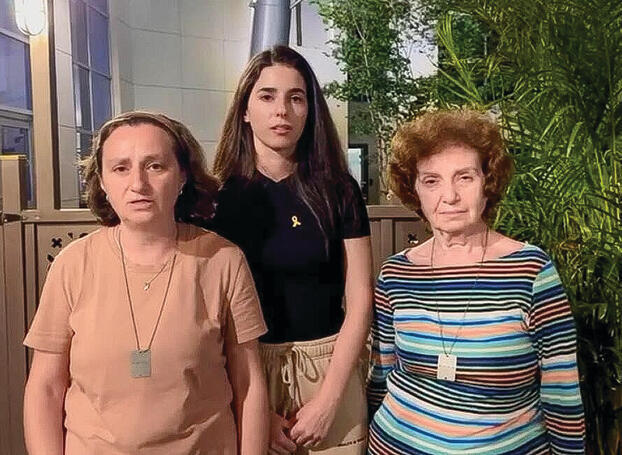
Sapir with Sasha's mother, Lena, and grandmother, Irena
When did you finally learn what had happened to him?
"Officially, only when I was released. In the first few minutes at Re'im, a social worker came up to me and said, 'Your mother and Sapir are waiting for you.' And I understood that if I'd come out before my father, he probably wasn't with us anymore.
"I broke down crying. I can still see him in front of me when I make decisions. His voice continues to guide me, even on days when I try not to let the loss consume me."
‘I was in a cage in Rafah. One day they came to film a video’
The person who helped rebuild Sapir and Sasha's relationship, even while he was absent, was his mother, Lena. The bond between the two women deepened while they were still being held in Gaza's tunnels.
"At first, I asked them to deliver a letter I'd written to her by hand in Hebrew," Sapir recalls. "The terrorist who had drawn the memorial candle agreed to take me down to the tunnel where Lena was being held. As soon as she saw me, she said, 'Sapir, I can't believe you're alive.'
"She was incredibly emotional. She had thought Sasha and I were dead because she'd looked out of the window and seen what happened in the guest room next to her house that Saturday."
Sapir later made another arrangement with one of her captors. "I had an agreement with another terrorist that he'd take me to Lena's group on Sasha's birthday, November 11. Lena was being held with Danielle and Emilia Aloni. She'd taken several sleeping pills and was terribly depressed that day.
"The moment I walked through the door, she jumped out of bed in tears. She couldn't stop crying. We sat together, and I told her, 'Do you know how long I've wanted to talk to you alone, without Sasha around, so I could ask you all kinds of things about him? And now I can!'
"Emilia drew a picture of Sasha and me getting married, with a wedding canopy in the background. She said she'd make us orange juice when we got married.
"A week before our release, they moved Lena into my group, and we caught up on everything. We talked endlessly. I told her all about Sasha's antics, and she asked, 'So how did you put up with him like that?'"
"My parents always thought I'd never find a partner," Sasha interjects.
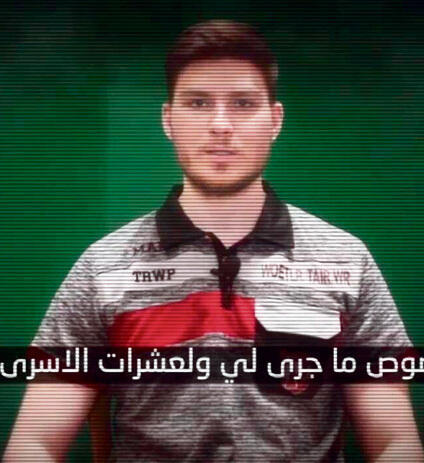
'I was surprised he mentioned me at all at the first video they released'. The video of Sasha released by his captors during captivity
"Lena told me so many stories about what he was like as a child," Sapir continues. "I felt that I got to know him better during those few days with her in captivity than I had during our entire year together.
"She told me, 'Sapir, I can't bear the thought of going back to Israel and facing whatever awaits me there. I need you to be released with me.' I stayed with her at the Kfar Maccabiah Hotel for almost two years, until Sasha came home. She was struggling with some very dark thoughts. She'd say, 'He's my only son. I have nothing else left in this world.'
"I kept trying to reassure her that he would be home soon. In her mind, she'd already married us off, and I played along. I even picked out names for the granddaughters she imagined Sasha and I would give her. My parents became close to her too, and we all grew into a family. We observed Shabbat together."
But were you perhaps idealizing Sasha while he was away? Weren't you afraid that he might return as a different person, or as the same man you had wanted to leave, making the future you had imagined impossible?
"I'd say to his mother, 'Yes, yes, a wedding.' But over time, I couldn't keep lying to her. As our relationship grew closer, I told her the truth: that Sasha and I had differences that might never be resolved. We came from different worlds. I'm a person of faith from a traditional Jewish home, and Sasha wasn't religious. That affected many aspects of our lives and habits.
"I tried to think about how long I could wait for him, and when I'd have to move on and find the person I was meant to be with, someone with whom I could fulfill my greatest dream of building a family. But I still felt I had to wait because I couldn't imagine dating someone else, especially someone who hadn't experienced what I'd been through. I felt we owed ourselves closure. He'd be released, we'd talk about everything, and then we'd either separate or stay together."
At some point, Sasha stopped mentioning you in the hostage videos released by his captors.
"I was surprised he mentioned me at all in the first video they released," she says. "I was happy he did. But when he didn't mention me in the second video, I was convinced he'd given up on us. I thought that if he'd believed there was still a chance before, he was now letting me go, as if to say, 'Move on with your life and find someone else.' I knew how much he hated feeling like a burden."
Meanwhile, Sasha was going through some of the darkest periods of his captivity. "I was held in a cage in Rafah, where they interrogated me about my military service. I was also in Khan Younis during the bombardments," he recalls.
"I kept going for my mother's sake. I knew that if I did something to end my life, she might do the same, or spend the rest of her life consumed by grief.
"One day, they came to film a video of me. They brought me clean clothes and someone who spoke very formal Hebrew. He started asking me questions. They filmed several videos for different factions involved in their internal politics.
"Then they filmed a video intended for Israel. The terrorist dictated exactly what I had to say, sentence by sentence. He even included Sapir's name, which he pronounced 'Sabir,' and insisted that I say I missed her.
"I tried explaining that I didn't think it was appropriate. In my mind, she'd already been free for five months and was getting on with her life. Maybe she'd even started rebuilding her life and looking for someone else."
"We took the first video, the one in which he mentioned me, to a body language analyst," Sapir recalls. She told me, 'Sapir, he loves you, but with his head rather than his heart.' And I hadn't told her anything about our relationship beforehand."
"My feelings for Sapir developed after I came home," Sasha says. "As far as I was concerned, the day I returned was the day we started from zero. Back in November, during captivity, I'd already buried myself emotionally. I wanted her to move on, partly because I genuinely didn't feel any romantic longing for her.
"I pushed people out of my mind during captivity because thinking about them only made me feel lonelier. I never imagined Sapir would be there for my mother. Why would she feel any obligation toward her? Her family also stood by my mother and gave her strength. They're a big part of the reason she's still alive today."
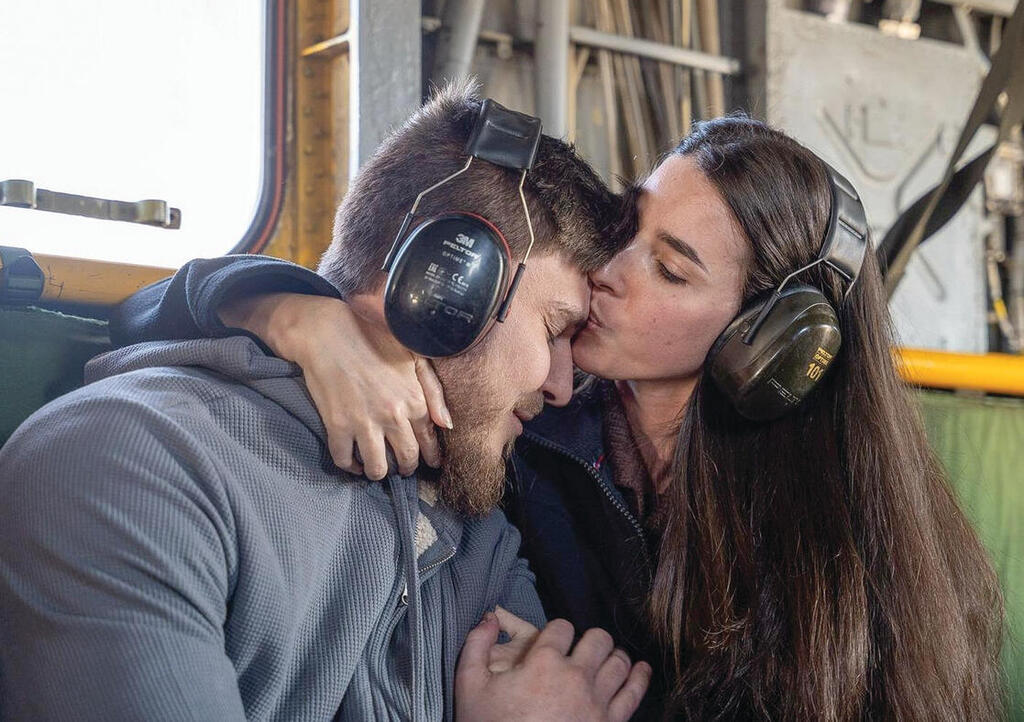
‘I felt I hadn't waited all that time for nothing. This is my man.’ Sapir and Sasha aboard a helicopter after his release
(Photo: IDF Spokesperson's Unit)
Troufanov was released in February 2025. The couple's relationship underwent a rapid transformation, culminating in a marriage proposal just five months later. "We came back as genuine, open people," Sapir says.
"Before captivity, I felt I was constantly walking on eggshells. I was afraid of ruining what we had, afraid he'd feel pressured by things I wanted. I hid my emotions, and that created a relationship that wasn't authentic.
"I came out of captivity a different person. I asked myself, 'What were you so afraid of all that time?' It feels so good to be direct, to feel confident about who you are and what you need. I promised myself that when he came back, I'd put everything on the table. I'd tell him I observe Shabbat and that it wasn't up for negotiation. I'd tell him all the things that might make him run away and see whether he stayed. And he came back suddenly able to open up emotionally too."
"We talked all night when I got back," Sasha says. "I suddenly saw someone with extraordinary strength in Sapir, someone with wisdom and warmth."
"That first night was one long conversation," Sapir recalls. "I felt that I hadn't waited all that time for nothing. This was my man. I was on cloud nine."
‘You could see the ring box from miles away’
The couple returned to Kfar Maccabiah, where former hostages had been staying, and initially lived in separate rooms. "I knew I needed my space, and she needed hers," Sasha explains. "Our relationship wasn't yet at the point where we were ready to share a room.
"I had all kinds of physical problems when I came back, from head to toe. After eating canned food for a year and a half, your digestive system isn't the same. My stomach would swell up. My skin would itch and turn red from soap because I wasn't used to showering. I couldn't sleep properly or get back into a routine. Even today, I still struggle with sleep and have recurring dreams."
"Before captivity, he always tried to appear strong and tough," Sapir says. "But when he came back, he was able to open up to me about his dreams and struggles. The fact that he now feels comfortable sharing those things with me has brought us closer."
"Sapir made it clear that we'd reached the point where I had to decide whether to propose," Sasha says. "At first, I wanted to wait because I felt that my friends were still in Gaza. Ariel and Arbel were still being held hostage."
Sapir, how did you know he wanted to propose for the right reasons, and that your relationship had a solid enough foundation beyond the emotional needs you were fulfilling for each other?
"I was afraid he wanted to make his mother happy. I didn't want him to propose because he felt he owed me something. I'd tell Lena, 'Don't say things to him like, "Sapir is the reason I'm alive," because it puts pressure on him.' But I also wanted to know where things were going. I needed reassurance."
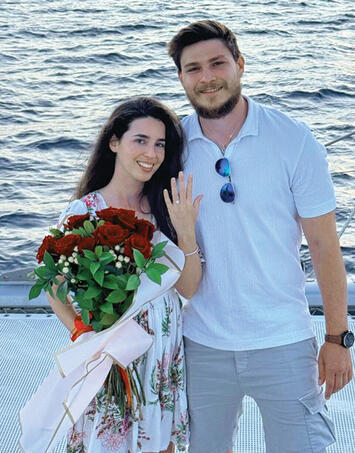
Sapir and Sasha during the marriage proposal
Much of their renewed connection developed during speaking tours they began giving to Jewish communities around the world shortly after Sasha's release. "We built shared experiences during those trips abroad," Sapir says. "During our first year together, we'd been two strangers who met on an app."
"You could say we feel as though we grew up together," Sasha adds. "That's something couples often look for, the feeling that they've developed as people alongside each other, rather than confronting two fully formed versions of one another, with each person trying to change the other.
"We became a good team. "We went on a speaking tour in the United States, and I knew I'd propose during that trip. We'd decided that the Caribbean would be our final destination. I started trying to convince her to wear something she wouldn't regret being photographed in, and to hurry so we'd make it in time for sunset."
"He was wearing tight shorts," Sapir recalls, laughing, "and you could see the ring box sticking out of his pocket from miles away. I remember thinking how sweet it was that he genuinely believed nobody could see it."
Both recognize that the transformation in their relationship has taught them lessons about communication and expressing their needs, beyond the extraordinary story of personal growth following trauma.
"Most of the questions we get during our talks are about our relationship," Sapir says. "We realized we wanted to talk about what took us from being a couple on the verge of breaking up to a couple who went through captivity and came back stronger."
Sasha, would you return to the Gaza border area to raise your children?
"I still haven't gone back, not even for a visit. All I have left are memories. I remember the kibbutz as it was on October 6, because on October 7 I was taken out of it with a bag over my head. Nothing has contaminated my memory of Nir Oz. That's why I don't go back. I want it to stay that way in my mind.
"It's difficult to admit, but there's an unwritten agreement with people who live in Israel's periphery. They benefit from relatively affordable living, in terms of taxes and prices, but they serve as a human shield. People who live in central Israel have the opposite arrangement. They enjoy relative security but pay a higher cost of living.
"I'd rather contribute enough to the country's economy to be able to live in central Israel, so my family won't be part of that unwritten contract that says, 'You'll be the first to absorb enemy fire. Sorry, my friend.' My mother, on the other hand, goes to Nir Oz three times a week to feed the cats."
You've had contact with politicians during the most critical period of your lives. How do you feel about the upcoming elections?
"There was a politician who told Lena and me, 'If it were up to me, you wouldn't be here either, and you wouldn't have come back,'" Sapir recalls. "I noticed Lena smiling out of the corner of my eye. When I asked why she was so happy, she said, 'Now I finally understand that only God can help me.'"
"There's a wonderful side to this country, but the politicians' hearts weren't in the right place," Sasha says. "They're in it for the money, the power and control over budgets."
"I'll probably vote for someone different from the person I voted for before October 7," Sapir says. "But they're all equally focused on looking good on Instagram, and I can't see myself voting for any politician with complete conviction."
"You see Ben Gvir having his picture taken with prisoners," Sasha says, referring to Israeli National Security Minister Itamar Ben Gvir. "As someone who was in the opposite situation, I know how much nonsense that is, because those are people who will say whatever he wants them to say.
"It's pure propaganda for the cameras. There's no candidate today whom I want to support publicly. I simply think that anyone who wants to be elected owes the families affected by October 7 a concrete plan explaining what they intend to do."