


The Shahed 101 is one particularly wicked piece of Iranian UAV hardware. It is 1.60 meters long, has a two meter wingspan and a carbon fiber body that makes it very hard to detect on radar. It is launched from Lebanon, slices through the sky in a chilling silence thanks to its electric motor, flies very far, up to 800 kilometers, and very low, almost brushing the treetops. In its belly it carries a cruel bomb weighing about eight kilograms. When it reaches its target, the Shahed 101 glides straight into it and explodes on contact with its shrapnel warhead, whose only purpose is to kill as many people as possible at once. It is a flying death machine, efficient and cheap, developed by Revolutionary Guards scientists with one central goal in mind: to hit as many Israeli soldiers as possible.
And indeed, soldiers serving on the northern border learned to recognize the Shahed 101’s spine chilling buzz, and also understood that there was no truly effective answer to this weapon. From the ground it is very hard to bring down, and by the time a helicopter or fighter jet manages to identify it, chase it and shoot it down, long minutes pass, sometimes deadly ones. What is left? Take cover well and hope it passes. Sometimes that does not help either. The Shahed 101 hit many communities in the north. In an attack on Kabri, for example, a reserve soldier was killed. There were also attacks in Eilat, in the Jordan Valley and elsewhere. Other UAV attacks took dozens more lives. At the Golani Brigade basic training base near Ramat Menashe, one UAV, as remembered, even made it from Lebanon to the prime minister’s home in Caesarea. Another came from Yemen and struck a building near the U.S. Embassy, killing a man. If against the rocket array the defensive layer provided by Iron Dome and Arrow performed impressively, with 90 percent to 95 percent interception rates, against drones and UAVs the numbers were far lower. Only about 50 percent were shot down in time.

But a little more than a year ago, that balance of terror was broken. It was in the evening hours when soldiers of the Dragon Battalion (946) in the north spotted a threat hovering over their sector. Dragon is a tactical battalion belonging to the Air Defense Array, reestablished after nearly 20 years since the previous battalion with the same name was disbanded. That night, the moment they had been waiting for finally arrived. Inside the battery’s operations trailer they tracked the target tensely. Then came the alert, then the lock. And then came the launch.
When the system was activated, no roar of a Tamir interceptor missile was heard outside. There was no terrifying boom of an Arrow launch either. In fact, aside from the soldiers’ strained breathing inside the trailer and the radio calls, there was no unusual sound. At first, nothing could be seen. But those minutes will enter history as the time of the first operational launch of an Israeli laser weapon.
And suddenly, about two kilometers away, the UAV from Lebanon was violently knocked sideways in a silent blow. It tried to stabilize, but its broken wing, with its tip hanging helplessly, left it no chance. The UAV spun on its axis, its nose pointed down, went into a spiral and fell like a stone to the ground. The next sound was the shouts of joy in the operations trailer, which were clearly heard far away.
These were justified shouts. Never before had anyone managed to bring down airborne weapons using a laser beam in operational activity. Everyone understood it was an event that changed the entire game. A real revolution.
At the end of May this year, on the 600th day of the October 7 war, the defense establishment revealed a stunning disclosure: laser cannons were participating in the war and had already brought down close to 40 UAVs launched by Hezbollah. “The Air Defense Array deployed laser systems in the field and achieved especially high interception results that saved civilians’ lives and protected national assets,” the statement said.
The video released was striking. One after another, enemy drones were seen breaking apart, exploding and diving into the ground. “Israel is the first country in the world to present a massive operational laser capability for intercepting threats,” said Brig. Gen. (res.) Danny Gold, head of the Defense Ministry’s Directorate of Defense Research and Development, or MAFAT.
Media outlets celebrated the entry into service of the Iron Beam laser system, also known as “Magen Or,” which had been widely discussed. But that was not true. In fact, these were several small mobile Rafael laser firing systems, Iron Beam M (“Lahav Barzel”) and Lite Beam, still in testing stages. They were drafted into the campaign and, in a way that surprised even their developers, repeatedly brought down UAVs. They did so at a fraction of the cost of fighter jets and helicopters scrambled toward drones, and of the air to air missiles fired at them.
This week we reveal that not only soldiers took part in this historic laser warfare, but also civilians. Because these were “demonstrators,” weapons still under development, engineers and technicians had to accompany them and make sure they worked properly, meaning they blew up UAVs but did not fry soldiers.
One of them was Dr. Y., the system engineer of Iron Beam. Dr. Y. and his team went into the field alongside Air Defense soldiers to operate the demonstrators. “We worked very hard to make this happen, our teams worked around the clock here in the field,” said Dr. Y. “The soldiers operated it for the first time and they learned fast. Very fast. But even then they had comments and suggestions for improvements, and we were here at night. Suddenly something is not working for someone, so you get a phone call on Saturday and jump in. This thing was constant. We also did very quick learning cycles.”
And people say engineers’ daily routine is boring. Was this something you ever thought you would have to do?
Dr. Y.: “I think it needs to be put in context. October 7, everyone wakes up and thinks what they can do. So after we went to donate blood, we met and started thinking, OK, what can we do now? Since we are all identified with laser, we said, OK, what can we do with laser?”
Dr. D., head of electro-optics systems in the laser project: “There was a team here that enlisted in an amazing way. But we also did not give up and continued in parallel on the main development. We were here under a lot of sirens at that time, and when you know the system saved some of that, it is a very good feeling.”
How can the IDF rely on a technology not fully proven yet to do operational work and protect civilians?
Lt. Col. Y., head of the high-power laser branch at MAFAT: “This system was supposed to reach the Air Force this year. So to take things the system had already successfully demonstrated, pack everything and as fast as possible send it to the field, that was very important to us. Suddenly there was something whose impact was bigger than we imagined. We understood the laser really would be the equalizer breaker.”
If until now talk about laser weapons was in the future tense, now it is turning into the present. Sometime in the coming month, the operational launch of Iron Beam will be carried out, and a line of new laser cannon batteries will be deployed near Iron Dome batteries. Iron Beam, to be called Iron Beam abroad, is a ground-based high-power laser weapon system, 100 kilowatts, the first of its kind in the world to enter regular operational service. The system proved effective in intercepting rockets, mortar bombs and UAVs at ranges of up to 10 kilometers.
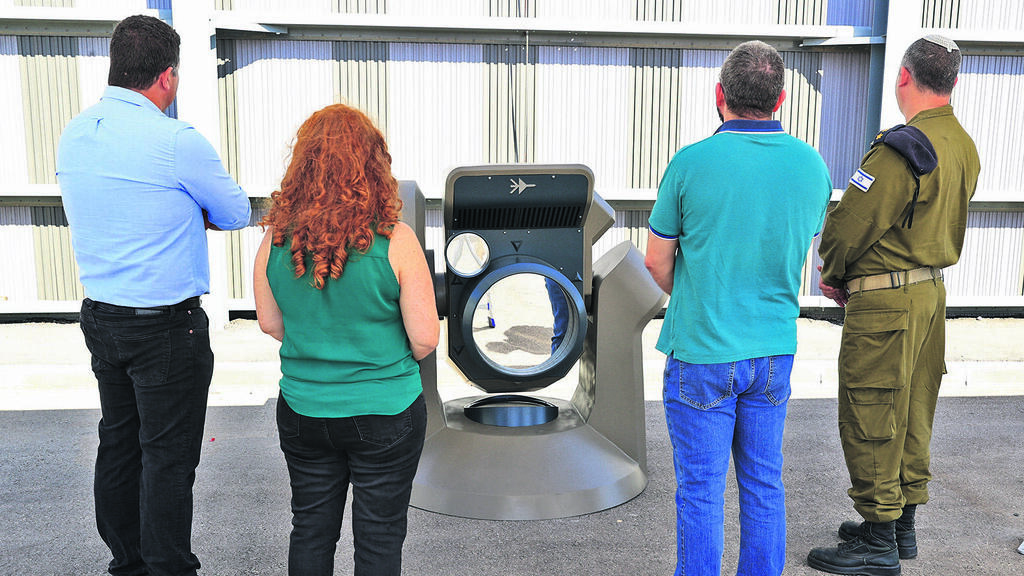
From left to right: Engineer A., engineer T., Dr. Y., and Lt. Col. Y.
(Photo: Elad Gershgoren)
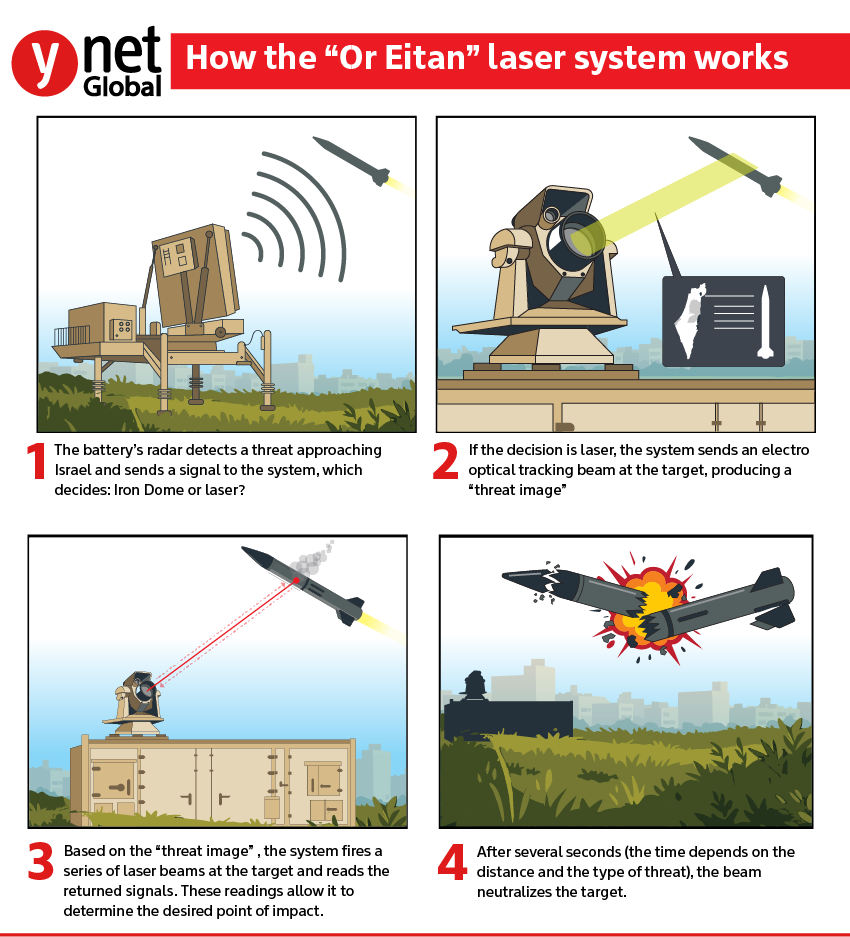
Iron Beam is operated using Iron Dome’s warning and command and control systems. In a split second, the system identifies whether an approaching threat requires a $50,000 Iron Dome missile or a laser shot costing about half a dollar. The considerations will be purely operational, of course, but the savings in interception economics will be enormous.
The IDF is the first military to operate laser weapons in a full operational framework, but it is fair to assume this is only the beginning of the revolution. In the not-too-distant future, we will likely see lasers mounted on satellites intercepting intercontinental missiles from space, airborne laser systems, including on drones, and other uses by ground forces. If a laser can intercept a UAV in the air, why not destroy, say, an enemy aircraft before takeoff, or armored vehicles in a distant camp? But all that, for now, is science fiction, just as Iron Beam was until recently.
This child has many fathers and mothers, many of them at Rafael’s David Institute, somewhere in northern Israel. The company employs close to 1,000 workers, about 100 of them on Iron Beam, one of the most complex and challenging projects ever developed by Israel’s defense industries. Last week, the system won the prestigious Aviation Week Laureate Award for 2026. “The world’s first high-energy laser system capable of effectively intercepting rockets, missiles and unmanned aerial vehicles,” the announcement said. The prize was awarded to Rafael together with development partners Elbit Systems and MAFAT.
In a rare move, Rafael allowed a visit to the place where Iron Beam was born and developed, the David Institute. It is a heavily fortified complex overlooking the sea, containing a set of buildings that look like a 1970s high-tech campus, but under a thick veil of secrecy and security. The products are different, too: air-to-air missiles, a hypersonic interceptor, Iron Dome and David’s Sling batteries, bombs and munitions. Rafael’s investment in research and development in 2024 amounted to about $1.8 billion, in addition to R and D budgets it received from the defense establishment for developing key systems for Israel’s defense.
Inside one of the hangars, four of the people who turned Iron Beam from science fiction into reality are waiting for us. Dr. Y., the chief system engineer of Iron Beam, a 47-year-old northern resident, married with four children, has been at Rafael since 2010 and has accompanied the project like a father following his toddler’s steps. Dr. D. is 46, married with three children, lives in the Lower Galilee, has worked at Rafael about a decade and today leads laser systems in the development and engineering division. He is responsible for electro-optics technology, the main driver that pushed the system forward, adaptive optics. We will get to that.
T. is a leading engineer on the project. She is 42, married and a mother of three, from the Krayot area. In the project, she is responsible for the director, which looks like a big lens but is actually the muzzle of the cannon that fires the lethal laser beam and aims it at the target. T. manages more than 40 team members and is the veteran among the four. She joined in 2010, a little before Dr. Y.
Lt. Col. Y., not to be confused with Dr. Y., is a Jerusalem resident, 41, married with five children. A trained engineer through the academic reserve program, he is an officer in MAFAT's R&D unit and serves as head of the high-power laser branch. He is the youngest in the group and has an important job: representing the IDF’s needs and pushing the teams to meet them on time. The needs are not always clear, especially as decisions change over time. We will get to that, too.
So who among you can say the laser is your baby?
Dr. Y.: “It is a child with many parents, a lot of them. It is not a one-person project. There is not one crazy guy pushing it. Many people are involved.”
Dr. D.: “Let’s say that both Dr. Y. and T. and I, throughout our time at Rafael, this is what we do.”
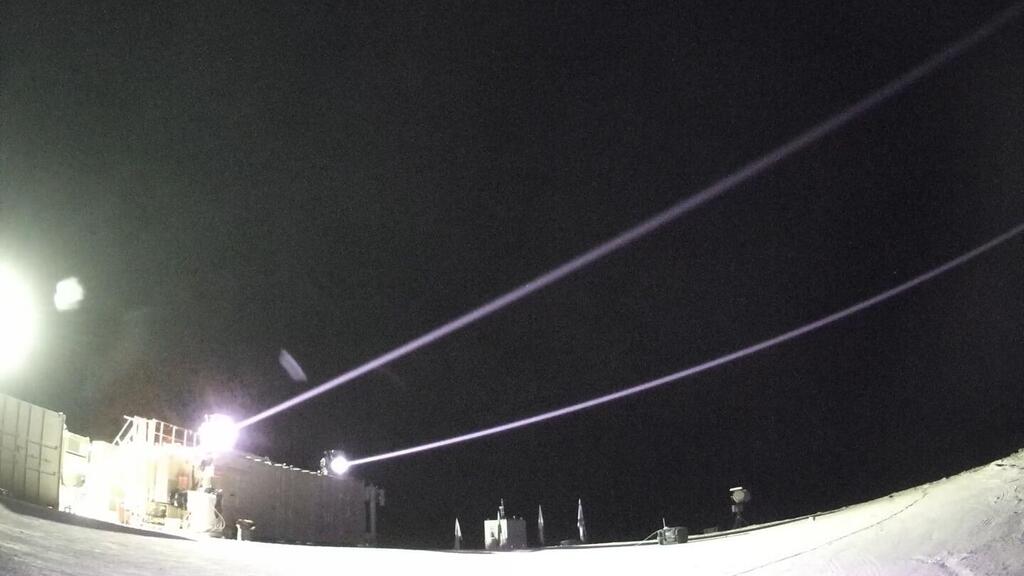
Iron Beam in action
(Photo: Defense Ministry)
To understand how big their achievement is, you need to understand how it started. For decades, around the world, people fantasized about turning lasers into weapons, making movies like “Star Wars” and “Blade Runner” real. The first attempts to build a laser weapon were by the Americans. In 1996, U.S. President Bill Clinton and Prime Minister Shimon Peres signed a contract for joint development of a rocket interception laser called Nautilus (THEL), led by Northrop Grumman. It was a system with enormous laser power based on dangerous chemical materials, heavy, large and above all very expensive. Then they tried to develop an airborne system called Skyguard that fired powerful laser beams from a jumbo jet, but that also proved too expensive. Israel’s defense establishment decided to give up on lasers in 2007 and prefer the development of Iron Dome. “It was not only that we stopped after that program for a second to rethink,” Lt. Col. Y. says. “The Americans also changed many directions after learning from it. Today we are leading all laser into a completely different field. It is no longer chemical laser but electric laser.”
The first operational laser interception in history took place about a year ago in northern Israel. The Iron Beam system identified a Hezbollah UAV moving toward Israel. Within seconds it lost a wing, dove into the ground and crashed
And indeed, Rafael then began developing a system called Iron Beam based on electric laser technology. The problem was that electric laser is cheaper and safer to produce than chemical laser, but much weaker. They solved this with a new technology called beam combining. The system generates several laser beams that unite into one powerful beam. The idea was to neutralize mortars and Qassam rockets, which were the prominent threats at the time.
Then came the argument. There was not enough money for both laser and Iron Dome. Experts split into two camps. Behind the scenes, stormy and heated debates unfolded, until then Defense Minister Amir Peretz decided in 2007: go with Iron Dome, also by Rafael. The laser stayed on a low flame, but engineers boosted the beam’s power greatly and overcame additional problems.
Over the years, repeated tests were held at the national test range in the Negev, and results were reported as successful. As early as 2010, successful laser interceptions of 60 mm and 120 mm mortar shells were carried out, but the defense establishment did not advance the project. In 2014, Rafael estimated the system would be operational within two years. In 2018, another successful test was conducted and announcements said the system would be available within a year. The problem was that the announcements were not matched with adequate budgets.
But then the battlefield changed and drones entered the arena. In 2020, Rafael built a laser system that in tests succeeded in intercepting drones. A year later, a few systems were ordered at a cost of 400 million shekels. Not long after, Naftali Bennett entered the prime minister’s office. He was very impressed by laser capabilities and ordered the system, then called “Magen Or,” to be deployed soon. The New York Times reported that Yahya Sinwar decided to advance the October 7 attack out of fear the system would be operational by the end of 2023. That, as we know, did not happen.
But the lesson seems to have been absorbed. Last year, the Defense Ministry signed a contract with Rafael and Elbit to supply the system by 2025, this time with a budget of 2 billion shekels. “The deal heralds a new era, the laser era,” said then Defense Ministry director general and today’s chief of staff Eyal Zamir. The next stage of expanding the array already has funding: $1.2 billion promised during President Joe Biden’s term. There are many plans for how that money will be used.
If you look for the father of laser beam theory, you arrive, of course, at Albert Einstein. In his 1917 paper, he described stimulated emission of beams, including light beams. Many years later, in 1960, Theodore Maiman turned the theoretical idea into reality and entered history as the inventor of the L.A.S.E.R., the not so sexy initials for “light amplification by stimulated emission of radiation.” Since then, people have tried to increase laser power more and more, and lasers have entered use in fields like medical surgery or precise industrial cutting. But turning them into real weapons was a long road. The main problem was power. You know the toy laser pointer the neighbor’s annoying kid bought at a convenience store and plays with while your cat goes crazy chasing the red dot? That toy has less than one watt of power. Iron Beam has 100,000 watts.
Power is not the only problem developers faced. Another problem is that targets move fast and even try to evade, and it is not easy to lock onto them. A third problem is range. Even the strongest laser reaches only a few kilometers, while threats may be farther away. That range shrinks sharply in cloudy or rainy weather. The biggest problem of all is atmospheric interference that distorts light beams, like shimmering mirages on a road on a hot day. Interference can completely shut down the laser’s ability to hit.
Engineer T. was born in Russia and immigrated as a little girl. Today she is responsible for developing the director that fires the laser. 'It is fun to work on something you know will ultimately protect your home, protect your children, protect the soldiers,' she said
Rafael and Elbit dealt with these challenges impressively. The energy to create a strong laser beam is now generated using fiber optics, and more and more fibers can be added to increase beam power. “For the system to work, we need the laser source we buy from Elbit, a very unique laser developed to our requirements, and they do it excellently,” explains Dr. A. They overcome interference with technology called adaptive optics. We will not dive into technicalities, but we will take Dr. A.’s word when he says: “It is critical, super unique and the place where we are best in the world, by a big margin.”
In the end, after breakthroughs, they had a system ready to test. How does it work? Let’s say Hezbollah launches a UAV toward Israel. The system’s radar, the same radar as Iron Dome, detects it and performs what is called “acquisition,” meaning it locks on. The command and control system decides whether to bring it down with an Iron Dome interceptor or whether conditions allow a laser interception. If laser is chosen, radar data is transferred to the laser director mounted on a gimbal, a rotating arm that lets it move 360 degrees quickly. All this time, the UAV is tracked, and adaptive optics feed in real-time corrections the laser needs to overcome air distortions. The director focuses the beam to the right diameter, and then you can “fire” the laser, or in professional language, perform a “lezira.”
Dr. Y.: “The challenge of aiming the beam is like a car that needs to drive in a big, crowded parking lot at 150 kilometers an hour. OK? You need all the systems that know how to see, all the algorithms that know how to think, the precision in the process. Then adaptive optics comes into play and corrects in real time the turbulence the air causes so the beams stay on target.”
There is something mind-blowing about your project. In every weapons world, it is easy to understand what it is: a bombing plane, a launched missile, an artillery gun. But this is the first time the public is shown a weapon that looks like science fiction. You basically built a working phaser.
Lt. Col. Y.: “I think in the end, success is worth much more than science fiction. The fact we can say a laser intercepts is reality, it is no longer anyone’s imagination. That beats everything. Even though we did it when it was still half science fiction.”
Dr. Y.: “The concept of laser as a weapon was not there at the beginning. When they asked the inventor of laser in the United States what it was good for, he talked about interesting physics, but newspapers already had science fiction pictures and aliens exploding. When they tried to go in the weapons direction, our professional forefathers started peeling that onion to see how to do it. Each time another problem is solved.”
Still, people think in science fiction terms, that a laser beam hits a target and blows it up, not that it tracks and heats it.
“Yes, that is a misconception. There can be a bit of disappointment for people who think of science fiction.”
All of this has pushed the world into a kind of new arms race. The United States reported deploying two small laser systems, 20 kilowatts, at its bases and several 60-kilowatt laser cannons on Navy destroyers. In parallel, Americans are developing huge 300-kilowatt lasers. Last year, the world was stirred when the U.S. Army confirmed it used a laser weapon to intercept an “enemy UAV” in the Middle East. Assessments were it was a Houthi UAV. Britain developed a system called DragonFire that is expected to be installed on British warships by 2027. The war in Ukraine is also pushing both Russia and Ukraine to accelerate laser weapons development. There are reports China is developing laser weapons and even sold laser systems to Saudi Arabia and Iran. Europe, mainly Italy and Germany, is in the race too, especially with naval systems, and Australia has developed a 100-kilowatt laser defense against drones.
Do you look at what is being done worldwide in this field?
Dr. Y.: “All the time. We know the systems, where they are made, who makes them.”
Does operational activity against Hezbollah UAVs help Rafael sell the system abroad?
“Both the conflict here and the conflict in Ukraine make it clear this is not only about economics and preparing to deal with swarms of drones. In the end, there is a limit to the ability to produce drones, and laser weapons create that limit. This is a nuisance worldwide, and laser systems that can deal with it have very high value. There is significant potential here for Israel and the partners.”
But the argument over lasers has not disappeared. Only recently, former intelligence officer and scientist Yossi Langotsky published an article in Haaretz criticizing what he called a “flood of public relations” around the system. He argued the chemical laser that was rejected had been far superior.
Did you have doubts you were on the right path?
Dr. Y.: “All the time.”
External criticism, or inside your team too?
“Inside the team, there is also the hesitation, a moment of, will this work, will this not work, and how. That is part of our ability to succeed, to identify obstacles, examine new directions, look and test ourselves. Luckily, MAFAT was always here, gave a push, and we knew how to deliver.”
T.: “A project like this, pushing many technologies to the edge and requiring creativity and thinking and huge effort over a long period, cannot be done without faith that in the end we will succeed. It is true there were, and still are, many challenges on the way. But if we do not believe, we would probably all go to the beach.”
Lt. Col. Y.: “There are decades of investments in technologies here and still many in the world say it will not work. I think you need to take it in small steps that eventually converge into a system. We advanced these technologies by generations, in places no one else did in the world.”
Last summer, for five weeks, the decisive test series for Iron Beam was held at the Shdema test range in the Negev. Success was a condition for advancing the project. The system indeed proved performance in intercepting UAVs, missiles, rockets and mortar bombs. “In 30 years, nothing will fly here without the State of Israel’s approval,” a senior defense official said. At the end of the test, the defense establishment gave the project the green light and changed its name in Hebrew to “Or Eitan,” in memory of Capt. Eitan Oster, a commando officer killed in southern Lebanon. His father had been one of the project’s initiators and developers.
The big challenge was to create a high power beam that could stay for a long time on a fast moving target that sometimes also evasively maneuvers. Or as Dr. Y. explains: 'Aiming the beam is like a car that has to drive through a big, crowded parking lot, but at 150 kilometers an hour.'
Why do you need five weeks for that? The shot takes a few seconds.
Dr. Y.: “There were tests that did not succeed so well. There are a lot of problems because everything is being done for the first time. The system generates a lot of data and you need to take it and understand what worked well, what worked less well, what else can be improved. When things do not work smoothly, you need to fix them. Then mechanical people come in and fix them. There is a lot of complexity, and like anything new, at first it learns to walk before it runs.”
Do your families know what you did in those five weeks, or did they ask where dad or mom disappeared to?
Dr. D.: “They know we do important things and that in the south it is usually the test site, but not much beyond that. But because they understand we are working for the defense of the State of Israel, they give support, even though it is hard.”
T.: “It is not only those five weeks. There are very long periods before the tests, many development hours, extra hours, sometimes night work. The family accepts it. Of course there are parts that are hard for the kids and a bit of a bummer, but they know it is for an important goal and that we all work hard for a system that will protect the country.”
Now you can already say what you did. Are they proud of their dad and mom?
A.: “When you are on the way home and something like this appears in the media, they do the math and understand. There is definitely pride.”
T., you were born in Russia and immigrated as a little girl. Did you ever think you would one day be dealing with the most significant things for Israel’s security?
“When I was little, no. But I was in the academic reserve program and I always wanted to work in defense fields, for the variety, interest and technological challenge, but mainly for the meaning. It is fun to work on something you know in the end protects your home, protects your children, protects the soldiers.”
Today you are a chief engineer and manage a team of dozens of employees. How common is it at Rafael that women are in such roles?
“There are quite a few, more than people think. But yes, Rafael is generally a relatively male organization, though there are women in senior roles.”
In the coming month, as noted, the Air Defense Array is expected to start receiving the first operational Iron Beam systems. “Just as Iron Dome once symbolized the shift from deterrence to active defense, so Iron Beam symbolizes the shift from a world of ammunition to a world of energy,” says Rafael chairman Dr. Yuval Steinitz. “This is a deep conceptual change.”
Rafael CEO Yoav Turgeman adds: “Every component in this system is the result of extraordinary cooperation between people with a real desire for innovation, between scientists and engineers, technology people who understand that true novelty is not only in laboratories but also in the way we work together. We are proud to deliver soon the first system off the production lines to the Defense Ministry, but for us this is only another stage in the journey.”
All four developers understand it is only the first stage. What is next? They refuse to elaborate.
These have been two difficult years. Does the thought ever pass through your mind, why do I need this, maybe follow many other engineers and find a shiny relocation job abroad?
Dr. Y.: “There are voices like that. But I think more people in Israel are enlisting in defense work in the past two years, in academia and engineering.”
Dr. D.: “The opposite. There are new recruits, and there are people who went abroad and came back because of the war.”
I assume your specialties would be in high demand at American companies. Maybe that is a consideration for you, or for people you know?
Dr. Y.: “I can imagine maybe that is true, even on a level of checking it out. But what we do here is very unique. We are on the technological frontier and at the peak of meaning that we all believe in. We do not need to look for extra meaning outside work hours and then work hard for it afterward. We have all of that here.”
First published: 18:26, 11.28.25