

He is known to everyone as Zhu Zhu, though his given name is Yosef. “It just stuck,” he says with a smile when we meet at the Re’im memorial site. At 69, he is still strong and tireless, a man of work. His family immigrated from Cairo when he was a baby, and since then, he has lived in Moshav Yesha, near the Gaza border, where he and his wife raised three children. Two of them, Yuval and Noam, were murdered on Oct. 7. Their sister, Maya, survived.
It is hard to catch him for a quiet conversation. Wireless earbuds are always in his ears, and every few minutes, he takes a call: “Hello, yes. Bring me 30 units, each piece 50 cents. OK, bye.”
Gallery
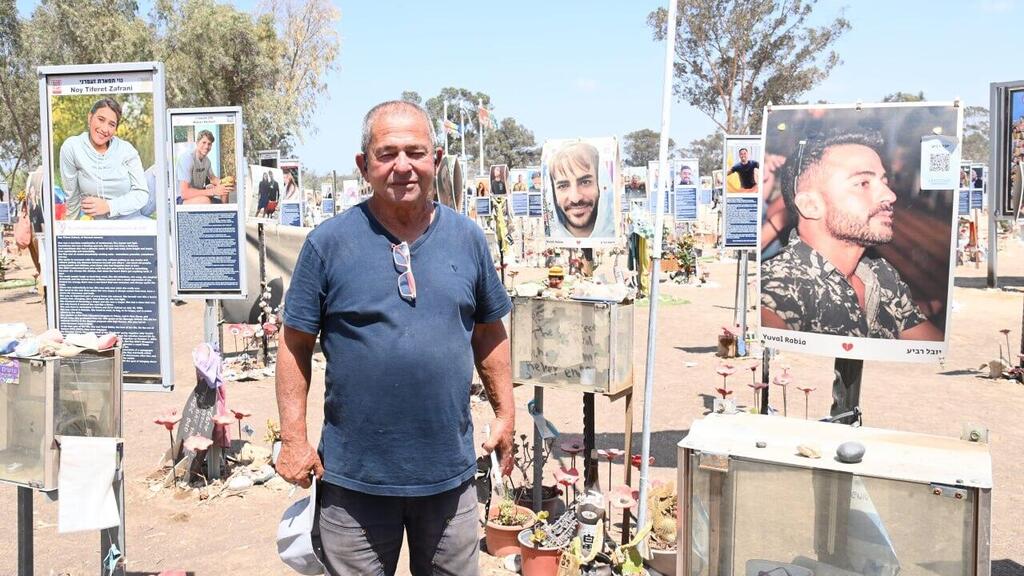
Yosef "Zhu Zhu" Rabia next to the memorials of his sons Yuval, and Noam who were murdered at the Nova Music Festival
(Photo: Herzl Yosef)
Yuval, 33, and Noam, 30, were killed together with Yuval’s fiancée, 27-year-old Noy Zafraani, after fleeing the Nova Music Festival between Nirim and Nir Oz. Their father came into the news in recent weeks after his cellphone, containing all of his memories of his sons, was stolen. Though the phone was returned, the files were gone. Friends of the brothers quickly organized, creating a group to share photos and videos.
“Of course, they went together,” Zhu Zhu says. “They were true brothers, and they went to celebrate Yuval and Noy’s engagement.”
Since the loss, he has thrown himself into even harder work. In the workshop in his backyard, he builds frames for the photos of every victim murdered in the area of Nova and other parties. He then drives 15 minutes to Re’im, where he installs them himself at the memorial site.
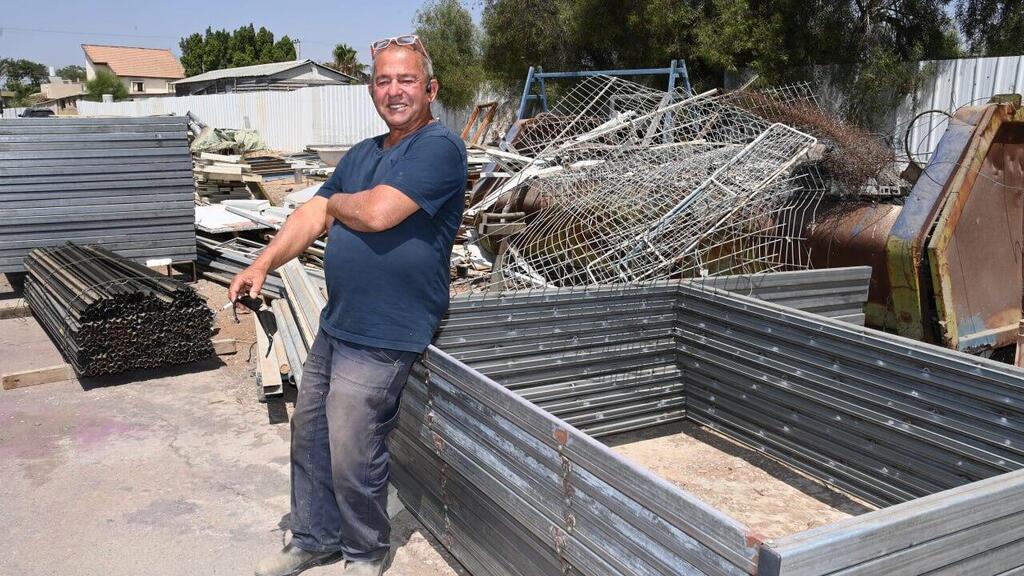
Yosef "Zhu Zhu" Rabia
(Photo: Herzl Yosef)
It may sound simple, but it is far from it: 417 names, each with a portrait. “The work keeps me sane,” he says quietly. “By the time I get into bed at night, I’m finished, I collapse.”
Among the metal pillars and rows of smiling faces, he moves like someone at home. “Yes, this is a very sad place,” he says, “but there’s also a lot of joy here. Everyone was beautiful, amazing, and smiling. I come here and I’m moved. It does me good.”
He speaks of his sons with deep admiration. Yuval, the eldest, “was simply an artist.” Noam, his eyes lit up, was a true anime fan. He was a nerd, in the best sense of the word.” A One Piece flag flies above his portrait at the site. In their father’s yard sits a strange vehicle: a bathtub mounted on wheels with a chair, decorated with the names of his sons and the date of their murder.
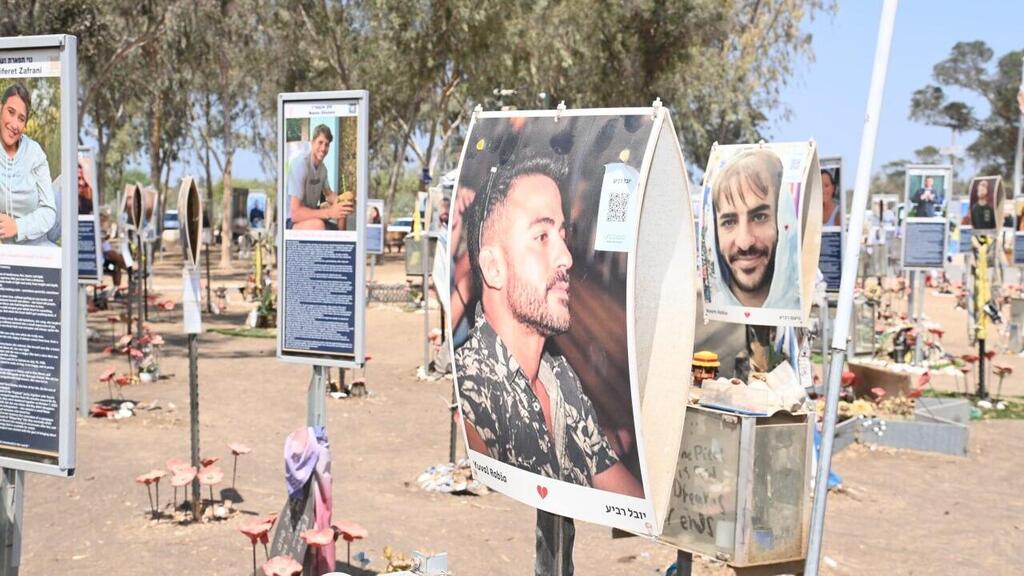
The memorial site at the Nova Music Festival
(Photo: Herzl Yosef)
“They were very close,” he says. “Even when Noam lived in Holon, Yuval would visit him a lot, and they spoke every day. They were both artists—Yuval painted, sculpted, made music; Noam danced, loved music. I had three kids, and all three were best friends. Our home was about music and art, not about money. Money doesn’t interest us. If there’s food, everything is fine.”
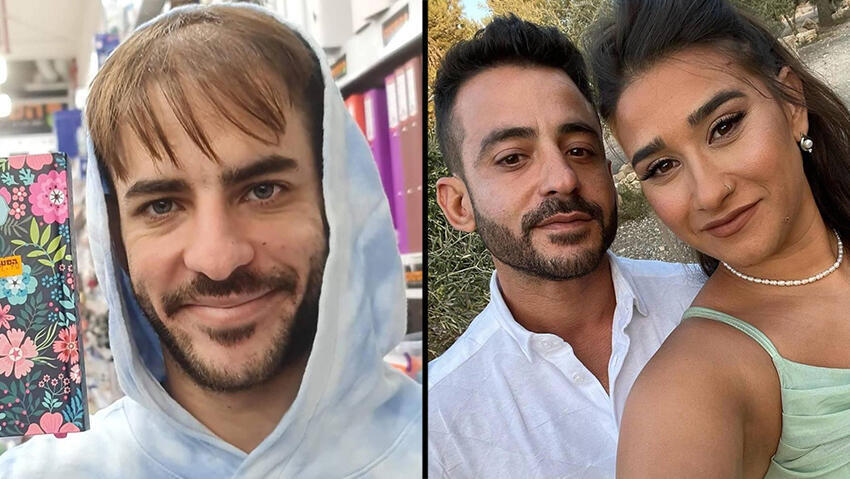
Noam, Yuval, and Yuval's fiancée Noy Zafraani
The grief is constant. Standing near their photos at the site, he dusts them carefully. “Such children, such children,” he murmurs. “It’s not easy. To see them here, but they’re not with me—it’s not easy.”
One thought torments him: his daughter Maya nearly joined them that day. Noy had begged her to come to the party, but she refused. “I hate trance music,” she told them. That refusal saved her life. “If she weren’t here today,” he says, “I wouldn’t be here either.”
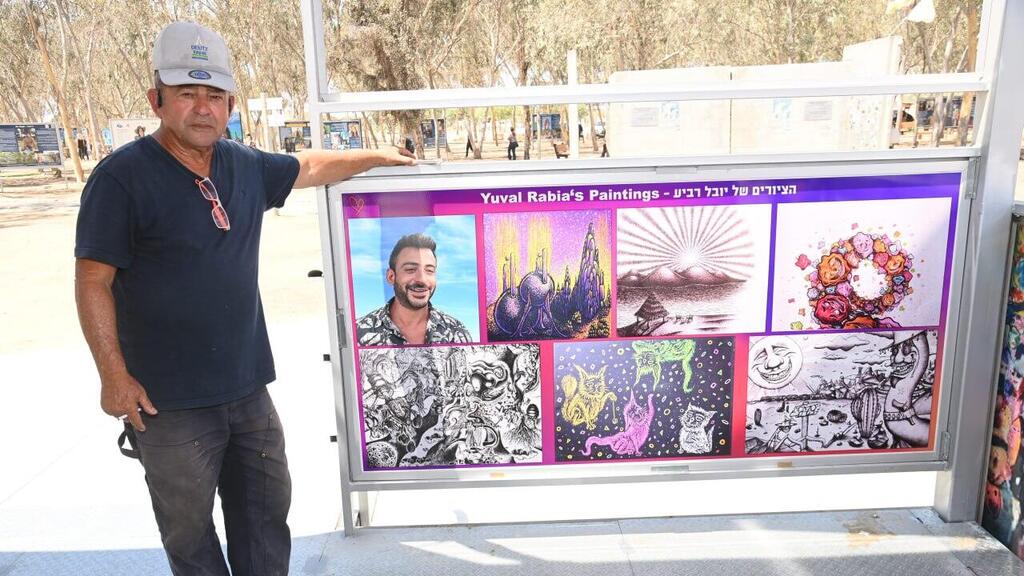
Building frames for other victims
(Photo: Herzl Yosef)
What if the three had never left the festival grounds? That question haunts him, too. The underground event was so little known that even the police were unaware of it. The terrorists did not reach the remote spot where 100 people celebrated. “When the rockets began, they left to find shelter at Noy’s friend’s home in Nir Oz. At the gate of the kibbutz, they were murdered,” he says.
Do “what if” thoughts overwhelm him? He sighs. “If, if, if. That’s life. My kids are gone. I have to keep living, and I have to do what I’m doing here. I’m here for the parents who can’t manage, to make this place more beautiful.”
Zhu Zhu is tough, rarely showing weakness, but the loss seeps into the smallest details. He no longer lights the grill in his yard, unless it’s for soldiers. His sons’ rooms remain locked. And most striking: though he builds frames for hundreds of other victims, Yuval and Noam’s photos are still tied with a plastic zip tie at the site. “We still haven’t managed to find the words to go with their picture,” he says.
Why Nova? “DJ Skazi put their pictures here. I don’t know how it happened, but today we call this place the memorial for the victims of Oct. 7. Everyone is remembered here. It’s long since stopped being only Nova.”
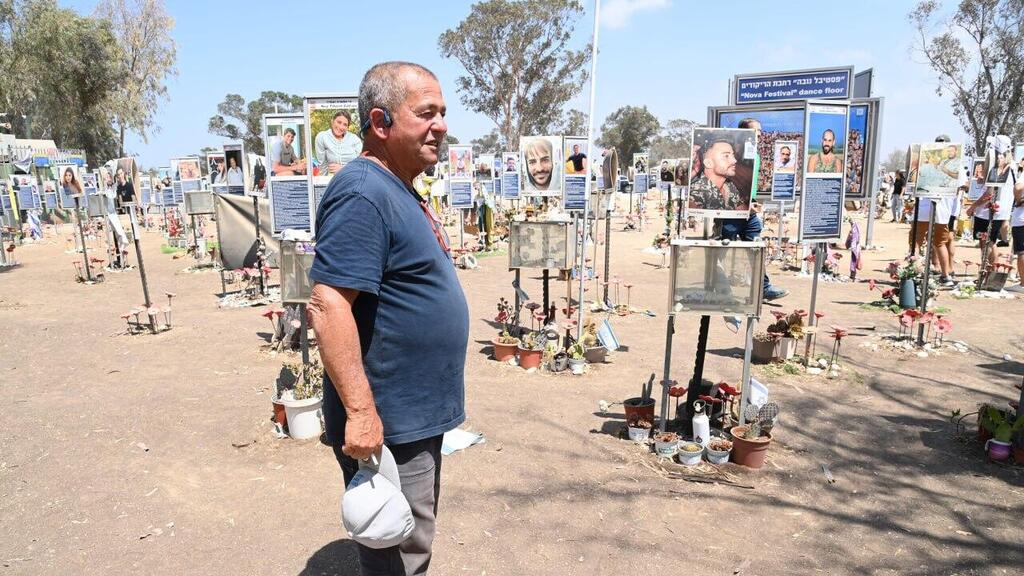
(Photo: Herzl Yosef)
What began as a temporary arrangement after Skazi’s farewell party—rusted stands and cardboard portraits—has become a formal memorial site. Steel pillars now hold photos printed on special paper imported from the United States, built to withstand weather and time.
He is not alone in the work. Others, like artist and former combat pilot Amir Khodorov, have taken on responsibility for the site. “I came to it by chance,” Khodorov says. “We realized those murdered here weren’t IDF soldiers, not from a kibbutz, not a town—and if we don’t unite them, maybe no one will remember them.”
The memorial today is visited by 6,000 people a day, nearly 2 million a year. “Everyone is here,” Khodorov says. “Rabbis’ sons, Haredim, secular, gay, lesbian, police, soldiers. All of Israel was here.”
For Zhu Zhu, every frame, every face, is part of his purpose. “Even if I lose a million shekels on this,” he says, “it will be the greatest profit of my life.”