

In the chaos of the 1973 Yom Kippur War, when Israel’s survival seemed to hang by a thread, Defense Minister Moshe Dayan — once the face of Israeli confidence — began to unravel. The man whose eyepatch had symbolized the daring triumph of 1967 now embodied the demoralizing gut punch of 1973.
Dayan’s descent during the war’s opening days was not only a crisis of command, but of spirit. As Arab armies stormed across the Suez Canal and the Golan Heights, Israel’s most admired general confronted a military disaster that shattered his composure — and, some believed, his will to live.
Gen. Uri Ben-Ari, then deputy commander on the Egyptian front, recalled escorting Dayan to an exposed desert staging area soldiers grimly nicknamed “the yard.” Under relentless Egyptian shelling, the defense minister returned there repeatedly. “He went there again and again,” Ben-Ari said years later. “We started to think he wanted to be hit.”
Maj. Gen. Avraham “Bren” Adan, whose armored division would later cross the Suez Canal and help reverse Israel’s fortunes, described a similar scene. Dayan, he said, wandered into an uncleared battlefield strewn with Egyptian bodies and weapons. Moments later, two Egyptian helicopters swooped overhead, dropping barrels of napalm near the Israeli bridgehead — one explosion landing less than 50 yards from where Dayan stood.
Adan later said he believed Dayan’s behavior was deliberate. “He wasn’t being reckless. He wanted to die — and he wanted to die in battle.”
Dayan’s anguish was rooted in an intelligence failure that he had not prevented. Military Intelligence chief Maj. Gen. Eli Zeira — once Dayan’s aide-de-camp — had assured the government that Egypt and Syria would not attack so soon after their 1967 defeat. Despite reports from abroad and warnings from Israeli troops of unusual Arab movements, Zeira dismissed the threat.
Uneasy but indecisive, Dayan approved only minor reinforcements. When war erupted on October 6, Israel’s reserves — two-thirds of its army — remained unmobilized. Within hours, Egyptian commandos armed with anti-tank weapons had destroyed much of Israel’s armor in the Sinai, and Syrian divisions had breached the Golan Heights.
As Israel’s defenses buckled, Dayan began speaking of “the Third Temple” — a metaphor for the State of Israel itself — being in danger of collapse. The phrase alarmed his colleagues. Prime Minister Golda Meir, fearing his despair would spread to the public, canceled his planned radio address that night.
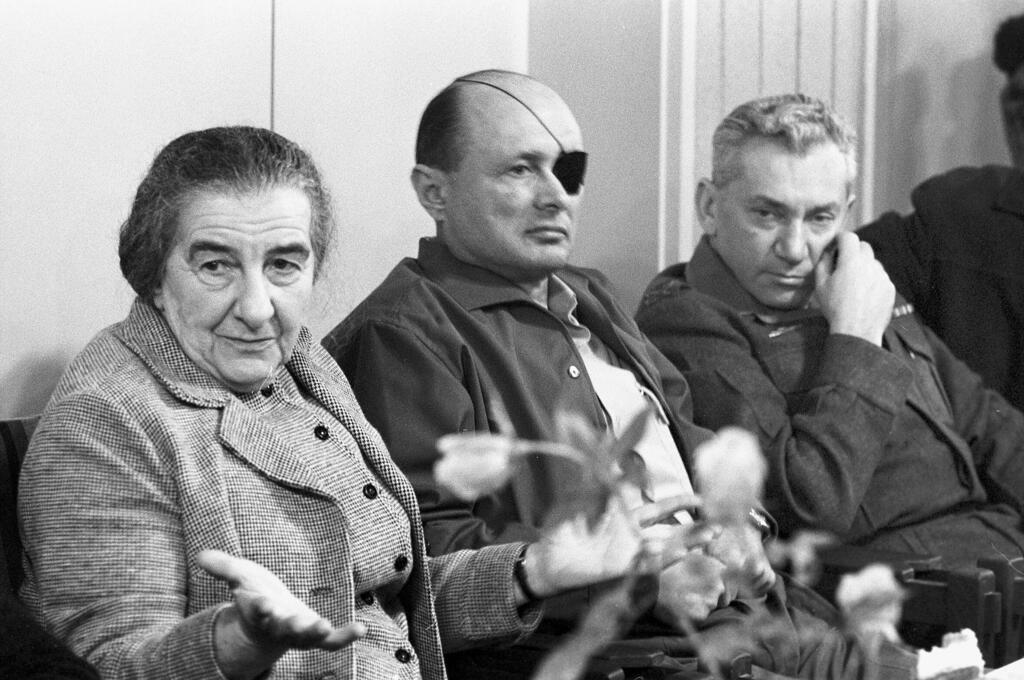
That image of Dayan’s breakdown was later immortalized in the 2023 film Golda, which dramatized Meir’s wartime leadership. In one of its most haunting sequences, Dayan — played by the late Rami Heuberger — is shown aboard a helicopter flying over the embattled Golan Heights, visibly shaken as the fighting rages below. Overcome, he vomits on the floor of the helicopter before returning to Tel Aviv, where he stumbles into Meir’s office disheveled and drenched in sweat, his shirt unbuttoned and his eyes wide with fear. Speaking in a near-hysterical tone, he tells her, “The Third House has fallen,” and pleads for nuclear preparations to begin.
While the film takes artistic license — no evidence confirms that Dayan used those exact words — it echoes a real historical moment. On October 7, 1973, Dayan reportedly urged Meir to authorize a readiness measure for Israel’s nuclear deterrent. According to accounts published years later, Meir rejected the proposal immediately.
Behind the despair, Dayan still thought strategically. Gen. Dov Tamari, who later became head of Military Intelligence, said that while other generals focused on their immediate sectors, Dayan saw the whole map. “He was the only one who thought like a strategist,” Tamari recalled.

(Photo: State Archives)
When Gen. Ariel Sharon led his division across the canal under heavy fire, he radioed headquarters to ask, “What’s happening elsewhere?” Dayan’s reply became one of the war’s most famous lines: “Arik, there is no elsewhere.”
The war ended with Israeli forces surrounding the Egyptian Third Army and pushing Syrian troops back toward Damascus, but the psychological damage lingered. Dayan, once the country’s most revered soldier, was met with shouts of “murderer” from grieving families when he appeared in public.
Yet he remained in public life. Three years later, Dayan joined Menachem Begin’s government as foreign minister and helped negotiate the 1979 peace treaty with Egypt — a country he had fought in four wars. For a man who had once believed Israel’s “Third Temple” was collapsing, it was a form of redemption.
Historians still debate how close Dayan came to ordering nuclear readiness in 1973, and how accurately Golda captured his unraveling. What is beyond dispute is that in those days of fear and fire, the man who once embodied Israel’s military triumphs confronted his own breaking point — and, in doing so, helped shape the peace that followed.