

Yahya al-Sarraj, a 64-year-old engineer by training, has served as Gaza City mayor since July 2019. Unlike his predecessors, he was appointed rather than elected, following recommendations from Hamas leaders in Gaza and senior officials in Qatar, who considered 10 other candidates before choosing him. Hamas viewed al-Sarraj as someone with a special standing in the community, serious, determined and obedient.
He is often seen wearing T-shirts and European-style trousers, an uncommon appearance in Gaza and not typically associated with members of the Islamic movement. However, he has remained careful to respect Hamas and operates in coordination with its leadership.
Despite his obedience, his appearance can be misleading. He is known as a secular man with excellent English, which he polished while earning master’s and doctoral degrees in civil engineering at universities in Leeds and Bradford in the UK. Still, he insisted on returning to Gaza, where he worked as a professor at two universities and as deputy dean at the Islamic University before becoming mayor.
He lives with his wife, Islam, and their children in a building that survived the war, on the main street in the Tel al-Hawa neighborhood, meaning “Hill of Wind” because of the dry air on the hill where it was built, in southwestern Gaza City.
In Gaza City, the mayor also serves as the head of the local government, while council members effectively function as unofficial ministers. Palestinian Authority President Mahmoud Abbas has completely boycotted them and refuses to visit the Strip.
Last month, the city had a rare reason to celebrate. A sister-city agreement was signed between Gaza and Geneva, guaranteeing Swiss assistance to the Strip and also benefiting senior city officials financially. During the signing, conducted via Zoom between the two city councils, al-Sarraj declared: “I will not leave my city.”
A local acquaintance tells me proudly that the name Gaza means strength. Gaza has always been strong, he says, with an exceptional way of life, even when it was under Egyptian rule.
“And now that strength has weakened,” I tell him. “To be honest, that strength was taken from us,” he replies. “We feel unwanted by the wider world.”
Until Oct. 7, Gaza’s mayor regularly spoke with a small group of Israeli journalists. That practice ended when the war began, or more specifically, on Oct. 22, 2023, when his eldest son, Roshdi al-Sarraj, owner of the photography company Al-Ein (“The Eye”), was killed in an Israeli airstrike on his home in Gaza. It remains unclear whether another person in the neighborhood was the intended target. Only two days earlier, his son had returned early from a work trip to Saudi Arabia and Qatar with his wife and young daughter after cutting the trip short.
Following the incident, the mayor cut off contact with Israeli media. “It no longer interests me, and they are not interested in having a genuine dialogue,” he explained. Although he avoids making militant statements against Israel out of concern for his family’s safety, he has maintained a complete communications blackout.
“You destroyed his life,” one of his associates tells me. Responding to claims that the mayor maintains close ties with Hamas leadership, the associate insists that “the mayor was never involved in terrorist activity against Israel, and even after his son was killed, he did not join Hamas. He had countless opportunities to leave the Strip, but he chose to stay and continue working for its residents.”
Leaving Gaza has become a costly gamble. Those seeking to leave Gaza now face dramatically different conditions than before. It is no longer a matter of paying a few hundred dollars per adult or $150 for children under 16. Today, applicants must pay the Egyptian travel company Hala $5,000-$6,000 per adult and $2,500 per minor. An average Gazan family of four seeking a better future elsewhere would need to pay about $20,000 just to leave, not including hundreds of dollars in additional brokerage fees.
That is not the only obstacle. The process of leaving Gaza is complex, and the number of approved departures remains limited. Names are approved only a day before travel, and even those who have paid the required fees are not always granted authorization to cross through the Rafah terminal.
Israel, Egypt and the Palestinian Authority are all involved in approving exits, and if any one side objects, a person’s departure can be canceled, with the payment not always refunded. Under current conditions, leaving Gaza is not only difficult but also a major financial gamble.
Marwan, a construction worker, took that gamble. He managed to raise more than $10,000 from a relative in Canada and arrived at the border crossing with his family, hopeful they would be allowed to leave. They waited four days before learning that one of his sons was suspected by Egyptian authorities of involvement in attempted terror attacks. His name was removed from the departure list, and the money was not refunded, with officials telling the family: “Maybe you will manage to change the charges against him.”
Ahmed, a local merchant, received approval for his wife and three children to leave. However, his name was marked with a blue circle after Israel’s Shin Bet objected to his departure. He returned to Gaza in anger, while his wife and children were picked up at the Egyptian border by relatives. Fortunately, they held dual Palestinian and European passports and were able to board a bus directly to Cairo International Airport.
Ahmed remained alone in Gaza, continuing his efforts to leave. His story is an example of how leaving Gaza is often impossible even for those desperate to go.
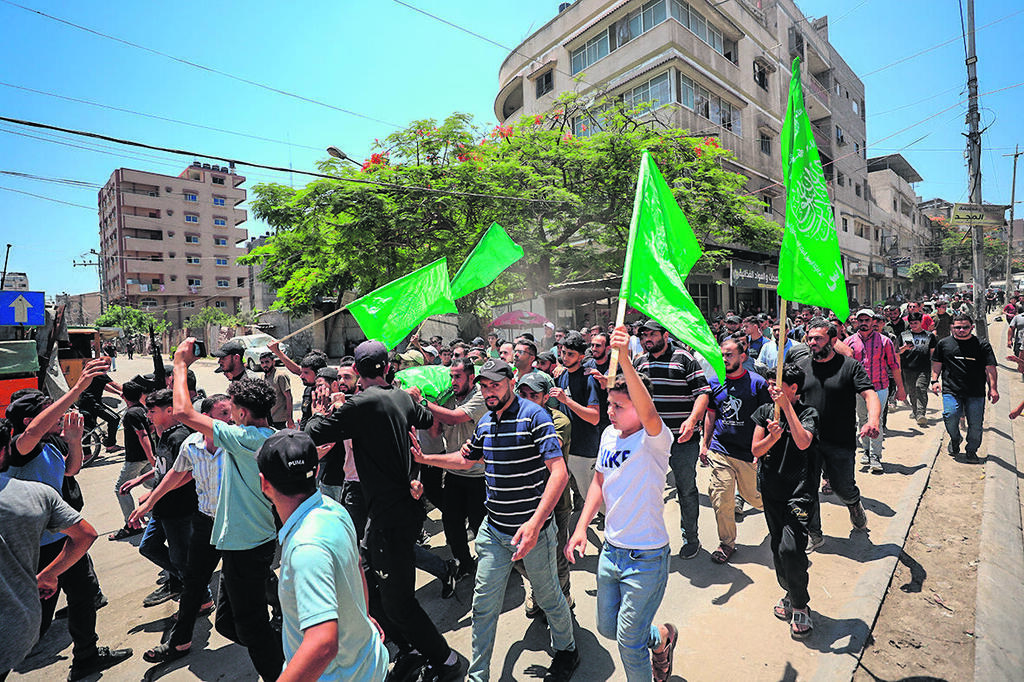
Hamas flags at a funeral procession in the Gaza Strip
(Photo: Anadolu/Getty Images)
Life in tents, hospitals without medicine
Eighteen massive tent camps have been established across Gaza. Blankets, sheets, plastic tarps, and whatever else is available are used to build them. Winters are cold and wet, summers are scorching, and inside the tents every square meter is packed.
Early each morning, children head to water distribution points and check whether food donations have arrived from Egypt or Jordan. At times, food and clothing aid from European countries also arrives, creating long lines that cause many to give up waiting under the intense heat.
Those who sometimes manage to get ahead of the queues are shop owners who hide food and bottled drinks, later selling them at inflated prices. A loaf of bread costs 7-10 shekels ($2.30-$3.25), a bottle of water costs 5 shekels ($1.60), and those are still among the cheaper items. Vegetables, fruit, sugar, flour and lentils are sold at prices roughly double those in Israel.
Only a few people, and only occasionally, manage to obtain cash for purchases. No one sells on credit anymore. “No one says ‘put it on my tab’ in Gaza anymore,” residents say. “Either you have the money, or you get nothing.”
Each camp has three tents designated for social needs. One is used by men from the morning hours, where they drink coffee, listen to the news and speak with relatives sleeping in other camps.
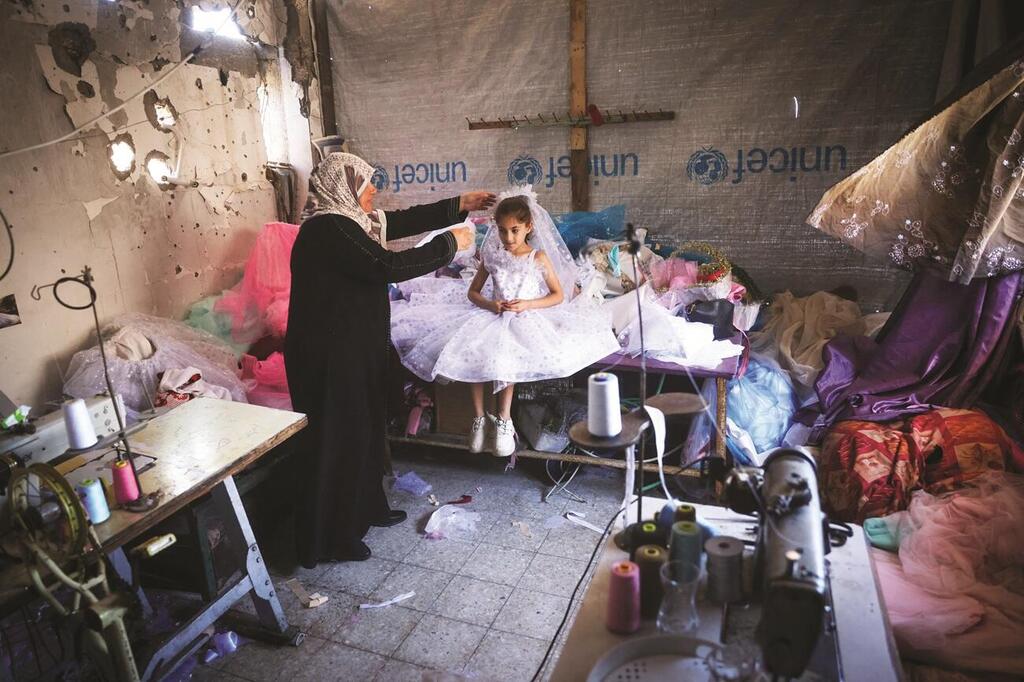
Two others serve as classrooms. Volunteer teachers arrive almost every morning, three to five times a week. There are no textbooks or notebooks. Teachers write with tiny pieces of chalk, students copy onto paper, and educators try to encourage them. During breaks, children recreate ball games using stones instead of marbles and sew dresses for dolls.
Residents shower only once a week using buckets due to a shortage of bathing water, leading to skin conditions and outbreaks of infectious diseases. Those whose health deteriorates try to reach one of the seven hospitals still operating in Gaza. The facilities have beds, but face shortages of medication and anesthetics.
While Israel’s Soroka Medical Center has not fully recovered from a missile strike during the Iran war, Gaza’s Shifa Hospital has resumed operations despite Israeli airstrikes and the November 2023 detention of its director, Dr. Mohammed Abu Salmiya, who was questioned by the Shin Bet over his cooperation with Hamas, allowing the group’s terrorists to operate rooms inside the hospital complex.
He was detained along with four senior doctors and released a year later back to Gaza with a warning not to cooperate with hostile actors. Today, Shifa’s emergency, maternity, pediatric and operating departments are functioning, though on a limited basis, with doctors working around the clock. Others, especially nurses and medical assistants, took the opportunity to leave for Australia and New Zealand.
Weddings among the ruins
Amid the chaos, Gazans still know how to celebrate. “We are people who love joy,” says Zaki, a former student. He is referring to monthly mass weddings where dozens of brides and grooms wear Turkish-made suits and dresses passed from one couple to another.
The couples walk among destroyed buildings, accompanied by improvised orchestras and young men performing traditional dabke dances. A group of female drummers arrives wearing colorful traditional clothing, while older women ululate in celebration.
“Zaki is right, there really is a lot of joy,” another Gaza resident says. “It is hard for me to understand how newlywed couples walk beside the ruins. There are piles of dirt, concrete blocks and broken glass, and they continue as if nothing happened.”
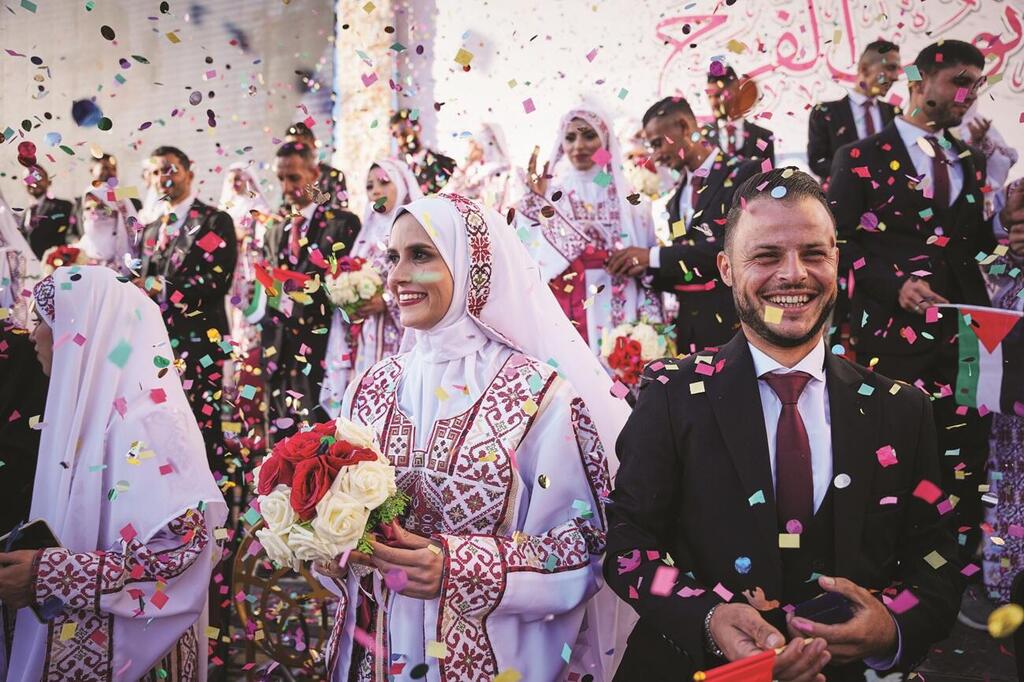
Mass wedding in Gaza
(Photo: Abdel Kareem Hana/AP)
Another wedding that drew attention involved Alaa Mousa, 33, from Khan Younis’ Nasser camp. She lost her husband during the war and married in April this year a man eight years younger who had lost his wife and two children in similar circumstances.
The couple met through a matchmaking arrangement initiated by a neighbor and decided to marry. The groom committed to paying a dowry of 1,500 Jordanian dinars from his hidden bank account in Jordan.
His family objected to the marriage, which was a modest ceremony held on a platform between tents, because of the age gap, particularly because the bride was nearly a decade older. “My husband has three young children who lost their mother. I will raise them as if they were my own,” the bride said. “The war has not ended,” the groom said. “We are looking for reasons to be happy.”
Abdallah Farhat, 29, also dreamed of getting married. “I put it off until now because of the economic situation,” he said after finding a woman five years older than him who had become widowed during the war. “There was opposition within the family because I married an older widow, but we found each other,” he said. “We decided to do everything we could to build a happy life.”
Alongside the return of the wedding season in Gaza, the halt in Israeli airstrikes has allowed residents to return ahead of summer to one of the Strip’s most popular leisure destinations: the coastline.
Gaza’s shoreline stretches for 41 kilometers, with prominent areas including al-Mawasi, south of Deir al-Balah, and extending toward the Rafah area. Thousands of families are expected to arrive there during the summer months, from the early morning hours until sunset.
Women arrive wearing dresses and head coverings, men wear shorts, and girls up to the age of 8 may wear shorter dresses. “It is important to protect the girl,” a Gaza resident tells me. “From the age of 12, every girl is considered a bride, although the legal marriage age has risen to 15 and even 17. Parents and brothers still have a responsibility to protect a girl’s reputation. If bad rumors spread about her, her sisters’ chances of marrying respectably could disappear as well.”
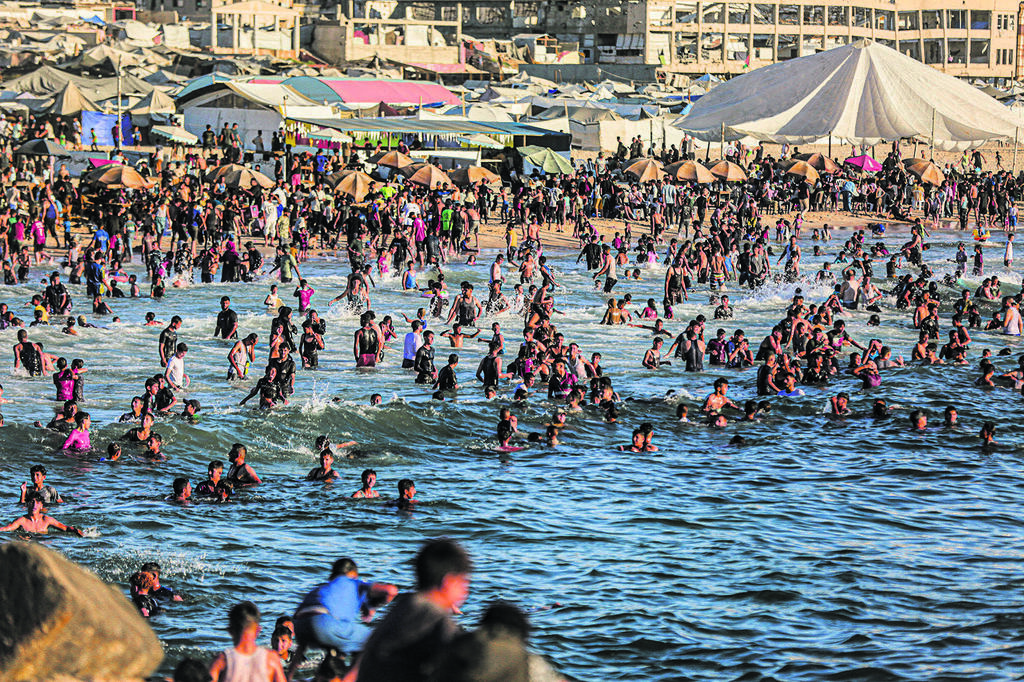
Gaza beach
(Photo: Faiz Qreqa/AFP)
Hamas remains in control
Meanwhile, alongside the improvised celebrations in Gaza and declarations in Jerusalem about “total victory,” Hamas remains the main force controlling events in the Strip.
Last weekend, Gaza woke to the sound of a protest calling on residents to gather near the ruins. Only a few dozen people dared to respond, and they quickly dispersed after Hamas sent masked men wearing the group’s uniforms to suppress any signs of rebellion.
Mayors from Deir al-Balah, Nuseirat and Gaza City addressed protesters through microphones, warning that there was “no point in going against Hamas because they could retaliate.”
Hamas operatives in uniform quickly arrived at tent camps and spread fear. “Don’t test us,” they warned young protesters. “Do not listen to incitement coming from the Zionists.”
The frightened protesters carrying signs did not dare mention Hamas directly, but their message was clear: “Leave, damn you.”
At two of the protest sites, a familiar image appeared: the portrait of IDF Arabic-language spokesman Avichay Adraee. His photos quickly spread across social media pages associated with Gaza, where few figures are as recognizable across the Arab world as Adraee.
“I have followed Adraee for years,” a resident of the destroyed Rimal neighborhood tells me. “His Arabic has improved over the years, and overall he seems like a nice guy who is overly devoted to his job.”
The surprise over his unexpected compliment toward an Israeli officer had barely faded when he asked what Adraee thought about Netanyahu.
Another question troubling Gaza residents concerns what they view as overly close ties between Israeli officials and prominent figures in the Palestinian Authority. “We all hate Abu Mazen,” a Gaza journalist reminds me. He says young people in Ramallah and Gaza are waiting for the death of Mahmoud Abbas, “who hates us,” and for the succession battles that would follow, creating turmoil that would occupy both Israel and Gaza once the leadership in Ramallah collapses.
“We have a very active Hamas network in the West Bank,” Gaza academics tell me. “Because of the weakness of the central government in Ramallah, Hamas is advancing its plans there.”
A key figure in any future succession battles in Ramallah will be Palestinian billionaire Mohammed Dahlan. He stopped visiting Gaza before the war began, but his wife, Jalila, a psychologist, continued visiting the Strip with bags of financial and food aid. Known in Gaza as “Umm Fadi,” she heads the Fata charity foundation, which works to support Palestinian refugee families in Gaza and Jordan.
Dahlan is considered an influential figure in Gaza, where he grew up in severe poverty in Khan Younis’ refugee camp. In recent years, after a bitter dispute with Abbas, he fled Ramallah, knowing that remaining would mean arrest.
Today, he lives in Abu Dhabi and serves as an adviser to Emirati ruler Mohammed bin Zayed. On one occasion, Dahlan told me he would not return to lead Gaza and that he had “lost interest” in pursuing Abbas’ position in Ramallah.
***
Two weeks ago, a group of Gazan men from refugee camps arrived at Nasser Hospital, the largest hospital in Khan Younis in southern Gaza. Their goal was to protest the lack of treatment for injuries, alleging financial corruption at the facility.
But like the young protesters a week earlier, they avoided directly criticizing Hamas. “No one cares what happens to the wounded,” they shouted. “Everyone is a thief.”
The accusations were directed not at Israel but at the Palestinian Health Ministry, while protesters refused to leave the hospital courtyard for hours. Journalists from Arab television networks were instructed to ignore the incident.
Another striking scene comes from Mohammed Ramadan Saad, a bookstore owner whose home and shop burned down. He moved to a tent camp in Deir al-Balah, spread a carpet inside his tent and opened an improvised bookstore, offering poetry and translated literature at symbolic prices in an attempt to provide temporary escapism from the harsh reality.
No one was buying from him, his acquaintances in Gaza tell me, so he decided to lend the books for free, asking only that they be returned intact.
“You walk past his neatly arranged tent in the evening,” one of them says, “and you are amazed to see people with no present and question marks about the future, quietly bent over books. Can anyone imagine such a scene anywhere else in the world?”
An aerial photograph would reveal eight refugee camps across the Gaza Strip. The largest, Jabaliya camp, is home to 114,000 people of all ages. It is followed by Rafah camp with 102,000 residents and Shati camp with 85,000.
Around 100,000 people have managed to leave, mainly wounded people and their companions, as well as those who were able to pay exit fees, squeeze through tunnels and escape into Sinai.
Egypt, Jordan and Saudi Arabia strongly oppose accepting additional Palestinian refugees. A Gaza resident named Aisha experienced this firsthand. In a phone conversation, she says:
“All the efforts we invested in obtaining a permit to leave, and all the money our relatives in the Gulf gave us, were stolen. We have no home, and some relatives have already left and are begging us to join them. But my father is elderly; he would not survive the long journey.
“It takes at least eight hours to cross the first checkpoint on the Palestinian side, then the second on the Egyptian side, board a bus and travel another three hours to the airport. It is a difficult journey for elderly people, and I am not willing to leave my parents alone in Gaza. Maybe one day workers from Cairo will come and build the new Gaza for us.”
Until that happens, Gaza remains far from returning to normal life. Hamas continues to maintain control on the ground and prevent uprisings, while residents face a worsening humanitarian crisis. Even leaving the Strip, despite repeated promises by Israeli officials that those who wish to do so would be able to, remains nearly impossible.
“You walk through what used to be the city center and find shops open, children begging for a gift, a toy or a doll, but your pockets are empty,” a Gaza resident says.
“There is no one left to blame for our situation. The world has forgotten us, and now and then they send us donations, food and clothing. You try to preserve your dignity, but eventually you give in and accept them.
“You cannot complain to Hamas because it is dangerous. They can arrest you, and you can disappear. If they decide to make you disappear, no one will ever find you.”