

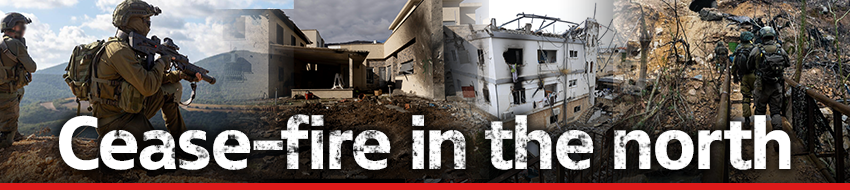

Marciano led his brigade’s command staff on a patrol of the Lebanese village of Markaba, just a few kilometers from Kibbutz Misgav Am. Suddenly, intelligence reports indicated that a Hezbollah commander, along with other terror operatives, was located just a few hundred feet away. The revelation stunned him. It was clear the mission was far from being over.
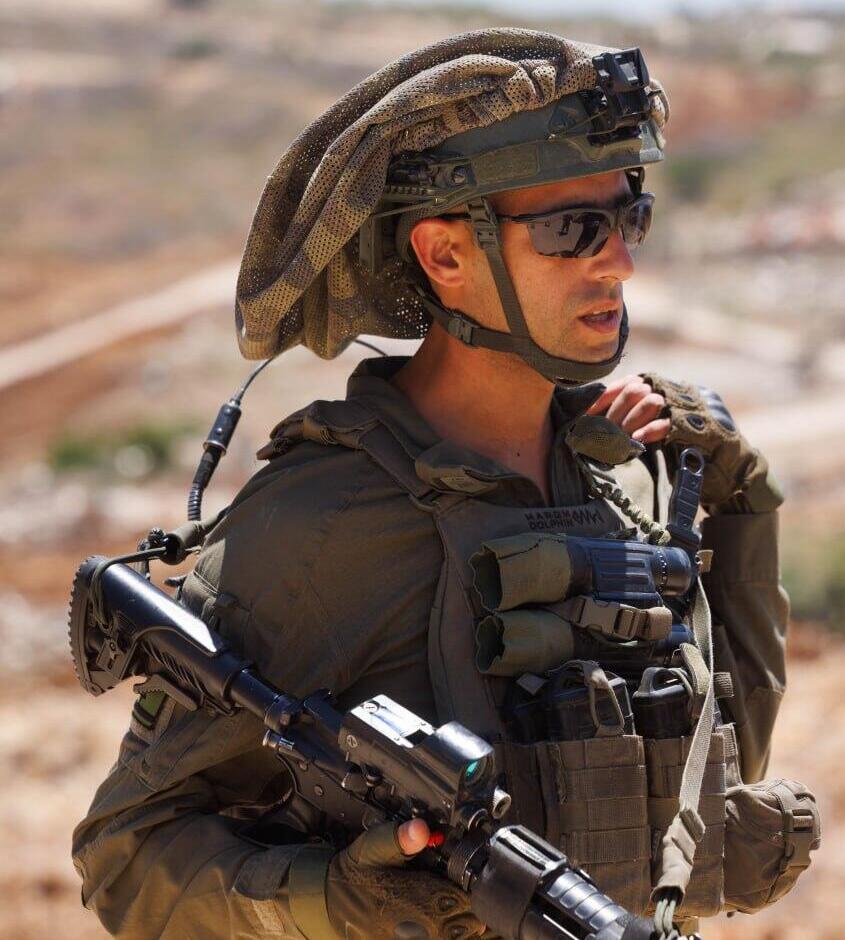
“We immediately stopped the convoy and turned the situation into an operational mission,” recalls 38-year-old Marciano, married to Dovrat and a father of four from a small community in northern Israel. “We were an armed team set out to capture the terror operatives, but before we got to them, they managed to drop their weapons and escape. That was the moment it hit me; if they feel comfortable enough to sit on a balcony, smoking a hookah the day after a ceasefire begins, we cannot afford to pause."
During those days, Marciano shifted the military tactic from “attack” to what he called “hunt and pursuit.” Since then, his soldiers have continued to track down and target Hezbollah terrorists and commanders throughout the sector.
He kept the Hezbollah men’s hookah as a memento at the brigade's headquarters. “It was still lit when we arrived, with burning coals. They were that confident we wouldn’t kill them. From that day forward, we launched a series of extended, deep operations in about five villages and the Saluki Valley, and well beyond the areas where we had maneuvered before, to achieve more results.
"I realized that if the enemy felt so secure in Markaba, it meant we hadn’t finished the war properly, and we had to deepen the achievement and destroy their capabilities," he says.
Marciano, a career IDF officer who came up through the Golani Brigade’s 13th Battalion and held various command roles before being appointed brigade commander, assumed the position about six weeks before the October 7 terrorist attack.
From the start of the ground offensive in Lebanon and throughout the months between the November 2024 ceasefire and the IDF’s withdrawal in February 2025, he spent every moment in Lebanese territory working to inflict a heavier price on Hezbollah and dismantle its assets.
Entering Lebanon
(Photo: Ziv Koren)
Last month, Marciano bid farewell to his comrades and officially handed over command of the brigade to Col. Yuval Mazuz. He began a year of academic studies, after which he is expected to return to military service.
In a straightforward, no-holds-barred interview, Marciano reflects on a year-and-a-half-long fight, expressing also pointed criticism, of the kind only a commander with boots on the ground and his finger on the trigger can express.
“Hezbollah’s invasion plan into Israel has been dismantled. That’s the major achievement,” he declares from his office at the brigade’s base in Kiryat Shmona. “But we could have done more."
Marciano’s war museum
Since October 8, 2023, the Hiram Brigade found itself in an inconceivable reality, which involved a drawn-out “defensive battle” against Hezbollah that lasted nearly a year. For much of that time, it seemed the soldiers stood behind the border fence with their hands tied.
Despite significant accomplishments, including the elimination of hundreds of terrorists and pushing Hezbollah’s elite Radwan Force away from the border, they were forced to watch Hezbollah launch thousands of rockets into northern Israel and destroy homes, without being given authorization to enter Lebanon and stop them.
At the time, the IDF's main objective was to leave the northern sector comparatively quiet and secondary to the southern front. However, a rapid sequence of events starting with the “pager operation” in September led Hezbollah to sustain blow after blow, and hence, the government gave the green light for troops to enter Lebanon and clear the area of enemy infrastructure.
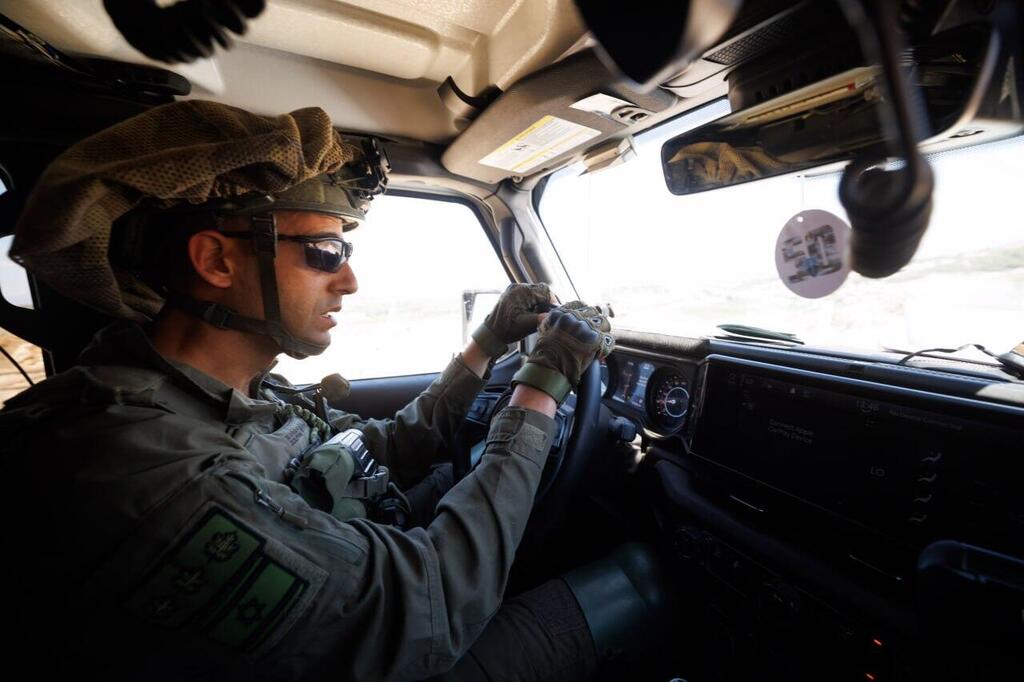
Col. Avi Marciano
(Photo: Ziv Koren)
“We should create a collective memory within Hezbollah which would lead them to relinquish the very idea of eliminating the State of Israel,” he adds. “Hezbollah should have a collective memory of the next hundred years, which will show them what the price they will pay if they plan to carry out an ‘October 7’ against Israel.
"From the moment the ceasefire was declared, my main mission was to move from house to house, from warehouse to warehouse, to clear and destroy, to make sure they can no longer have the ability to return here.
“As soon as the main maneuvering forces, like the Paratroopers, Golani and reservists, evacuated an area, we moved in immediately and began systematically clearing it. We returned to the villages to make sure no terror infrastructure remained.”
Not far from the brigade headquarters, in a small, fenced lot containing an old bunker, Marciano built a kind of war museum. It holds many items - a small fraction of the weapons and equipment seized from Hezbollah between the ceasefire and the final withdrawal of IDF forces.
For Marciano, it is a place of honor and remembrance, but also a warning sign from 21 months of war and years of strategic restraint that preceded it. At one point, he recounts, there was not enough room left to store the captured weapons in Israel, so they began destroying them deep inside Lebanese territory.
“We focused our efforts on the entire belt of major Shiite villages, from the area around Manara, Margaliot and Kfar Yuval all the way to the Litani River,” he says.
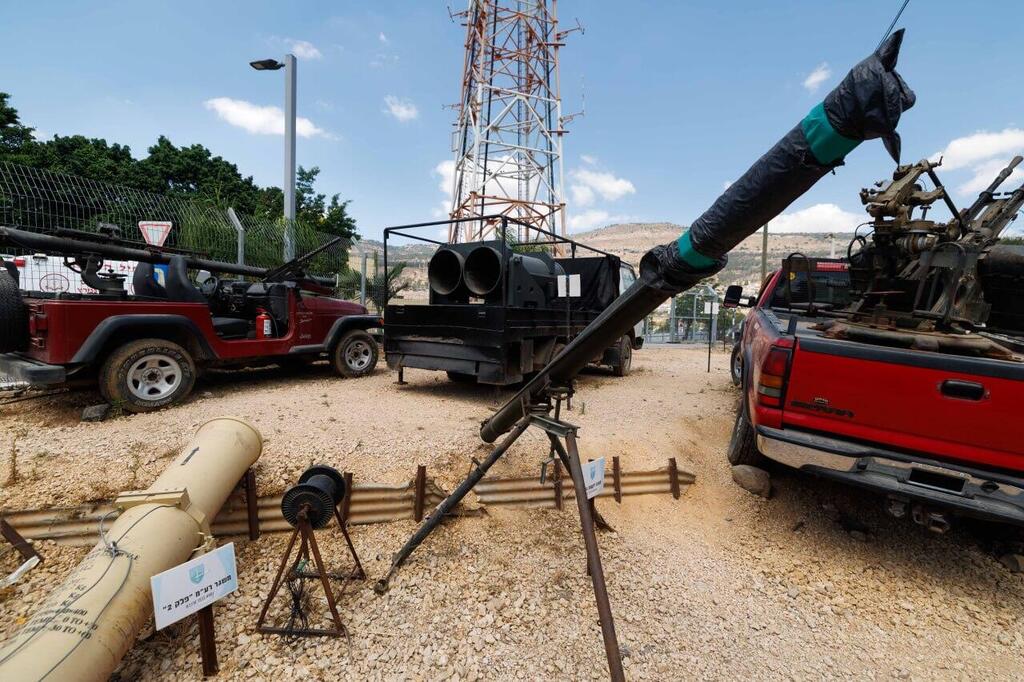
The 'war museum'
(Photo: Ziv Koren)
The guiding principle for him and his troops was clear and uncompromising, almost obsessive: “If you go into a place, don’t leave until it’s completely destroyed. We pushed back hard against the culture of 'immediacy', a mindset that demands us to finish quickly, right here and right now, and move on, and according to which everything has to happen instantly."
"Anyone who wants a short war will get a short-lived achievement," says Marciano. "If you want a long-term result, which will leave a mark on the enemy’s consciousness, the war will have to be long. There’s no other way to achieve that."
He points at Lebanon, less than three kilometers away, and becomes silent. The silence, as the cliché goes, is almost tangible. It's relative silence that is always tense. Even in the past week, Israeli airstrikes killed terrorists who were involved in Hezbollah’s efforts to rebuild. “The war, in terms of fierce ground maneuvering, is over,” he explains, “but to preserve its achievements, it will likely never truly end."
Inside Marciano’s improvised war museum are rockets, anti-tank missile launchers, sophisticated explosives, drones, sniper rifles, operational maps, documents, flags and even personal items belonging to slain Hezbollah operatives. According to Marciano, Hezbollah stockpiled these weapons not only to invade the Galilee, but with the intent to remain there.
The museum has drawn visits from senior IDF officials and international counterparts, including American generals involved in monitoring the ceasefire. Bereaved families whose loved ones fell in the northern operation have also come here.
“First and foremost, this ‘museum’ serves a professional-operational purpose,” Marciano says. “I want commanders and soldiers to see with their own eyes the threat we faced, and what the enemy is capable of.”
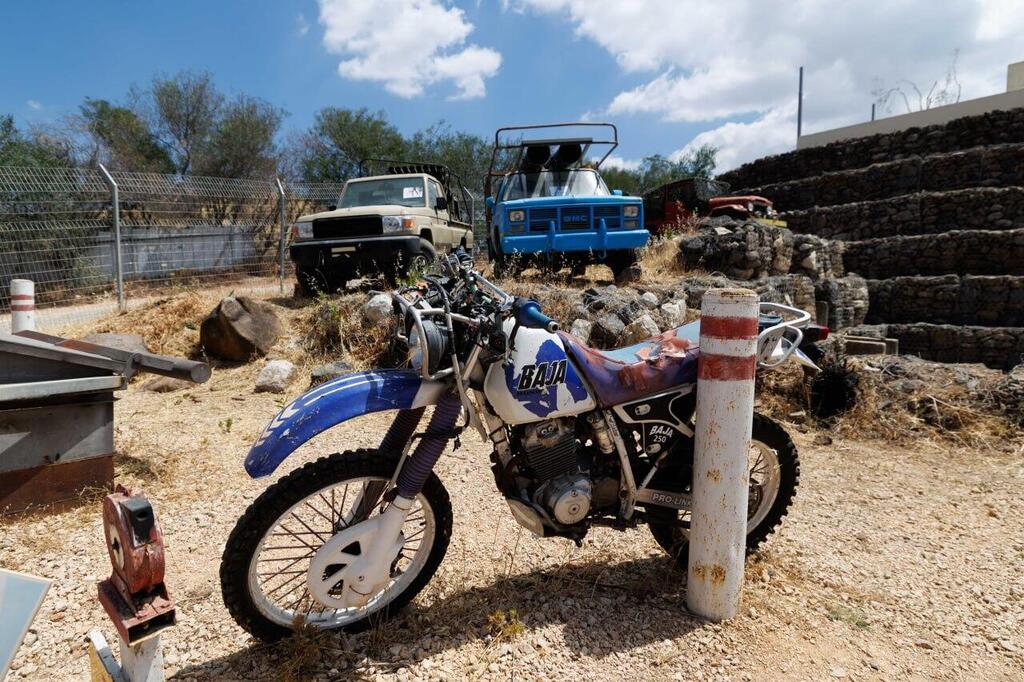
(Photo: Ziv Koren)
“There aren’t many soldiers who have ever seen an explosive device in their lives. They’re told, ‘If you’re patrolling the fence and spot an IED…’ but most of them have no idea what one even looks like. You can explain it via a PC presentation, but someone who sees it up close with their own eyes understands the threat better and will be a more professional and serious commander."
"The museum also has a psychological purpose", continues Marciano. “The message of this site is: ‘Don’t think it can’t happen.’ History repeats itself.
I hope that a decade from now, when someone tells the story of the awful and unimaginable reality we faced here, they’ll point to this place as a reminder of what we must never allow to happen again. The next war will certainly look different, and we can't tell who we will face or how the enemy will challenge us, but it’s critical to understand the enemy, his determination and way of thinking."
At the entrance to the bunker, Marciano points to a large Lebanese road sign taken from one of the villages that his brigade cleared. “This is the most interesting sign, which reads: ‘Al-Quds, 173 kilometers', which means Jerusalem,” Marciano says. “That was their long-term goal, not just Metula or Kiryat Shmona (in the north). Hashem Safieddine, who was marked as Nasrallah’s successor and was later eliminated, stood next to this sign when he visited the border before the war. Those visits are over. They won’t be coming anywhere near here again."
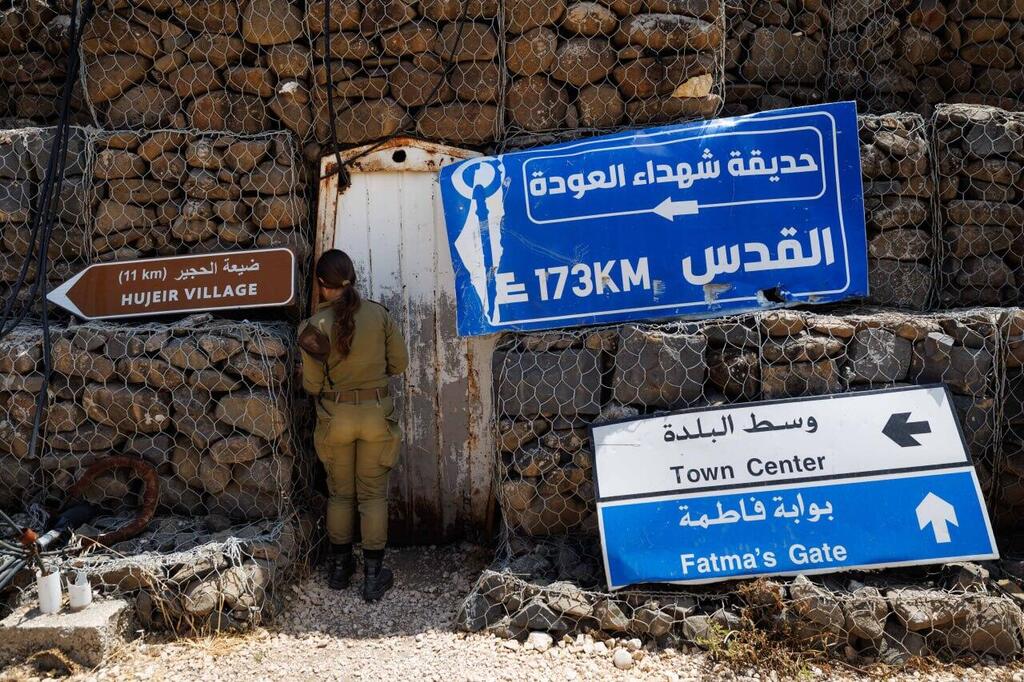
‘Al-Quds, 173 kilometers'
(Photo: Ziv Koren)
Every weapon in the collection has a story. “These launchers,” he says, gesturing toward a row of rocket launchers mounted on a new shiny red pickup truck, “we found them in the Saluki Valley, one of Hezbollah’s most fortified strongholds.
"I felt I could push the brigade that far, into the first line of villages beyond the Saluki Valley. But that’s where we stopped. We invested enormous effort here while neglecting other areas out of necessity.
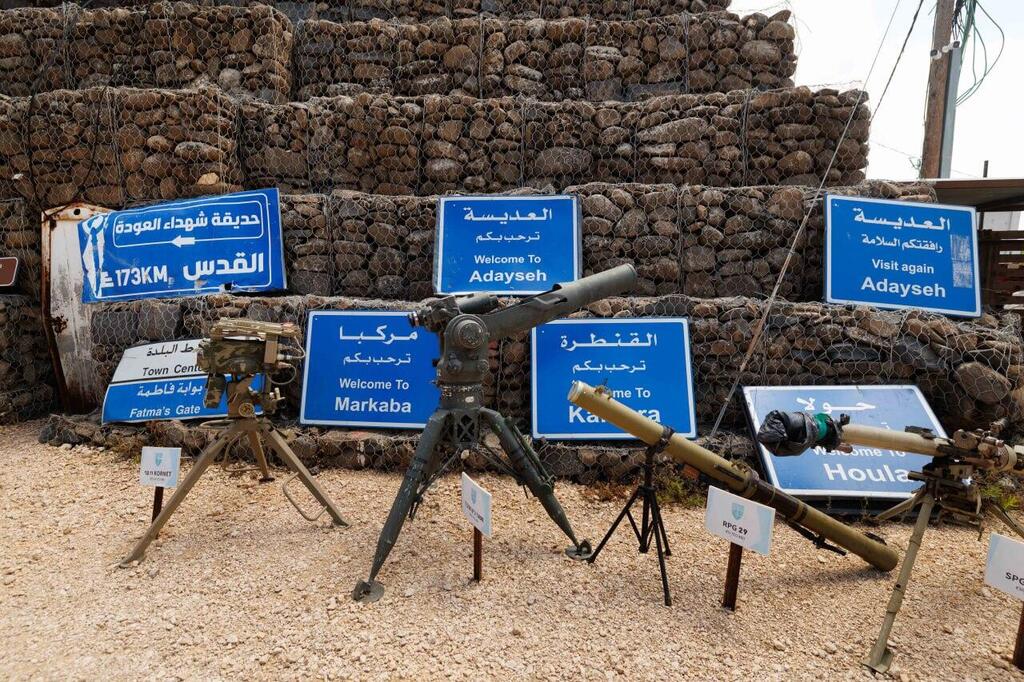
Marciano's 'war museum'
(Photo: Ziv Koren)
"If I could, I would have created a wider buffer between the Israeli and Lebanese communities, but in the end, that depends on how much explosives we are given. And that’s a painful issue,” he admits, revealing some of the frustration and sense of missed opportunities he continues to carry. We will elaborate on it later.
“Look at this optical fiber,” Marciano continues. “That is what's left from the anti-tank missile Hezbollah fired at my office here at the military base. It hit my room. It’s a copy of an Israeli missile; they learn fast.
Marciano's 'war museum'
(Photo: Ziv Koren)
"And here’s a drone we discovered just 50 meters from us in Metula at the start of the war. It was just behind us. All of a sudden, I heard a buzzing sound and saw something in the sky. We realized it was an explosive drone and opened fire at it. It was carrying three RPG warheads. Every item here represents a surreal experience."
Not enough explosives
On the way to the border and the new Narkis outpost, built inside Lebanese territory opposite the Israeli community of Margaliot to help protect residents in the area, Col. Marciano reveals a deeper internal debate within the IDF: how much post-war reconstruction to allow in Lebanon, and what to prevent. “Personally, I believe that any house Hezbollah used for terrorism should not be rebuilt,” he says.
From Lebanon’s highway adjacent to Israel’s border fence, nothing remained. It was wiped out as part of a recently revealed IDF engineering operation codenamed Silver Plow. “Unfortunately, there are still homes we didn’t fully demolish, even though they’re no longer habitable,” Marciano says, referring to the Shiite village of Kfarkela, which overlooks Metula and whose buildings reached right up to the Israeli border. “It was the size of Kiryat Shmona, with four- and five-story buildings, all under Hezbollah’s control. They used those buildings to store weapons, as firing positions and as launching points.”
“You're asking why we didn’t bring everything down? Sadly, it’s because we didn’t have enough explosives to do it,” Marciano says, reiterating his earlier criticism. “I’d actually want the general to come here, scold me and call me lazy because there are buildings we didn’t demolish, and missions we left unfinished. The security establishment should have mobilized more.
"My criticism is also toward myself for not pushing hard enough. I think we’re being far too merciful toward the enemy. These people across the border planned to slaughter us, rape our women and burn our children. We are a nation that needs to embrace struggle, not because we don’t love peace, but because there’s no one on the other side to talk to."
Marciano had requested the construction of three strategic outposts in the security belt just across the border in his sector. Due to political considerations, he was granted only two - one near Margaliot and another on the Hamamis Ridge overlooking from Metula.
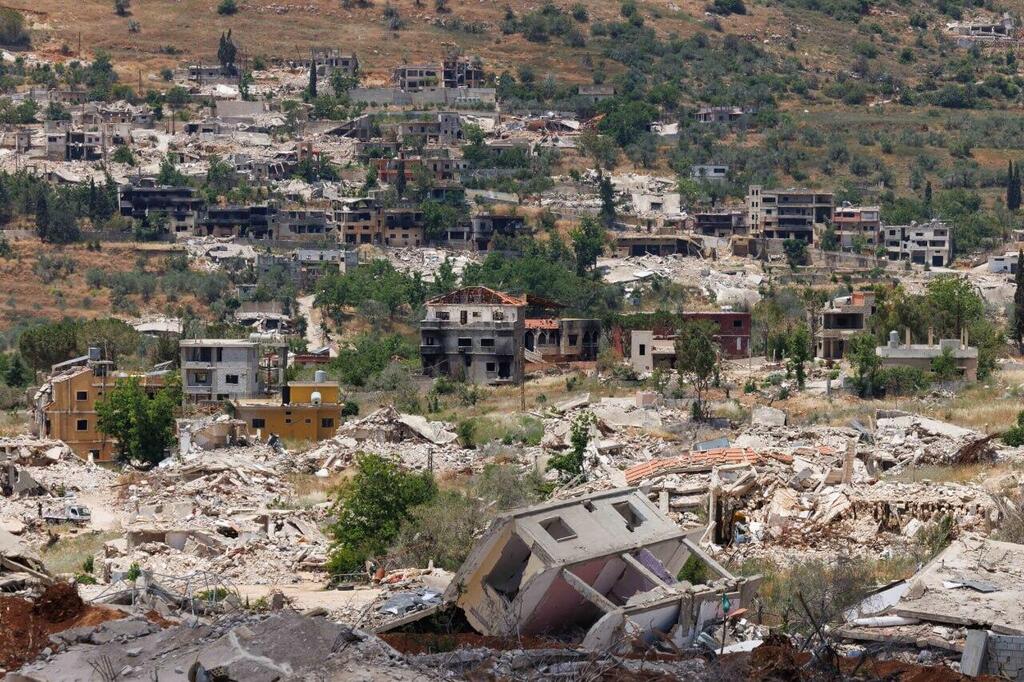
Not enough explosives to destory all buildings. Markaba, Lebanon
(Photo: Ziv Koren)
He also urged the IDF high command to leave openings in the fortified barrier and fought to establish small posts beyond those gaps to give troops line-of-sight into the destroyed and open terrain.
“I'm all for having a barrier, it’s a delaying obstacle, but it must not work against us by blinding us,” he explains. “I want a squad commander to feel he doesn’t need the chief of staff’s permission to cross it. He should see it as part of his responsibility to know what’s happening on the other side and protect us. He should fire a warning shot now and then, to make sure no one (terrorist) comes close. In the soldier’s operational mindset, I don’t want him to see the barrier as a limitation.”
Marciano recalls Hashem Safieddine’s visit to the border wall in July 2022, where he drew graffiti and signed on a photo of a slain Hezbollah operative. “Safieddine said, ‘You can hide behind walls, but one day we’ll cross it and be in front of you.'
"Well, we’re done being just behind the wall. In the Arab world, when you walk on your enemy’s land, it’s very different from just flying a drone above it. Defense starts with surveillance and monitoring tools aimed at the ridges overlooking us from Lebanon, but I’d rather be defending from top down, up to here at the border.
“We will not let them reestablish themselves here like before. That won’t happen,” says Marciano. Any ATV driving up on the ridge, if I have a tank available, I’ll fire at it. Why? Because there will be no more ATVs filming us.”
Standing atop one of the small "posts" that Marciano had carved into the border barrier near Metula, we looked out toward a distant site deep inside Lebanese territory. There, dozens of Hezbollah flags waved defiantly around a Hezbollah cemetery, a scene Marciano sees as a symbol of an unfinished psychological war.
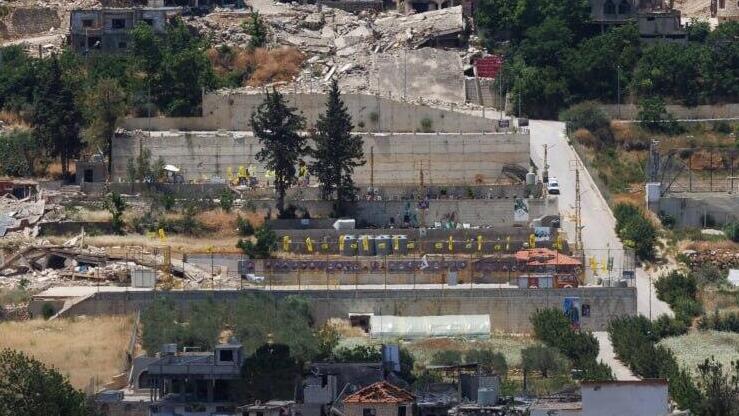
Hezbollah flags fly over a cemetery deep inside Lebanese territory, seen from the Israeli side of the border. The site, marked by yellow banners and guarded by fencing, serves as a burial ground for Hezbollah fighters
(Photo: Ziv Koren)
“They shouldn’t be there,” he says firmly. “In the end, there’s not much difference between these flags and the flags of the Nazis, who believed and acted in support of the same genocidal ideology. So, if you ask me why we don’t go in and take them down, I'll say because it’s a matter of agreements and politics, and that’s beyond my responsibility.”
Locals share Marciano's frustration. “I agree with the people of Metula who refuse to open their windows and see more Nazi-like flags. As a country, I think we cannot tolerate it, and I hope we do something about it,” he says. “But when there's (political) mechanism in place, and American involvement, and we fail to make it clear that we will not accept Hezbollah flags featuring weapons, then that's on us.”
He passionately adds, “I completely understand what civilians, or even soldiers, feel when they see those flags. It can drive you mad. You say to yourself, ‘This is an organization whose entire purpose is to wipe me out, and it’s right here beside us, waving its flag.’ And the flag is just the beginning, the first sign. That’s why I think that in this case we’re making a serious mistake."
He continues: “Would we tolerate seeing the Third Reich flag of the Nazi army in front of our eyes, dismissing it as ‘just a flag’? There's no doubt who put it up; It was not the Lebanese army but Hezbollah. And if they put it there, it means they’re still here. As long as Hezbollah is not reduced to a social-political movement, but an armed group committed to our destruction, and as long as its flag still features a weapon, they should not be allowed to return here. Not even with just a flag. The psychological war is no less critical than the physical one.”
The sharp criticism
The conversation inevitably evolves to October 7, 2023, and Marciano’s criticism gets sharper. “As soon as we realized something unusual and serious was unfolding in the south, I ordered all forces to deploy immediately to potential infiltration routes and open areas we believed Hezbollah might use to launch an attack against us. We were not going to sit in our outposts and wait for something to happen,” he says.
“We called everyone back from their homes to report in. Of course, I was torn between the desire to head south to assist and the chilling sense that the same kind of assault could erupt in my own sector in the north at any moment."
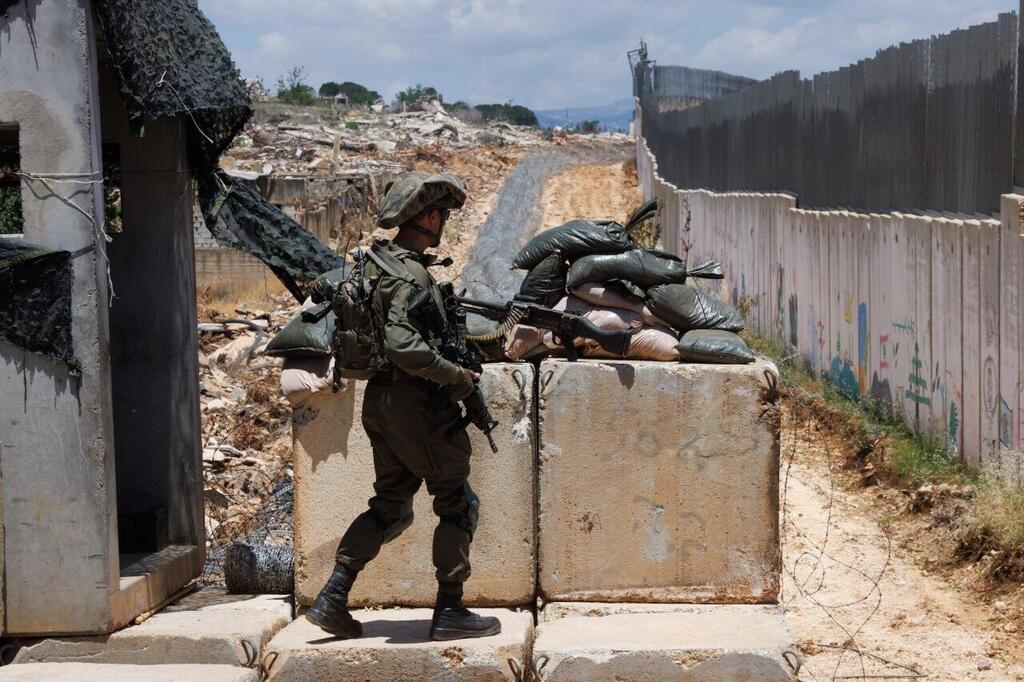
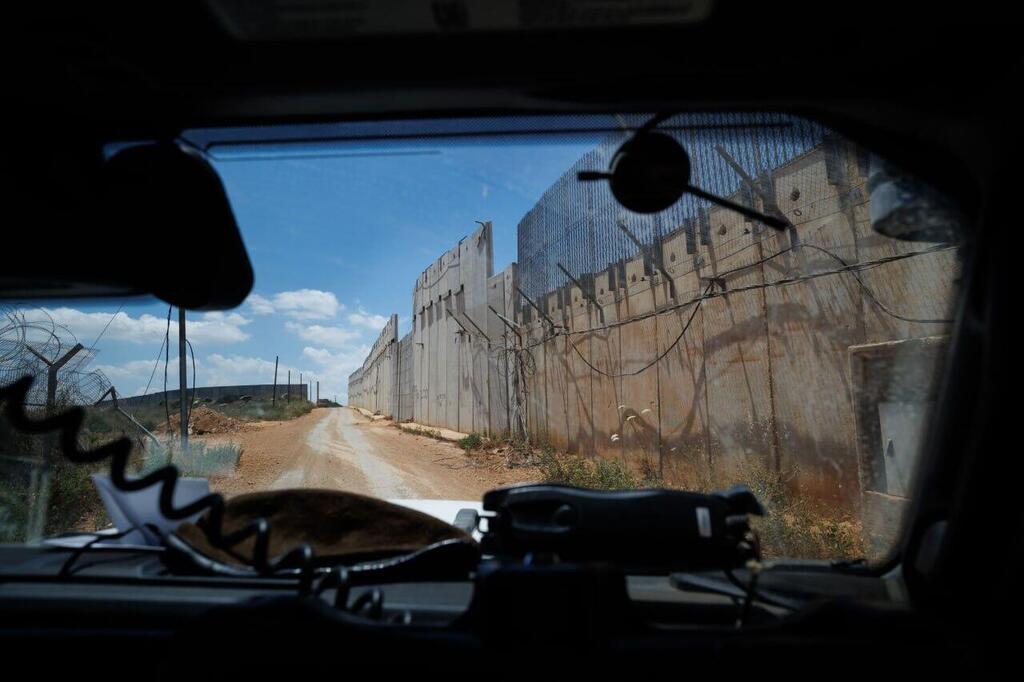
The wall between Israel and Lebanon
(Photo: Ziv Koren)
While the IDF may have failed to grasp the full scope of the threat in the south, Marciano notes that in the north, Hezbollah’s combat readiness, firepower and stated intentions, particularly Hassan Nasrallah’s public declarations about conquering the Galilee, were well known to military and political inner circles.
Marciano acknowledges the criticism and does not shy away from it, even though, as a relatively new brigade commander, he did not have access to all classified information. Still, his honesty is striking.
“If someone were to tell me now, at the end of my present position, ‘We appreciate your fighting and achievements, but you knew the threat, you understood the potential and still took on the role without doing more to prevent this horror and sound the alarm to shake the system, and for that, we’re dismissing you from the IDF’, I would lower my head and walk away. There’d be no argument about that.”
When asked about the public opinion that the military’s failure was deemed a “crime,” Marciano responds: “If that’s what you want to call it, go ahead. I see it as a complete breach of trust, but not a crime, because there was no malicious intent involved. We operated under the assumption that there would be early warnings for such an incident.
“Honestly, what we’ve achieved here since October 7 has been remarkable. But we were very lucky. Some might say divine intervention was at play, that the cards just fell in our favor. We took a terrible, painful blow in the south, like being hit on one side of the ribs, but as a result, we saved the other side, the north. That’s what happened. But it just as easily could have gone the other way, with the attack beginning here in the north, and the south going out to defend.”
“The IDF is one army - north and south alike,” Marciano adds. “Were we in good shape as a military before October 7? Absolutely not. I’m ashamed of that. Any senior officer who isn’t ashamed of what happened missed something fundamental in officer training, which involves the core values of responsibility and leadership."
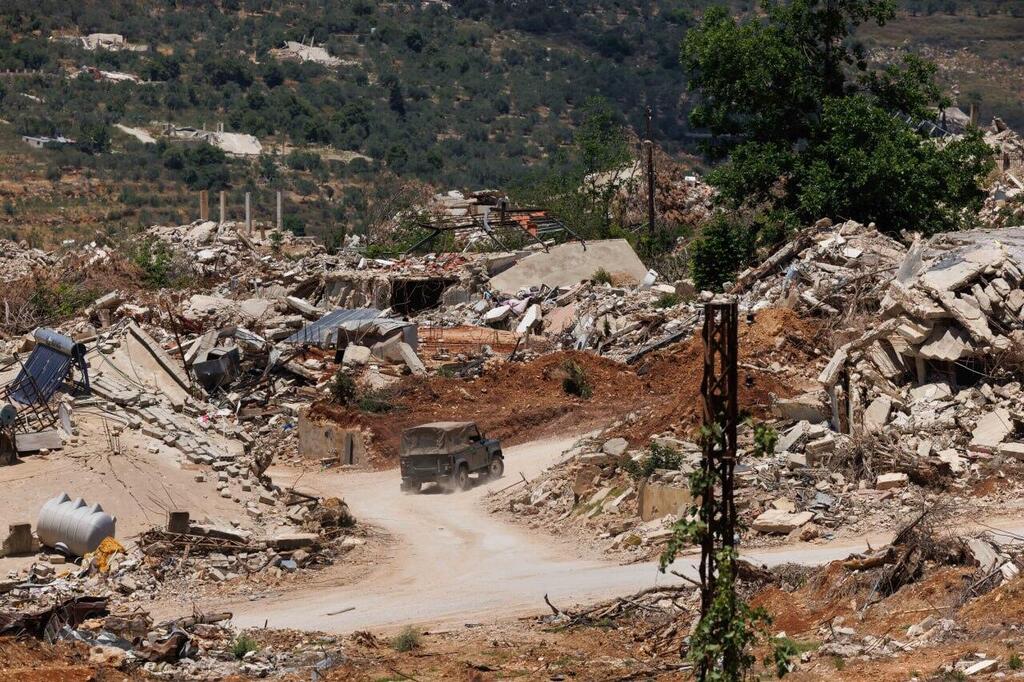
(Photo: Ziv Koren)
Still, his pride in his subordinates is clear. “I’m incredibly proud of my comrades, the battalion commanders, company commanders, platoon leaders and soldiers, because they have nothing to be ashamed of. They knew of Nasrallah’s threats from YouTube.
"I’m just a brigade commander, very young and new in the role. But those above me, who knew what was happening and had been in their positions for years, should absolutely be ashamed. If any of them feels proud about this, something must be off in their moral compass.”
His criticism begins with himself but goes well beyond. “My predecessor, Col. Sivan Bloch, for example, didn’t want to allow Hezbollah’s tents situated along the border. So you stomp your foot, pound the table, but they tell you, ‘Don’t escalate. That’s the instruction. We’re not stirring up the area.’
"It’s a sense of humiliation that’s impossible to put into words. You feel like you want to pull your hair out when you hear, ‘We’re not going to war, and any conflict on the border will lead to escalation.’ To fire a single shot at a Hezbollah operative’s leg, you had to get the chief of staff’s approval."
Today, emphasizes Marciano, the situation is fundamentally different. “If a squad commander, or a soldier, feels that something is wrong, they have full backing to shoot,” he says. “The commander on the ground knows that if he sees a motorcyclist who appears threatening, looks suspicious and is somewhere he shouldn’t be, the commander should take him down. I’ll deal with my soldier later on at the examination, to check whether the shooting was justified."
“But both my predecessor and I, and others, chose to stay in the military system before October 7, even when the situation was intolerable,” Marciano adds. “Brigade commanders paid with their lives in the south. And they would have been killed here too if the same scenario had been executed. It’s much easier to walk away and criticize from the sidelines, but we, IDF career officers, reservists and soldiers, chose to stay on the field, to fight and defend."
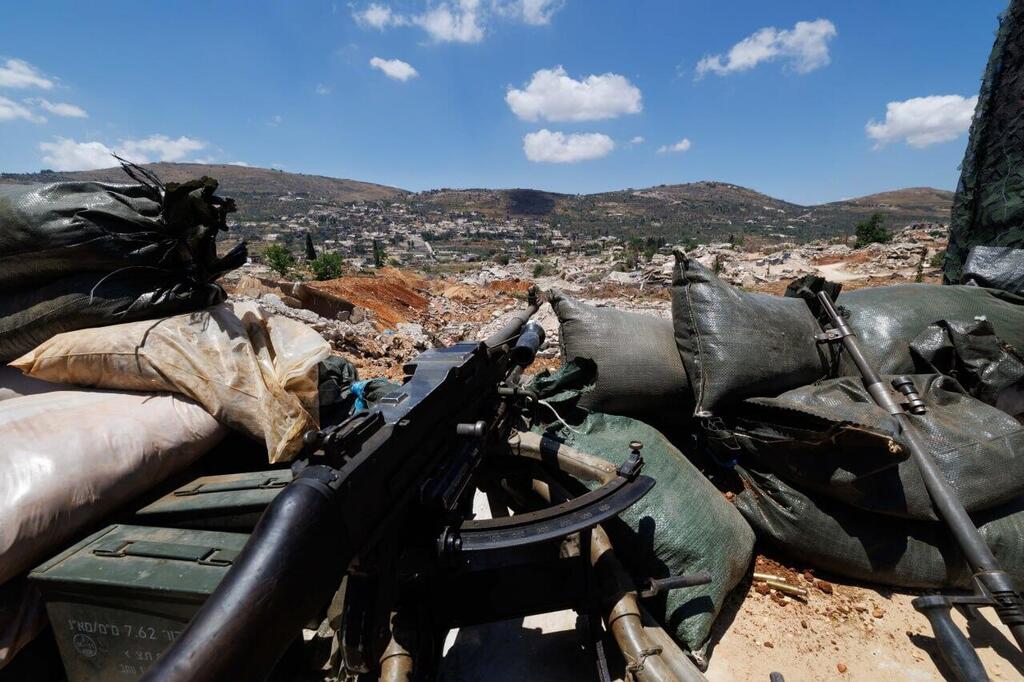
(Photo: Ziv Koren)
He continues: “I don’t know to what extent a brigade commander, or even a major general, can push for a dramatic decision like launching a campaign in Lebanon when the senior political and military echelon is locked in this mindset.”
“I’m not trying to shift responsibility onto others. I take full responsibility,” Marciano stresses. “But if you ask why I didn’t launch an offensive attack in the six weeks I was in command before October 7, the answer is simple: I’m not part of a militia. I can’t act against orders. If I had truly believed that was the most necessary step, I would have gone to my commanders and shaken them, but in the end, I’m a soldier.”
When asked for his opinion of Maj. Gen. Ori Gordin, the outgoing chief of the IDF Northern Command, Marciano says: “He’s a man of deep integrity. I can’t say he ‘made a mistake.’ I feel I made a mistake, and I’m ashamed of it."
Get the Ynetnews app on your smartphone: Google Play: https://bit.ly/4eJ37pE | Apple App Store: https://bit.ly/3ZL7iNv
He adds that even Brig. Gen. Shai Klapper, who led the 91st Division before the war and until recently, warned before October 7 that there weren’t enough troops for proper defense. “Does that absolve him of responsibility? No. It doesn’t absolve any of us.”
Still, Marciano stresses that "we should give credit to those who, for 20 years, laid the groundwork. “We knew where the rocket launchers were because a soldier a decade ago spotted something suspicious in a yard or warehouse and prepared the target that was waiting for us."
Raising four kids on a 'meager salary'
Last month, Marciano took his wife and children abroad for a yearlong sabbatical and peer-learning program. With his current role ending, he was not assigned to a new operational post in the IDF’s next round of appointments.
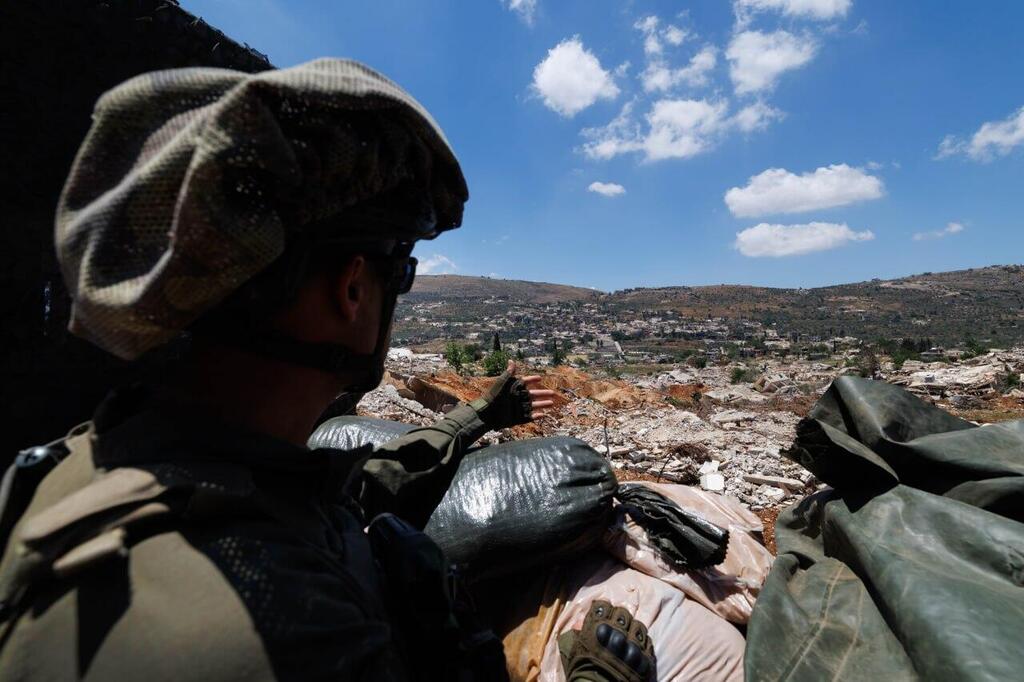
(Photo: Ziv Koren)
“It wasn’t my first choice,” he admits. “If I’d been offered a regular brigade command or another major operational role, I’d take it. The right and moral thing for me would have been to keep fighting in Gaza or stay here. But I don’t have that kind of role right now, and I have no problem in taking a break to learn, recharge, broaden my perspective and come back refreshed."
His family, he says, is grateful for the rare chance to spend a full year with their father at home. “The people of Israel, and so do I, should kiss the feet of my wife, Dovrat, and all the wives of career soldiers and military reservists,” he declares.
“Even before the war, I would see my newborn son only once a month, at most, and that’s while we, the young career officers, are earning a meager salary. There needs to be a return to strong military pensions. It's not about me, I don’t want anything. But it should go to the young career soldiers and fighters whose entire families are paying a heavy price.”
“My wife can’t build a meaningful career because she’s raising four young children, mostly alone. And we’re not willing to give up on having more kids because that’s a core value for us,” Marciano continues.
“My family, like so many military families, lives in constant anxiety for my life. I never see my kids. I’m not there when they need me, when they’re sick or can’t go to school because of the war. And when I finally come home after three consecutive months in the army, I’m a different person - exhausted, impatient and my mind is still focused on the battlefield. I hope this coming year will give my children and my wife their father and husband back.”
Looking to the future, Marciano hopes to eventually command the Golani Brigade. “But I have many great friends who are just as qualified for the role,” he adds. “If not Golani, I want to serve in the West Bank. I believe that’s where the next flare-up could be, and I want to be there, where I’m needed.”
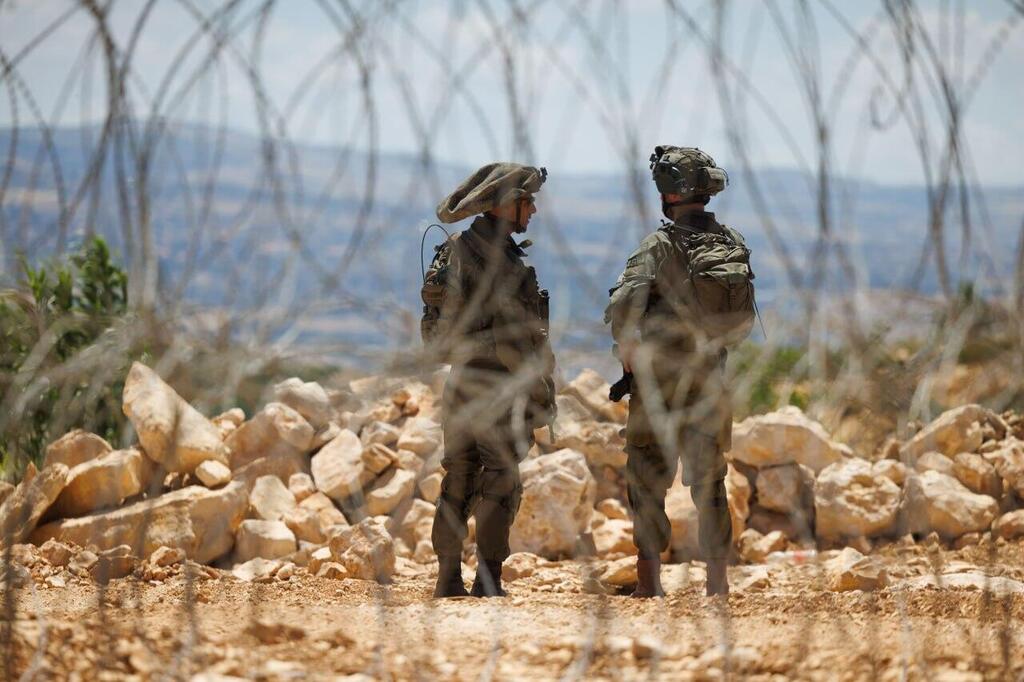
A patrol at the Lebanon border
(Photo: Ziv Koren)
His replacement, Col. Yuval Mazuz, who also succeeded him in his previous roles as commander of Golani’s 13th Battalion and operations officer of Northern Command, is, in Marciano’s words, receiving “the best brigade in the world."
Our current challenge is to ensure that a young Lebanese who joins Hezbollah is eliminated on the very day he signs his enlistment papers", Marciano says. “And if we see that it’s not working, and that deterrence isn’t enough, I hope my commanders and I will go in and secure the area by force.
"If the Lebanese army won’t dismantle Hezbollah, then we’ll go in and do it ourselves. We’ll start from where we left off, and push the threat beyond the Saluki River, and even farther.”