

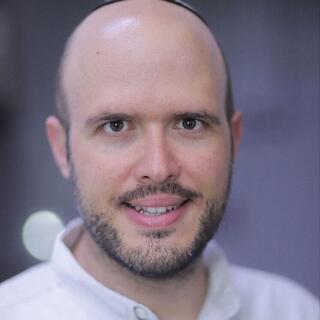
The odometer in Aviad Friedman's car tells the whole story. Every month, he drives more than 8,000 kilometers (5,000 miles) across Israel, traveling between two regions scarred by war. His wife, Hannah, sometimes asks how much longer he can keep running a marathon at a sprinter's pace. But Friedman, who wakes up every morning at 4:30 and begins his day with a run before plunging into mountains of bureaucracy, refuses to slow down.
For the past two years, he has led the Tekuma Administration, responsible for rebuilding the communities surrounding the Gaza Strip. About nine months ago, in January 2026, he took on the equally daunting and complicated challenge of rehabilitating northern Israel when he was appointed chairman of the unified Tekuma-Tnufa reconstruction administration.
Gallery
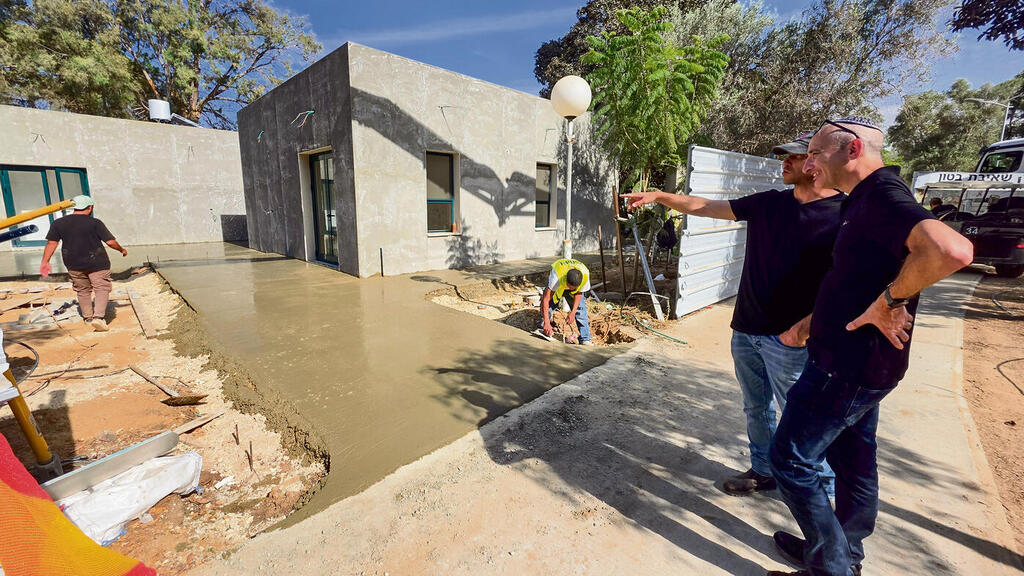
Aviad Friedman visits the reconstructed young people's neighborhood in Kibbutz Nirim
(Photo: Effie Sharir)
It turns out that his decision to assume responsibility for rebuilding the northern border communities went directly against the advice of those closest to him.
"No normal person would take this job," Friedman admits, recalling the moment his father pulled him aside for a private conversation. "It was the first time in my life my father ever asked me, 'Aviad, I'm asking you not to do this.' He told me I'd been very successful in business, successful in my previous positions and successful in the south. He asked why I wanted to fail and why I wanted to be associated with this after five people before me had failed. He practically begged me."
Our journey together through the communities surrounding Gaza in the south and along the northern border takes place at a particularly charged moment. Three years have passed since that dark morning during the Jewish holiday of Simchat Torah, and the gulf between the two regions is evident on every road, in every landscape and in every conversation with residents.
Standing on an observation hill in Sderot, the reconstruction chief points toward Beit Hanoun and Beit Lahia on the outskirts of the Gaza Strip, but asks us to shift our gaze from the destruction to what is rising around us.
"What's the most beautiful view in the world? A construction crane!" he declares with the enthusiasm of someone who once served as director-general of the Housing Ministry. "Because it means construction, because it means growth. That's what excites me. Forget Gaza for a second. Look at what's happening here and see how many cranes there are, and then look over there. Do you understand the difference?"
Sderot's success is reflected in striking demographic figures. The city entered the war with approximately 36,000 residents and has since grown to 42,000. Of the 12,000 families evacuated from the city in October 2023, only about 250 have chosen not to return.
Yet Mayor Alon Davidi is far from complacent. "If anyone in the government thinks that when the Tekuma Law and its funding end in 2028 the post-traumatic suffering here will also end, they're living in a fantasy," he tells us.
The Tekuma region, the official designation for the area surrounding Gaza, is now home to approximately 66,000 residents, an increase of about 10% compared with the prewar period and a growth rate 2.5 times the national average.
But as we head north toward the Galilee, the picture changes dramatically. There, facing Hezbollah and Lebanon, no forest of construction cranes fills the skyline. In Moshav Shomera, in the Ma'ale Yosef Regional Council, children heading to school in October 2026 still wait each morning for their bus beside a shelter riddled with shrapnel holes.
This contrast defines Friedman's daily struggle in his dual role: trying to bring hope and optimism to a region where the state removed obstacles and allocated resources generously, while confronting another where rigid bureaucracy, endless delays and a profound crisis of trust have prevailed, in an area that received little government attention even before the war.
Six months of hell
The disparity begins with the powers and resources granted to the two reconstruction administrations.
In the south, the Tekuma Administration was established immediately in October 2023, backed by dedicated legislation designed to remove bureaucratic obstacles and provide exemptions from tender requirements. It received independent implementation budgets, allowing it to manage infrastructure, education, health care and municipal funding without having to plead with individual ministers.
Of the 17.2 billion shekels (about $5.7 billion) approved for rebuilding the south, approximately 11.6 billion shekels (about $3.8 billion) had been committed and spent by the end of 2025, including more than 1.5 billion shekels (about $496 million) for physical reconstruction and temporary housing.
At Kibbutz Nirim, for example, the burned-out young adults' neighborhood was rebuilt by a contractor employing Chinese workers in double shifts. More than 90% of the kibbutz's community has now returned. At Kfar Aza, one of the communities devastated most severely in the October 7 attacks, the state invested 300 million shekels (about $99.2 million), and the first families began moving back into their homes this past summer.
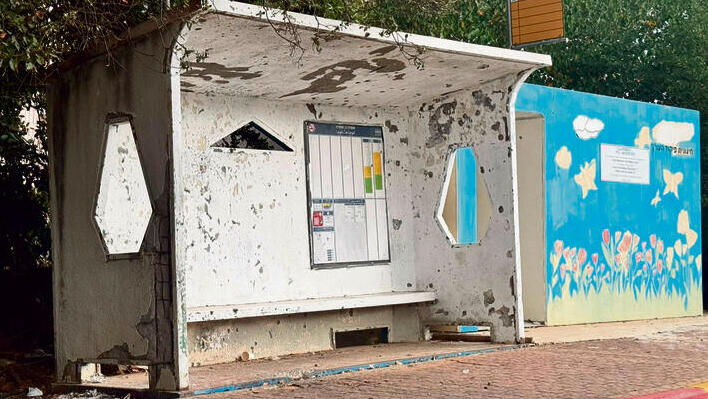
A bus stop riddled with shrapnel in Moshav Shomera in the Western Galilee
In the north, however, the process unfolded in almost exactly the opposite way.
The implementation headquarters established for the region had no executive authority. Maj. Gen. (res.) Eliezer "Chiney" Marom resigned after six months of unsuccessful efforts, while five different project directors were replaced or blocked for political reasons. The Joint Distribution Committee, a Jewish humanitarian organization, found itself drafting government resolutions instead of the state.
When Ze'ev Elkin was appointed a minister within the Finance Ministry, responsible for rehabilitation in both the north and south, he stabilized the system but failed to formalize the status of the understaffed northern administration or provide it with the authority and resources it needed.
Only in December 2025 was a decision made to merge it with its southern counterpart. The government's 13.4 billion-shekel (about $4.4 billion) reconstruction plan for the north was not finalized until June 2026, following Elkin's decision to approve it in stages, a process that took longer than expected.
Of the 6.1 billion shekels (about $2 billion) spent in the north so far, approximately 2 billion shekels went toward evacuation grants, compensation for abandoned properties and temporary arrangements rather than infrastructure reconstruction.
"It wasn't right. The government resolutions should have been approved long before I arrived," Friedman acknowledges candidly. "I came in December, and it was miserable. How can you get anything moving with eight or nine employees? The Joint had to draft a government resolution? Where does something like that happen? It's not normal. The State of Israel failed to do its duty."
Friedman also had to contend with a six-month period without a permanent director-general when he began his tenure at Tekuma, a leadership vacuum that delayed legislation and created difficulties that ultimately reduced the administration's original budget by nearly 10%, from 19 billion to 17.5 billion shekels.
"I felt like I was running up a downward-moving escalator. You're trying to climb, but the stairs are moving down beneath your feet," he recalls. "We went through six months of hell, fighting with every ministry. Here you have to get past the Finance Ministry, there the Budget Department, somewhere else the Justice Ministry. And the local authority heads are supposed to trust you when their basic level of trust isn't zero, it's minus 200."
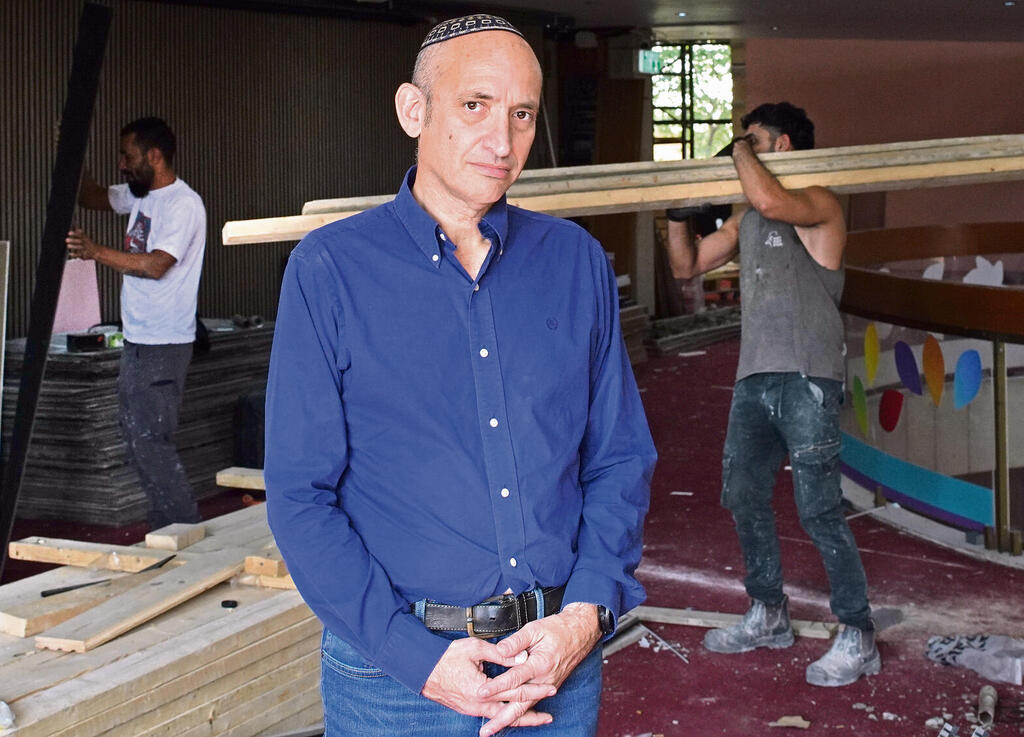
Aviad Friedman on the renovation of the Kiryat Shmona Culture Hall 'm not a magician, but I can be tested on
(Photo: Effie Sharir)
The starting point was a race against the clock, with the approaching elections setting a hard deadline.
"It was clear we didn't have unlimited time, and there were two options," Friedman recalls. "Either continue as things were, in which case there would be no government resolutions and we wouldn't finish before the elections, or go all in, build an administration from scratch, recruit 40 employees and get all the government resolutions approved for 13.5 billion shekels in the north and another billion or so for the Golan Heights.
"Can you imagine what would have happened if we hadn't managed to approve those resolutions before the elections were called? Trust was so low that people would simply have left."
Friedman knows the enormous disparity between the two administrations from every possible angle.
"At Tekuma, we control the money. We make the decisions and implement them together with government ministries and organizations such as Netivei Israel. I insist on working closely with the ministries' directors-general, but I'm not dependent on their goodwill," he explains.
"By contrast, Tnufa had no implementation capabilities from the outset, and most of the budgets remained with the government ministries. Only now have we established our own accounting and legal departments within Tnufa, and we're implementing projects worth nearly 1.5 billion shekels ourselves over the next five years."
Despite the grueling work and the long wait before tangible results emerge, Friedman refuses to give up.
"We have a moral obligation to the citizens of the State of Israel, especially those in the north, to believe this is possible," he says passionately. "If we, as a professional team, don't believe things can change, we've already lost.
"We were brought into the game in the second half, trailing 3-0. In a soccer match, you can sit on the sidelines and say it's over, curse the referee's mother or offer commentary on television. But in real life, this is our country. What's the alternative? The State of Israel has no choice but to win this game."
'Not allowed, not allowed, not allowed'
For meaningful change to take place, Friedman knows the reconstruction system must be insulated from the political interference that has accompanied it.
For more than a year, Kiryat Shmona Mayor Avichai Stern was boycotted by ministers and political figures, led by Prime Minister Benjamin Netanyahu, who sought to help Stern's Likud-backed rival in the municipal elections. Although Stern published a video this week supporting Netanyahu and thanking him for the resources that will finally be invested in the city, the underlying hostility has not disappeared.
Later, allegations emerged that Likud activists and politically connected figures had been appointed as project directors in the north during Elkin's Likud primary campaign. Even delays in releasing reconstruction funds through the Knesset Finance Committee in August were linked to attempts by committee chairman Knesset lawmaker Hanoch Milwidsky to exert political pressure amid the rehabilitation crisis.
"It's always good when the primaries are over, because they're a constant source of background noise," Friedman admits. "I have no idea whom the administration's employees vote for, and compared with government ministries, Tekuma and Tnufa are remarkably nonpolitical.
"When Milwidsky tried to make political capital at my expense, presenting himself as someone who was 'saving the north,' he approached 18 local authority heads and asked them to join a video he was making. Not one agreed to cooperate with him.
"Unfortunately, the government system rewards whoever shouts the loudest, leaving the weakest behind. But ultimately, residents of Kiryat Shmona or anywhere else shouldn't suffer because of politics involving their mayor.
"We're in the middle of a long war that will continue for a long time, even if there are no sirens or rocket impacts. We have to rise above left and right, above one party or another, and above individual ministers. I'm glad all the unnecessary disputes with Avichai Stern at the beginning have ended."
Then, almost casually, the man who has spent 30 years at the highest levels of public administration offers a pointed observation about the government's attitude toward Israel's periphery: "For starters, the Israeli government doesn't have a single government ministry director-general who lives in the north or the south."
Looking ahead to the next government, which will take office after the elections, and to the remaining years of the administrations' mandates, ending in 2028 in the south and 2030 in the north, Friedman sets out three critical demands. Without them, he warns, the entire reconstruction effort could collapse.
His first demand directly concerns northern residents' finances: the immediate approval of an income tax benefits package for communities along the confrontation line, which remains stalled in the Knesset Finance Committee.
"Ask me what hurts me the most. It's that they haven't finished the income tax issue," he says in frustration. "We allocated 300 million shekels to increase tax benefits, but the work in the Finance Committee and the Knesset simply hasn't been done.
"We have to finish this. Otherwise, the loss of trust will be enormous. If every resident in the north could feel that extra disposable income in their pocket right now, the entire atmosphere would be different. Do residents of the northern confrontation line deserve more than residents of Ashkelon or Samaria? Yes, absolutely, and we'll fight for it," he said.
His second demand from the next government and Knesset is the passage of a Tnufa Law for the north, modeled on the Tekuma Law enacted for the south.
"Why? Because once you have a law defining this as a region requiring special treatment, I don't have to beg the accountant general and government lawyers for a tender exemption with every decision," he explains.
"What could kill all our work in the north is the planning committees. If I have to stand in line at a planning committee to build a conservatory in Beit Jann, waiting behind a woman in Ma'alot who wants to enclose her balcony, you won't see results in the north even in two years," he says. "I don't care who the next prime minister is. We've been through a war. Give us two years without all these obstacles."
His third demand, and the one keeping him awake at night more than anything else, is an absolute prohibition on across-the-board cuts to reconstruction budgets in the north and south. For Friedman, this is not a theoretical concern but a fear rooted in past experience.
"In 2015, they announced a major 15 billion-shekel plan for the north, and then they cut it. In 2018, they launched a 5 billion-shekel fortification plan for the north, and then they cut that, too. I'm afraid the next government will say, 'What a wonderful plan,' and then start cutting it bit by bit. Not allowed, not allowed, not allowed. Not a single shekel can be cut from the budgets for the north and south. They have to be exempt.
"There will always be health problems and children who have been harmed, but a genuine plan for the growth of the north comes along once every 50 years," he said.
Friedman's worst nightmare materialized sooner than he imagined. Just this week, during a contentious Cabinet meeting on Sunday, ministers approved an across-the-board cut of approximately 4% to government budgets, citing urgent security needs. The decision will remove 114 million shekels from the northern Tnufa programs and approximately 130 million shekels from the southern Tekuma programs.
Although the finance minister and his ministry's director-general quickly made public commitments to restore the funds later, Friedman sees the move as playing with fire, threatening to destroy what little trust remains among residents.
"One very effective way to destroy the trust that's left is to tell people, 'Here's what you're getting,' and then turn around and say, 'Actually, you're getting less,'" Friedman warns. "Anyone who wants to bring about change has to give people a sense of stability. The message must be that the budgets for the north and south are untouchable."
He believes the prospect of future cuts could distort decisions on the ground and damage long-term reconstruction.
"As an economist, I know that when someone senses a shortage, they tend to say, 'Let's invest in something quick, because if I invest in infrastructure, which is long and complicated, the money might no longer be available when I need it.' A mayor shouldn't have to live with that feeling, and we mustn't put ourselves in that position."
The security situation in the north remains a constant reminder of how fragile the recovery is. Just last week, the Galilee was shaken by a tragedy in which an unexploded cluster munition detonated during an outing by students from a religious high school in the Upper Galilee.
The incident has left Friedman deeply concerned about further damage to the northern tourism industry, already struggling after years of conflict. Here, too, assistance aimed at recovery and growth remains slow, with few tangible results.
"This tragedy worries me enormously," he says. "The relevant authorities have to locate and remove every unexploded munition, and people must be warned again and again not to touch them. But the solution absolutely cannot be to tell people to stop hiking or vacationing in the north. We took our family vacation in the north this year. We visited all 12 Druze communities. We have to bring tourists back to the north."
'What breaks my heart'
At a progress meeting in the Beit Jann Local Council, the gulf between government decisions and ordinary citizens becomes painfully clear. Friedman holds meetings of this kind every few weeks in each of the 25 local authorities covered by the Tnufa Administration.
Council officials and project directors from JDC's ELKA division, which supports the community, describe the cultural and practical difficulties of making government programs accessible to residents. Druze farmers do not know how to navigate digital tenders and are reluctant to apply for government assistance, while efforts to encourage women's employment encounter additional barriers.
Friedman listens, takes notes and presses his staff to simplify the procedures. For him, the government's decision to subsidize daycare in northern border communities illustrates both the potential to transform families' lives and the intolerable difficulty of actually getting public funds released.
"The crisis of trust is insane, and I understand the people. They're absolutely right after three years in which they felt the region had been abandoned and nobody cared," he says with visible pain.
"It breaks my heart to see residents waiting for a few crumbs and getting no answers because of legal obstacles and bureaucracy. Look at Beit Jann. There's a government decision here affecting 198 children, whose families are now paying 2,000 shekels less every month for daycare.
"For a young couple here, 2,000 shekels a month is half a mortgage payment! You have no idea what we went through fighting the bureaucracy and the lawyers to get that money released."
As we drive away from Beit Jann, I confront Friedman with what local authority heads have been telling me behind closed doors: The government may finally have approved a resolution, but in practice, it amounts to a cumbersome 900-page document with an endless maze of provisions that nobody knows how to navigate.
Worse still, the administrative structure in the north remains an anomaly. Friedman is responsible for the entire region, but within it are whole areas over which he has no control. The Ministry for the Development of the Negev and Galilee oversees certain activities in the cities; the Settlement Division operates in moshavim and kibbutzim; the Interior Ministry pursues its own priorities. And on top of everything else, his administration must also oversee the government resolution concerning the Golan Heights.
Friedman chooses his words carefully. "From the outset, on October 8, they should have established two separate administrations with all the necessary departments, including people and community, construction and economics, and legislated the Tnufa Law as a second part of the Tekuma Law," he says.
"In practice, that didn't happen. So when I came in, I had two choices in dealing with the existing situation: either get into territorial fights over authority or sit down with the directors-general of the Ministry for the Development of the Negev and Galilee and the Settlement Ministry, who are excellent professionals, and build a system in which people support one another rather than put obstacles in each other's way. None of us is running in party primaries, and none of us is seeking elected office."
But what about the claim that the administration itself, which controls the flow of approvals, sometimes becomes another obstacle, making life miserable for local authority heads?
"I told the mayors that nothing sits on my desk for more than 72 hours, one way or the other," he replies. "I can say yes and I can say no, because we have an obligation to make sure the money goes toward growth rather than plugging budget holes or serving political interests.
"Sometimes it's actually useful for a mayor facing political pressures to have someone who tells him no. But he'll get an answer within 72 hours. In the south, no request sits with us for more than 24 hours.
"We constantly remind ourselves that an administration that doesn't work quickly has no right to exist. The excellent people who came to work in our administrations, some of whom gave up permanent positions elsewhere, have no career ladder here. They're not going to retire from the administration. They came because they believe in the mission, and they're giving everything they have for the region, where most of them live."
Friedman asks that he and his team in the north be judged in a matter of weeks, when the money begins flowing and government resolutions are translated into actual projects and construction cranes start changing the Galilee's landscape. But he says the real bottleneck lies with the gatekeepers in Jerusalem, particularly the Finance Ministry's Budget Department and the Justice Ministry.
"Do you know when things really started changing on the legal side in the north?" Friedman asks. "The day we brought Gil Limon, the deputy attorney general, and his team on a tour. He stood out there with drones overhead, and afterward I took him to meet Stern in Kiryat Shmona. His entire perspective changed that day."
Reality is measured by results
But the shift in attitudes in Jerusalem has yet to translate into priorities on the ground. The gap between the north and south is particularly glaring when it comes to transportation and infrastructure.
I present Friedman with figures that would drive any northern resident to despair. In the south, road reconstruction and improvement projects worth more than 700 million shekels have already been completed. In the north, by contrast, a government resolution allocating 600 million shekels for transportation was approved only in early June 2026.
By mid-October, the state had released a first, pitiful installment of just 37 million shekels, which arrived last week. Another 40 million shekels is expected to be transferred soon, with a promise of 156 million shekels by the end of December.
Why does everything happen quickly and professionally in the south while reconstruction in the north drags on?
"If you're asking me what happened over the past three years, why none of this happened earlier and why it's all taking so long, I have nothing to say," Friedman replies. "And I'm not going to give you excuses, because reality is measured by results."
Forget grand visions for a moment. The shrapnel-riddled bus shelter we saw in Shomera is the face of the reconstruction effort. The Ma'ale Yosef Regional Council approved a record budget of approximately 290 million shekels this year, yet infrastructure damaged during the recent wars has still not been repaired.
Why don't you pick up the phone and make sure that shelter gets replaced?
"How much does a bus shelter cost? The council head has money now, and he has a substantial municipal budget. Let him replace it!" Friedman responds.
"On my next tour there, I'll say to council head Shimon Guetta, 'Shimon, what's going on? Why does it look like this?' And then he'll fix it. But the administration cannot and must not replace the local authority heads. Elected officials have responsibilities. The local authority has to function, and our job is to push it forward and strengthen it.
"If local authority heads tell you they don't have engineers, and a project to build a community center is stuck waiting for a quarter-time engineer at the planning and building committee, behind a neighbor's request for a pergola permit, that's exactly why we allocated money to strengthen local authorities, so they can hire engineers.
"Just as 180 new families have arrived in Kiryat Shmona, engineers who are drawn to the Zionist challenge will come, too."
Friedman distinguishes between different parts of the north following the prolonged rounds of fighting.
"I separate Kiryat Shmona and Metula from the other local authorities," he says. "In Shlomi, Nahariya, Ma'alot, Mevo'ot Hermon and the Upper Galilee, this isn't a tragedy with a predetermined ending. That's not the situation there. But I agree that the atmosphere is difficult. Still, residents will begin seeing results within weeks.
"I prioritized funding for the hospital in Nahariya at the expense of other things, because when a western Galilee resident sees in 2027 that the hospital has another operating room and an MRI machine, and that the hospital itself looks different, they'll feel that something has changed.
"When Kiryat Shmona residents have a 24/7 medical center, when millions are invested in schools through the GEFEN education programs, and when the municipal funding reaches local authority accounts in a month or two, people will sound different.
"That won't undo the failures of the past, and I've told the local authority heads that I'm not a magician. But in another year, at least, you'll be able to judge me by what we've achieved in the north."
As our journey draws to a close and darkness settles over the roads of the Galilee, the odometer in Friedman's car continues to climb. We return to the biggest question of all: How does he balance residents' pain and despair with the strategic planning needed for long-term growth, including a target of attracting 100,000 new residents to the north and doubling the population of the Gaza border region over the next decade?
"Once, when I was trying to explain how I envisioned the administration, I said it had to be like Jacob's ladder, a ladder standing on the ground with its top reaching heaven," Friedman says. "That means, on the one hand, staying firmly grounded, always down there in the field, close to people's pain, making them feel comfortable calling me even at 2 a.m., and never lying to them, because as a country, we've already lied to them a hundred times.
"On the other hand, our minds have to be focused on the future. We have to believe that Tel-Hai in Kiryat Shmona, where we've invested a billion shekels in the institution and higher education in the north, and the half-billion shekels invested in Sapir College in the south, are the keys to attracting young people.
"As long as the Swiss aren't living in Gaza and the Australians aren't living in Lebanon, we'll be living alongside enemies. And in a place that lives alongside enemies, the State of Israel has to reach into its pocket and give its residents security and hope."