

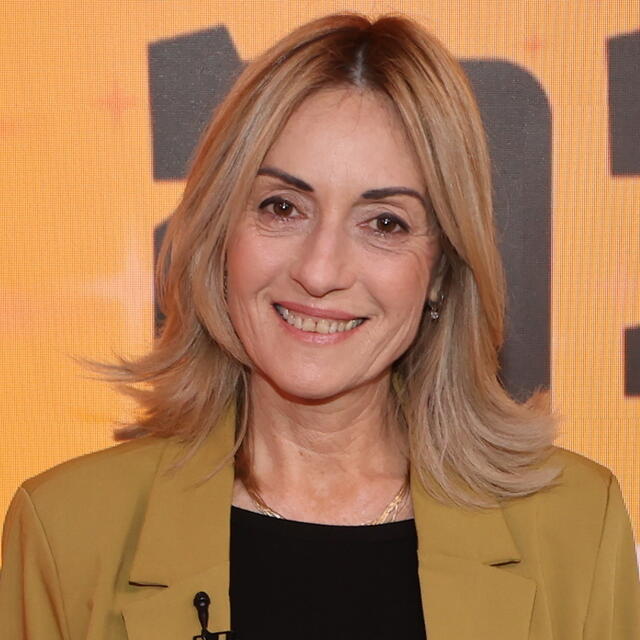
"I work because I have to. If I had the option not to work, I wouldn't. I'd spend these years enjoying life. Unfortunately, I don't have that choice because my monthly income is too low," said Yair Kaplan, 70, a widower from Herzliya, father of four and self-employed tax adviser.
Kaplan is far from alone. By some estimates, hundreds of thousands of older Israelis continue working to make ends meet because they have no alternative. They have given up their retirement plans and have little time to pursue the dreams they hoped to fulfill later in life.
Gallery
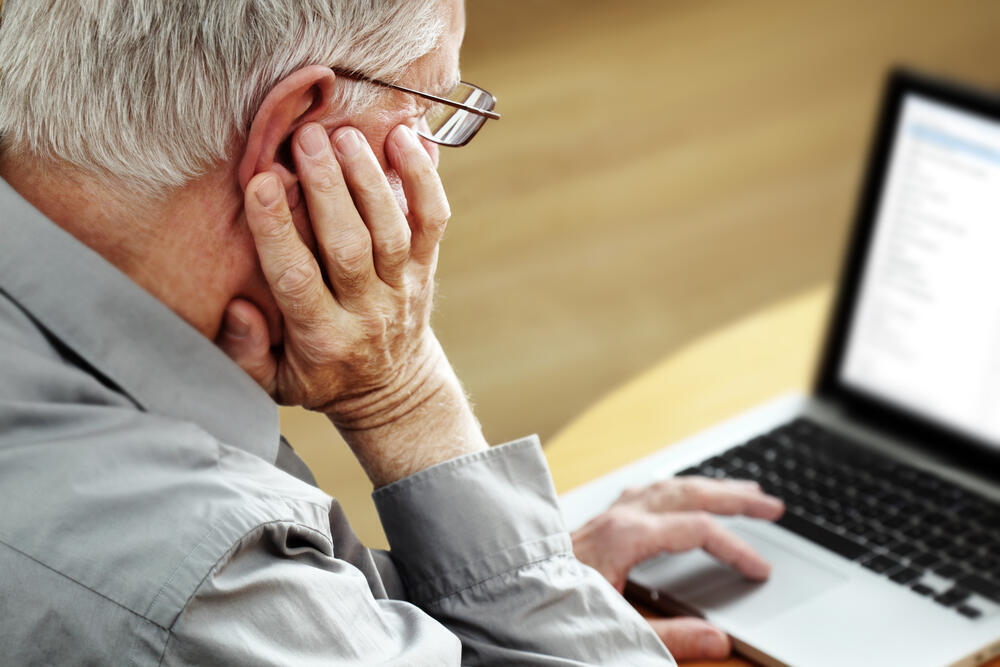
Hundreds of thousands of older Israelis continue working to make ends meet because they have no alternative
(Photo: Shutterstock)
Kaplan's story raises one of the most important financial questions facing Israeli workers: How much should people save for retirement to maintain their standard of living — or at least come close to the one they had before retiring?
It is worth recalling that Israel's mandatory pension order took effect in January 2008, extending pension coverage to about one million workers who until then had not been covered by a pension arrangement through either a collective bargaining agreement or an individual contract.
Until then, employer pension contributions were not mandatory. As a result, Israelis who are now 67 or older — who were around 50 years old when the reform took effect — spent decades working without pension contributions. Many are therefore forced to continue working after reaching retirement age, doing whatever work they can find for as long as they are able.
Because Israel's pension system is based on accumulated savings, the amount people receive after retirement depends on how much was contributed on their behalf over the years, the investment returns on those savings and the length of time they saved. Workers who earned low wages early in their careers or experienced periods of unemployment may therefore reach retirement with relatively modest savings, as may those who received no pension contributions before 2008.
In addition to pension payments, Israeli citizens are also entitled to an old-age benefit from the National Insurance Institute.
 Yair KaplanPhoto: Courtesy
The senior citizen benefit is paid from retirement age, subject to an income test, or from age 70 regardless of income. As of 2026, the minimum monthly benefit is 1,838 shekels for eligible Israeli residents insured by the National Insurance Institute. Those whose income falls below the eligibility threshold can receive the benefit from retirement age. At age 80, the minimum monthly payment rises to 1,941 shekels.
'Medication alone costs thousands of shekels'
Rona Hadida, 74, lives with her 76-year-old husband, who is fully disabled, in a rented apartment in Hadera. They have two sons and grandchildren.
Born in South Africa, Hadida immigrated to Israel 50 years ago. She initially lived at Ma'agan Michael, where she studied Hebrew at an ulpan — an intensive Hebrew-language program for new immigrants — and met her husband, who had immigrated from Argentina. After marrying, they moved to Malkia in the Upper Galilee.
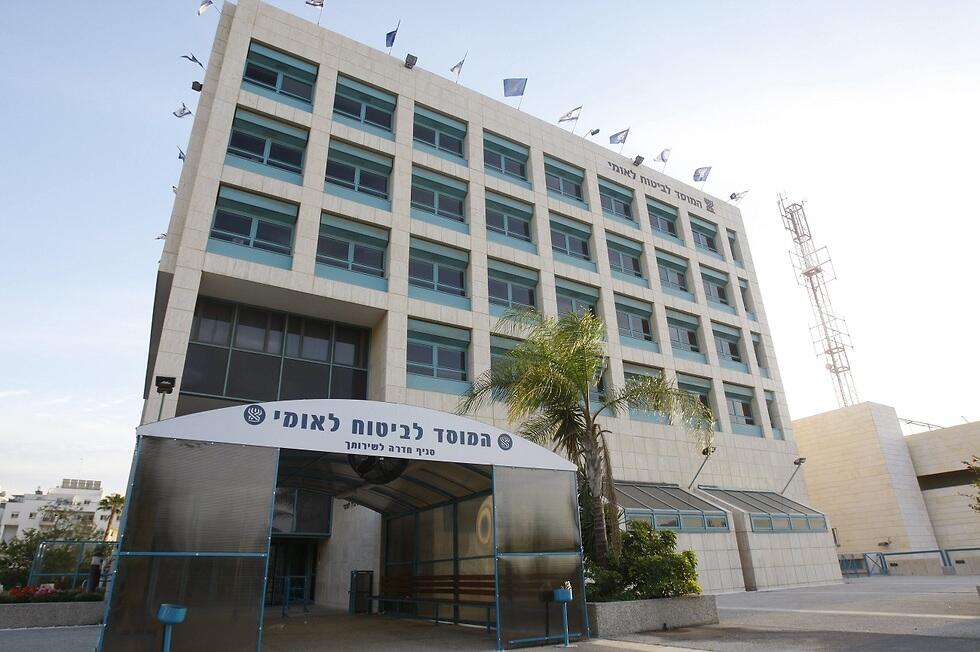
National Insurance Institute
(Photo: Nimrod Glickman)
"I earned a degree in library science back in South Africa," she said. "I asked to work in my profession, but they wouldn't let me. I spent five years working in the kitchen. Only after we announced we were leaving did they offer me a librarian's job. By then it was too late. We left with a bitter taste."
The couple later moved to Ashkelon and then to Moshav Idan in the Arava, where they worked as farmers for 12 years. Family pressure eventually led them to move to Argentina, but after two years they returned to Israel and settled in Netanya.
"For about a year I worked as a secretary. It was a nightmare. In 1993, after all those moves, I finally started working as a librarian at Ruppin Academic Center. I worked there until retirement at age 67. I loved every minute of it, and the salary wasn't bad."
Her husband, an industrial and management engineer, never held a job with formal pension benefits, she said, and therefore has no pension.
What do you live on each month?
"My pension from Ruppin is about 5,000 shekels. I receive around 4,000 shekels a month from National Insurance because I worked until age 67, and my husband receives about 3,500 shekels a month. Together it sounds reasonable, but it's difficult. Medication and other monthly expenses alone run into hundreds or even thousands of shekels.
"At first I thought we'd manage. When I realized we couldn't, I found a part-time job at the library in Michmoret. I enjoy working, I wake up happy every morning and earn another 3,500 shekels a month.
"We have no savings. I'm afraid of the day I won't be able to work anymore. I'm already 74. Not a day goes by without me wondering how many more years I can keep this up. I don't want to live a long life if I'm unhealthy and don't have enough money to take care of myself and my husband. I certainly don't want my children to have to support me. It should be the other way around, and I can't help them."
What about owning a home?
"We wanted to, but it wasn't possible. When we finally found a small apartment and saved enough for a down payment, the bank refused to give us a mortgage because of my husband's disability. They suggested taking the mortgage out in our son's name, but then what would he do when he wanted to buy a home of his own?
"More than 20 years have passed. My husband is still alive, thank goodness, but we still don't own a home. The 5,000 shekels we pay in rent every month could have gone toward mortgage payments instead."
So how much should you save?
"There isn't a single definitive answer to the question of how much money people need for retirement," said Avi Gasner, a financial retirement planning expert.
He pointed to one of the key concepts in retirement planning: the "replacement rate" — the percentage of a person's final salary that will be replaced by retirement income after leaving the workforce.
A commonly accepted rule of thumb in the financial world is that retirees need an income equal to 60% to 70% of their final salary to maintain their standard of living.
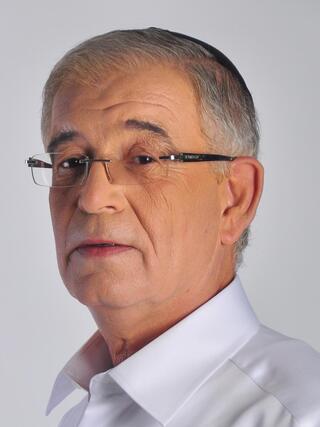 Avi GasnerPhoto: Shayari Hila
 "The minimum amount needed to live with dignity in retirement is highly subjective. Some people live on 5,000 shekels a month, and they survive. At the same time, some expenses decline after retirement, while others — such as healthcare, medication and leisure — may increase with age," Gasner said.
According to Gasner, "The amount provided by National Insurance is not enough to maintain a reasonable standard of living without additional pension savings. People need to reach retirement knowing exactly how much money they have so they can retire with dignity.
"My late father always used to tell me, 'From every lira you earn, put half aside for a rainy day.' We haven't used liras for decades, but the principle still applies.
"My recommendation is to save 20% of your take-home pay — about 10% of your gross salary — and not touch it. That's in addition to mandatory pension contributions. I also recommend private health insurance and prescription drug coverage. Spending a few dozen shekels a month can help cover healthcare costs that rise with age and can become very expensive. People should be able to enjoy old age rather than wake up every morning worried about money."
'I never thought about a pension'
"It never crossed my mind that anyone would contribute to a pension for me, or how much I would need one in the future," said Goldie Roth Saban, 69, a divorced woman who rents an apartment in Ramat Gan.
Roth Saban never worked in a long-term salaried position. She previously worked as a life coach and served as a foster parent, while dedicating most of her time to raising her children and caring for her family.
 Goldie Roth Saban Photo: Courtesy
"All I have today is the pitiful National Insurance benefit. Someone explain to me how anyone is supposed to live on that. I have to work. Today I manage an office for a company. I like working there. I hope I can keep doing it, because without that job I wouldn't make it through the month."
Roth Saban, who lives alone, owns a small apartment in Beersheba.
"I rent it out for 2,500 shekels a month. Together with another 2,500 shekels from National Insurance, I have 5,000 shekels coming into my bank account every month."
She pays an additional 2,500 shekels to rent a small apartment in Ramat Gan so she can live close to her children and grandchildren. She also earns about 5,000 shekels a month managing an office.
"I get by on 10,000 shekels a month. I'm just worried about the future."
What do you mean?
"I'm already getting tired. I keep asking myself what will happen in a few years. How will I survive if I can't keep working? Even if I move back to Beersheba, how can anyone live on 2,500 shekels from National Insurance?
"I often go outside and start crying over what I see. Almost every day I see an elderly woman walking hunched over, collecting bottles to return for a few shekels. I collect bottles for her, and I wonder whether I'll end up in the same situation."
Yekutiel Meshi, director of policy promotion and government relations at the nonprofit 121, said the government must introduce a differential old-age benefit and increase payments for retirees with no pension or with pensions below 5,700 shekels a month — an amount equivalent to the minimum wage after mandatory social contributions.
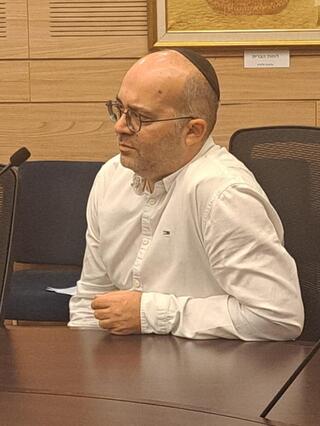 Yekutiel MeshiPhoto: nonprofit 121
"At the same time, the old-age benefit should be linked to the average national wage to prevent it from being eroded over time," he said.
"In Israel in 2026, tens of thousands of older adults continue working beyond retirement age not because they want to, but because they have no financial choice. Many work in physically demanding jobs because their pensions alone do not allow them to live with dignity.
"Nearly half of Israel's older population has no pension at all or receives only a very small one. The goal is simple: to enable every older Israeli to live with dignity and make the decision to keep working a matter of choice rather than economic necessity."