


Any assessment of IDF Chief of Staff Lt. Gen. Eyal Zamir after a year and a half in the job has to begin with the circumstances in which he took command. Not since Israel’s 1948 War of Independence has a chief of staff entered office while the IDF was engaged on six active fronts.
At the same time, Zamir has had to resist pressure from some of the most powerful forces in the governing coalition in order to preserve public confidence in the military, prevent the politicization of the senior command and operational decision-making, and recruit thousands of additional combat troops whose absence is limiting the IDF’s ability to carry out its missions.
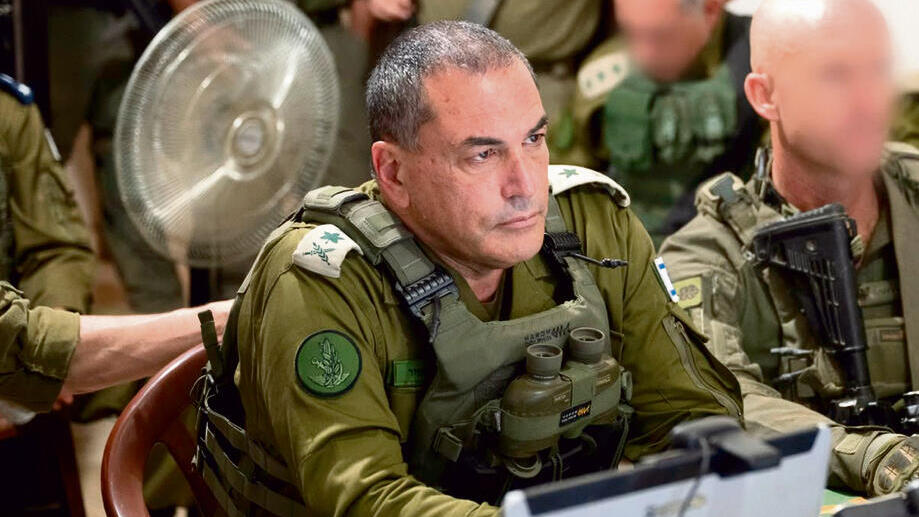
Zamir’s most significant achievements as chief of staff have come on the battlefield. According to updated assessments by the IDF Intelligence Directorate and Operations Directorate, Israeli military operations in Operation Rising Lion and Operation Roaring Lion under his command have left Iran no longer a nuclear threshold state, a status it is expected to remain outside for several years, according to assessments Zamir and Military Intelligence recently presented in closed discussions. The “annihilation plan” conceived by the elder Khamenei and reaffirmed by his son has been pushed back by at least five years. All of the hostages, living and dead, have been returned from Gaza, while the military forces of Hamas and Palestinian Islamic Jihad no longer constitute the threat to southern Israel they once did. Instead, the IDF is subjecting them to what it calls a “creeping siege,” alongside an intensive campaign of targeted killings and the destruction of underground infrastructure intended to prevent them from rebuilding their capabilities.
According to current and former senior IDF officers, Zamir has also restored the ground forces’ confidence in their ability to maneuver and clear territory both above and below ground despite the threat of anti-tank weapons and drones. They point to recent operations in Lebanon, particularly the crossing of the Litani River, the capture of the Beaufort Ridge and the destruction of the Ali Taher Ridge. Equally important, the IDF under Zamir has managed to implement an offensive operational doctrine while navigating between the demands of a hawkish Cabinet and a combative defense minister on one side, and those of the White House, which wants stable ceasefires in Gaza and Lebanon, on the other.
Across all fronts, Zamir is rapidly implementing Israel’s new security doctrine. Based on the lessons of Oct. 7, its core principles are forward defense and prevention. The doctrine has not yet been formally adopted by the government or Cabinet, but the IDF is already shaping its operational approach around it. Some in academia, the Finance Ministry and the defense establishment question whether the IDF can sustain the doctrine over time because of worsening shortages of personnel and funding, as well as the lack of international legitimacy for security zones and permanent military positions inside the sovereign territory of Lebanon and Syria and within the Gaza Strip.
The IDF currently exercises operational control over some 1,220 square kilometers and maintains 63 military positions in Gaza, Lebanon and Syria. Along Israel’s peace border with Jordan, it has established a new formation, the Gilad Division, while construction continues on a barrier and fence intended to prevent a surprise assault by jihadist militias approaching from the east. In Syria, in addition to maintaining forward defenses for Israeli communities on the Golan Heights, Zamir’s General Staff, with Cabinet approval, has established and maintains what it regards as a credible threat that has so far thwarted Turkish President Recep Tayyip Erdoğan’s plans to take control of Syria and has guaranteed the security of the Druze in Suwayda province.
In the West Bank, known in Israel as Judea and Samaria, Central Command and the Shin Bet have over the past year reduced Palestinian terrorism to a level Israel has rarely seen: no fatal shooting or bombing attacks, five Molotov cocktail attacks, one vehicle-ramming attack and two attempted rammings. Alongside that achievement, however, Zamir and the IDF face a serious and dangerous failure in dealing with violent Jewish extremists and in their inability to prevent or remove farms and outposts established illegally but backed by the government.
The three Israelis killed in the West Bank this year, one combat officer and two civilians, died during what the IDF euphemistically calls “friction incidents” with Palestinians. In practice, these involved violent attacks by Jewish extremists on Palestinian communities or provocative incursions by Jews into Palestinian towns and villages. The IDF, which exercises military authority in the West Bank, has been unable to enforce the law there or fully meet its obligations under international law.
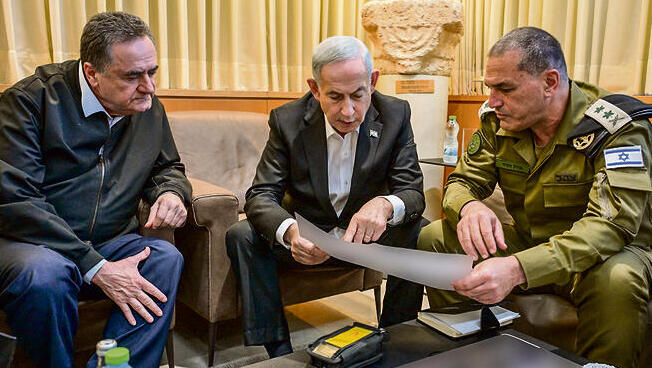
Israel Katz, Benjamin Netanyahu and Eyal Zamir
(Photo: GPO)
Zamir has had to manage all of this under four major constraints.
The first is the requirement to carry out Cabinet directives and the policies of Prime Minister Benjamin Netanyahu, even when they conflict with operational or intelligence considerations or with the judgment of Zamir and a significant number of General Staff officers. As commander of the military and the senior operational authority, Zamir has learned to work within directives issued by a political leadership that frequently announces that it “instructed” or “ordered the IDF” to take action, while trying to preserve military values and professional judgment.
The second constraint is imposed by US President Donald Trump, his policies and his envoys. The most extreme example was Washington’s intervention to prevent an Israeli Air Force strike package at the end of Operation Rising Lion. More often, however, the American restrictions are more flexible, leaving the chief of staff, rather than the political leadership, responsible for navigating them firmly but carefully while constantly assessing the position of an unpredictable White House and knowing that Israel’s political leadership would be quick to blame him if anything went wrong.
Israeli-American cooperation in both defense and offensive operations, particularly with US Central Command, has reached levels unprecedented in Israel’s history in scale, intensity and closeness. At times, that relationship has allowed Zamir to receive information in advance that the prime minister, for various reasons, preferred not to share with him, including information related to the hostages.
The third constraint is the severe shortage of combat manpower. It repeatedly forces Zamir to call up reservists in order to sustain forward defenses and prevent an uprising from erupting in the West Bank.
The fourth, and more traditional, constraint is the defense budget. Every previous chief of staff has had to enter the familiar confrontation in which the Finance Ministry says there is no more money and the military argues that without additional funding today, it will not be able to confront tomorrow’s threats. Zamir is dealing with a situation in which Finance Minister Bezalel Smotrich has delayed the transfer of funds already approved for the military by the prime minister and Cabinet. In fairness, Israel’s defense budget is currently more than twice the level it was before the war.
Zamir, who previously served as director general of the Defense Ministry, understands the fiscal pressures. He nevertheless argues that Israel’s new security doctrine, the need for greater independence in weapons production and the possibility of new strategic threats emerging require immediate investment in infrastructure, preparation and procurement.
Industrial-scale operations
Zamir often says he accepted the position because he regarded it as a mission. He does not seek to diminish the record of his predecessor, Herzi Halevi, who publicly accepted responsibility for the military’s part in the failures of Oct. 7 but nevertheless managed to continue functioning and lead the IDF’s rapid recovery. When Zamir took office, however, the military was suffering what people close to him describe as a “crisis of trust across the chain of command” caused by the shock of Oct. 7 and a pervasive sense of responsibility for the disaster. Senior officers at the rank of major general and brigadier general blamed one another, rival groups and different branches of the military clashed, and some officers openly said they had lost confidence in Halevi.
Zamir was determined to pull the IDF out of that crisis and set himself two primary goals: bringing the hostages home and preparing the military and the Israeli home front for a confrontation with Iran. When he assumed command on March 5, 2025, 59 hostages remained in Gaza, 24 of them believed to be alive, and no agreement for their release was being negotiated. Hamas, despite the blows it had absorbed, was still buoyed by what it viewed as the success of Oct. 7.
Relations between the political leadership and the IDF were close to openly hostile, largely because politicians, led by Netanyahu and Defense Minister Israel Katz, were doing everything they could to avoid responsibility for the Oct. 7 failures and direct it instead toward senior IDF and Shin Bet officials. At the same time, Netanyahu and Katz were quick to claim credit for every military success.
What troubled the incoming chief of staff most, however, was the fact that 42 hostages had been killed or murdered in captivity. “That will not happen under us,” Zamir was heard saying during a General Staff discussion. He summoned Maj. Gen. (res.) Nitzan Alon, who was responsible for the military’s work on the hostages, and Maj. Gen. (res.) Poli Mordechai, who assisted him. At Zamir’s insistence, they presented him with the circumstances surrounding the death of every hostage and the lessons learned in each case.
Zamir now says with satisfaction: “During my tenure, not a single hostage died.” In his view, military pressure on Hamas was the central factor that led to the return of all the remaining hostages, living and dead, in the October 2025 agreement. US envoy Steve Witkoff also said so publicly after the deal was completed.
The IDF campaigns in Gaza, including Operations Oz VeHerev, Gideon’s Chariots and Gideon’s Chariots II, were conducted according to a new operational strategy introduced by Zamir. He moved away from repeated raids into neighborhoods and defined areas and toward a slower method that exposed troops to less danger in built-up areas and prevented Hamas from reestablishing itself in areas the IDF had already cleared. That strategy has brought the IDF to a point where it now controls about 67% of the Gaza Strip up to the Yellow Line, with 42 military positions slightly east of that line, while waging a war of attrition against Hamas through sustained firepower and targeted killings.
Before Zamir took office, Iran had twice launched missiles at Israel. Israel’s responses had consisted of limited, targeted actions that, in Zamir’s view, only encouraged Tehran to continue attacking. Zamir has recalled in private conversations that when he entered the job and reviewed existing plans for an attack on Iran, he concluded that a fundamental change was needed: Israel had to move from surgical strikes against individual targets to what he called “industrial-scale operations.”
The aim was to disable, for as long as possible, Iran’s air defense network in the west of the country, which had prevented the Israeli Air Force from operating freely; the various elements of Iran’s nuclear program, with particular emphasis on nuclear scientists, facilities involved in developing an actual nuclear weapon and uranium enrichment sites; and the ballistic missile and drone forces threatening Israel’s civilian population. The strategy also called for eliminating senior commanders in the Revolutionary Guard and Iranian military.
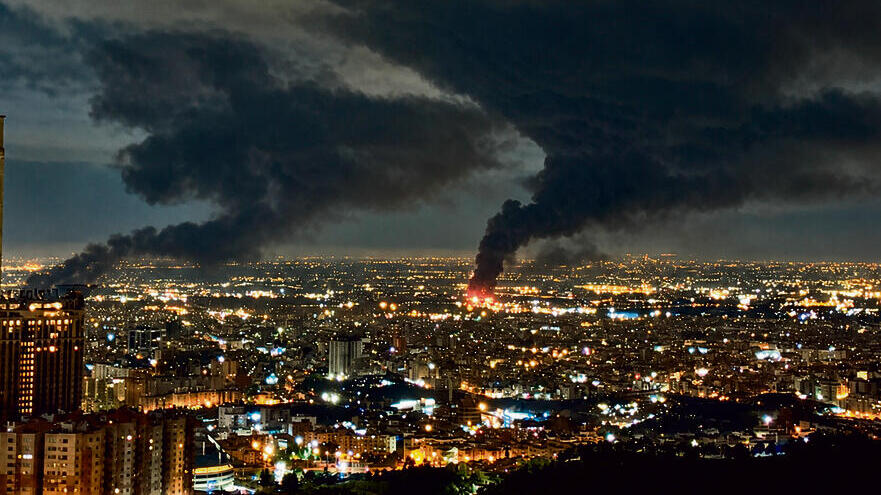
IDF strikes in Tehran
The need to change the attack plan stemmed from developments in the overall Iranian threat that were not widely known to the Israeli public. In 2011, Supreme Leader Ali Khamenei published what the article describes as a plan for Israel’s destruction by 2040 in his book *Palestine*. The plan became known as the “2040 Doctrine.” It envisioned Israel’s elimination in several stages.
The first stage was a campaign of encirclement and attrition carried out through Hezbollah, Hamas, Iraqi militias, the Houthis and Syrian forces, creating a ring of fire around Israel. The second was to make life intolerable for Israeli Jews and create enough fear to drive them back to their countries of origin. In the next stage, Jewish-owned land would pass to Palestinians. Finally, Palestinians would hold a referendum on establishing a Muslim state in place of Israel. His son and successor, Mojtaba Khamenei, reaffirmed the plan and declared that the Tehran regime remained committed to the objective of ensuring that Israel would not continue to exist beyond 2040.
By 2023, Iran had in practice become a nuclear threshold state. It possessed about 440 kilograms of uranium enriched to 60%, from which, according to the assessment presented here, enough material for the cores of roughly 10 nuclear warheads could have been produced within weeks. What made an attack on Iran more urgent was that the elder Khamenei had taken a step he had previously avoided: He authorized Iranian scientists to advance the “weaponization program” intended to turn enriched uranium cores into nuclear weapons.
The Revolutionary Guard was advancing another element of the annihilation plan: the production of thousands of ballistic missiles and drones that could be launched in barrages of dozens or even hundreds at a time. The assessment was that Israeli, American and allied missile defenses would not be able to cope with those numbers, certainly not with interception rates above 80%.
During the initial planning for Operation Rising Lion, American participation in strikes against Iranian targets was not contemplated. At first, Zamir coordinated with then-CENTCOM commander Gen. Michael Kurilla only on defenses against Iranian missiles and drones. People who witnessed the discussions with the Americans came away with the impression that Kurilla did not believe the IDF would be able to neutralize Iran’s air defenses, a prerequisite for the operation’s success.
There was another problem. Israel’s defense establishment concluded that neither the IDF nor Mossad could disable the enormous Fordow uranium enrichment facility, which is buried deep inside a granite mountain, and that only the United States had the capability to do so. But Zamir, who had spent many hours working with Kurilla, believed during the planning stage that if Israel succeeded in neutralizing western Iran’s air defenses, there was a realistic possibility that the United States would agree to attack Fordow.
On June 12, 2025, minutes before Israeli aircraft were due to take off, Zamir asked to speak at the Cabinet meeting convened to authorize the operation. He reminded the ministers of the “annihilation plan,” which Iran and its proxies had already begun putting into practice, and concluded: “Jewish history will not forgive us if we fail in this operation.”
What followed is well known. The strikes in Operation Rising Lion eliminated a significant portion of Iran’s military and security leadership, killed 13 nuclear scientists and struck secret facilities where development and testing connected to nuclear weapons production had been carried out. When the Americans saw that the operation was succeeding, after Israel struck Natanz, facilities in Isfahan and the heavy-water facility at Arak and inflicted severe damage on Iran’s uranium enrichment program, Trump decided to join the campaign, as Zamir had predicted.
The Israeli Air Force cleared the way for American bombers, which then attacked the Fordow enrichment facility and put it out of operation for an extended period. It is important to qualify the result. The 12-day war, or Operation Rising Lion, did not destroy Iran’s nuclear program or missile program. It set them back by several years.
The immediate danger of Iran being able to break out toward a nuclear explosive device within weeks, or field many thousands of ballistic missiles within months, was removed. But Zamir understood that Iran remained dangerous and could rebuild those capabilities within a relatively short period. That, according to the analysis, is why Operation Roaring Lion and full cooperation with the Americans were required: to push Iran’s nuclear, ballistic missile and drone programs back for a much longer period; destroy most of the development and production infrastructure of its defense industries; and weaken the regime, the Revolutionary Guard and the Basij in order to encourage the Iranian public to rise against and overthrow the regime.
After Military Intelligence and the Air Force presented detailed, intelligence-verified results from Operation Roaring Lion, Zamir concluded: “Iran is no longer a nuclear threshold state. We have pushed Khamenei’s annihilation plan back five years.” He added: “There is no precedent for the scale of force employed in Iran by Israel and the Americans.”
The decision to eliminate Iran’s leadership, including Ali Khamenei, drew criticism on the grounds that Israel is now dealing with a regime whose decision-making processes are less orderly, slower and far more extreme and rigid than before. Israeli decision-makers, including Zamir, remain convinced that eliminating the elder Khamenei was necessary because he was the driving force and ideological authority behind the plan to destroy Israel. Mojtaba is more extreme and rigid than his father, they believe, but lacks the same authority and ability to execute policy. They also believe that decapitating the leadership accelerates Israel’s broader objective of bringing down the regime in Tehran.
The green presentation
Zamir places great value on the close operational cooperation and personal relationships he has developed with American commanders. At one point during Operation Roaring Lion, CENTCOM commander Adm. Brad Cooper called Zamir on a secure line and told him that Iran’s closure of the Strait of Hormuz had become a serious problem.
The Revolutionary Guard naval commander responsible for enforcing that closure effectively was Alireza Tangsiri. Cooper asked Zamir whether anything could be done to stop Tangsiri from functioning. He told his Israeli counterpart that Tangsiri was in a multistory building at Bandar Abbas port, but that the United States did not want to bomb the entire port and instead wanted him neutralized in a precision operation. Cooper acknowledged during the call that only Israel had the intelligence and operational capability to carry out such a strike.
A week later, Zamir called Cooper and told him: “Tangsiri is no longer with us.” A precision air-to-ground missile had entered through the window of Tangsiri’s office and killed him.
Overall, Operation Roaring Lion left about 4,530 members of the Revolutionary Guard and about 430 Basij personnel dead. Most components of Iran’s nuclear program, particularly enrichment capabilities, were set back by years. Iran nevertheless retains some capabilities. These include about 440 kilograms of uranium enriched to 60%, hidden at three sites: Isfahan, Fordow and an underground mountain facility near Natanz.
Those locations are under extremely close joint Israeli-American surveillance. If Iran tries to remove the enriched uranium and enrich it further to weapons grade, 90% or higher, Israel and the United States are expected to detect it. Even if Iran succeeded in accessing and processing the enriched uranium it still possesses, the assessment is that it would require about a year to produce an initial nuclear device.
During Operation Rising Lion, Israel struck around 100 components of Iran’s military industry connected to missile production. Operation Roaring Lion struck another 2,600 sites and production facilities, including plants producing solid rocket fuel. Iran launched around 1,000 drones at Israel. None penetrated Israeli defenses.
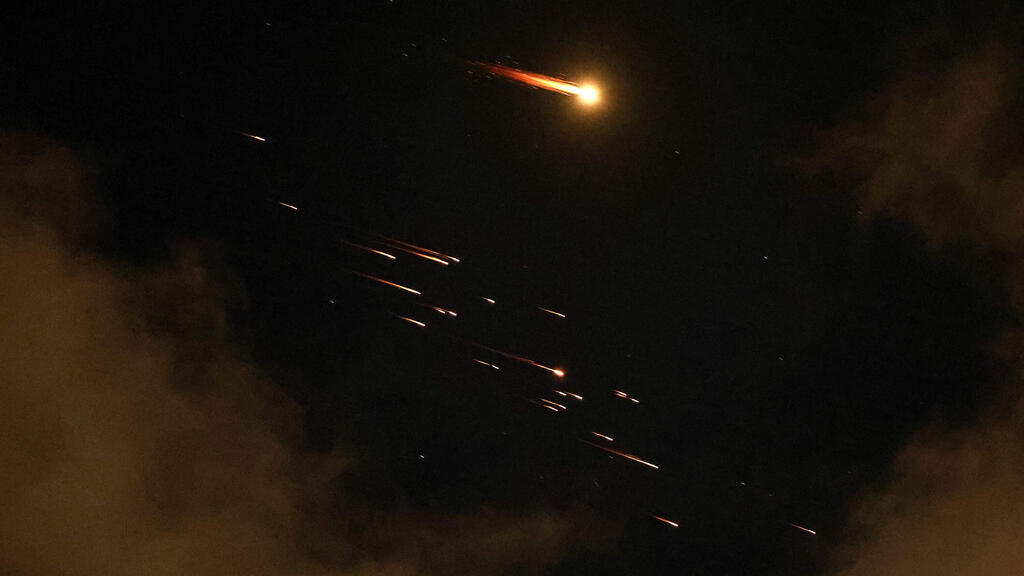
Iranian missile fired at Israel
(Photo: Jack Guez/AFP)
“The Iranians wanted to reach 4,000 missiles by the end of 2026 and 8,000 by 2027. They won’t get there,” said a senior defense official familiar with the figures. Assessments indicate that Iran had around 1,600 ballistic missiles remaining after Operation Roaring Lion. Most are stored in tunnels, some of which remain blocked while others have been reopened. Of roughly 400 launchers, fewer than 200 remain. But the same official warned that if Iran is left undisturbed, it could reach its target of 4,000 ballistic missiles in about two years.
The Intelligence Directorate has developed a system that examines in detail which components of Iran’s nuclear, missile, command-and-control and military-industrial systems were struck, and the extent of the damage. The findings were converted into a presentation dominated by the color green, indicating systems assessed as completely destroyed.
Iran’s military-industrial capabilities, including its production and development capacity, are clearly no longer what they were. Its optics industry, for example, was completely destroyed, while significant parts of the steel and petrochemical industries were damaged. Zamir is nevertheless the first to acknowledge that Iranian missiles still pose a threat and could become an even greater danger in the future. Continued Israeli-American efforts in this area will therefore be necessary.
Quietly and deliberately
Zamir has continued developing the new security doctrine that emerged within the IDF after Oct. 7. Its key elements are forward defense at Israel’s borders and preventive action. Under this approach, whenever the IDF identifies an emerging threat, large or small, whether in an adversary’s intentions or capabilities, it acts without delay. Instead of containing the threat, it seeks to destroy it while it is still developing whenever possible.
As a result of that strategy, IDF forces are now positioned well beyond Israel’s borders in Gaza, Lebanon and Syria. The number of forces assigned to border defense is 300% greater than it was on Oct. 6, 2023. On the morning of the Oct. 7 attack, the IDF had 38 battalions deployed along the borders and in the West Bank. Today it has 89, including 39 reserve battalions.
The operational model for defending the borders has also been adjusted to reflect the new doctrine. In Lebanon, for example, the military uses forward defense, prevention and deterrence. Forward defense is implemented through security zones and military positions on commanding terrain that provide both observation and fields of fire from well beyond anti-tank missile range. Within those zones, the IDF destroys buildings, bunkers and tunnels that Hezbollah could use if it returned to the area. On prevention and deterrence, the IDF responds with fire not only to Hezbollah military activity but also when it receives intelligence that such activity is being planned.
The operation on the Ali Taher Ridge was in a category of its own. Hezbollah, working with the Revolutionary Guard’s Quds Force, excavated at least two enormous underground complexes beneath the ridge, possibly more. They housed command centers, logistics facilities and heavy weapons belonging to Hezbollah’s principal operational region facing Israel, known as Badr, an organizational formation roughly comparable to an Israeli military command.
After the Second Lebanon War, the area became Hezbollah’s central operational hub, and the war of recent years was directed from there. The IDF, however, lacked sufficient intelligence, including the locations of the tunnel shafts, and did not know whether Iranians were present underground.
What was clear was that the facility was very large, had been excavated with Iranian assistance and was regarded by Hezbollah and its Iranian patrons as a major symbol, a strategic military asset and an investment whose destruction would inflict both a military and psychological blow. They viewed it as a kind of “Karbala” battle for the Shiite movement. Hezbollah sought to deter Israel from destroying the tunnels by threatening renewed Iranian missile barrages, but the IDF was not deterred.
The Americans prohibited Israel from taking action that would trigger a major Hezbollah response, and Israel itself did not want renewed fighting with either Iran or Hezbollah. Israel gave the militants barricaded inside an opportunity to leave under a white flag. When they did not emerge, a quiet battle began under a complete media blackout.
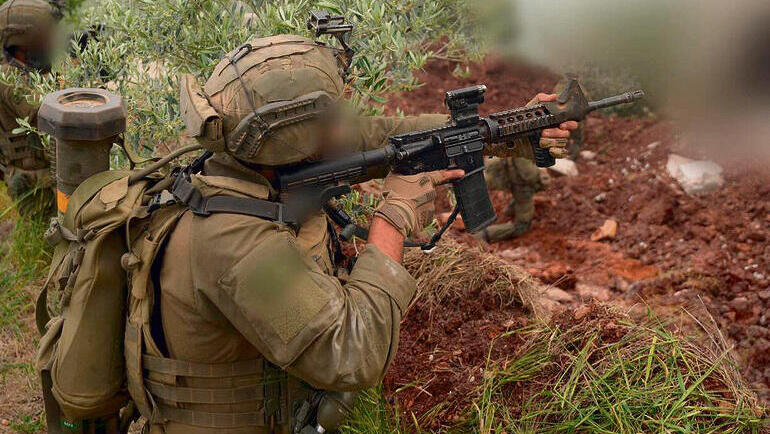
IDF troops in Lebanon
(Photo: IDF)
Zamir held an operational assessment almost every evening. He focused on two central constraints: the political leadership’s instruction not to cause an escalation and, above all, the safety of Israeli troops. The operation continued for months, cautiously and methodically, without abandoning its objectives, until the ridge was destroyed. Zamir, a graduate of Israel’s military boarding school, followed its motto: “Quietly and securely.”
Zamir is aware that Israeli national psychology has changed since Oct. 7. At a General Staff meeting about two weeks ago, he was heard saying: “We cannot afford even one terrorist attack.”
He added: “I don’t want the security situation to affect either what happens during the holidays or the course or outcome of the elections. The IDF cannot afford to let even one attack through, and we need to respond quickly to every attack or attempted attack.”
Later, Zamir believes it will be possible to reduce the burden on reservists, both through more selective call-ups and by releasing reserve formations. Two divisions are currently operating in Gaza, one active-duty and one reserve division. After the elections, Zamir intends to withdraw the reserve division.
If the political leadership approves, he also intends to reduce the size of the security zones and the number of IDF positions in Lebanon, both to save reserve manpower and money and to strengthen the current Lebanese government politically in its confrontation with Hezbollah. The IDF would then be able to prepare properly for what Zamir expects could eventually become the decisive confrontation with Iran.
The underlying security doctrine, however, will remain unchanged. “I don’t want to defend from the border line,” Zamir says. “I want to defend from forward positions as long as there is no diplomatic arrangement.”
In other words, the IDF’s approach is to place its forces between the enemy and Israeli civilians living near the border by operating inside enemy territory. In Zamir’s view, the military is currently not large enough to perform that mission on the required scale.
The IDF has established another division and another tank brigade, rebuilt armored formations and created numerous additional combat units. All require personnel. That brings the issue back to the draft of Haredi, or ultra-Orthodox, men.
It is one of the issues that has caused the current government to view Zamir with hostility. Zamir has repeatedly stressed that during wartime the IDF urgently needs more troops, especially active-duty combat soldiers. In practice, his position helped derail legislation that would have regulated the Haredi draft, a bill that IDF officials openly refer to as the “draft-evasion law.”
Zamir did not merely demand the enlistment of eligible Haredi men. He also devoted substantial time and effort to establishing dedicated frameworks that would allow them to serve while maintaining a Torah-observant lifestyle. That undercut arguments by Haredi politicians that the military neither needed nor genuinely wanted Haredi recruits.
At the same time, the issue of recruiting Haredi and more hard-line national-religious soldiers has placed Zamir in a difficult position. On one hand, he is demanding Haredi enlistment and creating specialized frameworks for Haredi recruits and students from hesder yeshivas, arrangements that in practice exclude women from some settings. At the same time, he is fighting growing religious radicalization among some soldiers from those communities.
One example involved Givati Brigade soldiers who refused to go on an operational mission because a female paramedic would be riding with them inside a Namer armored personnel carrier. Zamir ordered the soldiers who refused the command jailed, but it was not an isolated case.
It followed a controversy over “Messiah” patches that Zamir ordered soldiers to remove from their uniforms, and an incident in which an IDF soldier smashed the head of a statue of Jesus in Lebanon. Zamir instructed field commanders, not all of whom agreed with him, to enforce operational discipline. His concern was not only that highly publicized signs of religious radicalization were damaging the IDF’s already eroding international legitimacy, but more importantly that soldiers could begin dividing their loyalty between military commanders and civilian rabbis whom religious troops consulted.
This is only one area of military-society relations in which Zamir is trying to enforce the principle of institutional, nonpartisan service expected of the IDF as Israel’s national military.
A dismissal announced on live television
Relations with the political leadership are a separate issue. When the defense minister and prime minister offered Zamir the position of chief of staff, he promised to establish a committee to reexamine the IDF’s Oct. 7 investigations conducted under Halevi.
Even while serving as Defense Ministry director general, Zamir had doubts about the quality of some of those military inquiries and therefore wanted to establish a review committee. It is also reasonable to assume that he understood Katz personally wanted such a review because it could reinforce the argument that senior IDF officers, particularly Military Intelligence, bore responsibility for the Oct. 7 failures rather than the political leadership.
Zamir was also asked to ensure that the small number of brigadier generals and major generals who had remained in senior positions after Oct. 7 leave their posts, among them then-IDF spokesman Daniel Hagari. If Zamir thought those steps would satisfy the political leadership, he was mistaken.
It was not long before Katz began trying to dictate the appointment and removal of officers at the ranks of major general and brigadier general. IDF appointments fall under the chief of staff’s authority, although for senior officers from colonel upward, the chief recommends candidates and the defense minister formally approves them.
Katz used that authority in an attempt to advance appointments of his own, following the pattern of other government ministers who sought to place political allies in senior executive jobs even when, according to the article’s assessment, they lacked the appropriate qualifications, provided they would be politically indebted to those who appointed them.
The latest case came when Katz announced live on Channel 14 that Maj. Gen. Dado Bar Kalifa, head of the IDF Personnel Directorate, would become the next commander of Central Command. The current Central Command chief, Maj. Gen. Avi Bluth, himself religiously observant and a graduate of the Eli pre-military academy, was considered too institutionally independent by extremist settlers, many of whom vote in Likud primaries and could have affected Katz’s political future had he not eventually been guaranteed a place on the party slate.
The announcement effectively amounted to the public dismissal of a serving Central Command chief, made without coordination with the chief of staff. Zamir had in fact decided to appoint Bar Kalifa to the position, but only after Bluth completed his term as planned.
Zamir regarded Katz’s announcement, with justification in the author’s assessment, as a blatant circumvention of his authority. He nevertheless avoided a public response that would have drawn him into an unproductive media confrontation with the defense minister.
People close to Zamir describe him as stubborn and highly protective of his authority, but also calm and experienced in dealing with hostile politicians. Several hours after Katz’s Channel 14 statement, the IDF Spokesperson’s Unit issued a statement on Zamir’s behalf saying there would be no new senior appointments before 2027. In other words, Katz’s timetable would not happen.
At General Staff meetings and other forums, Zamir has made clear that he will not allow political leaders to make or influence appointments inside the military and that IDF officers serve the people of Israel, not the Likud Central Committee.
Another tactic used by right-wing ministers against Zamir and senior commanders who insist on operational discipline and refuse to give religious soldiers special treatment is to draw a distinction, on social media and in closed discussions, between a supposedly “weak, left-wing” senior command and troops in the field, who are portrayed as uniformly heroic and eager for battle.
That happened, for example, when right-wing ministers demanded a rapid operation to capture Gaza City and take over the entire Strip, arguing that this was the only way to free all the hostages. According to the analysis, it was clear that behind the demand was a political-messianic agenda aimed at renewing Jewish settlement in Gaza.
Zamir opposed a rapid assault. He argued that storming Gaza City and its surrounding areas would lead to the deaths of most of the living hostages, cost many soldiers their lives and might still fail to achieve its objectives. Instead, he presented an alternative plan based on slower but painful military pressure on Hamas. That plan was ultimately implemented and, in his view, produced precisely the desired result.
That did not stop Cabinet ministers from telling journalists willing to listen that Zamir was “not offensive enough.” Asked to respond to that accusation, Zamir said: “I will not risk even one soldier in order to carry out a military operation that serves political objectives, and I will not accept political appointments inside the military.”
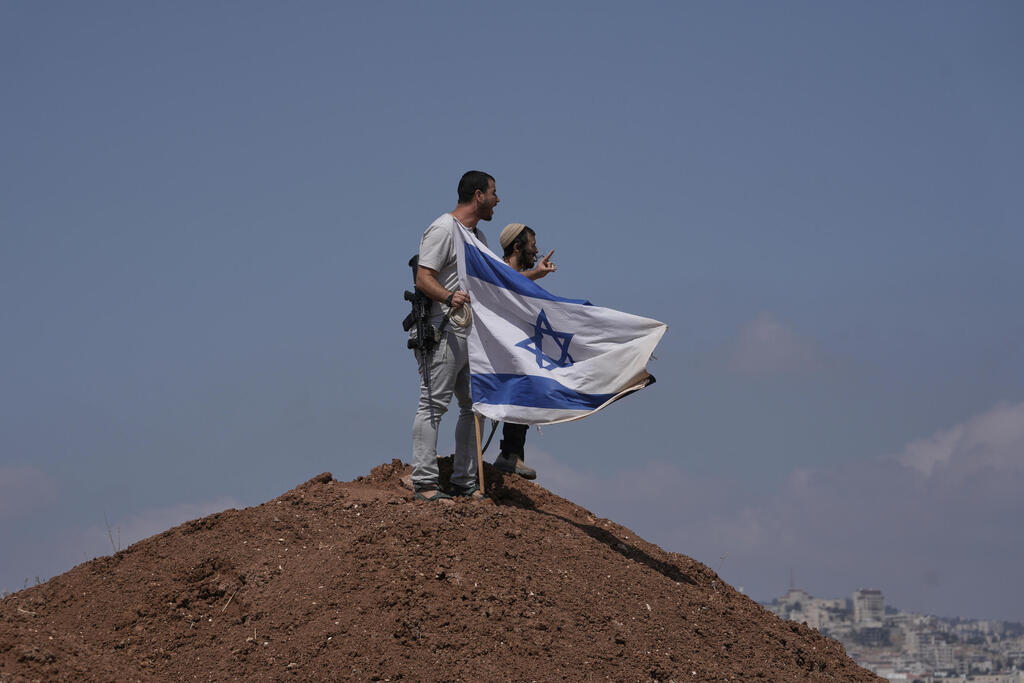
Settlers on a hill near Beit Sahour with an Israeli flag
(Photo: AP Photo/Mahmoud Illean)
Zamir also faces criticism from Israel’s center-left opposition. Critics there argue that the IDF has lost control and is failing to do what is necessary to stop what they describe as ethnic cleansing by violent Jewish extremists in the West Bank.
In their view, Zamir is facilitating illegal and immoral political moves, damaging what remains of Israel’s diplomatic and military legitimacy internationally and potentially helping trigger a Palestinian intifada.
In private conversations, Zamir responds by pointing to the factors he says have tied both his hands and those of the IDF and prevented the military from properly dealing with Jewish extremists and terrorism. The most important factor is the shortage of combat troops.
During the current Jewish holiday period and on the eve of Israel’s elections, 26 combat battalions are deployed in the West Bank, with preventing Palestinian terrorism as their primary mission. They are not trained for policing. The result is that the IDF presence at the growing number of confrontation points is too thin to stop violent incidents from escalating.
The situation becomes even more complicated when the reservists responding to an incident belong to local territorial-defense units, known in Hebrew as HAGMAR, meaning they themselves are settlers living on the farms or in the communities from which the provocateurs came. On Zamir’s orders, most reservists serving in those West Bank territorial-defense formations, who had been receiving substantial pay for their service, were recently released.
The government has also imposed three measures that have sharply restricted the IDF’s ability to deal with illegal farms, outposts and Israeli lawbreakers. Under the coalition agreement, authority over the Civil Administration in the West Bank was transferred to Smotrich, who also serves as a minister within the Defense Ministry.
Katz, meanwhile, stripped the Central Command chief of the authority to issue administrative detention orders against Israeli lawbreakers in the territories. Katz and Smotrich have also prevented the military from dismantling outposts or farms built without authorization on the grounds that they are in the process of receiving government approval.
The government has therefore, in practice, severely restricted the IDF’s ability to enforce the law against Israeli civilians in the West Bank. Zamir was recently heard saying: “If there is one thing that frustrates me, it is this.”
A growing pressure point
Having learned from Halevi’s difficult experience with Netanyahu, Zamir has recently warned the prime minister and Cabinet several times, both orally and in writing, that the Jewish holiday period and the run-up to the elections are volatile and dangerous across almost every front, particularly Iran, the West Bank, Lebanon and the threat of attacks abroad.
The greatest immediate danger, in his assessment, comes from the West Bank. Palestinian tensions are already high because of the weakness of Palestinian Authority President Mahmoud Abbas and his security apparatus, worsening economic conditions, uncertainty over whether Palestinian elections will take place in November, and incitement by Hamas and Palestinian Islamic Jihad with Turkish backing.
But tensions are currently being driven above all, according to the analysis, by increasingly frequent and violent attacks by Jewish extremists, provocative incursions by Jews into Palestinian villages, and farms and outposts being established almost every week in Areas A and B of the West Bank, often on privately owned land.
Three escalation scenarios in the West Bank are currently of particular concern to Zamir. The first is an especially deadly Palestinian attack that inflames both sides and triggers violent confrontations across the West Bank. Zamir refers to such an incident as a “strategic attack.”
The second is what the IDF calls a “turning of the guns” scenario, in which Palestinian Authority security forces use their weapons against Jewish extremists and against the IDF. The third is widespread Palestinian unrest escalating into attacks on Jewish settlements and outposts.
Any one of those scenarios, or a combination of them, would likely develop into a large-scale intifada that could spread into Israel itself. Much of Zamir’s attention is therefore focused on preparing the IDF for the possibility of an eruption without warning on one or more volatile fronts, with particular emphasis on rapidly containing escalation in the West Bank.
Zamir does not say so explicitly, but he appears convinced that the IDF under his command has delivered results and has already significantly improved Israel’s national security position. His message now is that it is the politicians’ turn.
Before or after elections in Israel and the United States, he believes political leaders must close at least some of the open fronts and translate the IDF’s operational achievements in Lebanon, Gaza, Syria and the West Bank into durable security arrangements.
Scale of the damage to Iran
* Iran had aimed for 4,000 ballistic missiles by the end of 2026 and 8,000 by the end of 2027; assessments say it now has about 1,600 missiles remaining
* Of roughly 400 launchers, 200 were destroyed
* The nuclear program was set back by years, but Iran still has about 440 kilograms of uranium enriched to 60%
* About 4,530 Revolutionary Guard personnel and 430 Basij members were killed during Operation Roaring Lion
* Some 2,600 sites and production facilities belonging to Iran’s defense industry were hit
Scale of the damage to Hezbollah
* Between 7,000 and 9,000 Hezbollah operatives have been killed since Oct. 7
* During Operation Roaring Lion, the Radwan Force lost about 30% of its personnel, killed or wounded
* The security zone controlled by the IDF covers more than 7% of Lebanon’s territory; hundreds of thousands of people have been displaced from their homes
* Hezbollah’s rocket and missile inventories have been reduced by about 60% for Katyusha rockets, 80% for medium-range rockets and 65% for long-range missiles
Scale of the damage to Hamas
* About 67% of the Gaza Strip is under IDF control, with 42 military positions maintained there
* About 80% of Hamas tunnels have been destroyed or neutralized
* Hamas and other armed groups have lost about 98% of their indirect-fire weapons inventory
* The weapons stocks of Hamas’ territorial battalions have been reduced by about 50%
* About 35% of Hamas’ Nukhba forces have been killed since the start of the campaign