


The most serious act committed by Maj. Gen. Yifat Tomer-Yerushalmi, the Military Advocate General, and her subordinates was, allegedly, lying to the High Court of Justice. Although the matter remains under police investigation and must therefore be referred to as alleged, the facts already verified show that military prosecutors, with Tomer-Yerushalmi’s approval, submitted an official statement to the court claiming they were unable to identify who leaked the edited security-camera footage from the Sde Teiman detention facility. That statement was—and remains—a complete falsehood.
Lying to the High Court is a criminal act that, if proven, must lead to prosecution of senior officers—the top echelon of the military justice system—and, if convicted, punishment accordingly.
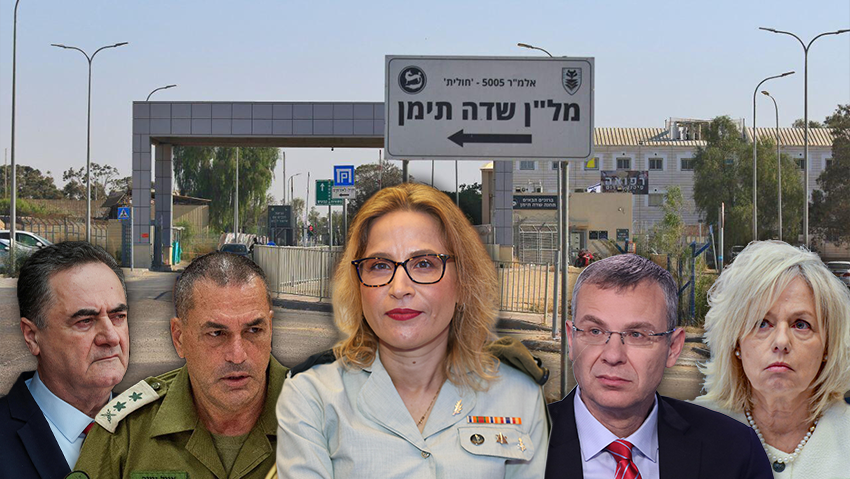
(Photo: Meir Even Haim, Rafi Kutz, Avi Moalem, Abigail Uzi, IDF Spokesperson’s Unit, Reuters/Ronen Zvulun)
But the real damage is far broader. The revelation that those tasked with upholding the law leaked investigative materials and then misled the High Court has already caused a deep erosion of public trust in the military justice system in particular, and in Israel’s judiciary in general. At a time when Israel’s law-enforcement leadership is fighting to maintain its independence in the face of political assault, the “Tomer-Yerushalmi affair” strikes a severe blow to the rule of law from which it will be difficult to recover.
The scandal has also harmed Israel internationally. The exposure of the brutal abuse of a Hamas detainee from Gaza at the Sde Teiman detention site dealt a heavy blow not only to Israel’s image but also to its legitimacy and that of the Israel Defense Forces. It is important to note that the video leaked by the Military Advocate General’s Office was not what first brought the case to light. The abuse was uncovered only because of the brutality of the reservist guards from Unit 100.
According to the indictment, they injured the detainee all over his body, including in an intimate area so severely that he had to be hospitalized in a civilian facility. From there, reports spread on social media—some claiming the detainee had been raped—before being picked up by Israeli and international media. By the time the Military Advocate General’s Office, under Tomer-Yerushalmi’s orders, launched an investigation, the abuse was already public knowledge.
The video she later authorized to leak was intended to counter right-wing activists and politicians who accused prosecutors of fabricating a “blood libel.”
When examining the “blood libel” claim—which Defense Minister Israel Katz is now among those promoting—it becomes clear that it rests on the allegation that the detainee was raped by the guards. That accusation surfaced in the media even before the investigation began. The probe by military prosecutors ultimately found that while the detainee had been stabbed with a sharp object near the rectum, there was insufficient legal evidence to define the act as rape. The indictment against the five reservists therefore does not include a rape charge, though the assault itself was documented by the facility’s security cameras.
To portray this as a fabricated “antisemitic blood libel,” as some on the right claim, is false. The Military Advocate General’s Office opened the investigation and filed charges based on real, documented abuse.
The exposure of the leak and the false statement to the High Court by those entrusted with the law has already gravely undermined public confidence in the justice system. In a period when law-enforcement officials must defend their ability to perform their duties, the “Tomer-Yerushalmi affair” delivers a blow from which they may not recover.
The “blood libel” narrative is a fake story pushed by elements of the extreme religious-nationalist right to pressure military prosecutors and judges not to fully pursue the case against the five defendants. These same elements had already waged an aggressive smear campaign against Tomer-Yerushalmi, accusing her of “tying the hands” of soldiers in the field and endangering their lives.
The political and psychological pressure fueled by this campaign—similar to that now directed at the attorney general—placed a heavy burden on Tomer-Yerushalmi and, it appears, clouded her judgment and that of several senior aides. Unlike the attorney general, she succumbed to the pressure and made a critical mistake when she approved the leak of parts of the video to prove prosecutors had not invented a “blood libel.” That error escalated into an alleged criminal act when her office lied to the High Court.
This affair is far from over, but it already reflects a troubling trend that has taken root in Israel’s public life over the past three years: the politicization of the military. In simple terms, partisan and ideological politics are increasingly influencing decision-making and operations at all levels of the army—from the General Staff to field commanders.
Examples abound: the prime minister’s rejection of the General Staff’s recommendations on operational methods; the coordinated effort by the prime minister and his ministers immediately after Oct. 7 to deflect blame for the massacre onto the IDF and the Shin Bet; and Defense Minister Israel Katz’s recurring public humiliation of the chief of staff and senior generals by delaying appointments of officers deemed “not from our camp.” Katz’s political considerations, particularly his primary campaign, now seem to shape how he uses—or abuses—his authority over the military.
On the ground, politicization is evident in the behavior of some reservists in territorial defense units in the West Bank, who often stand by as extremist settlers—so-called “Hilltop Youth”—attack Palestinian residents, and at times even join in, armed with IDF weapons. The permissive attitude of the police under National Security Minister Itamar Ben-Gvir and the protection offered by Katz and Finance Minister Bezalel Smotrich have created near-total impunity. This lawlessness is eroding what little legitimacy Israel still has in Europe and North America.
I am not naïve. Political interference in military affairs existed even before Israel’s founding. David Ben-Gurion himself intervened, but he did so in the name of statehood—to prevent civil strife and strengthen national security. The Altalena affair and the dismantling of the Palmach were not political maneuvers to ensure his survival or boost his party.
Successive prime ministers, including those from the right, adhered to that state-oriented ethos, understanding that solidarity and motivation across ideological lines are the foundation of Israel’s defense.
The current government’s politicization of the army is dangerous because it leads senior officers to make strategic and systemic decisions that are not professional, encourages field insubordination by soldiers who believe they enjoy political backing, and—most alarmingly—undermines morale among regular and reserve troops aligned with Israel’s liberal mainstream.
This could eventually result in widespread refusal to serve—or even emigration.
None of this excuses Tomer-Yerushalmi or her subordinates. They are not political victims and should not receive leniency. But under the crushing weight of political bullying, other weak links in the chain may yet break—and that could cost Israel both blood and legitimacy.