

At the center of Israel’s diplomatic and security agenda are significant developments in two arenas. In Gaza, the second phase of the plan initiated by the U.S. president has begun. In Iran, a waiting phase is underway, marked by uncertainty about the future of the protest movement and President Trump’s policy.
In both arenas, Israel’s ability to shape events is limited. I therefore propose initiating a diplomatic move in another arena, the Syrian arena, with the aim of swiftly reaching a comprehensive security agreement between Israel and Syria.
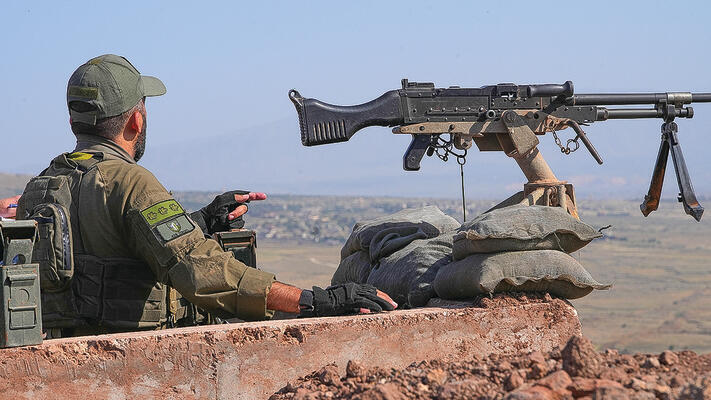
(Photo: Efi Sharir)
The previous agreement with Syria, the 1974 Disengagement of Forces Agreement signed after the Yom Kippur War, held for 50 years, longer than any other agreement with an Arab state, despite numerous challenges to its validity. The collapse of Bashar Assad’s regime in December 2024 effectively brought that agreement to an end. Acting under political direction, the IDF launched Operation Arrow of Bashan, moved quickly and decisively and took control of areas adjacent to the Syrian border with the Golan Heights, including the summit of Mount Hermon. At the same time, Israel carried out extensive strikes across Syria to destroy weapons stockpiles of strategic importance and prevent their capture by the new regime.
Since then, Israel has sought to advance two ambitious diplomatic goals on its northern front. One is to leverage the ceasefire agreement signed in November 2024 to promote Lebanon’s entry into a process of normalization and peace. The other, in Syria, is to pursue a two-stage process, beginning with the regulation of security conditions along the shared border and culminating in Syria’s joining the Abraham Accords.
Without vigorous American involvement, progress on either track is impossible. Indeed, the U.S. president appointed his ambassador to Turkey, Tom Barrack, as his personal envoy to advance this vision. Ambassador Barrack has shown diligence and initiative and invested considerable effort, with Minister Ron Dermer working closely with him to help resolve disputes with both Lebanon and Syria. At this stage, however, the bottom-line points to a complex picture.
In Lebanon, President Michel Aoun appears to be a leader committed to his country’s future rather than to foreign interests, primarily Iranian ones, that brought it to the brink of ruin. Yet despite his good intentions, Aoun has failed in his efforts to implement the core clause of the agreement signed with Israel: the disarmament of Hezbollah throughout Lebanon. There are many reasons for this, chief among them the fundamental weakness of the Lebanese army and the fear of Aoun and his government of sliding into civil war. Hezbollah did suffer severe blows during the year of fighting with Israel, reflected in its decision to refrain from responding to hundreds of targeted killings and powerful strikes carried out by Israel as part of its policy of enforcing violations of the agreement with fire. Still, the Shiite terror organization, thanks to its clear military superiority, deters its rivals from undertaking diplomatic moves that would break new ground.
The result is that there has been no practical progress in the U.S.-led trilateral dialogue on disputed issues along the Israel-Lebanon border. Israel has made clear that its forward defensive deployment in southern Lebanon will not change as long as Hezbollah poses a threat to residents of the north. Escalation now appears more realistic than the achievement of understandings.
In my view, the Syrian track appears more promising
For some time, as reported, there has been ongoing diplomatic dialogue between Israel and the new regime in Syria. I had the opportunity to take part and was impressed that the shared interests outweigh the points of division. Ahmad al-Sharaa, Syria’s president, has tied his country’s fate to the United States and the West. In the Arab world, he is aligned with the moderate Sunni axis led by Saudi Arabia. The current Syrian leadership’s hostility toward Iran and Hezbollah is deep and genuine. In my intimate dialogue with senior Syrian officials, I became convinced that practical solutions can be found for each of the principles Israel must insist on. There are three: our commitment to protect members of the Druze community living near our border with Syria; the need to prevent the deployment of state forces hostile to Israel in areas that threaten our freedom of action in distant arenas; and ensuring the demilitarization of southern Syria as part of the defense concept for the communities of the Golan Heights.
As part of my mission as head of the National Security Council, I held a series of discreet meetings on Syria. Israel’s primary concern is that Syria could become a proxy state on our northern border. Given the inflammatory rhetoric of Turkish President Recep Tayyip Erdogan, this is not an unfounded fear. Still, the most effective way to thwart such a scenario is to maximize the benefits Syria stands to gain from linking up with President Trump’s Middle East peace initiative and from cooperation with Israel. This has been, and remains, the American strategy. Yet the White House did not demand any quid pro quo for its support of the new regime. Trump met with al-Sharaa through Saudi mediation and lifted sanctions that had paralyzed Syria’s economy. In the absence of American leverage, the challenge of finding a balance point between Israeli and Syrian interests has become more difficult. Difficult, but possible.
Syria does not raise the issue of Israeli sovereignty over the Golan Heights in the context of border security arrangements, both because there is no chance of change on this issue and because the Trump administration supports that sovereignty without reservation. But in negotiations over new security arrangements, it is likely that the Syrians will demand an Israeli withdrawal from the new areas in which the IDF deployed for defense in late 2024. The solution can be based on identifying an optimal balance point between an Israeli presence on Syrian territory and the actual implementation of measures that ensure Israel’s vital security interests. Determined, continuous and effective action by Syrian regime forces to eradicate the activity of Iran, Hezbollah, Hamas and Islamic Jihad throughout Syria, alongside the complete demilitarization of the area south of Damascus, would expand Israel’s room for flexibility.
 Tzachi HanegbiPhoto: Dana Kopel
The government has defined the IDF’s hold on areas adjacent to the border as a temporary measure intended to safeguard vital security interests. If those interests are preserved, the door opens to creative understandings. In the peace agreement with Egypt, Israel insisted that withdrawal from the Sinai Peninsula be spread over three years, during which Egypt was required to implement substantive provisions of the agreement, such as the establishment of full diplomatic relations and an exchange of ambassadors. This is a model that proved itself and can be discussed in the dialogue with the United States and Syria.
In conclusion, the goal of “Syria first” can be placed at the forefront of Israel’s diplomatic efforts. Time is of the essence. We have entered an election year, and political considerations will gather momentum as we move forward and overshadow substantive ones. An open arena can be closed, and success there would serve as a positive lever in the other arenas.