


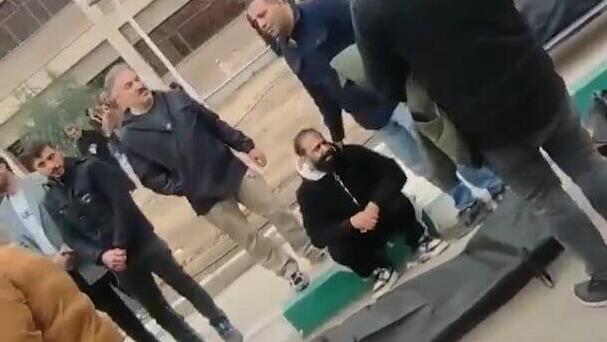
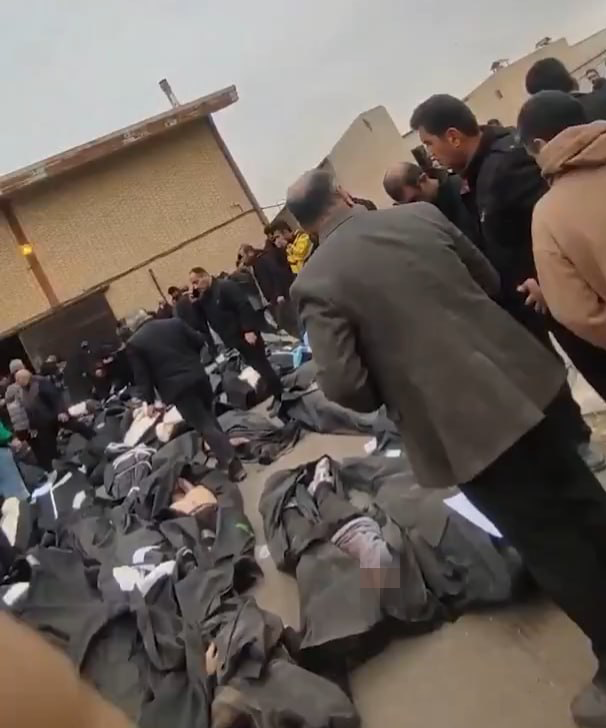
This video should have shaken the foundations — worldwide, in foreign ministries, at the United Nations, across the global media. Of all the documentation that has emerged from the struggles against the Islamic Republic, there is no video as incriminating as this one. Six-plus terrifying minutes, horrifying and shocking: a morgue on the outskirts of Tehran. Its parking lot. The cameraman walks with his cellphone, filming continuously. All that is visible are bodies wrapped in black plastic and the sounds of wailing — of women and men. One or two people, usually, beside each body. It is hard to count them. They are everywhere. Among them move people, usually men, searching for the bodies of their loved ones.
This video from Iran should have shocked the world


This is not a war, and not an ethnic or religious conflict. These are civilians shot by the regime — by the Basij militia, the police, perhaps the Revolutionary Guards. The video shows people clustering near a truck that carried bodies. Near a large hall whose floor is smeared with blood. Beside another hall, at whose entrance dozens of bodies lie. Then a road, another road, the twists of the parking lot and neglected sidewalks, and people with terror-stricken, lost looks in their eyes.
Inside a room, images of the dead are projected on a screen, and people stand searching for their dead. It is impossible to see this and not think about this monster, the Islamic Republic — about how killing its own citizens is a recurring matter, one attempted uprising after another. In one place it was reported that to release a body, the authorities demand thousands of dollars — “the cost of the damage.” You crushed and ruled, you murdered and inherited.
Is what we are seeing in Iran a revolution? What we are seeing is a beginning. Revolutions are rare — far more rare than commonly assumed. They are often confused with coups, regime changes, internal liberalization or what were once called “velvet revolutions.” These are not revolutions. A coup replaces rulers with others; reform reorganizes centers of power; even social collapse can leave elites intact. A revolution does something far more radical: it eliminates an entire ruling class and replaces it with another. That is why revolutions are so rare — and why they are almost always flooded with blood.
In modern history, true revolutions appear late and in only a few cases: the French Revolution, the slave revolt in Haiti, the Russian Revolution of 1917. Their decisive feature is not protest or upheaval, but social inversion. Those who ruled do not merely fall — they are pushed to the bottom. State terror is not a deviation from revolution. It is a governing tool.
The Iranian Revolution of 1979 fits this pattern, and few remember it. The new Islamic Republic executed thousands of real and imagined enemies — former officials, political rivals, leftists and opponents — to ensure that no alternative elite could arise. The revolution’s secular allies were eliminated. The greatest revolutionary, Hannah Arendt wrote, becomes the greatest conservative after seizing power. In the case of the Islamic Republic — a murderer, of course.
Masses of protesters in the streets are not enough for a revolution. An impossible economic and social situation is not enough for a revolution. Even a regime that barely functions as a state will not fall on its own. Revolutions require something far more difficult and rare: the ability to turn popular energy into an alternative power. Arendt wrote: “Revolutions are not made by revolutionaries. Revolutionaries are those who know when power lies in the street and when it can be picked up. Armed uprising by itself has never led to a revolution.”
Demonstrations in Tehran
In other words, two things must happen. First, the regime must struggle to order violent repression. The images and videos from Iran are disturbing not only because of the loss of life, but because they show that the rule of the ayatollahs and their aides enjoys the backing of the security forces. It orders killing — and they kill. As long as this is the case, it is hard to see a revolution. What could develop is a civil war, and even that would occur only if the army — which is not the Revolutionary Guards and whose standing has risen in recent years — were to split. There is no intelligence indicating this.
The second condition is that street power be converted into governing power. Otherwise, it will dissipate. Slogans will not help here. Revolution is a profession that requires discipline.
This point is illustrated well by a small detail from Vladimir Ilyich Lenin’s journey back to Russia in 1917, when he returned by train under the auspices of Kaiser Germany. “The Germans conveyed Lenin in a sealed train from Switzerland to Russia, like a plague bacillus,” Winston Churchill wrote. Lenin was on the most important journey of his life, and he was intensely focused. His Bolshevik comrades were wilder than he was. They wanted to smoke. He forbade it. They played and drank; he demanded early bedtimes. Because Lenin banned smoking, they smoked in the toilets. Lenin’s solution, according to one biography, was to issue tickets: second-class tickets for those who wanted to smoke, first-class tickets for those who wanted to use the toilet. This is what Lenin was doing days before taking over Russia. A demonstration of what? That he was, first and foremost, a supreme organizer, a marshal of power, an artist of control. A revolutionary.
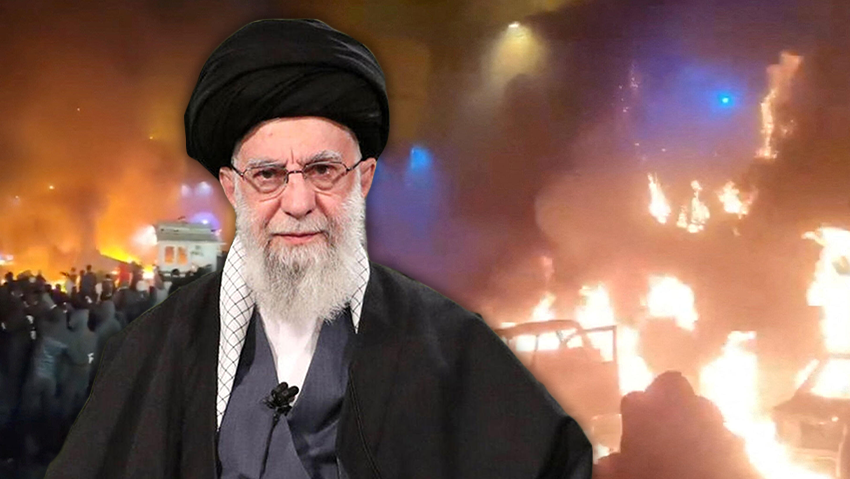
(Photo: Social Media/via REUTERS, AFP/HO/KHAMENEI.IR)
And the question is: who are these people right now in Tehran? Because without such a group, there is no revolution. What could happen — and this is in fact a standing assessment of Western intelligence services — is a kind of internal putsch. For example, one that turns the supreme leader into a “symbol” and seizes military control of the state. Anyone who wants to know the state of opposition to the Iranian regime should look at three indicators: the number of people in the streets, the degree to which the security forces obey orders to slaughter them, and the growth of an organized revolutionary core capable of seizing power. Only one of the three — the street protests — currently exists in full. But as noted, that does not rule out another kind of change — first and foremost, the transformation of Iran from a theocratic dictatorship into a military dictatorship.
One more thing: all the theories of revolution presented here were developed in a world without mobile phones, without the rapid movement of ideas and messages. What once took a year in the old world can take half a day in today’s Tehran. And the question of questions: what would American intervention bring about? Before that, one must ask: what is “intervention”? If intervention means a one-time, symbolic strike against regime symbols, or even an attack on Revolutionary Guards bases, that is one thing. A tailwind for the protesters? Certainly. The entire notion of “not giving the impression of foreign intervention” has long been considered anachronistic. The protest in Iran yearns for a precise American strike. But would it be effective if it is relatively one-off? Not necessarily.
And what about repeated strikes? The American administration is committed to an ethos that opposes foreign wars. It is doubtful that President Donald Trump would want to declare war on Iran and be drawn into it. What is clear is that Israel must prepare for the possibility of a counterstrike — against it.
The Iranian regime is convinced that everything unfolding across the country is the product of a grand Western plot, directed by Israel and the Mossad, in cooperation with the United States — an extraordinary influence campaign, including activity on the ground (and as has been said in Iran for a hundred years: “and the British are in on it, too!”). The implication is that a direct blow to regime symbols could indeed provoke retaliation against the State of Israel. One can hope that preparations are being made for that.