

The latest scandal that emerged overnight marks a troubling escalation in the subterranean conflict unfolding within the American establishment against Israel.
The dramatic leak to NBC News, according to which the Pentagon's Defense Intelligence Agency (DIA) raised Israel's espionage threat level to the highest "critical" category, is not a routine security incident. To understand its significance, historical context is essential.
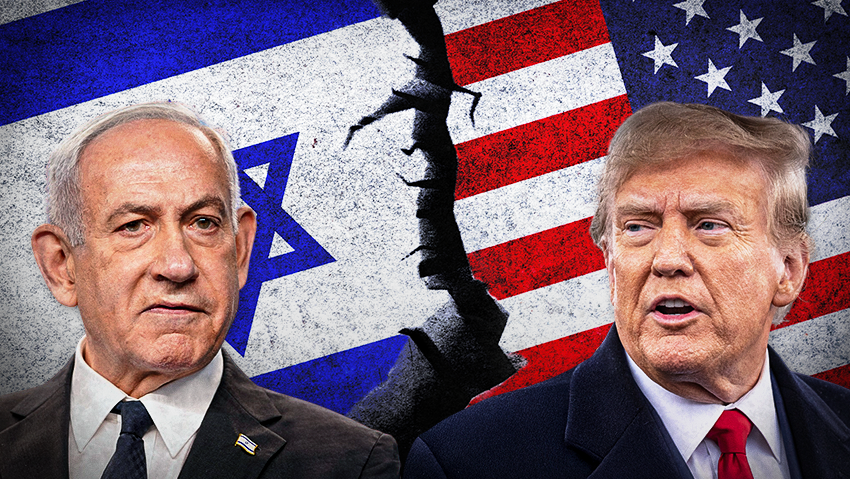
(Photo: lev radin/shutterstock, REUTERS/Nathan Howard, KAWANT HAJU/AFP, shutterstock)
Since the Jonathan Pollard affair in the 1980s, Israel has been careful to avoid spying on U.S. soil or monitoring senior American officials. For that reason, the current report raises numerous questions, particularly given that the leaked document reportedly contains no forensic evidence or concrete findings proving a breach, only alleged "concerns."
The absence of evidence raises an obvious question: Is this merely a coincidence, or could the document represent a kind of land mine or parting gift left behind by departing intelligence officials? To answer that question, one must look at the timing.
It is highly noteworthy that anonymous intelligence-community "sources" chose to leak the information precisely as Congress is considering Section 224 as part of the National Defense Authorization Act (NDAA) for fiscal year 2027.
A dramatic initiative
Section 224 is a dramatic and critical initiative intended to deepen, synchronize and accelerate U.S.-Israel defense technology cooperation. The provision focuses on shared challenges at the forefront of military technology, including counter-drone systems, missile defense, artificial intelligence and cybersecurity.
It requires the Pentagon to appoint a senior official to coordinate that cooperation, ensuring that American and Israeli forces maintain a qualitative advantage on the battlefield.
The isolationist wing in the United States has mounted a forceful campaign against the provision, spreading what the author views as myths that it would "merge" the two militaries, give Israel influence over Pentagon supply chains and, above all, grant Israel unrestricted access to sensitive U.S. military data.
Now, just as the provision faces a critical test, an intelligence document surfaces warning that Israel is aggressively spying on the United States. The institutional logic of the leakers is, in the author's view, entirely clear: How can Congress approve legislation that expands information-sharing and technological cooperation with a country simultaneously designated a "critical espionage threat"? This amounts to a targeted effort to derail the legislation.
To connect the dots behind this campaign, it is worth revisiting the controversy surrounding Joe Kent's departure two months ago.
Kent, the Trump-appointed director of the National Counterterrorism Center (NCTC), resigned and launched an unprecedented attack on Israel. He argued that Iran does not pose an immediate threat and accused Israel and its supporters of dragging America into an unnecessary war. He also linked his wife's death in Syria to a conflict that he claimed Israel helped create. Kent is not operating in a vacuum. Does his worldview also reflect the outlook of former Director of National Intelligence Tulsi Gabbard?
Throughout her tenure, Gabbard displayed deep opposition to any military confrontation with Iran. Although she presented her resignation as a personal decision related to her spouse's illness, there are indications behind the scenes suggesting that she was actually forced out because of those disagreements.
Tying the president's hands?
The DIA is structurally subordinate to the Pentagon, but as director of national intelligence, Gabbard controlled the National Intelligence Program budget and defined intelligence priorities.
Could the bureaucratic infrastructure left behind by her and Kent now be producing documents lacking forensic support in an effort to derail Section 224, tie the president's hands and deepen the rift between the two countries? But the broader picture extends far beyond a struggle within the intelligence community.
The isolationist and nationalist current within the Republican Party and Trump's political orbit is waging a multifront campaign to distance the United States from Israel. Intelligence matters and legislation are only one vector in that effort.
Another major vector currently being employed is the Christian issue, which played a significant role during the campaign in Lebanon.
To understand this from a geostrategic perspective, one must remember that Trump pledged to protect Christians wherever they live around the world. Supporters point to actions such as the use of military force against Boko Haram in Africa, which Trump described as part of protecting Christians globally.
Against that backdrop, the unusual invitation extended to the Greek patriarch to visit the White House should be viewed in a different light.
The patriarch is not a head of state who would ordinarily be expected to meet with the president of the United States. Rather, the author argues, it was a calculated move by the same nationalist faction seeking to advance an anti-Israel narrative.
The patriarch focused specifically on Lebanon and the Holy Land when he said that ancient communities seek to preserve their faith and freedom of worship, and that ensuring access to the Holy Land is a prerequisite for regional stability. Those pressures, according to the author, were reflected in a heated exchange between Prime Minister Benjamin Netanyahu and Trump regarding the continuation of military operations in Lebanon.
It must also be acknowledged, the author argues, that the campaign there was ultimately affected by irresponsible actions by some Israeli soldiers who desecrated Christian symbols, including a cross associated with Jesus and a statue of Mary.
Such conduct, together with the troubling phenomenon of ultra-Orthodox Jews spitting at tourists and clergy members in Jerusalem, provided officials in Washington with precisely the ammunition they were seeking to constrain Israel's actions.
Add to that inflammatory comments from politicians discussing the takeover of southern Lebanon, including Christian villages, and a perfect campaign emerges portraying Israel as carrying out ethnic cleansing.
Israel's Foreign Ministry has been making important efforts to counter what the author describes as this distortion on social media. In that context, the recent decision by Foreign Minister Gideon Saar to appoint a special envoy at the ambassadorial level to engage with the Christian world deserves mention.
The appointment of Ambassador George Deek to the position is a strategic step intended to bring order to the issue, moderate tensions and centralize engagement with these communities, with particular emphasis on Christian Zionists.
 Dr. Kobby BardaPhoto: Tal Givoni
When all of these developments are viewed together — the allegedly evidence-free DIA leak coinciding with the advancement of Section 224 in Congress and the pressure campaign surrounding Christian communities in Lebanon and Jerusalem — they form a coherent picture. This is a coordinated effort by the isolationist camp to apply pressure on the president and drive a deep wedge into U.S.-Israel relations.
Dr. Kobby Barda is a senior lecturer at the Holon Institute of Technology (HIT) and a senior fellow at the Jewish People Policy Institute (JPPI).