

Israel spent the past week debating what Saudi Arabia received in its agreement with the United States — a defense pact, a civilian nuclear program and movement toward an F-35 jet deal — and what Washington gained in return, including a pledge of $1 trillion in Saudi investments. But a focus on the transactional overlooks what both leaders highlighted publicly: an agreement to develop artificial intelligence, presented as the centerpiece of the entire initiative rather than a ceremonial add-on.
That emphasis reflects a broader strategic campaign. Former President Donald Trump is operating on a timetable aimed at 2027, a year many experts describe as the decisive point in the global race for AI. They say that by then, the advantage in technology, energy and manufacturing may become so entrenched that rivals will struggle to catch up.
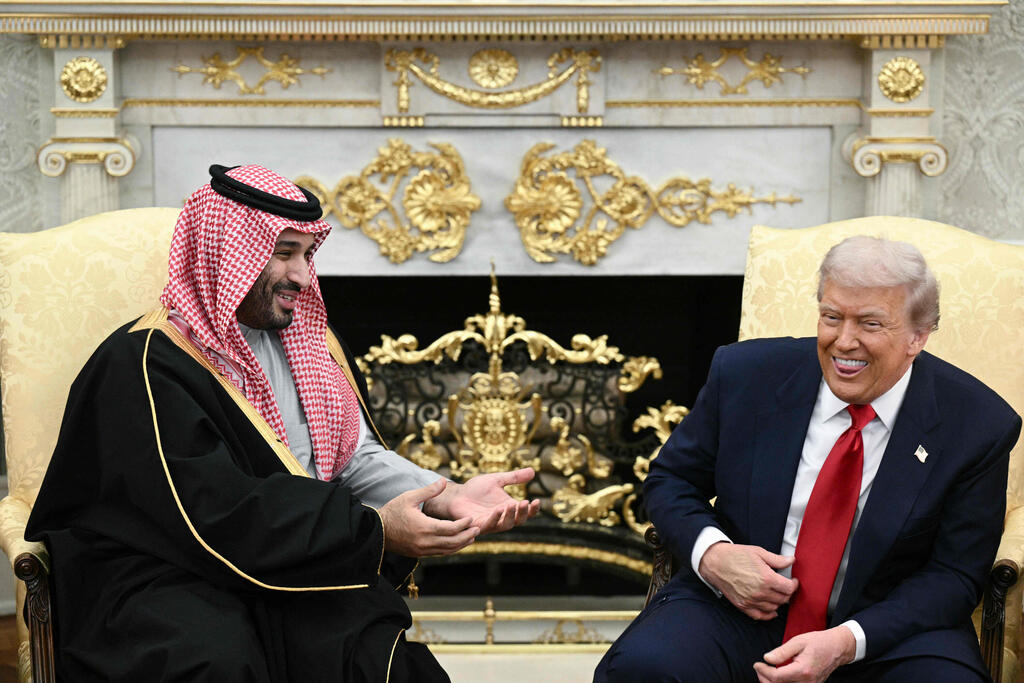
(Photo: Brendan SMIALOWSKI / AFP)
The AI industry relies on raw materials and chip manufacturing, a supply chain dominated by China from mining to processing and distribution. Recent disclosures that Beijing asked German companies to hand over sensitive commercial data in exchange for access to critical raw materials underscored the depth of that leverage.
To counter that dependence, the United States has moved in recent months to build a global network of suppliers. Washington signed mining and processing deals in Australia and Malaysia. In Africa, Trump brokered a truce between Congo and Rwanda after a direct appeal from Congo’s president, clearing the way for U.S. access to essential minerals for chip production. A similar agreement with Ukrainian President Volodymyr Zelenskyy focused on raw-material cooperation and supply chains. Pakistan has also joined these partnerships on critical metals. Together these steps are meant to reduce China’s monopoly and create an independent supply route.
Raw materials are only part of the challenge. Electricity is another. A U.S. Energy Department report found that American data centers and AI facilities consumed about 4 percent of national power in 2024, a figure projected to rise to nearly 12 percent by 2028.
Those demands come alongside the growth of electric vehicles and cryptocurrency mining. California has already imposed temporary bans on charging cars during peak load. Large portions of the national grid are not designed for an economy where data centers consume more power than much of traditional industry.
Major tech companies are searching for solutions. Microsoft purchased a civilian nuclear reactor in Pennsylvania to support its data centers, though analysts say the effort is insufficient for the scale of demand.
Israel is not a formal party to the U.S.–Saudi agreement, but it holds capabilities no other regional state can match: advanced technology infrastructure, security capacity to protect data and energy flows, and a geographic position that naturally links emerging Asian corridors to the Mediterranean. These elements may allow Israel to provide stability along the developing route.
Saudi Arabia enters this framework not as a country seeking status but as a partner able to supply the energy and infrastructure the United States cannot meet alone. Crown Prince Mohammed bin Salman is pursuing a plan to shift the kingdom from exporting raw energy like oil and gas to exporting AI services. His goal is to transform Saudi Arabia into an AI powerhouse hosting global-scale data centers and computing capacity.
The kingdom also holds a key geostrategic position along the IMEC corridor, the route linking India, the Middle East and Europe. The project aims to rival China’s Belt and Road Initiative by enabling independent flows of electricity, data and goods between Asia and Europe.
Trump is also looking at near-term milestones: the November midterm elections and the Nobel Peace Prize, awarded a month earlier. After missing out this year because a hostage deal concluded after the committee’s deadline, he has repeatedly said that only he can deliver historic peace. Advisers see his regional diplomacy and outreach to Mohammed bin Salman as part of a narrative positioning him as the leader who reunites the descendants of Isaac and Ishmael after centuries of conflict. Some supporters even frame it as closing a historical circle dating back to the 630 battle of Khaybar, when forces of the Prophet Muhammad defeated the Jewish community in the Arabian Peninsula.
Prime Minister Benjamin Netanyahu now faces a difficult choice. Trump has a narrow window to secure the image he wants at the White House, though the timeline could stretch into September 2026. If Netanyahu wants to stand at the center of that historic moment, he must make decisions with heavy political costs.
 Dr. Kobby Barda
The most significant centers on whether to adopt a clear framework that moves toward a Palestinian state or can be presented internationally as such. Netanyahu’s late father, historian Benzion Netanyahu, taught him the weight of historic choices. Should the prime minister seek to sign an agreement that reshapes the region, he would likely face a coalition breakup, early elections and a transformed political landscape.
That is the fault line Israel now confronts. Trump is building a global structure aimed at 2027 and sees Israel as part of it, though not unconditionally. If Netanyahu pays the political price and aligns Israel with the emerging strategic corridor, he could be the one to sign a groundbreaking agreement. If not, another government may do so later, leaving Israel inside the global framework but no longer at its center.
Dr. Kobby Barda is a researcher of American political history and geostrategy at the Interdisciplinary School at HIT Holon.