

For years, those intent on tarnishing Israel’s reputation worldwide have worked to turn two accusations into accepted truths: that Israel is an apartheid state and that its democracy is giving way to dictatorship. Both have become central pillars of a wider campaign to delegitimize Israel.
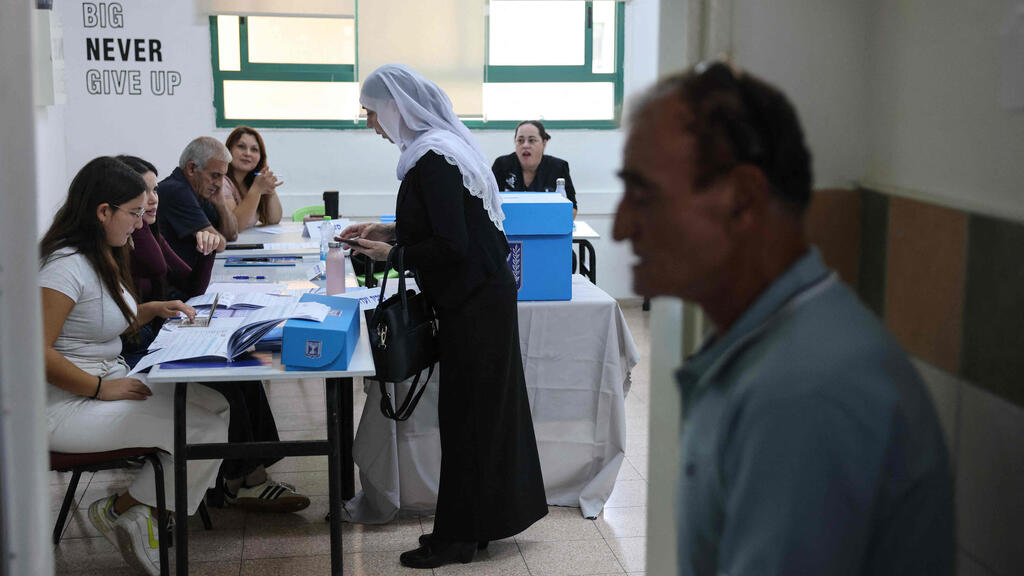
A polling station in Daliyat al-Karmel
(Photo: AHMAD GHARABLI / AFP)
Arab citizens voted in record numbers. Turnout in Arab-majority localities reached almost 80%, exceeding the national average, and Arab-led parties won 19 seats, their strongest result ever. For the first time in Israel’s history, these parties hold more seats than the Jewish ultra-Orthodox, who won 13. Their votes also helped push smaller parties below the electoral threshold, changing the balance of power in the Knesset.
The significance goes beyond the record itself: Arab-led parties now hold 19 of the Knesset’s 120 seats, almost 16% of the chamber. These parties place Palestinian national interests at the center of their politics, yet their representatives serve in parliament in substantial numbers, with a significant presence extending far beyond one or two members. It is difficult to find a parallel in another Western democracy, and in this respect Israel displays a form of hyper-democracy, allowing far greater latitude than other democracies that routinely accuse it of being insufficiently democratic.
Arab-led parties now hold a pivotal position: an opposition government cannot reach a majority without their support. That is a striking picture of parliamentary representation. Arab citizens are not shut out of Israel’s political system. They vote, win seats, shape the map and help determine who can govern.
The second accusation, that Israel is sliding into dictatorship, fares no better. Benjamin Netanyahu’s Likud remained the largest party, but his governing bloc won only 53 seats, eight short of a majority. The same pattern appeared in 2021: Likud won the most seats, yet Netanyahu could not form a government. A leader’s long tenure does not make a country a dictatorship. The ability of voters to deny him a majority, and of elected representatives to form an alternative, is democracy at work.
 Isaac Zarfati, CEO of StandWithUs UK Photo: Danielle Bennun
No election can settle every argument about Israel. But this one has made two familiar claims much harder to sustain. Israel’s Arab citizens exercised political power on an historic scale. And the incumbent government faced the verdict of the ballot box, then fell short.
For years, those seeking to discredit Israel have invoked apartheid and dictatorship as settled facts about Israel. These results tell a story Israel’s accusers would rather ignore. Millions of Israelis, Jews and Arabs, have demonstrated that their democracy remains fiercely contested and accountable to its voters. Now would be a good time for those who spent years telling the world otherwise to offer Israel an apology. Will they? Don’t hold your breath.
- Isaac Zarfati is the CEO of StandWithUs UK