

The election results confront Israel's center-left with the true meaning of former President Reuven Rivlin's "Four Tribes" speech: Recognize Arab citizens as full partners in government or once again entrust the country's future to a political alliance that has already proven its failure.
More than a decade ago, President Reuven Rivlin delivered his historic "Four Tribes" speech. He described the demographic changes taking place in Israel and the need to build a new social consensus among four groups: secular Jews, religious Zionists, ultra-Orthodox Jews and Arab Israelis. But the speech was never solely about social, educational or economic issues. It also carried a far-reaching political conclusion, one that the election results make clearer than ever: Without a partnership with Arab society, the anti-Netanyahu bloc will be unable to translate its electoral strength into political power.
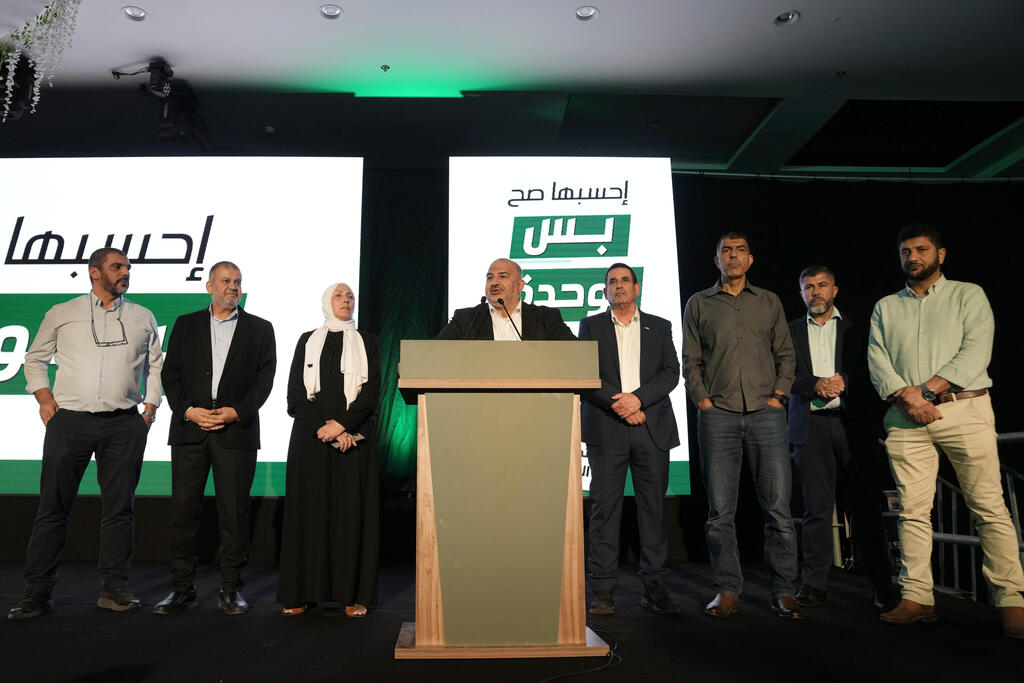
Ra'am campaign headquarters
(Photo: AP Photo/Mahmoud Illean)
Israeli politics is taking shape before our eyes along the lines Rivlin outlined in his speech. Secular and traditional Jewish Israelis, on both the right and left, can no longer take for granted their ability to form a government on their own. The path to power runs through alliances with other groups in Israeli society. For years, we have grown accustomed to viewing the ultra-Orthodox and religious Zionists as natural coalition partners, while Arab citizens have remained outside the political equation. Yet Arab society carries no less political weight than these groups, and ignoring it is not only a democratic injustice but also political blindness.
These three groups have taken different approaches to their relationship with the state. Religious Zionists seek to consolidate their position as an elite that serves and leads the country. The ultra-Orthodox leadership works to preserve its community's autonomy, at times behaving as though the population it represents lives in a separate jurisdiction, benefiting from state resources while being exempt from some of its obligations. Arab society, meanwhile, is moving in the opposite direction, with a growing desire for economic, social and civic integration, and now political integration as well.
That trend found dramatic expression in the latest elections. According to estimates, voter turnout in Arab society reached approximately 80%, a huge increase over the previous elections. When Arab citizens turn out to vote in such large numbers, they are not merely asking to be heard. They are demanding a role in shaping the country's future.
Responsibility to the voters
This is a moment of reckoning for Arab political leaders. The power entrusted to them carries a responsibility to their voters. The message emerging from the vote for the Joint List and Ra'am, the United Arab List party, is clear: Arab voters want results. Personal security, a crackdown on crime, solutions to housing and urban planning problems, infrastructure, education and employment. This does not mean that questions of national identity have disappeared. Rather, Arab citizens are demanding that their leaders serve not only as representatives of their identity but also as leaders capable of delivering tangible achievements.
The election results present the anti-Netanyahu bloc with a straightforward conclusion: Anyone seeking to return to power must be prepared to form a government with the Arab parties. That means not settling for outside support, not treating Arab Knesset members as a last-minute lifeline and not apologizing for the partnership itself.
But the greater test lies with Jewish political leaders. After the events of recent years, particularly the devastating war Israel has endured, the time has come to acknowledge a truth that Israeli politics has stubbornly sought to suppress: Arab citizens are not guests in this country, nor are they partners whose participation is conditional. They are an integral part of Israeli society, and partnership with them is essential to building a shared future.
The election results present the anti-Netanyahu bloc with a straightforward conclusion: Anyone seeking to return to power must be prepared to form a government with the Arab parties. That means not settling for outside support, not treating Arab Knesset members as a last-minute lifeline and not apologizing for the partnership itself. Instead, it means building an open political alliance based on shared civic interests and a common responsibility for Israel's future.
The alternative
The other option is all too familiar: A right-wing government resting on an alliance with the ultra-Orthodox leadership and religious Zionists. That alliance has already demonstrated its limitations and the social price it exacts. Instead of a new civic compact, we have seen divisions deepen over military service, the sharing of national responsibilities and collective accountability.
The ultra-Orthodox leadership has refused to recognize that political partnership cannot rest solely on the distribution of budgets and power. It must also involve sharing civic obligations. Attacks on the IDF, state institutions, the media and Israeli liberalism have illustrated just how shaky the foundations of this alliance are.
By contrast, a Jewish-Arab alliance could be built around shared concerns: personal security, education, employment, equal opportunity, the rule of law and functioning public services. Such a partnership does not require agreement on every national or political issue. It requires recognizing that the prosperity of Arab society does not come at the expense of Jewish society, but is instead a prerequisite for the prosperity of Israel as a whole.
This brings us to Gadi Eisenkot and Naftali Bennett. Both seek to lead Israel into a new political era. Both promise responsible leadership committed to the interests of the state. But that commitment is now being put to the test. Can they break free from the political boundaries imposed by the right and recognize Arab parties as legitimate partners in government?
The Arab parties generally oppose Zionism and support Palestinian statehood, though they differ in their willingness to cooperate with Jewish-led governments. Many Jewish politicians, particularly on the right, oppose forming coalitions with them because of disagreements over Israel's Jewish identity and their criticism of Israeli military policies. Others are reluctant to risk the political backlash of relying on Arab parties to stay in power.
Bennett has already demonstrated, by forming the 2021 coalition government with Ra'am, that such a partnership is possible. This time, however, more is needed than a political experiment born of coalition necessity. What is required is an explicit strategic decision: to transform Jewish-Arab partnership from a means of forming a government into a guiding principle of governance.
If Eisenkot and Bennett want to replace the current government, they must say clearly and unequivocally: We will form a government with the Arab parties. No hesitation, no apologies and no deliberately keeping that possibility vague until after the elections.
 Nimrod DweckPhoto: Elad Branga
For years, the right has succeeded in portraying the very idea of partnering with elected Arab representatives as a political threat. Center and center-right leaders have reinforced that narrative whenever they have avoided presenting such cooperation as a legitimate option. In doing so, they have ruled out in advance one of the main paths to forming a government.
The time has come to decide whether to continue playing by the rules dictated by the right or to dare to redraw the boundaries of what is politically possible.
Rivlin understood more than a decade ago that Israeli society had changed beyond recognition. Israeli politics is still struggling to come to terms with that reality. His "Four Tribes" speech was a call for a new social contract. The election results have now turned it into a political imperative.
Arab citizens have already demonstrated their willingness to participate. The question now is whether Eisenkot and Bennett are prepared to give them a seat at the government table.
Nimrod Dweck is a co-founder of Darkenu, an Israeli civic movement, and Little Citizens, a nonprofit organization promoting democracy education. He is a lecturer at Reichman University and a high-tech entrepreneur.