

Imagine this: the president of the most powerful nation on earth, the man who vowed to "make America great again", sitting and biting his nails while waiting for the response of one man, the orphan of Ali Khamenei. He cannot even remember his first name: Mochtaba? Mojbatá? Mojtaba? Is this guy real? Are you sure we did not kill him?
Yet he sits and waits for news from Tehran. Like the man who promised to jump off the circus roof but froze once he got up there. “Jump already,” shouted the man who bet on him. “There is no question of jumping,” the man replied, “but how do I get down from here?”
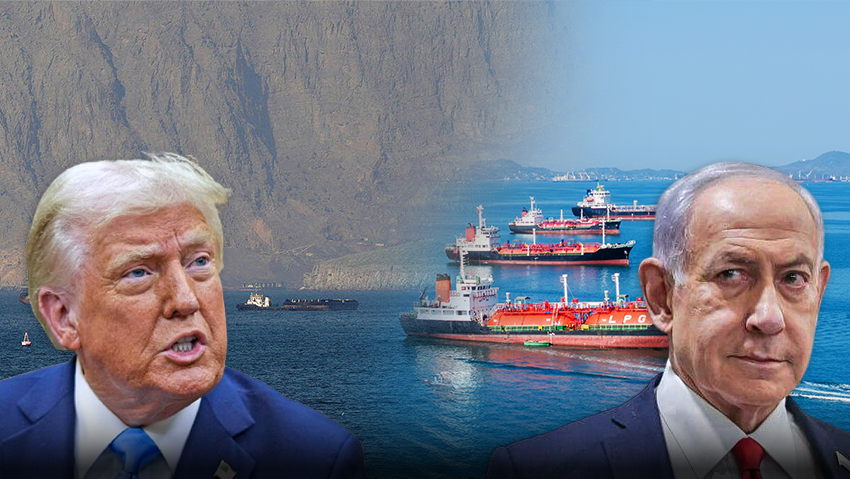
Donald Trump, Benjamin Netanyahu and the Strait of Hormuz
(Photo: Miriam Elster, Evan Vucci/AP, shutterstock, REUTERS/Stringer/File Photo)
The very act of waiting for the supreme leader’s word is already a major achievement for Iran. When the United States and Israel launched Operation “Epic Fury” (Operation Roaring Lion), their leaders never imagined that after nearly three months Iran would be in a better position than at the start of the operation. If the current deal now being discussed is implemented, the damage will be even worse: the billions flowing into the regime’s coffers will go far. As big as the fury, as big the roar, so is the defeat.
Exactly one month ago, in a joint article for the Saturday supplement of Yedioth Ahronoth, Ronen Bergman and I described a chronicle of a failure foretold. On February 11, Netanyahu met Trump and his aides in the situation room at the White House. Netanyahu laid out his war plan: at its core, the engine of the plan, was regime change. He asked Trump for permission to put the head of Mossad, David "Dadi" Barnea, on screen in the room via video link from Israel.
Barnea reported years of preparations for the grand operation, with massive investment: a Kurdish militia would invade from Iraq, other minority forces would invade simultaneously, and regime opponents, fueled by propaganda backed by Israel, would rise from within. The air force would protect from above the march on Tehran. The regime would collapse: Israel already had a candidate for leadership, one of their own who had quietly switched sides. Under his rule Iran would abandon its nuclear program, its proxies and its terrorism. The victory would be complete.
Trump remained silent. The atmosphere was friendly, inviting. Netanyahu flew back to Israel feeling his life’s mission had been fulfilled. The next day, in a meeting in the same room at the White House, with the full American political and security leadership and without Israelis, the plan was approved without its core, without its engine. “Farce,” the CIA director called it. “Bullshit,” said Secretary of State Rubio. Trump stayed silent, letting things sink in, neither endorsing nor rebuking.
Trump was thinking about Venezuela: replacing a ruler with another ruler in a covert operation, fast, pre-planned, with almost no casualties. Netanyahu was thinking about Syria: an armed, protected march in which regime strongholds would collapse within days under its force. Vice President Vance was thinking about the Bay of Pigs, the failed and pathetic attempt to send thousands of Cuban exiles in boats to Cuba to topple Castro’s regime.
Why do I return to the discussions of February 11 and 12? Because they required a third discussion between Trump and Netanyahu on the question of the chances of success of the attack, and what logic remained once the regime-change plan was removed. Each side understood what it wanted to understand. When the attack began on February 28, Netanyahu acted as if the plan had been fully approved: he instructed the air force to divert aircraft and munitions to bomb Basij checkpoints en route to the Kurdish region in order to clear a corridor for the invaders. In Iraq, the Kurdish militia prepared for invasion, all as planned. When it was time to set out, Trump vetoed it and the cards were reshuffled.
From what I have learned about the plan, I believe it was an arrogant mistake, castles in the air. I may be wrong, we will likely never know. But the existence of the plan at least showed planning, forward thinking. In the absence of an alternative plan, we are sliding into a never-ending war on three, perhaps four fronts, holding territories that are not ours, with soldiers we do not have, in a bloody war against enemies we do not know how to deter and without giving real security to our citizens. Israel is under the absolute authority of a capricious, hollow, desperate American president. Trump understands who works for him. “Netanyahu's fine,” he said recently, “he'll do whatever I want him to do.”
When Moshe Dayan heard a compliment like that, he used to remark: “A good guy in the bad sense of the word.” Israel must break out of the Iranian trap. Netanyahu is the last person who can extract it from it.